‘Kraken’ Is the U.S. Navy’s Monster Motion-Based Research Simulator“克拉肯”是美国海军的巨型动态研究模拟器
If Star Tours at Disneyland made you sick don't even lay your eyes on Kraken.
新闻视频
Updated Jul 3, 2020 4:25 AM EDT
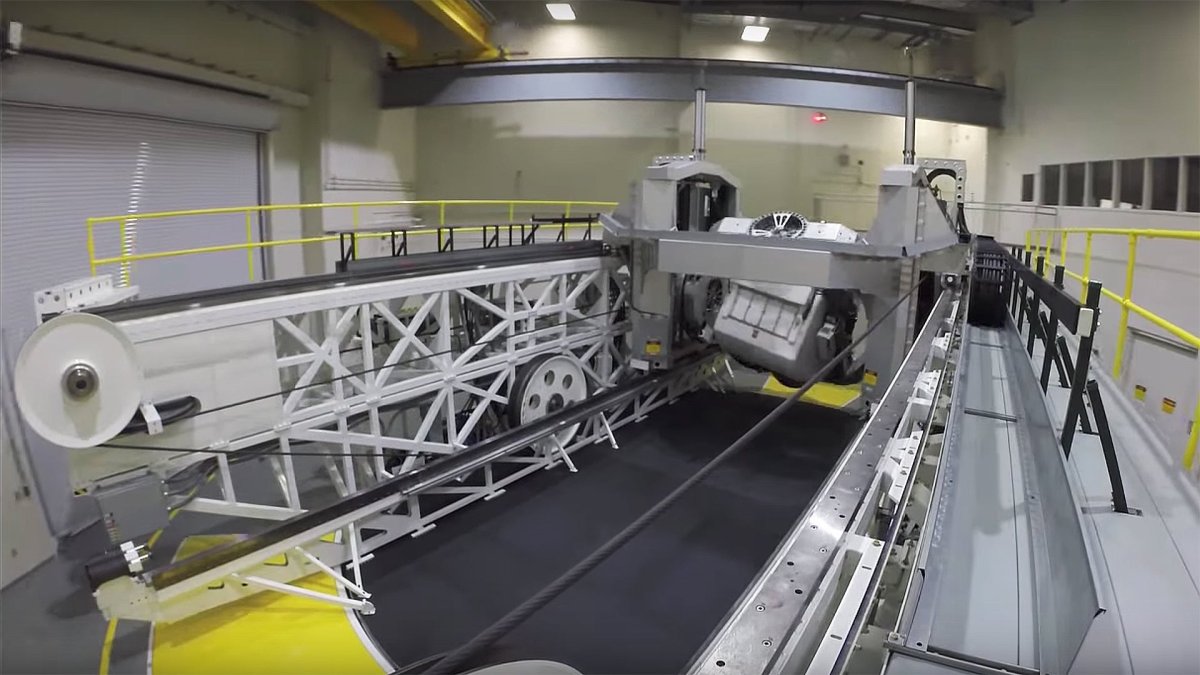
One of the features most elaborate motion-based simulators lack are the sustained gravitational forces that can have severe effects on a vehicle’s crew. That is not the case for the Navy’s GL-6000 disorientation research device, better known as “The Kraken.” The $19 million monster of a simulator is the centerpiece of the Captain Ashton Graybiel Acceleration Research Facility at Wright Patterson AFB in Dayton, Ohio that opened in June 2016.
The system weighs a quarter of a million pounds, leverages 4,500 horsepower, and provides simultaneous motion on six axes. In other words, it gives its occupants one hell of a ride.
The goal of this engineering marvel is to allow researchers to evaluate human factors like operational effectiveness, performance, and safety in various moving vehicles as accurately as possible without actually putting anyone (or anything) in danger. And the Kraken is not just about flight, although it can accurately reproduce rotary-wing and fixed-wing aircraft of virtually all types. It can also simulate the motion dynamics of submarines, boats, and land vehicles.
Its cockpit, or “gondola,” is totally reconfigurable to mimic whatever type of vehicle needs to be simulated. This rapid adaptability drastically saves in terms of cost and the time needed to execute disparate test and research programs.
“While we recognize the tremendous challenges overcome and the feats of engineering and cunning required to create the marvel that is the Kraken, we also acknowledge that it is the natural realization of Capt. Graybiel’s vision,” Navy captain and commanding officer of the new facility Rees Lee said at its opening last year. “For the first time in the history of aerospace medicine, fully realistic motion simulations can be created which allow the exhaustive research necessary for a comprehensive understanding of spatial disorientation and other motion and acceleration-based phenomenon”
Research done on Kraken, and new solutions that come from that research, should result in fewer motion-related vehicle mishaps out in the field. As a result, the incredibly complex simulator and lab will likely save lives—and some very expensive vehicles, too.
The tragedy of controlled flight into terrain in particular—a problem that has plagued military aircrews for the majority of man’s history in the air—is one area that the Pentagon has begun to make large strides in curtailing in recent years. The F-16, and soon other fighters and military aircraft, are being fitted with automatic ground collision avoidance systems (Auto-GCAS) that automatically recover the aircraft from an imminent flight into terrain, thus saving a disoriented or unconscious pilot from certain death. Similar systems could be adapted to keep less advanced low-flying aircraft from flying into mountains and other obstacles in poor visibility or at night.
While Auto-GCAS is one solution for a narrow but very formidable set of issues, Kraken aims to take on a much wider set of problems, including examining the causes of disorientation and other medical and human-factors science related to the phenomena.
An impressive digital rendering of the mighty Kraken., ETC Aircrew Training Systems
The name of the new center that houses Kraken is a tribute to Captain Ashton Graybiel , a Navy scientist and medical doctor who made groundbreaking advances in acceleration research and its physiological effects during the 1950s and 1960s, then continued making new discoveries all the way through the 1980s. His work included game-changing studies of disorientation, weightlessness, human balance and the body’s ability to cope with heavy acceleration. Graybiel’s data, reports and research instruments were absolutely essential when it came to NASA’s success during the space race.
Graybiel was also a renowned cardiologist whose published works changed the field dramatically from the 1940s on. Him and his team established their original biomedical research lab at the Navy School Of Aviation Medicine in Pensacola, Florida in the 1950s. By 1970 the lab had grown immensely, and was rebranded independently as the Naval Aerospace Medical Research Laboratory (NAMRL).
So, yeah, if anyone deserves a facility like this one named after them, it’s Captain Graybiel.
Captain Lee stated the following during the facility’s grand opening last year:
“In October 2010, the Navy moved its aeromedical research arm from Pensacola to Wright-Patterson as part of the Base Realignment and Closure initiative, it brought together Air Force and Navy scientists with long histories of ground-breaking and innovative aeromedical research to work side-by-side, establishing the potential to create the world’s most advanced and capable aeromedical research center in the world. Over the last six years we have been working to realize that potential. Today, with the activation of the Kraken Disorientation Research Device, and the establishment of the Captain Ashton Graybiel Acceleration Research Facility, we take another giant step to realizing that potential.”
Contact the author: Tyler@thedrive.com
Comments couldn’t be loaded. Please refresh the page.
更新于美国东部时间2020年7月3日凌晨4:25
大多数精密的动态模拟器都缺乏持续的重力作用,而这种作用会对乘员造成严重影响。但海军的GL-6000定向障碍研究设备,也就是人们熟知的“海怪”(The Kraken),却不存在这个问题。这台耗资1900万美元的巨型模拟器是位于俄亥俄州代顿市赖特-帕特森空军基地的阿什顿·格雷比尔上尉加速研究中心的核心设备,该中心于2016年6月启用。
这套系统重达25万磅,拥有4500马力,并可同时在六个轴向上运动。换句话说,它能给乘客带来极致的乘坐体验。
这项工程奇迹的目标是让研究人员能够在不危及任何人(或任何物体)安全的前提下,尽可能精确地评估各种移动车辆的操作效率、性能和安全性等人为因素。虽然 Kraken 能够精确模拟几乎所有类型的旋翼机和固定翼飞机,但它的功能远不止于飞行。它还可以模拟潜艇、舰艇和陆地车辆的运动动力学。
它的驾驶舱,或者说“吊舱”,可以完全重新配置,以模拟任何需要模拟的车辆类型。这种快速适应能力大大节省了执行不同测试和研究项目所需的成本和时间。
“我们承认,为了打造‘海怪’这一奇迹,人们克服了巨大的挑战,展现了卓越的工程技术和巧妙的构思。同时,我们也认识到,这是格雷比尔上校愿景的自然实现,”海军上校兼新设施指挥官里斯·李去年在设施落成典礼上说道。“在航空航天医学史上,我们首次能够创建完全逼真的运动模拟系统,从而开展必要的详尽研究,全面了解空间定向障碍以及其他基于运动和加速度的现象。”
Kraken 的研究及其衍生出的新解决方案,有望减少实际道路上与车辆运动相关的事故。因此,这个极其复杂的模拟器和实验室很可能挽救生命,甚至还能保护一些非常昂贵的车辆。
飞机撞地事故,尤其是这一困扰了人类航空史大部分时间的军事飞行员的悲剧,近年来已成为五角大楼大力遏制的领域之一。F-16战斗机以及即将服役的其他战斗机和军用飞机,都已配备了自动地面防撞系统(Auto-GCAS),该系统能够自动将飞机从即将撞地的危险中拉回,从而挽救失去方向感或意识不清的飞行员的生命。类似的系统也可用于防止低速飞行的飞机在能见度低或夜间撞上山脉或其他障碍物。
虽然 Auto-GCAS 是针对一组狭窄但非常棘手的问题的一种解决方案,但 Kraken 的目标是解决更广泛的问题,包括研究迷失方向的原因以及与此现象相关的其他医学和人因科学。
令人印象深刻的巨型海怪克拉肯的数字渲染图。ETC 机组人员训练系统
这座新中心以阿什顿·格雷比尔上尉的名字命名,是为了纪念这位海军科学家兼医学博士。格雷比尔上尉在20世纪50年代和60年代对加速度及其生理效应的研究取得了突破性进展,并在80年代继续进行新的发现。他的研究包括对方向感丧失、失重、人体平衡以及人体应对剧烈加速度能力等方面的变革性研究。格雷比尔的数据、报告和研究仪器对于NASA在太空竞赛中取得成功至关重要。
格雷比尔也是一位著名的心脏病专家,他发表的著作从 20 世纪 40 年代起极大地改变了该领域。20 世纪 50 年代,他和他的团队在佛罗里达州彭萨科拉的海军航空医学学校建立了他们最初的生物医学研究实验室。到 1970 年,该实验室规模已大幅增长,并更名为海军航空航天医学研究实验室 (NAMRL),成为独立的机构。
所以,没错,如果说谁配得上以自己名字命名的这种设施,那非格雷比尔上尉莫属。
李上尉在去年该设施盛大开幕式上发表了以下讲话:
“2010年10月,作为基地调整与关闭计划的一部分,海军将其航空医学研究部门从彭萨科拉迁至赖特-帕特森空军基地。此举汇聚了空军和海军在航空医学研究领域拥有悠久历史的科学家,他们并肩工作,有望打造世界上最先进、最强大的航空医学研究中心。过去六年,我们一直致力于实现这一目标。今天,随着克拉肯定向障碍研究装置的启用和阿什顿·格雷比尔上尉加速研究设施的建立,我们朝着实现这一目标又迈出了重要一步。”
联系作者:Tyler@thedrive.com
评论加载失败,请刷新页面。