‘Khao soi’ in Kepong: Newcomer Kao Mongkhol cooks up a Chiang Mai classic甲洞的“Khao soi”:新人 Kao Mongkhol 烹制清迈经典
KUALA LUMPUR, Oct 15 — I’ve long had an affinity for the Northern Thai dish khao soi, and since I’ve yet to visit Chiang Mai or anywhere in northern Thailand, I’m always...
The article explores the author's quest for authentic Northern Thai dishes in Kuala Lumpur, focusing on the lesser-known khao soi.
Despite Northern Thai cuisine's limited representation compared to more popular Thai dishes, the author finds a promising spot at Kao Mongkhol in Bandar Menjalara.
The restaurant offers traditional khao soi, with its characteristic spices and garnishes, although the author notes some adjustments to enhance the dish's flavor balance.
While praising the authenticity of the khao soi, the review suggests improvements in the restaurant's air conditioning and attracts potential visitors with its affordability compared to traveling to Chiang Mai.
KUALA LUMPUR, Oct 15 — I’ve long had an affinity for the Northern Thai dish khao soi , and since I’ve yet to visit Chiang Mai or anywhere in northern Thailand, I’m always hunting for that thick noodle-and-curry dish in KL.
The results are often mixed.
Northern Thai cuisine doesn’t enjoy the popularity of Southern and especially Central Thai cuisine here (think tom yum , pad thai , green curry), and what little representation it has is often based solely on Isan cuisine.
I suspect it’s partly a marketing problem. In Malaysia, khao soi is often described as the Thai equivalent of curry noodles.
It’s a useful heuristic, sure, but one that usually ends in disappointment once you discover how little the two share.
Instead of a soupy, seafood-based broth with plenty of curry leaves and chilli, with sambal on the side, khao soi is built on a deeply aromatic spice paste, simmered in lots of coconut milk and served with raw shallots and pickled mustard greens.
Like the rest of Northern Thai cuisine, khao soi shares influences and ingredients with Myanmar’s Shan State and China’s Yunnan province.
Its roots lie with the Chin Haw, Chinese migrants, mostly from Yunnan, who made their way to Thailand via Myanmar and Laos.
A significant minority were Muslim, which is why most versions of khao soi are still traditionally served with chicken.
The dish carries hints of this history.
Pickled mustard greens are a Yunnan staple, and tsaoko , the Chinese black cardamom that grows in Yunnan’s highlands, is arguably the defining ingredient of the spice paste.
That context is usually missing, even at a little gem I recently found in Kepong.
Granted, it’s not something that fits easily on a menu, but at Kao Mongkhol in Bandar Menjalara, there’s nary a mention of it at all.
Barely seven months old, the restaurant focuses on khao kha moo and khao na pret , Teochew-influenced Thai braised pork leg and duck on rice, both hugely popular among Thai dishes in KL.
Shrewd, considering the neighbourhood.
But there is khao soi (RM13.90) and, more surprising still, khanom chin nam ngiao , a classic Chiang Mai dish with roots in Myanmar’s Shan State: fermented rice noodles ( khanom chin ) in a spicy pork rib and tomato broth.
It’s listed under the northern name for the noodles, khanom sen (RM13.90).
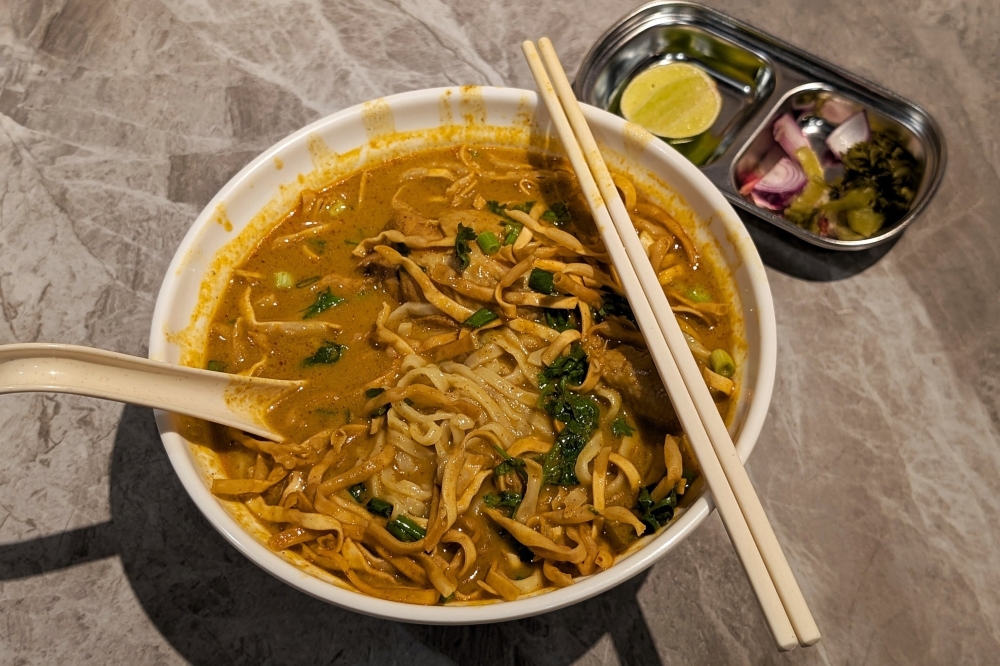
The khao soi ticks all the requisite boxes: crispy wheat noodles on top, a braised chicken drumstick, and soft wheat noodles in a thick, complex curry.
I won’t pretend my palate can pick out every component in the paste, but it has the warm, earthy and creamy profile I expect from khao soi .
It’s less sweet than some versions I’ve tried, and on the milder side, so I added all the shallots and pickled mustard greens, then asked for more.
I recommend you do the same, since the condiments are what bring the bowl into balance.
I also tried the khao kha moo (RM16.90) and kueh zap (RM15.90). I could confidently pick out five-spice and soy sauce in both, but neither was meltingly soft nor herbally robust enough to be notable.
The air conditioning situation could use work, so I might wait for a cooler day, but otherwise I’m curious to come back for the khanom sen .
It’s cheaper than a ticket to Chiang Mai.
Bandar Sri Menjalara, Kuala Lumpur.
Open Tuesday to Sunday, 10.30am—9pm
Facebook: Kao Mongkhol
Instagram: @kaomongkhol
* This is an independent review where the writer paid for the meal.
* Follow us on Instagram @eatdrinkmm for more food gems.
* Follow Ethan Lau on Instagram @eatenlau for more khao soi chronicles.
Fortune Cafe in Taman Danau Desa serves simple Chinese pleasures like flaky, juicy ‘roujiamo’, ‘liang pi’ and dumplings in a sour soup
From squid ‘bee hoon’ to fish skin wrapped ‘yong tau foo’, enjoy old school cooking at Seremban’s Coffee Tiam Foo
So Good Kolo Mee in Taman Cheras Pertama woos us with ‘kolo mee’, ‘kueh chap’ and ‘laksa’ that will banish any Sarawakian’s homesickness
Sultan Ibrahim attends day two of 273rd Conference of Rulers
Defence lawyer denies family statements in Irene Sofiya case, warns against fabricated social media posts
Malaysia’s births fall 4.5pc in 2025 as fertility rate drops to 1.5 children per woman
这篇文章探讨了作者在吉隆坡寻找正宗泰国北部菜肴的经历,重点介绍了鲜为人知的泰北咖喱面(khao soi)。
尽管与更受欢迎的泰国菜相比,泰国北部菜肴的代表性有限,但作者在 Bandar Menjalara 的 Kao Mongkhol 餐厅发现了一个很有前途的地方。
这家餐厅提供传统的泰北咖喱面,保留了其特有的香料和配菜,不过作者也指出,为了提升这道菜的口味平衡,餐厅做了一些调整。
评论在称赞咖喱面正宗的同时,建议餐厅改进空调系统,并指出与前往清迈相比,这里价格实惠,吸引了潜在的游客。
吉隆坡,10 月 15 日——我一直很喜欢泰国北部的咖喱面(khao soi),由于我还没有去过清迈或泰国北部的任何地方,所以我一直在吉隆坡寻找这种粗面条咖喱菜。
结果往往好坏参半。
泰国北部菜肴在这里并不像泰国南部,尤其是中部菜肴那样受欢迎(想想冬阴功汤、泰式炒河粉、绿咖喱),而且即使有少量的代表,也往往只是基于伊桑菜肴。
我怀疑这部分是市场营销的问题。在马来西亚,咖喱面通常被描述为泰式咖喱面。
这当然是一种有用的启发式方法,但一旦你发现两者之间几乎没有共同之处,通常最终都会导致失望。
与以海鲜为主料、加入大量咖喱叶和辣椒的浓汤,以及佐以叁巴酱的传统咖喱面不同,咖喱面是以浓郁的香料酱为底,用大量椰奶慢炖而成,并配以生红葱头和腌芥菜。
与泰国北部其他菜肴一样,咖喱面也受到缅甸掸邦和中国云南省的影响,使用相同的食材。
它的起源可以追溯到钦虎人,他们是来自云南的中国移民,经由缅甸和老挝来到泰国。
穆斯林是当地人口中的很大一部分,因此大多数版本的咖喱面仍然沿用鸡肉的传统做法。
这道菜蕴含着这段历史的痕迹。
腌芥菜是云南的主食,而生长在云南高原的中国黑豆蔻——草蔻,可以说是这种香料酱的主要成分。
即使是我最近在甲洞发现的一家小店,通常也缺少这种背景信息。
诚然,这道菜不太容易出现在菜单上,但在 Bandar Menjalara 的 Kao Mongkhol 餐厅,却完全没有提到它。
这家餐厅开业仅七个月,主打泰式红烧猪腿饭和泰式鸭饭,这两道菜都深受吉隆坡泰国菜的欢迎,并受到潮州菜的影响。
考虑到周边环境,这算得上精明。
但这里有咖喱面(RM13.90),更令人惊讶的是,还有缅甸掸邦的经典清迈菜肴——发酵米粉(khanom chin nam ngiao):用辛辣的猪肋排和番茄汤烹制的发酵米粉(khanom chin)。
它被列为面条的北方名称,khanom sen(RM13.90)。
这道咖喱面满足了所有必备条件:上面铺着酥脆的小麦面条,配上炖鸡腿和浸在浓郁咖喱汁中的软小麦面条。
我不会假装我的味蕾能分辨出酱料中的每一种成分,但它具有我所期待的泰北咖喱面应有的温暖、泥土味和奶油味。
它比我尝试过的某些版本甜度低,味道也比较淡,所以我加了所有的红葱头和腌芥菜,然后又要求再加一些。
我建议你也这样做,因为调料能让这碗菜的味道更加平衡。
我还尝了椰奶糯米糕(16.90令吉)和椰香糕(15.90令吉)。我能肯定地说,这两道菜里都有五香粉和酱油的味道,但它们既不够软糯,也没有浓郁的香草味,所以并不出彩。
空调情况还有待改进,所以我可能会等到天气凉爽些再来,但除此之外,我很想回来尝尝卡侬森。
比去清迈的机票还便宜。
吉隆坡斯里门加拉拉镇 (Bandar Sri Menjalara)。
周二至周日,上午10:30至晚上9:00营业
Facebook:Kao Mongkhol
Instagram:@kaomongkhol
* 这是一篇独立评论,作者自行支付了餐费。
* 关注我们的Instagram账号@eatdrinkmm,获取更多美食资讯。
* 关注 Ethan Lau 的 Instagram 账号 @eatenlau,了解更多考索伊美食故事。
位于 Taman Danau Desa 的 Fortune Cafe 供应简单的中式美食,例如酥脆多汁的肉夹馍、两皮和酸汤饺子。
从鱿鱼米粉到鱼皮酿豆腐,在芙蓉的咖啡添福餐厅,尽享传统美食。
Taman Cheras Pertama 的好干捞面以“干捞面”、“粿条”和“叻沙”来吸引我们,让砂拉越人一扫思乡之情
苏丹易卜拉欣出席第273届统治者大会第二天会议
辩护律师否认家属在艾琳·索菲亚案中的证词,并警告公众提防捏造的社交媒体帖子。
马来西亚2025年出生率将下降4.5%,生育率将降至每名女性1.5个孩子。