Rules governing tech can’t be monopolised by a handful of powerful states, big tech firms: Vivian维维安:科技领域的规则不能被少数几个强大的国家或大型科技公司垄断。
Vivian Balakrishnan says AI rules cannot be monopolised by powerful states and big tech firms, urging global norms and guardrails. Read more at straitstimes.com.
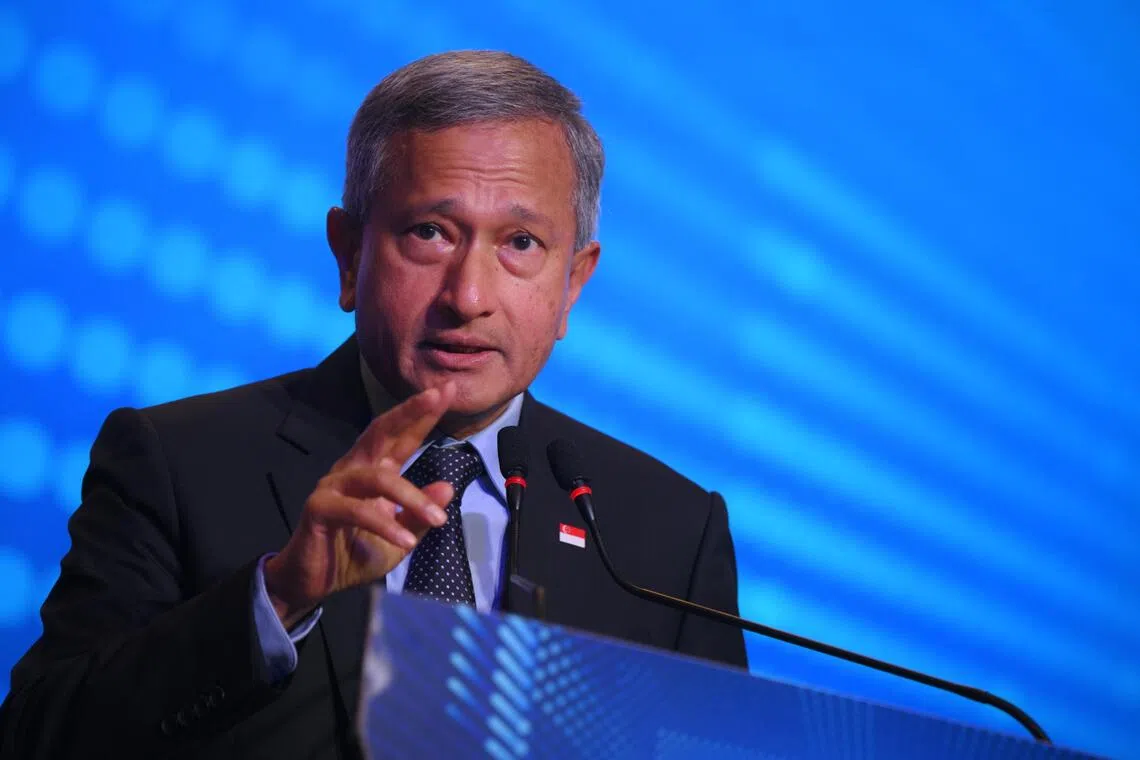
Vivian Balakrishnan, Minister of Foreign Affairs, also highlighted the increasing role of AI and tech companies in conflicts and global diplomacy.
Published Oct 15, 2026, 06:03 PM
Updated Oct 15, 2026, 06:03 PM
Singapore says tech rules must not be controlled by a few states or big firms. Vivian Balakrishnan called for all countries, including small and developing ones, to shape global norms.
He warned that AI is advancing faster than governments can govern it. Risks include lost human control, scams, ransomware, wider inequality, and machine-speed escalation in conflicts.
Balakrishnan urged a new compact between governments, tech companies and the wider international community. He said countries need research, talent and infrastructure, and international capacity-building remains essential.
SINGAPORE - The rules and guardrails governing the technologies that affect everyone cannot be monopolised by a handful of powerful states and big tech companies, said Foreign Affairs Minister Vivian Balakrishnan on Oct 15.
He was referring to the increasing role of artificial intelligence and tech companies in conflicts and global diplomacy .
As a small state, Singapore believes that consensus on the global stage must include all nation-states, such as small sates and developing countries, said Balakrishnan.
“Most of us - in fact, even the superpowers - will not have a monopoly on the complete technology stack. There will always be some level of interdependence,” he said. A tech stack refers to software tools, programming languages, frameworks, and infrastructure used to build and run an application.
Speaking at the Singapore International Cyber Week at Marina Bay Sands Expo and Convention Centre, Balakrishnan noted that tech is advancing exponentially, faster than the ability to govern it,
While the ability to effectively govern emerging tech like AI has not kept pace globally, governments are still ultimately responsible for national security, international law and the decisions on the use of force, he said.
And while there are opportunities with tech, there are also major risks.
The risks include: losing human control over increasingly autonomous systems; tech being misused by malicious non-state actors to turbocharge criminal activities like those involving scams and ransomware; and tech disrupting economies and increasing inequality and divisions in societies.
“These are fundamental challenges that no government, no matter how powerful, and no technology company, no matter how innovative, can solve on their own,” said Balakrishnan.
“We need a new compact between governments, technology companies and the wider international community,” he said. The minister noted that engagement with tech firms is especially important for cutting-edge frontier AI, where a small number of companies are developing capabilities with far-reaching impacts on international security.
“We need a shared, unvarnished, bald assessment of the risks. We need to develop common norms and guardrails so that we can accelerate the pace of technology and reap its benefits, but also deal with the risks.”
This does not mean stifling innovation but instead increasing trust, safety and assurance so that innovation can flourish, he said.
While finding consensus on these dilemmas will not be easy with the current geopolitical environment, some progress on building international consensus on norms of how parties should behave has been made.
For example, Singapore chaired a United Nations working group on infocomm tech security from 2021 to 2025. That experience showed that even in the current fractured world, it is possible to find consensus and establish norms, he said.
International affairs are also not just the domain of nations. Balakrishnan said that some of the most consequential actors at the global stage are not nation-states but big tech titans.
Some of these companies, valued at trillions of dollars, are worth more than some UN member states. They also control critical technologies and digital platforms that people rely on, as well as the pace and frontier of AI in recent times.
“The decisions made in the boardrooms or by the CEOs of these companies - on access, on deployment, on safeguards - have consequences far beyond national borders. And these decisions affect our economies, our societies, and our national security,” said the minister.
He drew parallels of today’s situation with the era of major chartered trading companies. They included the British East India Company and the Dutch East India Company, which were active during the 18th and 19th centuries.
These companies accumulated enormous economic and political power. They could raise armies, navies, negotiate treaties, and even conquer and administer territories. For example, the British East India Company played a central role in the colonisation of India, the founding of Singapore as a free port and the Opium Wars in China.
“I’m not saying that today’s internet titans are the same - I hope they’re not the same. But again, it is worth remembering that we are now at a moment in which private companies possess capabilities and resources that exceed that of most nation-states,” he added, without naming specific tech companies.
Even so, AI - which has been observed in the conflicts in Ukraine and the Middle East - is fundamentally changing warfare. He said that the tech is increasingly playing a bigger role in strategic and operational decisions, like “decisions to fire or not to fire”. This is similar to how steel and the industrial revolution transformed warfare during the first two World Wars.
The consequence of AI now is that miscalculations and escalations can occur at machine speed, which leaves little time for people to make judgements and intervene in crucial decisions of life and death.
Another issue is that many parts of the world still have not caught up with the last industrial revolution.
“All of us need to get to the frontiers of the next digital AI revolution,” said Balakrishnan. “Otherwise, the digital divide will widen the disparity in economies and military power will also become more entrenched, and we will set up ourselves for a new stage of neo-colonisation beyond the technological front.”
He added that countries “must also make sure that no one is excluded from the benefits, and no one pays the price of facing externalities whilst profit is privatised”.
Nations should aspire to be at the forefront of deploying frontier AI effectively, fairly, comprehensively, to improve lives and to transform their economies, he said. And for them to participate meaningfully, countries will need three capabilities: foundational research, talent and infrastructure.
“But not every country - even a superpower - can build this entire stack on its own. And that’s why we continue to believe that international capacity-building is still essential,” Balakrishnan said.
AI/artificial intelligence
外交部长维文·巴拉克里希南也强调了人工智能和科技公司在冲突和全球外交中日益重要的作用。
发布于 2026 年 10 月 15 日下午 6:03
更新于2026年10月15日下午6:03
新加坡表示,科技规则不应由少数国家或大型企业掌控。维维安·巴拉克里希南呼吁所有国家,包括小国和发展中国家,都应参与制定全球规范。
他警告说,人工智能的发展速度超过了政府的管控能力。风险包括人类控制力的丧失、诈骗、勒索软件、日益加剧的不平等以及机器在冲突中加速升级等。
巴拉克里希南呼吁各国政府、科技公司和更广泛的国际社会之间建立新的契约。他表示,各国需要科研、人才和基础设施,国际能力建设仍然至关重要。
新加坡——外交部长维文·巴拉克里希南10月15日表示,影响每个人的技术规则和保障措施不能被少数几个强大的国家和大型科技公司垄断。
他指的是人工智能和科技公司在冲突和全球外交中日益重要的作用。
巴拉克里希南表示,新加坡作为一个小国,认为全球舞台上的共识必须包括所有民族国家,例如小国和发展中国家。
“事实上,我们大多数人——甚至包括超级大国——都无法垄断完整的技术栈。各种技术之间总会存在一定程度的相互依赖,”他说道。技术栈指的是用于构建和运行应用程序的软件工具、编程语言、框架和基础设施。
巴拉克里希南在新加坡滨海湾金沙会展中心举行的新加坡国际网络安全周上发表讲话时指出,科技正以指数级速度发展,其速度超过了对其进行管控的能力。
他表示,虽然全球范围内有效管控人工智能等新兴技术的能力尚未跟上步伐,但各国政府最终仍对国家安全、国际法以及武力使用决策负有责任。
虽然科技领域蕴藏着机遇,但也存在着重大风险。
风险包括:人类对日益自主的系统失去控制;恶意非国家行为体滥用技术来加速诈骗和勒索软件等犯罪活动;以及技术扰乱经济,加剧社会不平等和分裂。
巴拉克里希南说:“这些都是根本性的挑战,任何政府,无论多么强大,任何科技公司,无论多么创新,都无法独自解决。”
“我们需要各国政府、科技公司和更广泛的国际社会之间建立新的契约,”他说道。这位部长指出,与科技公司的合作对于前沿人工智能领域尤为重要,因为少数几家公司正在开发对国际安全具有深远影响的能力。
“我们需要对风险进行坦诚、客观、公正的评估。我们需要制定共同的规范和保障措施,以便加快技术发展步伐并从中获益,同时也能应对风险。”
他表示,这并不意味着扼杀创新,而是要增强信任、安全感和保障,从而使创新蓬勃发展。
尽管在当前的地缘政治环境下,就这些难题达成共识并不容易,但在就各方应如何行事的规范建立国际共识方面已经取得了一些进展。
例如,新加坡在2021年至2025年期间担任联合国信息通信技术安全工作组主席国。他表示,这段经历表明,即使在当今世界四分五裂的情况下,也有可能找到共识并建立规范。
国际事务并非仅仅是国家之间的事务。巴拉克里希南指出,在全球舞台上一些最具影响力的行为体并非民族国家,而是大型科技巨头。
这些公司中有些市值高达数万亿美元,甚至超过了一些联合国成员国的国土价值。它们还掌控着人们赖以生存的关键技术和数字平台,以及近年来人工智能的发展速度和前沿阵地。
部长表示:“这些公司董事会或首席执行官们就准入、部署和保障措施等问题做出的决定,其影响远远超出国界。这些决定会影响我们的经济、社会和国家安全。”
他将当今的情况与大型特许贸易公司时代进行了比较。这些公司包括活跃于18世纪和19世纪的英国东印度公司和荷兰东印度公司。
这些公司积累了巨大的经济和政治权力。它们可以组建军队、海军,缔结条约,甚至征服和统治领土。例如,英国东印度公司在印度的殖民统治、新加坡自由港的建立以及中国的鸦片战争中都发挥了核心作用。
“我并不是说今天的互联网巨头和以前一样——我希望它们不一样。但同样值得注意的是,我们现在所处的时代,私营公司拥有的能力和资源已经超过了大多数民族国家,”他补充道,但没有点名具体的科技公司。
即便如此,人工智能——在乌克兰和中东冲突中已有所体现——正在从根本上改变战争。他表示,这项技术在战略和作战决策中扮演着越来越重要的角色,例如“开火还是不开火的决定”。这与钢铁和工业革命在前两次世界大战期间改变战争的方式如出一辙。
人工智能带来的后果是,误判和事态升级可以以机器的速度发生,这使得人们几乎没有时间做出判断,也无法干预生死攸关的关键决定。
另一个问题是,世界上许多地区仍然没有赶上上次工业革命的步伐。
巴拉克里希南表示:“我们所有人都需要走上下一轮数字人工智能革命的前沿。否则,数字鸿沟将加剧经济差距,军事力量也将更加根深蒂固,我们将为超越技术前沿的新殖民主义阶段做好准备。”
他还补充说,各国“还必须确保没有人被排除在利益之外,也没有人因为利润私有化而付出外部性代价”。
他表示,各国应力争在有效、公平、全面地部署前沿人工智能方面走在前列,以改善人民生活并推动经济转型。而要真正参与其中,各国需要具备三项能力:基础研究、人才和基础设施。
“但并非每个国家——即使是超级大国——都能独立构建起这套完整的体系。正因如此,我们仍然认为国际能力建设至关重要,”巴拉克里希南说道。
人工智能