Estonia erects first of 600-strong Baltic bunker wall on Russia border爱沙尼亚在俄罗斯边境修建了首道由600个掩体组成的波罗的海防空洞墙。
The timeline for completion remains uncertain amid procurement and coordination snags.
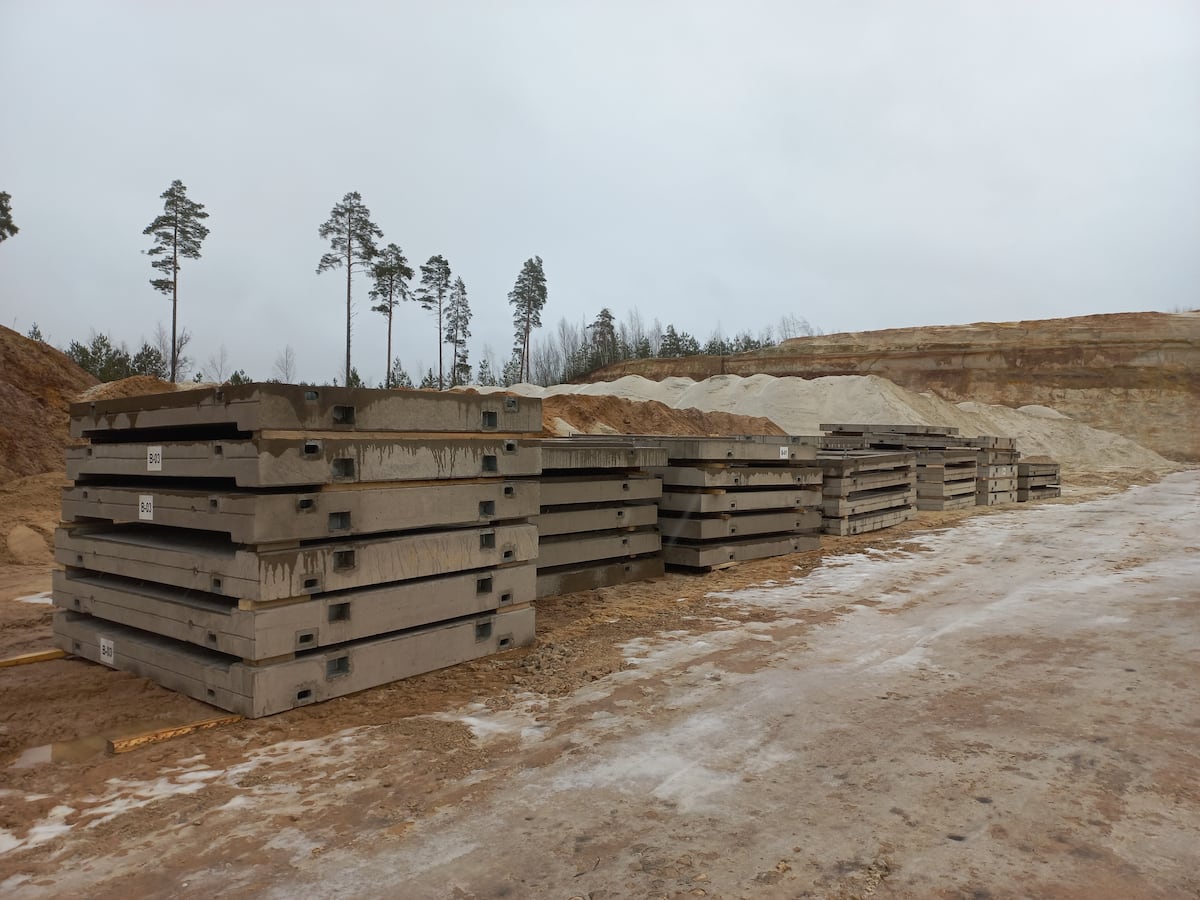
BERLIN — Estonia has begun installing the first concrete bunkers along its southeastern border with Russia as part of the Baltic Defense Line, marking a key milestone for the trilateral fortification project despite delays.
Five bunkers were awaiting installation as of this week, with Estonian officials targeting 28 bunkers in the ground by year’s end, according to Krismar Rosin, press officer for the Estonian Centre for Defence Investments. The initial batch represents the first phase of a 600-bunker network designed to strengthen the European Union’s and NATO’s eastern flank .
In an interview with Defense News, Rosin acknowledged the timeline remains uncertain. The bunkers are being deployed in Setomaa municipality and southeastern Estonia, with 27 situated on government or municipal land and only one on private property.
The deployment comes a year later than originally planned, following procurement complications that forced Estonian officials to restructure their approach. An initial tender for all 600 bunkers received bids exceeding legal cost limits because construction companies couldn’t accurately assess installation challenges without knowing the exact locations, which defense officials kept confidential for operational security, Rosin said.
“Since those companies did not know … does it have a boggy terrain, does it have some kind of forest terrain, how is the access – they offered very expensive bids," Rosin explained.
Estonian officials solved the problem by scaling back to a 28-bunker pilot program and revealing approximate locations to bidders to obtain realistic cost estimates while gathering implementation lessons before the larger procurement. The remaining 572 bunkers are meant to be tendered by year’s end.
As of Friday, Nov. 12, the bunkers were “currently being deployed but not yet fully ready,” the Estonian Center for Defense Investments said in an email.
A bunker shell is emplaced in Estonia near the border with Russia in December 2025. (Estonian Centre for Defence Investments)
The bunkers, each approximately 35 square meters, are designed to withstand 152mm artillery shells. They represent one part of a layered defense system meant to stop a possible Russian invasion. All barbed wire and dragon’s teeth obstacles have been delivered and stored in pre-positioned areas awaiting installation if the need arises, Rosin said.
Beyond procurement issues, the project faces coordination challenges requiring approval from multiple stakeholders, including the Estonian Defence Forces, Police and Border Guard, municipalities, and private landowners – all while adhering to peacetime environmental and safety regulations.
“We are building it in peacetime, which means that we have to follow the peacetime law,” Rosin said, contrasting this with wartime scenarios where military engineers could do things like digging anti-tank trenches “fast, within a few hours, probably.”
Coordinating the project with the Border Guard, whose patrol road requirements and tactical plans must align with the Defence Forces’ bunker and anti-tank ditch placements, has added to the overall complexity.
Estonia's envisioned fortifications along he border with Russia. (Estonian Centre for Defence Investments)
For instance, only 500 meters of a planned 3.4-kilometer test anti-tank trench has been completed, with additional construction delayed pending Border Guard approval, whose area of operations the test trench would cross through, said Rosin.
Despite the setbacks, Estonia remains ahead of Latvia and Lithuania in physical implementation, according to Rosin. All three countries announced the coordinated Baltic Defense Line project, but are executing their national portions independently based on varying terrain and threat assessments, although they cooperate on concepts and knowledge-sharing.
Estonia’s €60 million ($70 million) budget for the project – with approximately €30 million spent to date – is significantly lower than Lithuanian and Latvian allocations, reflecting Estonia’s shorter border length and natural obstacles, including Lake Peipus and extensive bog areas. The Estonian project excludes air defense systems and advanced firepower that neighboring countries are incorporating.
The Estonian Border Guard has already deployed a separate “drone wall” detection system along portions of the border, which is often confused with the Defence Forces’ Baltic Defense Line project but is a separate measure, Rosin said.
Editor’s note: This story was updated after the Estonian Centre for Defence Investments updated its information about the initial number of bunkers to be built: five, not seven.
Linus Höller is Defense News' Europe correspondent and OSINT investigator. He reports on the arms deals, sanctions, and geopolitics shaping Europe and the world. He holds master’s degrees in WMD nonproliferation, terrorism studies, and international relations, and works in four languages: English, German, Russian, and Spanish.
柏林——尽管有所延误,爱沙尼亚已开始在其与俄罗斯接壤的东南部边境沿线建造首批混凝土掩体,作为波罗的海防线的一部分,这标志着这项三方防御工事项目取得了关键性进展。
据爱沙尼亚国防投资中心新闻官克里斯玛·罗辛称,截至本周,已有五个掩体等待安装,爱沙尼亚官员的目标是在年底前建成28个掩体。首批掩体是旨在加强欧盟和北约东翼防御的600个掩体网络的第一阶段。
罗辛在接受《防务新闻》采访时承认,具体时间表仍不确定。这些掩体部署在塞托马市和爱沙尼亚东南部,其中27个位于政府或市政土地上,只有1个位于私人土地上。
由于采购过程中出现复杂情况,爱沙尼亚官员被迫调整采购策略,导致此次部署比原计划推迟了一年。罗辛表示,最初为全部600个掩体进行的招标中,由于建筑公司无法在不了解确切位置的情况下准确评估安装难度(出于行动安全考虑,国防部官员对具体位置保密),导致投标价格超过了法定限额。
罗辛解释说:“由于这些公司不了解情况……比如那里是沼泽地、森林地带,以及交通状况如何——所以他们的报价非常高。”
爱沙尼亚官员通过将试点项目规模缩减至28个燃料舱,并向投标人公布大致位置以获得更切合实际的成本估算,同时在更大规模的采购之前收集实施经验,从而解决了这个问题。剩余的572个燃料舱计划在年底前进行招标。
爱沙尼亚国防投资中心在一封电子邮件中表示,截至 11 月 12 日星期五,这些掩体“目前正在部署中,但尚未完全准备就绪”。
2025年12月,爱沙尼亚靠近俄罗斯边境地区部署了一个掩体。(爱沙尼亚国防投资中心)
这些碉堡每个面积约35平方米,设计用于抵御152毫米炮弹。它们是多层防御体系的一部分,旨在阻止可能的俄罗斯入侵。罗辛表示,所有铁丝网和龙牙障碍物均已运抵并存放于预先部署区域,以备不时之需。
除了采购问题外,该项目还面临协调方面的挑战,需要获得包括爱沙尼亚国防军、警察和边防部队、市政当局和私人土地所有者在内的多个利益相关方的批准——所有这些都必须在遵守和平时期环境和安全法规的前提下进行。
罗辛说:“我们是在和平时期建造的,这意味着我们必须遵守和平时期的法律。”他将此与战时情况进行了对比,在战时,军事工程师可以“快速地,可能在几个小时内”挖掘反坦克壕沟。
与边防军协调该项目,边防军的巡逻道路需求和战术计划必须与国防军的掩体和反坦克壕沟的部署保持一致,这增加了整体的复杂性。
爱沙尼亚设想沿俄边境修建防御工事。(爱沙尼亚国防投资中心)
例如,罗辛表示,计划修建的3.4公里长的反坦克试验壕沟目前只完成了500米,其余部分的建设则因需等待边防部队的批准而延期,因为该试验壕沟将穿过边防部队的行动区域。
罗辛表示,尽管遭遇挫折,爱沙尼亚在实际执行方面仍然领先于拉脱维亚和立陶宛。这三个国家都宣布了波罗的海防线协调项目,但由于地形和威胁评估的差异,各自独立执行本国部分,不过它们在概念和知识共享方面开展合作。
爱沙尼亚为该项目拨款6000万欧元(7000万美元),迄今已支出约3000万欧元,远低于立陶宛和拉脱维亚的拨款额,这反映出爱沙尼亚的边境线较短,且面临诸多自然障碍,包括佩普斯湖和广袤的沼泽地。爱沙尼亚的项目不包括邻国正在建设的防空系统和先进火力。
罗辛表示,爱沙尼亚边防部队已经在部分边境地区部署了一套独立的“无人机墙”探测系统,这经常与国防军的波罗的海防线项目混淆,但实际上是一项独立的措施。
编者按:爱沙尼亚国防投资中心更新了有关最初要建造的掩体数量的信息后,本文已更新:五个,而不是七个。
林努斯·霍勒是《防务新闻》的欧洲记者和开源情报调查员。他报道影响欧洲乃至全球的军火交易、制裁和地缘政治。他拥有大规模杀伤性武器不扩散、恐怖主义研究和国际关系三个硕士学位,并精通英语、德语、俄语和西班牙语四种语言。