MQ-72C Cargo Helicopter Drone Capabilities Demonstrated For U.S. Army.MQ-72C 货运直升机无人机能力已向美国陆军进行演示。
The Marines have been the primary interested party in the MQ-72C, but the Army already flies the UH-72 Lakota and needs similar capabilities.
新闻视频
By Joseph Trevithick
Published Oct 15, 2026 6:56 PM EDT
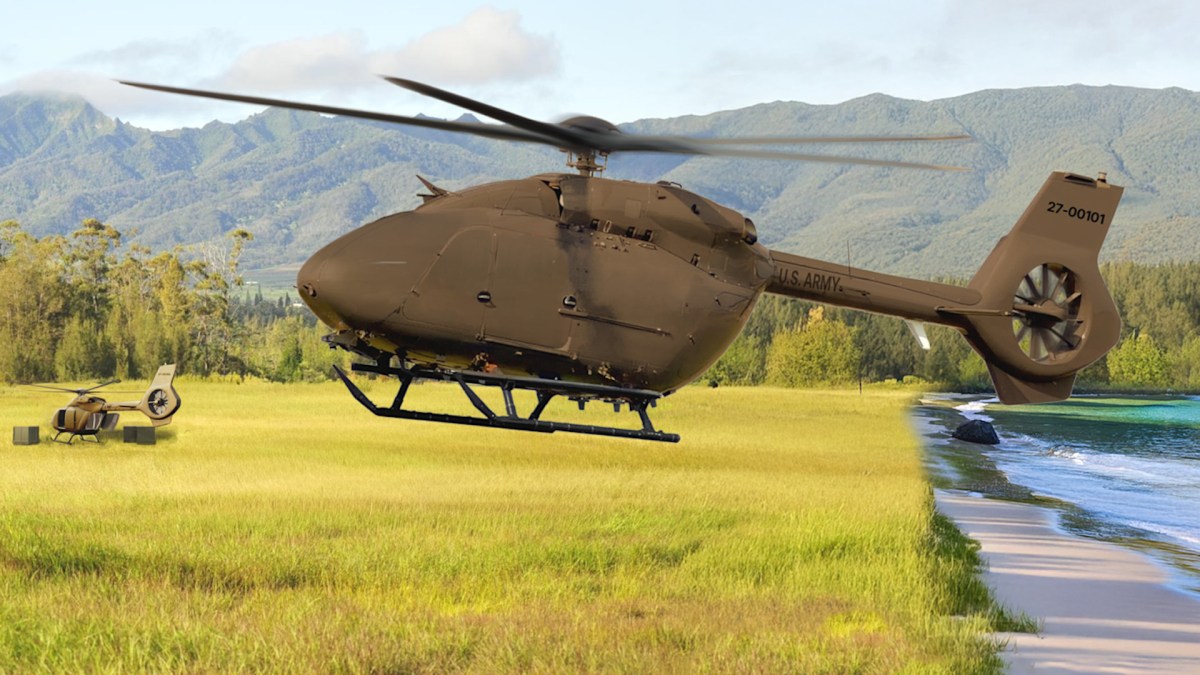
Airbus recently put the demonstrator for its MQ-72C drone helicopter through the paces for the U.S. Army. The MQ-72C has been in development for several years now for a U.S. Marine Corps competition seeking a new uncrewed cargo-carrying Aerial Logistics Connector (ALC). The Marines see uncrewed logistics ‘connectors’ as key to future expeditionary and distributed operations , and a similar Army requirement could be on the horizon, especially to support long-range air assaults .
Jaysen Yochim, Senior Director for the ALC program at Airbus, talked about the demonstration for the Army with our Howard Altman at the Association of the U.S. Army’s (AUSA) main annual convention on Monday. Airbus is currently teamed with L3Harris Technologies, Shield AI, and Parry Labs on development of this drone helicopter for the Marines, as you can learn more about here .
The current iteration of the MQ-72C is based on the crewed UH-72B Lakota, which is in turn a variant of Airbus’ H145 twin-engine light helicopter. The Army operates crewed UH-72s today , but only in non-combat roles, including counter-drug and border patrol missions, and almost exclusively within the borders of the United States.
US Army crewed UH-72 Lakota helicopters. US Army US Army UH-72A Lakotas. US Army
The MQ-72C demonstration for the Army, which Airbus self-funded, took place last week at Huntsville Executive Airport just outside of Huntsville, Alabama. The service has a major presence in the Huntsville area, which is focused heavily on supporting aviation and missile developments. As of April of this year, Airbus and its partners had already conducted four rounds of autonomous flight testing of the initial demonstrator version of this design, which is not in a fully uncrewed configuration.
“We did a demonstration for the Army down in Huntsville, really to show all the capabilities that we’ve been able to develop so far on the Marine Corps-funded program,” Yochim said. “We had a total of five demonstration flights that we did down there, showing everything from the autonomous capability of the aircraft in a hover.”
This included “complex hovering patterns, both step turns and fly-through turns, similar to what you’d see on an airfield, to just show how it can be integrated onto an airfield inside of the existing routing structure and everything that exists on an airfield,” he continued. “We did multiple traffic patterns to demonstrate just a normal traffic pattern, like a normal day would be, but also traffic patterns or a flight with a no-fly zone popping up in the middle of the flight.”
The video below shows previous flight testing of the MQ-72C demonstrator.
In that latter instance, the MQ-72C had to “autonomously make decisions” about how it was “going to route itself around the no-fly zones” once they popped up, he added. The human operator did provide the initial flight plan. There was also a pilot on board during the autonomous flight demonstrations, but only as an added safety margin, and they “never had to take control of the aircraft once,” according to Yochim.
Though the demonstrator now has provisions for a pilot, the intention is for the MQ-72C to eventually operate in a completely uncrewed mode. The current version of the design has two LIDAR sensors, facing front and back, as well as an electro-optical camera at the nose end, to help with navigation and otherwise provide situational awareness while operating in the uncrewed mode.
Those sensors feed “imagery into the flight computer with HiveMind that’s interpreting that through its perception systems to make decisions on the go,” Yochim explained. HiveMind is an autonomy software package from Shield AI, which is in use on a growing number of other uncrewed platforms, as you can read more about here .
Yochim also talked about work that has already been done to start laying the groundwork for controlling the MQ-72C in the fully uncrewed mode. Parry Labs has been leading ground control station work.
“Over the summer is really where now the aircraft, rather than having a pilot inside the aircraft, or sorry, an autonomous operator inside the aircraft, using a gaming computer to tell the aircraft what to do, now the aircraft is receiving commands from a ground control station,” he told us. “That is that human in the loop, sending commands to the aircraft over Starlink, so that it has beyond line-of-sight. We’ve had flights that have been autonomously commanded from up to 70 miles away. All of that is stuff that’s happened in the last year. We also have where the aircraft can be commanded from both a ground control station like this and also with the Samsung tablet.”
SpaceX’s Starlink space-based network and its more secure, government-focused cousin, Starshield, are in increasingly widespread use across the U.S. military for communications and other purposes . At present, Starlink also dominates the commercial market for these services globally. Starlink and Starshield offer highly persistent and robust connectivity that is ideal for uncrewed aircraft command and control operations.
The current MQ-72C demonstrator also lacks certain features that are expected to be found on the final configuration. Plans for a set of clamshell doors at the nose notably still have yet to be realized. The UH-72 design already features clamshell doors at the rear of the fuselage, as seen below. The end goal is for the uncrewed version to have an open pass-through main cabin, offering major advantages for loading and unloading cargo, and doing so rapidly.
US Army National Guard A look in through the rear of a UH-72A in a medical evacuation configuration. US Army National Guard
The nose door arrangement has been “designed. It’s been 3D rendered. It’s gone through some testing on that end, but not flight testing,” Airbus’ Yochim told us. “The flight testing, wind tunnel testing, things like that, take time, and it’s just not been the priority to get there with getting the aircraft ready.”
Yochim said that Airbus is now looking toward the 2029-2030 timeframe for integrating the nose doors. This is tied, in part, to the Marine Corps’ ALC program, where delayed funding has shifted the schedule to the right. On that front, the Marine Corps is aiming for demonstration of this capability in an operationally relevant context next year. The Airbus-led team is also not the only one under contract for that program, with Near Earth Autonomy and Honeywell are also working on a design based on the Leonardo AW139 helicopter. The expectation is that the Marines will eventually pick a single ALC design to actually acquire.
In the meantime, Airbus is clearly eyeing other opportunities, including with the U.S. Army. The company’s main arm in Europe is also now pitching a functionally identical U145 drone helicopter based on the current generation H145 design.
At @ILA_Berlin , we introduce the Airbus U145: an uncrewed, fully autonomous variant of the H145. Optimised for cargo with no cockpit, an integrated nose door, and full autonomy, its first flight is set for late 2026. https://t.co/MbodUxYxyI pic.twitter.com/2EnMXzog6c — Airbus Helicopters (@AirbusHeli) June 8, 2026
At @ILA_Berlin , we introduce the Airbus U145: an uncrewed, fully autonomous variant of the H145. Optimised for cargo with no cockpit, an integrated nose door, and full autonomy, its first flight is set for late 2026. https://t.co/MbodUxYxyI pic.twitter.com/2EnMXzog6c
Airbus did the “demonstration to just show the Army the capabilities that we’ve been developing with the Marine Corps,” Yochim told us. “So the Marine Corps has been funding the program up to now, and so the message we are giving the Army is this is how far your sister unit [sic; service] has been able to get us with the funding that we’ve had. It’s already product that’s out there. It’s already product that’s working.”
As mentioned, the Marines see ALC as part of a larger family of uncrewed logistics ‘connectors,’ in the air and on the surface, which will be critical to supporting expeditionary and distributed operations involving units spread across far-flung forward locations. The service sees this as particularly central to an island-hopping campaign scenario in the context of a larger potential high-end fight with China in the Pacific, where traditional logistics chains will be top targets. The conflict with Iran has only underscored how disruptive those threats can be.
The Army is facing many of the same kinds of future operational scenarios, especially when it comes to supporting future airmobile operations. The service is already expecting air assaults to take place over far greater distances in the future thanks to the introduction of the MV-75A tiltrotor . Those units will need to be supported once they arrive at their objectives, which could be heavily contested.
A rendering of a pair of MV-75A tiltrotors. Bell
“We did several [air assaults] over the last few years directly from Fort Campbell to the Joint Readiness Training Center, which is 500 miles, give or take. The [Marine Corps’ MV-22] Osprey can do that very fast and in one leap,” Army Maj. Gen. David Gardner, head of the 101st Airborne Division, told our sister site Task & Purpose at AUSA . “Our current helicopters, you’ve got to make some fuel and re-arming stops along the way, and the distance isn’t there. But now that helped us think through as a division how we were going to command and control something that moved, expanded our battlefield, so to speak, twice as far, three times, four times as far, and twice as fast.”
The 101st is the Army’s premier air assault formation and is set to be the first to fly MV-75As operationally.
“We can put some things inside the helicopter, and we can put some things under a helicopter with a sling load . We’re not going to sling load something moving 250-ish knots for 500 miles. We’re not going to hang Humvees under that,” Gardner also told Task & Purpose . “We learned some things about how we need to get our equipment to the battlefield, how we need to get our sustainment to the battlefield at those distances, how we might need to rely on autonomous logistics delivery systems.”
A US Army CH-47 Chinook helicopter seen carrying a Humvee and an M119 105mm towed howitzer slung underneath. US Army
It should be stressed that the market for semi-autonomous aerial logistics support is heating up, and that the MQ-72C is not the only option to meet such a requirement. As noted, there is another competitor in the running just for the Marines’ ALC effort, the AW139-based offering from Near Earth Autonomy and Honeywell.
Last year, Sikorsky, now a subsidiary of Lockheed Martin, revealed that it was working on a fully uncrewed version of the Black Hawk helicopter that also features a clamshell nose . Sikorsky has also been working with Robinson Unmanned on a pilotless version of the smaller R66 helicopter that again features clamshell doors at the front of the fuselage. Bell, together with Near Earth Autonomy, is developing an uncrewed cargo-carrying version of its Model 505 Jet Ranger X, as well. The drone versions of the R66 and Jet Ranger X are aimed primarily at another Marine Corps ‘connector’ program called the Medium Aerial Resupply Vehicle-Expeditionary Logistics (MARV-EL).
A rendering of the uncrewed Bell 505. Near Earth Autonomy
As mentioned, the Army does already operate crewed UH-72s, but it also flies Black Hawks. The service is also expanding its use of contractor-operated R66s for pilot training .
The Army does not appear to have formalized any requirement for a cargo-carrying drone helicopter yet. At the same time, the comments from Maj. Gen. Gardner certainly suggest one may be emerging now.
There was at least enough interest within the Army already to accept Airbus’ offer of a demonstration of its MQ-72C last week.
Contact the author: joe@twz.com
Comments couldn’t be loaded. Please refresh the page.
作者:约瑟夫·特雷维西克
发布于美国东部时间2026年10月15日下午6:56
空客公司最近为美国陆军对其MQ-72C无人直升机演示机进行了全面测试。MQ-72C已研发数年,旨在参与美国海军陆战队一项新型无人货运空中后勤连接器(ALC)的竞标。海军陆战队认为无人后勤“连接器”对于未来的远征和分布式作战至关重要,而陆军也可能很快提出类似的需求,尤其是在支持远程空中突击方面。
空客ALC项目高级总监杰森·约希姆(Jaysen Yochim)周一在美国陆军协会(AUSA)年度大会上与我们的霍华德·奥特曼(Howard Altman)谈到了为陆军进行的演示。空客目前正与L3Harris Technologies、Shield AI和Parry Labs合作,为海军陆战队开发这款无人直升机,您可以在这里了解更多信息。
目前的MQ-72C无人机以UH-72B“拉科塔”直升机为基础,而UH-72B“拉科塔”又是空客H145双引擎轻型直升机的衍生机型。美国陆军目前仍在使用UH-72直升机,但仅用于非战斗任务,包括缉毒和边境巡逻,而且几乎全部在美国境内执行任务。
美国陆军机组人员驾驶的UH-72“拉科塔”直升机。美国陆军UH-72A“拉科塔”直升机。美国陆军
由空客公司自筹资金的MQ-72C无人机演示项目上周在阿拉巴马州亨茨维尔市郊的亨茨维尔行政机场举行。美国陆军在亨茨维尔地区拥有强大的军事存在,该地区致力于支持航空和导弹研发。截至今年4月,空客及其合作伙伴已对该设计的初始演示样机进行了四轮自主飞行测试,该样机并非完全无人驾驶。
“我们在亨茨维尔为陆军做了一次演示,主要是为了展示我们在海军陆战队资助的项目上迄今为止所开发的所有能力,”约希姆说。“我们在那里总共进行了五次演示飞行,展示了飞机悬停的自主能力等所有功能。”
他继续说道:“这包括复杂的悬停模式,包括阶梯转弯和飞越转弯,类似于你在机场看到的那种,目的是为了展示如何将它整合到机场现有的航线结构和所有设施中。” “我们进行了多种飞行模式演示,既包括正常的飞行模式(就像平常的一天一样),也包括飞行途中突然出现禁飞区的飞行模式。”
下面的视频展示了MQ-72C验证机之前的飞行测试。
他补充说,在后一种情况下,MQ-72C 必须“自主决定”如何在禁飞区出现后“绕过禁飞区”。虽然初始飞行计划是由操作员提供的,但据约希姆称,在自主飞行演示期间,机上也有一名飞行员,但这只是为了增加安全保障,而且他们“一次也没有接管过飞机”。
尽管目前验证机已配备飞行员,但MQ-72C的最终目标是实现完全无人驾驶。当前版本的设计方案配备了前后两个激光雷达传感器以及位于机头的光电摄像机,用于辅助导航并在无人驾驶模式下提供态势感知。
Yochim解释说,这些传感器将“图像传输到搭载HiveMind系统的飞行计算机,HiveMind通过其感知系统解读图像,从而实时做出决策”。HiveMind是Shield AI公司开发的一款自主软件,目前已被应用于越来越多的无人平台上,您可以在这里了解更多信息。
约希姆还谈到了为实现MQ-72C完全无人驾驶模式的控制而开展的基础工作。帕里实验室一直在牵头进行地面控制站的建设工作。
“今年夏天,我们真正实现了飞行器转型。以前飞机里会有飞行员,或者更准确地说,是会有自主操作员,用游戏电脑来操控飞机。现在,飞机是由地面控制站发出指令,”他告诉我们。“这就是人机交互的体现,通过星链向飞机发送指令,使其能够进行超视距飞行。我们已经实现了从70英里(约113公里)外自主操控的飞行。所有这些都是去年取得的成果。此外,我们还实现了通过地面控制站(例如这个)以及三星平板电脑来操控飞机。”
SpaceX 的星链 (Starlink) 天基网络及其更安全、面向政府的姊妹网络星盾 (Starshield) 在美国军方的通信和其他用途中正得到越来越广泛的应用。目前,星链在全球商业市场也占据主导地位。星链和星盾提供高度稳定可靠的连接,非常适合无人机指挥控制操作。
目前的MQ-72C验证机还缺少一些最终配置中预期具备的功能。例如,机头蚌壳式舱门的计划至今尚未实现。UH-72的设计已经在机身尾部配备了蚌壳式舱门,如下图所示。最终目标是使无人驾驶版本拥有开放式贯通主舱,这将极大地提高货物装卸的效率和速度。
美国陆军国民警卫队 从UH-72A医疗后送直升机的后部向外看。美国陆军国民警卫队
空客公司的约希姆告诉我们,机头舱门的设计已经完成,3D渲染也已经完成,并且经过了一些测试,但还没有进行飞行测试。“飞行测试、风洞测试等等都需要时间,而这些测试并非飞机准备工作的首要任务。”
约希姆表示,空客目前正着眼于2029-2030年完成机头舱门的集成。这部分与海军陆战队的先进后勤保障(ALC)项目有关,该项目资金延迟导致进度提前。海军陆战队的目标是明年在实际作战环境中演示这项能力。此外,由空客牵头的团队并非该项目的唯一承包商,近地自主公司(Near Earth Autonomy)和霍尼韦尔公司也在基于莱昂纳多AW139直升机进行设计。预计海军陆战队最终会选定一款ALC设计方案进行采购。
与此同时,空客显然也在关注其他机遇,包括与美国陆军的合作。该公司在欧洲的主要分支机构目前也在推销一款功能相同的U145无人直升机,该直升机基于现款H145的设计。
在柏林国际航空航天展览会 (ILA Berlin) 上,我们推出了空客 U145:H145 的无人驾驶、全自动版本。该机型针对货运进行了优化,没有驾驶舱,配备一体式机头舱门,并具备完全自主飞行能力。其首飞预计将于 2026 年底进行。https://t.co/MbodUxYxyI pic.twitter.com/2EnMXzog6c — 空客直升机 (@AirbusHeli) 2026 年 6 月 8 日
在柏林国际航空航天展览会 (ILA Berlin) 上,我们推出了空客 U145:H145 的无人驾驶、全自动版本。该机型针对货运进行了优化,没有驾驶舱,采用一体式机头舱门,并具备完全自主飞行能力,预计将于 2026 年底首飞。https://t.co/MbodUxYxyI pic.twitter.com/2EnMXzog6c
约希姆告诉我们:“空客进行这次演示,只是为了向陆军展示我们与海军陆战队共同研发的能力。海军陆战队一直为该项目提供资金,所以我们想传达给陆军的信息是,你们的兄弟部队利用现有资金已经取得了如此大的进展。产品已经面世,而且运行良好。”
如前所述,海军陆战队将空中后勤保障系统(ALC)视为更广泛的无人后勤“连接器”系统的一部分,这些系统涵盖空中和水面作战,对于支持分散在遥远前沿阵地的部队开展远征和分布式作战至关重要。海军陆战队认为,在太平洋地区与中国可能发生的更大规模的高端冲突中,这种系统对于跳岛作战场景尤为重要,因为传统后勤链将成为首要目标。与伊朗的冲突更加凸显了这些威胁的破坏性。
陆军正面临着许多类似的未来作战场景,尤其是在支援未来空中机动作战方面。由于MV-75A倾转旋翼机的投入使用,陆军预计未来空中突击的作战距离将大大增加。这些部队抵达目标后需要得到支援,而这些目标可能面临激烈的对抗。
两架MV-75A倾转旋翼机的渲染图。贝尔公司
“过去几年,我们多次从坎贝尔堡直接空降到联合战备训练中心,全程大约500英里。海军陆战队的MV-22‘鱼鹰’倾转旋翼机可以快速完成这段距离,”陆军少将、第101空降师师长戴维·加德纳在接受美国陆军协会(AUSA)旗下网站Task & Purpose采访时表示。“我们目前的直升机需要中途加油和重新装弹,距离太远了。但现在,这帮助我们整个师思考如何指挥和控制这种机动性强、能将战场范围扩大两倍、三倍、四倍,速度也快两倍的飞行器。”
第 101 空降师是陆军首屈一指的空中突击部队,并将率先投入 MV-75A 进行作战飞行。
“我们可以把一些东西装进直升机里,也可以用吊索把一些东西吊在直升机下面。但我们不会用吊索把东西以大约250节的速度吊运500英里。我们也不会把悍马车吊在它下面,”加德纳还告诉《任务与目标》杂志。“我们了解到一些关于如何将装备运送到战场、如何在如此远的距离上将补给运送到战场,以及我们可能需要依赖自主后勤运输系统等方面的知识。”
一架美国陆军CH-47“支奴干”直升机被拍到,机上载有一辆悍马军车,车底悬挂着一门M119型105毫米牵引式榴弹炮。
需要强调的是,半自主空中后勤保障市场正在升温,MQ-72C并非满足此类需求的唯一选择。正如前文所述,还有另一款产品也在竞标海军陆战队的空中后勤保障项目,那就是由近地自主公司(Near Earth Autonomy)和霍尼韦尔公司(Honeywell)联合开发的基于AW139平台的无人机。
去年,现为洛克希德·马丁公司子公司的西科斯基公司透露,他们正在研发一款完全无人驾驶的黑鹰直升机,该机型也采用了蚌壳式机头。西科斯基公司还与罗宾逊无人机公司合作,研发一款小型R66直升机的无人驾驶版本,该机型同样在机身前部配备了蚌壳式舱门。贝尔公司与近地自主公司合作,也在开发其505型喷气游骑兵X型无人货运直升机。R66和喷气游骑兵X的无人机版本主要面向海军陆战队的另一个“连接器”项目——中型空中补给飞行器-远征后勤(MARV-EL)。
贝尔505无人驾驶飞行器的渲染图。近地自主飞行
如前所述,陆军目前已装备有人驾驶的UH-72直升机,同时也装备黑鹰直升机。此外,陆军还在扩大使用承包商运营的R66直升机进行飞行员训练。
陆军似乎尚未正式提出对货运无人直升机的需求。但与此同时,加德纳少将的言论无疑表明,这种需求可能正在酝酿之中。
至少陆军内部已经有足够的兴趣接受了空客上周提出的MQ-72C演示邀请。
联系作者:joe@twz.com
评论加载失败,请刷新页面。