Watch Russian Submariners Train To Escape A Burning Submarine Through A Torpedo Tube观看俄罗斯潜艇兵训练如何通过鱼雷发射管逃离燃烧的潜艇
Russia is no stranger to submarine fires and other accidents, including a blaze on the spy sub Losharik earlier this year that killed 14.
新闻视频
By Joseph Trevithick
Published Nov 15, 2019 3:00 PM EST
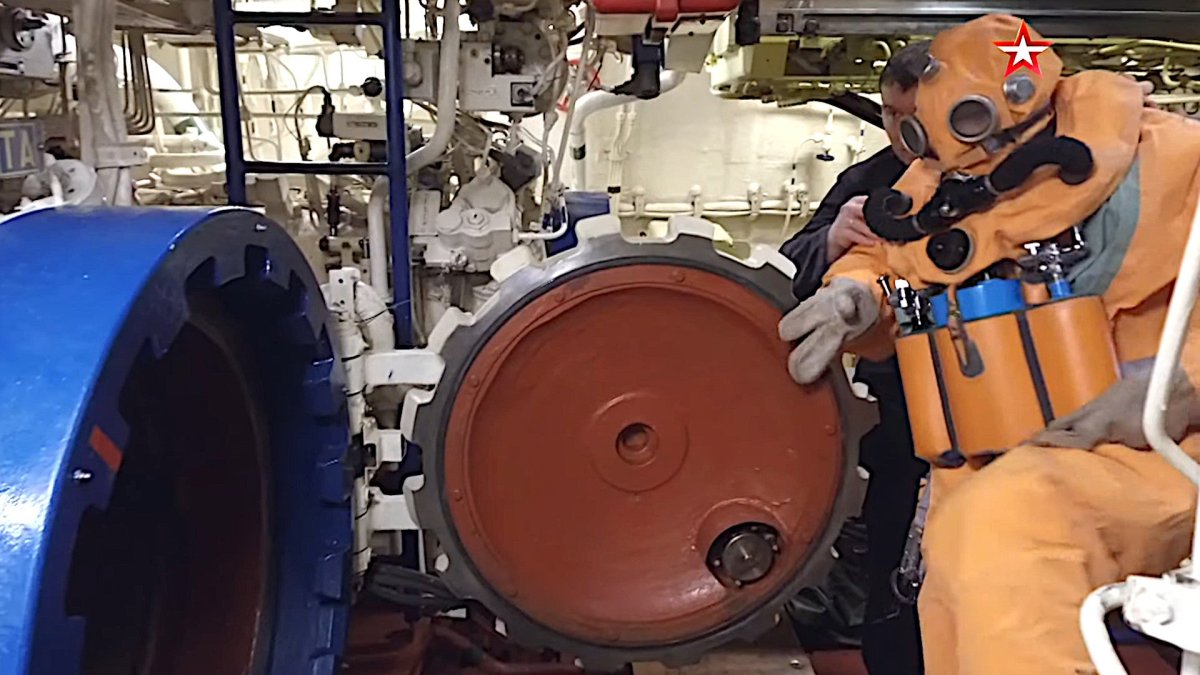
The official television channel of Russia’s Ministry of Defense recently offered a look at an emergency drill onboard the Project 949A Oscar II class nuclear-powered guided-missile submarine Tver. It begins with personnel responding to a potential blaze onboard and ends with a sailor practicing how to escape through a torpedo tube using a special suit. These types of drills are routine and hardly surprising given the particular danger that fires pose to subs, which the War Zone
has previously explored in-depth. Still, there is no doubt that there is some added emphasis within the Russian Navy on this kind of preparedness following the fire onboard the spy submarine Losharik earlier this year that killed 14 sailors.
TV Zvezda posted the brief segment online on Nov. 14, 2019. We don’t know when the drill occurred, but it took place in the frigid waters off the Kamchatka Peninsula in Russia’s Far East region. Tver , which is assigned to the Russian Navy’s Pacific Fleet , is homeported at the Rybachiy Nuclear Submarine Base in Kamchatka.
The video shows personnel racing to seal a compartment and otherwise battle the fire after the drill begins. They can be seen carrying small, portable emergency breathing devices in cases slung around their necks. These systems typically feature a self-contained oxygen supply and some form of hood to protect the wearer from smoke. They are generally intended for short-duration use only to allow individuals to escape to a safe area.
It’s not stated in the TV Zvezda clip, but these may be PDU-3s, which provide enough oxygen for the user to breath for around 20 minutes, depending on how active they are and other factors. During the fire aboard Losharik in July 2019, which you can read about in much greater detail in this past War Zone piece , personnel reportedly used these emergency breathing systems, as well as a fixed emergency breathing apparatus, as they fought the blaze.
Working fast to contain a fire onboard a submarine to as few compartments as possible and get it otherwise under control is of paramount importance. As The War Zone
has already explored in the past, fires within submarines are relatively unique given the confined environment that gives the heat and smoke no way to escape and dissipate. This, in turn, significantly increases the risks of smoke-related injuries because of how quickly it builds up inside the submarine’s small compartments.
However, sealing off compartments can also leave sailors stranded at other ends of the submarine, without an easy means of getting out of the submarine to safety. Many classes of Russian submarines have special escape pods built into their sails, but it might be difficult for submariners to get to them if they’re stranded at one end of the boat or another with a fire between them and this method of egress.
The escape pod on the Russian Project 945 Sierra class nuclear attack submarine Kostroma removed during maintenance., Russian Internet
So, the drill onboard Tver also involved multiple individuals donning special emergency suits and exiting through the torpedo tubes at the front of the submarine. Rather than traditional diving gear, these suits only have a limited amount of oxygen to enable the individual to get to the surface, and hopefully to waiting rescuers. In the case of this drill, a Russian Navy support boat was sitting on the surface waiting for them, which was no doubt welcome given that it is winter in Kamchatka and forecasts show that the ambient temperatures during the day remain firmly below freezing. As a result, water temperatures are generally very cold and this drill also occurred at night.
A picture of Tver in the ice-filled waters of the Rybachiy Nuclear Submarine Base, giving a sense of how cold things can get in Kamchatka., Russian Ministry of Defense
TV Zvezda also said that the suits are available for sailors evacuating subs that have sunken to the bottom of the ocean. This is what infamously happened to the Kursk , another Oscar II class submarine, following a torpedo explosion in 2000. Of the submarine’s crew of 118, approximately 23 survived the initial mishap, but were unable to escape and died later.
The escape suits are not a perfect solution, of course, and it’s not clear what the maximum safe depth for using them might be. Still, they do offer another way to try to get to safety depending on the exact circumstances and it is better to have that option than not.
This incident with Losharik earlier this year only underscores the importance of having emergency systems like the breathing devices and escape suits, as well as the value of regular training to ensure that submariners know how to use them, if necessary. Beyond that mishap, and the Kursk disaster , Russia, and the Soviet Union before it, is hardly a stranger to submarine accidents, in general, too.
The one-of-kind Project 685 nuclear-powered attack submarine K-278 Komsomolets
is presently leaking radiation on the bottom of the Barents Sea, where it has been sitting since it sunk following a fire in 1989. Five sailors attempted to use the submarine’s escape pod, but it malfunctioned and only one who had also been wearing a breathing device survived.
Right before the Soviet Union collapsed in 1991, the Typhoon class ballistic missile submarine TK-17 almost sank after an R-39 Rif submarine launched-ballistic missile exploded in its launch tube during an exercise. In 2008, a fire suppression system on the Project 971 Akula -class nuclear attack submarine Nerpa , meant to quickly suffocate fires with inert gas, inadvertently went off, killing 20 sailors and injuring 41 more. These are only some of the submarine accidents that Russia has suffered and, in recent years, there have been a number of serious fires involving sub simply undergoing maintenance or otherwise in port .
Escaping a burning submarine in a cumbersome suit through a torpedo tube certainly isn’t for the faint of heart, but having as many options as possible to get out alive is surely welcome.
Contact the author: joe@thedrive.com
Comments couldn’t be loaded. Please refresh the page.
作者:约瑟夫·特雷维西克
发布于美国东部时间2019年11月15日下午3:00。
俄罗斯国防部官方电视台近日播放了一段949A型“奥斯卡II”级核动力导弹潜艇“特维尔”号上的紧急演习画面。演习开始时,艇员们正在应对可能发生的火灾;演习结束时,一名水兵正在练习如何穿着特制防护服通过鱼雷发射管逃生。考虑到火灾对潜艇的特殊危险性,这类演习是例行公事,并不令人意外。
此前已有深入探讨。不过,毫无疑问,在今年早些时候间谍潜艇“洛沙里克”号发生火灾,造成14名水兵丧生之后,俄罗斯海军更加重视此类防范措施。
俄罗斯“红星”电视台于2019年11月14日在网上发布了这段简短的视频。我们不知道演习的具体时间,但演习地点位于俄罗斯远东地区堪察加半岛附近冰冷的海域。“特维尔”号核潜艇隶属于俄罗斯海军太平洋舰队,母港位于堪察加半岛的雷巴奇核潜艇基地。
视频显示,演习开始后,人员迅速封锁舱室并扑灭火灾。他们脖子上挂着装有小型便携式应急呼吸器的箱子。这些呼吸器通常配备独立的氧气供应系统和某种形式的防护罩,以保护佩戴者免受烟雾侵害。它们一般仅供短时间使用,以便人员逃生到安全区域。
电视Zvezda的片段中没有明确说明,但这些可能是PDU-3型呼吸器,根据使用者的活动程度和其他因素,它可以提供足够的氧气供其呼吸约20分钟。2019年7月,洛沙里克号(Losharik)发生火灾,详情可阅读之前《战区》(War Zone)的报道。据报道,当时船员在灭火过程中使用了这些应急呼吸系统以及固定式应急呼吸器。
迅速控制潜艇上的火势,使其尽可能局限于少数舱室,并尽快将其控制住,至关重要。正如战区所言。
正如以往研究中所探讨的那样,潜艇内部火灾相对特殊,因为潜艇内部环境封闭,热量和烟雾无法逸散。这反过来又显著增加了烟雾相关伤害的风险,因为烟雾会在潜艇狭小的舱室中迅速积聚。
然而,封闭舱室也可能导致水兵被困在潜艇的另一端,难以安全脱困。许多俄罗斯潜艇的指挥塔上都装有特殊的逃生舱,但如果水兵被困在潜艇的一端,而逃生舱又被大火阻隔,他们就很难到达逃生舱。
俄罗斯945型“塞拉”级核动力攻击潜艇“科斯特罗马”号在维护期间拆除了逃生舱。(俄罗斯互联网)
因此,在“特维尔”号潜艇上的演习也包括多名人员穿上特制的应急服,从潜艇前部的鱼雷发射管逃生。这些应急服并非传统的潜水装备,而是仅配备少量氧气,以确保人员能够浮出水面,并最终抵达等候的救援人员身边。在这次演习中,一艘俄罗斯海军支援艇在水面待命,这无疑令人欣慰,因为堪察加半岛正值冬季,天气预报显示白天气温将远低于冰点。因此,水温通常非常低,而且这次演习也是在夜间进行的。
一张特维尔城在雷巴奇核潜艇基地冰封水域中的照片,展现了堪察加半岛的严寒程度。(俄罗斯国防部)
兹韦兹达电视台还报道称,这些救生衣可供从沉没于海底的潜艇中撤离的水兵使用。库尔斯克号潜艇就是个典型的例子,这艘奥斯卡II级潜艇在2000年遭遇鱼雷爆炸后沉没。潜艇上共有118名船员,其中约23人在最初的事故中幸存,但未能逃生,最终全部遇难。
当然,逃生服并非完美无缺,而且目前尚不清楚其安全使用的最大深度。不过,根据具体情况,它们确实提供了一种逃生途径,有总比没有好。
今年早些时候“洛沙里克”号潜艇的事故凸显了呼吸器和逃生服等应急系统的重要性,以及定期训练以确保潜艇艇员在必要时能够使用这些设备的价值。除了这次事故和“库尔斯克”号潜艇灾难之外,俄罗斯,以及之前的苏联,总体而言,也并非没有发生过潜艇事故。
独一无二的685型核动力攻击潜艇K-278“共青团员”号
目前,这艘潜艇正沉没在巴伦支海海底,辐射泄漏。自 1989 年起火沉没以来,它就一直静静地躺在那里。五名水兵曾试图使用潜艇的逃生舱,但逃生舱发生故障,只有一名佩戴呼吸装置的水兵幸存下来。
1991年苏联解体前夕,台风级弹道导弹潜艇TK-17在一次演习中,一枚R-39“里夫”潜射弹道导弹在其发射管内爆炸,险些沉没。2008年,971型阿库拉级核动力攻击潜艇“涅尔帕”号上的灭火系统发生意外,该系统本应使用惰性气体快速扑灭火灾,却意外启动,造成20名水兵丧生,41人受伤。这些只是俄罗斯潜艇事故中的一部分,近年来,一些潜艇在进行维护或停泊港口期间也发生了多起严重火灾。
穿着笨重的潜水服,从燃烧的潜艇中通过鱼雷发射管逃生,这绝对不是胆小的人能做的,但拥有尽可能多的逃生选择当然是值得欢迎的。
联系作者:joe@thedrive.com
评论加载失败,请刷新页面。