10 years of The Coconut Club: How its S$12.80 nasi lemak challenged the way we value local food椰子俱乐部成立十周年:它售价12.80新元的椰浆饭如何挑战了我们对本地食物的价值认知
From a cold-press coconut machine developed by an F1 engineer to daily ikan bilis inspections, the restaurant's painstaking approach to Singapore's beloved dish hasn't come cheap. But, as it celebrates a decade in the business, what does its journey tell us about the value of local food?
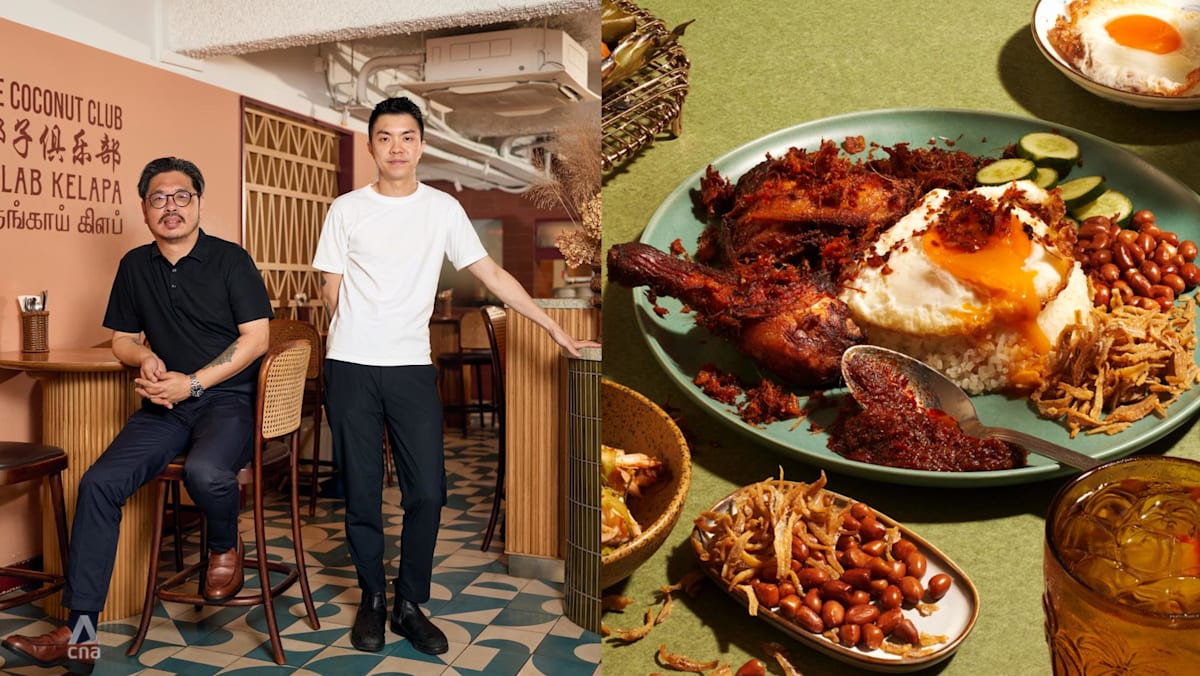
From a cold-press coconut machine developed by an F1 engineer to daily ikan bilis inspections, the restaurant's painstaking approach to Singapore's beloved dish hasn't come cheap. But, as it celebrates a decade in the business, what does its journey tell us about the value of local food?
Chefs Daniel Sia and Marcus Leow of The Coconut Club, which celebrates its 10th anniversary this year. (Photos: CNA/Dillon Tan, The Coconut Club)
This audio is generated by an AI tool.
It’s been 10 years since The Coconut Club first opened its doors serving S$12.80 nasi lemak to a mildly scandalised public.
Managing partner Daniel Sia, who has headed it up for the last five years, recalls that “I myself was skeptical when it first opened. I was like, ‘Seriously? Why is it so expensive?’
“But, when I tried it – I wouldn't say it changed my life, but it did change my perception,” he chuckled. Impressed by the quality of the ingredients, “I said, ‘If you compare this to a similarly-priced product, it's worth the money."
The Coconut Club was co-founded in Singapore in 2016 by Lee Eng Su, who set out to elevate the humble nasi lemak through painstaking attention to ingredients, particularly freshly squeezed coconut milk.
Its original S$12.80 nasi lemak raised eyebrows at a time when the dish was largely associated with inexpensive hawker fare, but the restaurant soon attracted a loyal following and earned Michelin Bib Gourmand recognition.
It helped that, just two months after the opening in October, the restaurant received a high-profile endorsement when then-Prime Minister Lee Hsien Loong hosted then-Philippine president Rodrigo Duterte there over a nasi lemak meal.
The Coconut Club's flagship restaurant at Beach Road. (Photo: The Coconut Club)
Following Eng Su’s untimely death in 2019, the business continued under his brother before being acquired by hospitality group The Lo & Behold Group in 2021. It subsequently moved from its original Ann Siang Hill premises to a larger flagship restaurant on Beach Road in 2022, expanding its menu of locally-inspired dishes while retaining nasi lemak as its signature.
Its expansion continued with a more casual neighbourhood outlet in Siglap in 2023, followed by an all-day dining concept at New Bahru in River Valley in 2024.
The components on the plate have remained the same: jasmine rice infused with coconut; organic chicken marinated for 12 hours in housemade rempah; fried ikan bilis; and spicy-sweet sambal.
All about nasi lemak (Photo: The Coconut Club)
And, yes, there are still people who complain about the pricing, Sia disclosed. A plate of ayam goreng berempah nasi lemak today costs S$22 due to inflation and rising costs.
But, “we’ve created restaurants that people dress up for and choose for a date. We have people bringing their overseas friends. We have people bringing their own wines.” Around the main specialty dish, there’s now a menu of small plates and sharing plates that includes beef cheek rendang, threadfin fish curry, sambal squid and seafood laksa, as well as a cocktail menu that features pandan highballs and masala chai penicillins.
“We even had somebody propose,” Sia shared. The proposal took place when the restaurant was at Ann Siang Hill, and when it moved to Beach Road, the couple booked out the place for their wedding. “And then, a couple of months ago, they came back, with a one-year-old kid.”
The Coconut Club's managing partner Daniel Sia with executive chef Marcus Leow (Photo: CNA/Dillon Tan)
“Coconut Club, when it first opened, really was one of the very first to serve local food in a restaurant kind of setting, with a dish that is found in hawker centres. The brand is one of the early pioneers of championing local Singaporean food, and we really want to take this even further in the next 10 years as well,” Sia said.
What that looks like is “constant improvement on a daily basis, making the nasi lemak better than it was the day before.”
For example, a lot of tweaking has gone into the star of the dish: the rice.
“Initially, there was chicken fat in the rice. Some people are vegetarian, so we took that out, and also, I felt that the chicken fat actually distracted from the coconut flavour. We improved on increasing the coconut flavour while making it lighter. And the sambal – some people said it was too spicy; not sweet enough. We heard the feedback and we worked on it. Most importantly, all the components need to make the coconut rice better, rather than overpower the coconut flavour.”
(Photo: The Coconut Club)
A lot of geekiness has gone into the pursuit of the perfect nasi lemak, according to Sia. There’s the machine, developed by a Formula One engineer, that cold-presses the coconuts so that heat doesn’t affect their flavour. There’s the daily ikan bilis inspection to make sure they are the right size. And, there’s the taking into account the micro-seasons of coconuts, which cooks are trained to taste as the fruits can have a higher water content during rainy seasons.
For a dish like beef rendang, for example, there’s extensive experimentation with different cuts, sourcing and techniques, like steam-baking beef cheek so the meat retains more flavour and a better texture.
“There is a place for hawker food that you eat on a regular basis. There's also a place for restaurants serving local Singaporean food,” Sia opined. “If you compare, it's still a plate of nasi lemak, but in terms of the quality, care and technical skills that we put in, it’s different from what you can get for cheaper.”
Not just nasi lemak (Photo: The Coconut Club)
What makes The Coconut Club’s nasi lemak Singaporean?
“We don't get stuck into, ‘It should be like that’ or ‘it should only be eaten with this or that’,” Sia said. “Singapore is a mashup of different cultures and races. So, it makes a Singaporean version a little bit more exciting because we have different things, like kerabus and curries that can go with the coconut rice”, with the unifying factor being that “everything needs to complement the rice”.
Their upcoming 10th anniversary celebrations will embrace this idea with a series of collaborations including a rotating hawker residency launching Oct 24 with New Station Rice Bar, a capsule collection of merchandise with local apparel label Wacky Wears, a Berempah Birthday Bash on Oct 25 with every item priced at S$10, and a limited-edition pastry box with chef Maira Yeo.
In 10 years, an entire ecosystem of chefs embracing local cuisine has blossomed, and The Coconut Club, which once blazed a trail, isn’t an anomaly any more.
“It's difficult to do it on your own, but, I think, because there are other people championing local Singaporean food as well, it makes the market more aware that local Singaporean food should be preserved and celebrated,” Sia said.
“You know, there was a debate in Parliament about having not enough local brands in the malls. I think people are a bit more aware that we should try and keep that heritage alive in Singapore, rather than just going for the foreign brands and foreign food.”
(Photo: CNA/Dillon Tan)
Looking ahead, the journey of seeing where contemporary interpretations of Singapore cuisine could go continues. In April last year, Sia and chef Marcus Leow, formerly of Magic Square and Naked Finn, opened Belimbing on the floor above The Coconut Club’s Beach Road flagship, with Leow heading Belimbing’s kitchen on top of serving as executive chef for The Coconut Club.
Belimbing’s finer, contemporary interpretations of Singaporean cuisine include dishes like the wagyu with sunchoke abacus seeds and pongteh broth; charcoal-grilled “assam pedas” Taiwanese threadfin with burnt eggplant and razor clam; and mud crab and porcini mushroom XO claypot rice served with crab fat curry that are on its latest menu.
Chicken kerabu (Photo: Belimbing)
Leow enjoys pushing the boundaries of what Singaporean cuisine can be with menus that may not read very Singaporean at first glance, but evoke a sense of familiarity or nostalgia in diners.
As a young chef, “I didn't really think about Singaporean food that much. I thought of other cuisines as more interesting, like French or Spanish,” he said.
Now, he feels it’s crucial for a newer generation of cooks “to understand why our cuisine is so important”. The onus is also on chefs to better communicate to diners “the amount of care, the amount of thought, the amount of work and the finesse that we put in. It doesn't mean that food from foreign cuisines should be more expensive.”
Belimbing's main dining room (Photo: Belimbing)
Elevated local food today “shouldn't just be about putting premium ingredients on the menu and then calling it an elevated version”. Instead, it should be “thinking about what makes like great dishes really good” and refining processes, he asserted.
For example, “in Belimbing’s previous menu, we did something with kedongdong, which people think is just used in a drink or in a sambal. We did it in a sorbet form. It was very nice to see older folks say, ‘I didn't know you could do it like that’.”
In the past, “the attitude towards traditional cuisine was very much ‘if it's not broken, don't fix it’,” Leow observed.
“Now, there are a lot of people in my generation who are exploring Singapore’s cuisine”, probing the idea that “Singaporean cuisine can be forward-looking”.
“It’s obviously changing the perception not only of local diners, but also making Singapore cuisine a hotter destination. I'm really happy that people are much more receptive to Singaporean cuisine now. At Belimbing and The Coconut Club, I don't feel that worried to put out something that's a bit different.
“I think everyone plays a part in pushing the cuisine forward.”
The Coconut Club is at 269 Beach Road, 97 Frankel Avenue and 46 Kim Yam Road, New Bahru 01-14. Belimbing is at 269A Beach Road.
A single handpicked story that we think you shouldn't miss. Just one a day.
从一台由F1工程师研发的冷压椰子机,到每日对江鱼仔的严格检验,这家餐厅对新加坡这道深受喜爱的菜肴精益求精的态度,自然价格不菲。但值此餐厅庆祝开业十周年之际,它的发展历程又能告诉我们本地美食的价值何在呢?
椰子俱乐部(The Coconut Club)今年迎来十周年庆,主厨Daniel Sia和Marcus Leow合影。(图片:CNA/Dillon Tan,椰子俱乐部)
这段音频由人工智能工具生成。
椰子俱乐部开业至今已有 10 年,当时它以 12.80 新元的价格向公众供应椰浆饭,这在当时引起了一些争议。
过去五年一直负责管理这家公司的合伙人丹尼尔·西亚回忆说:“我本人在它刚开业时也持怀疑态度。我当时想,‘真的吗?为什么这么贵?’”
“但是,当我尝试之后——我不会说它改变了我的人生,但它确实改变了我的看法,”他笑着说。他对成分的品质印象深刻,“我说,‘如果把它和价格相近的产品相比,它物有所值。’”
椰子俱乐部由李英苏于 2016 年在新加坡联合创立,他致力于通过对食材,特别是鲜榨椰奶的精益求精,来提升普通的椰浆饭的档次。
这家餐厅最初推出的售价为 12.80 新元的椰浆饭在当时椰浆饭主要与廉价小贩食品联系在一起的情况下引起了人们的关注,但这家餐厅很快就吸引了一批忠实的顾客,并获得了米其林必比登美食推荐的认可。
值得一提的是,这家餐厅在 10 月份开业仅两个月后,就获得了高调的认可,当时的马来西亚总理李显龙在那里款待了当时的菲律宾总统罗德里戈·杜特尔特,并一起享用了椰浆饭。
椰子俱乐部位于海滩路的旗舰餐厅。(图片:椰子俱乐部)
2019 年 Eng Su 不幸去世后,他的兄弟继续经营这家餐厅,直到 2021 年被酒店集团 The Lo & Behold Group 收购。随后,餐厅于 2022 年从安祥山的原址搬迁到海滩路更大的旗舰餐厅,扩大了本地风味菜肴的菜单,同时保留了椰浆饭作为其招牌菜。
其扩张计划继续推进,于 2023 年在 Siglap 开设了一家更休闲的社区门店,随后于 2024 年在 River Valley 的新峇鲁开设了一家全日制餐饮概念店。
盘中的食材保持不变:椰香茉莉米饭;用自制香料腌制 12 小时的有机鸡肉;炸江鱼仔;以及香辣甜酱。
关于椰浆饭的一切(图片:椰子俱乐部)
西亚透露,确实还有人抱怨价格。由于通货膨胀和物价上涨,一份香料炸鸡椰浆饭现在的价格是22新元。
但是,“我们打造的餐厅已经成为人们盛装打扮、约会首选之地。顾客会带海外朋友前来,也会自带酒水。” 除了招牌主菜之外,餐厅现在还提供一系列小食和分享菜,包括牛颊肉仁当、咖喱马鲛鱼、叁巴鱿鱼和海鲜叻沙,以及一份鸡尾酒单,其中包含香兰叶高球和玛萨拉奶茶青霉素鸡尾酒。
“我们甚至还遇到过求婚呢,”Sia分享道。求婚发生在餐厅还在安祥山的时候,后来餐厅搬到了海滩路,这对情侣就包下了整个场地举办婚礼。“然后,几个月前,他们带着一个一岁的孩子又来了。”
椰子俱乐部的管理合伙人Daniel Sia与行政总厨Marcus Leow(图片:CNA/Dillon Tan)
“椰子俱乐部刚开业时,确实是最早一批在餐厅环境中供应本地美食的餐厅之一,菜品常见于小贩中心。该品牌是早期倡导新加坡本地美食的先驱之一,我们希望在未来十年里将这一理念推向新的高度,”Sia说道。
这意味着“每天不断改进,让椰浆饭比前一天更好吃”。
例如,这道菜的主角——米饭——就经过了许多调整。
“最初,米饭里加了鸡油。有些人是素食主义者,所以我们去掉了鸡油。而且,我觉得鸡油确实掩盖了椰子的味道。我们改进了配方,增强了椰子的味道,同时让米饭更清淡。至于叁巴酱——有些人说太辣,不够甜。我们听取了反馈意见并进行了调整。最重要的是,所有配料都应该让椰香米饭更好吃,而不是掩盖椰子的味道。”
(图片来源:椰子俱乐部)
据Sia介绍,为了做出完美的椰浆饭,厨师们投入了大量的心血。比如,他们使用一台由一级方程式赛车工程师研发的机器,对椰子进行冷压,以避免高温影响椰子的风味。他们每天都要检查江鱼仔的大小,确保它们符合标准。此外,他们还要考虑到椰子的微季节变化,厨师们需要通过品尝来判断椰子的含水量,因为雨季的椰子含水量可能更高。
例如,对于牛肉仁当这道菜,人们进行了大量的试验,尝试了不同的部位、来源和烹饪技巧,例如用蒸汽烘烤牛脸肉,这样肉就能保留更多的风味和更好的口感。
“街头小吃有它的地位,可以让你经常光顾。同时,提供新加坡本地美食的餐厅也有它的地位,”Sia说道。“如果比较的话,虽然都是椰浆饭,但我们在品质、用心和烹饪技巧方面投入的精力,与那些价格更低的同类产品截然不同。”
不仅仅是椰浆饭(图片:椰子俱乐部)
是什么让椰子俱乐部的椰浆饭具有新加坡特色?
“我们不会纠结于‘就应该那样吃’或者‘只能配这个或那个吃’,”Sia说道。“新加坡是不同文化和种族的融合之地。所以,新加坡版的椰浆饭更有特色,因为我们有很多不同的菜肴,比如咖喱饭和咖喱,都可以搭配椰浆饭。”而它们的共同点在于“所有食物都必须与米饭相得益彰”。
他们即将迎来 10 周年庆典,并将通过一系列合作来体现这一理念,包括 10 月 24 日与 New Station Rice Bar 合作推出的轮换小贩驻场活动,与本地服装品牌 Wacky Wears 合作推出的胶囊系列商品,10 月 25 日举行的 Berempah 生日派对(每件商品售价 10 新元),以及与厨师 Maira Yeo 合作推出的限量版糕点盒。
10 年来,一个由厨师组成的、拥抱本地美食的生态系统蓬勃发展起来,而曾经引领潮流的椰子俱乐部也不再是异类了。
“单凭一己之力很难做到,但我认为,正因为有其他人也在倡导新加坡本地美食,这才能让市场更加意识到应该保护和推广新加坡本地美食,”Sia说道。
“你知道,国会曾就购物中心本土品牌数量不足的问题进行过辩论。我认为人们现在更加意识到,我们应该努力在新加坡保留本土文化遗产,而不是一味追求外国品牌和外国食品。”
(图片:CNA/Dillon Tan)
展望未来,探索新加坡当代美食发展方向的旅程仍在继续。去年四月,Sia 与曾任职于 Magic Square 和 Naked Finn 的主厨 Marcus Leow 在 The Coconut Club 位于 Beach Road 的旗舰店楼上开设了 Belimbing 餐厅。Leow 除了担任 The Coconut Club 的行政主厨外,还负责 Belimbing 的厨房运营。
Belimbing 对新加坡美食的更精致、更现代的诠释包括:和牛配菊芋算盘籽和娘惹汤;炭烤“assam pedas”台湾丝鳍鱼配烤茄子和蛏子;以及泥蟹和牛肝菌 XO 砂锅饭配蟹油咖喱,这些都是其最新菜单上的菜品。
喀拉布鸡(照片:Belimbing)
Leow 喜欢突破新加坡菜的界限,他的菜单乍一看可能不太像新加坡菜,但却能唤起食客的熟悉感或怀旧之情。
他说,作为一名年轻厨师,“我并没有过多考虑新加坡菜。我觉得其他菜系更有趣,比如法国菜或西班牙菜。”
如今,他认为新一代厨师“理解我们菜肴为何如此重要”至关重要。厨师们也有责任更好地向食客传达“我们投入的心血、思考、努力和精湛技艺。但这并不意味着外国菜系就应该更贵。”
贝林宾的主餐厅(照片:贝林宾)
他强调,如今的高档本地美食“不应该只是把优质食材摆上菜单,然后就称之为高档版本”。相反,它应该“思考是什么让那些美味佳肴真正变得美味”,并改进烹饪工艺。
例如,“在Belimbing之前的菜单中,我们用到了木瓜,人们通常认为木瓜只能用来做饮料或叁巴酱。但我们把它做成了冰沙。看到一些年纪大的人说,‘我不知道木瓜还能这样吃’,感觉非常好。”
廖先生观察到,过去“人们对传统美食的态度很大程度上是‘如果没坏,就别修’”。
“现在,我们这一代人中有很多都在探索新加坡美食”,这体现了“新加坡美食可以具有前瞻性”的观点。
“这显然不仅改变了本地食客的看法,也让新加坡美食成为更热门的旅游目的地。我很高兴现在人们对新加坡美食的接受度更高了。在Belimbing和The Coconut Club,我并不担心推出一些与众不同的菜品。”
“我认为每个人都为推动美食发展贡献了自己的力量。”
椰子俱乐部位于新巴鲁海滩路 269 号、弗兰克尔大道 97 号和金炎路 46 号,邮编 01-14。Belimbing 位于海滩路 269A 号。
每天一篇,我们精心挑选一篇您不容错过的精彩故事。