Are two free N95 masks enough? What to know about wearing and reusing them amid the haze两个免费的N95口罩够用吗?在雾霾天气下,佩戴和重复使用N95口罩需要了解哪些信息?
Two N95 masks may be enough for a week for someone who wears them only for short commutes, but those who spend several hours outdoors may need to replace them more often, says an NUS public health expert.
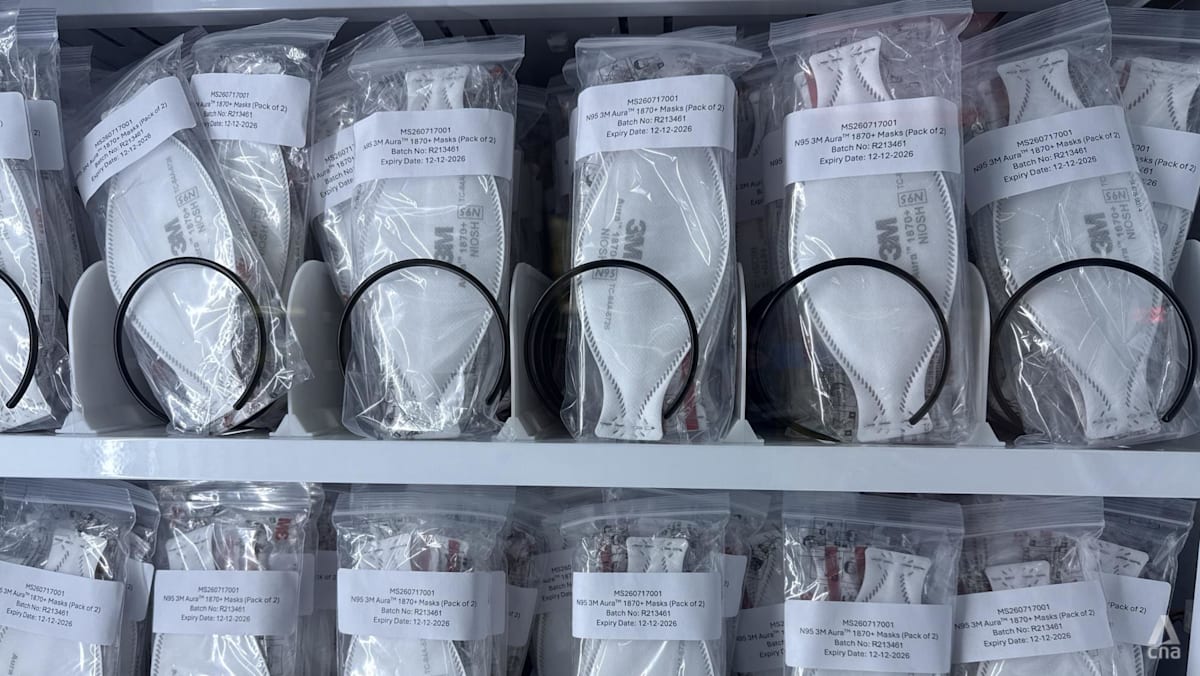
Two N95 masks may be enough for a week for someone who wears them only for short commutes, but those who spend several hours outdoors may need to replace them more often, says an NUS public health expert.
A vending machine holding 500 masks set up at Clementi Bus Interchange on Oct 14, 2026. (Photo: CNA/Charmaine Jacob)
This audio is generated by an AI tool.
SINGAPORE: If you've collected your two free N95 masks to protect yourself from the haze, how long can you use them before they need to be replaced?
The answer depends on how often you wear them, how long you spend outdoors and whether the masks remain in good condition, an expert said.
Free N95 masks are being distributed to eligible Singaporeans after a sharp rise in PM2.5 levels on Wednesday (Oct 14) , with air quality deteriorating further in parts of Singapore on Friday.
Here's what you need to know about making the most of your masks, including when to wear them and how to store them between uses.
ARE TWO N95 MASKS ENOUGH?
That depends on how frequently and for how long they are worn, as well as how well they are maintained, said Associate Professor Miranda Loh from the NUS Saw Swee Hock School of Public Health.
"For someone who only wears a mask for short commutes and takes care to keep it clean and in good shape, two masks may be sufficient for a week," she said.
“However, someone who spends several hours outdoors each day would likely need to replace their masks more frequently.”
Prolonged use can cause moisture and dirt to build up, while repeated handling can affect a mask's shape and fit.
"Rather than focusing on a fixed number of days, I would encourage people to pay attention to the condition and fit of their masks and replace them when necessary," Assoc Prof Loh said.
HOW LONG CAN AN N95 MASK LAST, AND CAN IT BE REUSED?
N95 masks can be reused, but there is no fixed number of hours or uses for which they remain effective, said Assoc Prof Loh.
Their lifespan depends on how frequently they are worn and whether they remain in good condition.
For someone who wears a mask only during a short commute, reusing it the following day may be reasonable, provided it has been stored properly and remains clean, dry and undamaged.
But masks should be replaced if they become deformed, torn, dirty or damp, or if they no longer fit snugly against the face.
A poor fit can allow polluted air to enter through gaps around the edges, reducing the mask's effectiveness.
"Over time, moisture from our breath can accumulate in the mask, particularly with prolonged use. I would therefore recommend replacing masks regularly, especially if they are worn for extended periods," Assoc Prof Loh said.
She also advised users to check the fit each time they put on a mask, ensuring there are no gaps around the edges.
HOW SHOULD YOU STORE A USED N95 MASK?
Proper storage can help preserve a mask's condition if it is to be reused.
Assoc Prof Loh advised keeping masks clean and dry, in a place where they will not be crushed or bent out of shape.
A clean paper bag or a container that allows the mask to retain its shape can be suitable.
If a mask becomes damp after use, it should be allowed to dry before being stored to reduce the risk of microbial growth.
Users should also avoid unnecessarily touching the inside of the mask, handling it by its straps as much as possible to keep it clean.
WHEN SHOULD YOU WEAR AN N95 MASK?
Not everyone needs to wear an N95 mask whenever haze conditions worsen.
According to the Ministry of Health's (MOH) haze advisory, healthy people generally do not need N95 masks during their commutes or when indoors.
When the 1-hour PM2.5 reading is in the very high band, healthy individuals should minimise all outdoor activity. Those who need to be outdoors may wear a well-fitting N95 mask to reduce their exposure.
Vulnerable groups, including the elderly, pregnant women and those with chronic heart or lung disease, should avoid outdoor activity when the 1-hour PM2.5 reading is in the high band. If they must go outdoors, they may consider wearing an N95 mask.
Assoc Prof Loh said the decision should take into account a person's health, how long they expect to be outdoors, the intensity of their physical activity and prevailing air quality.
Wearing an N95 mask is generally a "reasonable precaution" when the PSI is in the unhealthy range, particularly for those spending extended periods outdoors, she said.
“I would especially encourage people who are more vulnerable to the effects of air pollution, such as those with asthma or other respiratory or cardiovascular conditions, to consider wearing an N95 mask if they can tolerate it,” she added.
However, the masks can be uncomfortable when worn for long periods, and some people may find it difficult to breathe through them.
Assoc Prof Loh said that vulnerable people should prioritise minimising their exposure by staying indoors as much as possible and reducing outdoor physical activity. A well-fitting N95 mask could provide additional protection when going outdoors is unavoidable.
WHAT IF YOU DON'T HAVE AIR-CON OR AN AIR PURIFIER?
For those without access to air-conditioning or air purifiers, there are still practical steps they can take to reduce their exposure to haze.
Professor Rajasekhar Balasubramanian, NUS Keppel Professor in Sustainability Solutions at the College of Design and Engineering, suggested using fans to improve air movement indoors.
In "extreme cases", wearing a face mask at home was "not a bad idea", he said.
"Of course, we cannot sleep with a face mask on, so some form of ventilation would be very helpful," he added.
Separately, the National Environment Agency (NEA) advises households to close doors and windows when outdoor air quality worsens to slow the entry of haze particles, and to reopen them when conditions improve.
It also recommends reducing indoor sources of pollution, such as cigarette smoke and candles, and using wet-cleaning methods such as mopping or wiping to remove settled dust.
Air-conditioned haze shelters have also been set up at community clubs and selected Residents' Committee and Residents' Network centres.
Get our pick of top stories and thought-provoking articles in your inbox
Stay updated with notifications for breaking news and our best stories
Join our channel for the top reads for the day on your preferred chat app
新加坡国立大学一位公共卫生专家表示,对于只在短途通勤时佩戴口罩的人来说,两个 N95 口罩可能足够使用一周,但那些在户外待上几个小时的人可能需要更频繁地更换口罩。
2026年10月14日,金文泰巴士转换站设置了一台装有500个口罩的自动售货机。(图片:CNA/Charmaine Jacob)
这段音频由人工智能工具生成。
新加坡:如果您领取了两个免费的N95口罩来保护自己免受雾霾侵害,那么在需要更换之前,您可以使用它们多长时间?
专家表示,答案取决于你佩戴口罩的频率、你在户外停留的时间以及口罩是否保持良好状态。
周三(10 月 14 日)PM2.5 浓度急剧上升后,新加坡政府向符合条件的新加坡公民免费发放 N95 口罩,周五新加坡部分地区的空气质量进一步恶化。
以下是关于如何充分利用口罩你需要了解的信息,包括何时佩戴口罩以及如何在两次使用之间存放口罩。
两个N95口罩够用吗?
新加坡国立大学苏瑞福公共卫生学院副教授罗美兰表示,这取决于佩戴的频率和时长,以及保养情况。
“对于只在短途通勤时佩戴口罩,并且注意保持口罩清洁完好的人来说,两个口罩可能就足够用一周了,”她说。
“但是,每天在户外待上几个小时的人可能需要更频繁地更换口罩。”
长时间使用会导致水分和污垢积聚,反复触摸会影响口罩的形状和贴合度。
“与其关注固定的天数,我更鼓励人们注意口罩的状况和贴合度,并在必要时更换口罩,”罗副教授说。
N95口罩可以使用多久,可以重复使用吗?
罗副教授表示,N95口罩可以重复使用,但没有固定的使用时长或次数限制,因此无法保证其有效性。
它们的寿命取决于佩戴频率和是否保持良好状态。
对于只在短途通勤时佩戴口罩的人来说,如果口罩存放得当,保持清洁、干燥且无损坏,那么第二天重复使用口罩可能是合理的。
但如果口罩变形、破损、脏污或潮湿,或者不再紧贴面部,则应更换口罩。
口罩佩戴不当会导致污染空气从边缘缝隙进入,降低口罩的防护效果。
“随着时间的推移,呼吸产生的水汽会在口罩内积聚,尤其是在长时间佩戴的情况下。因此,我建议定期更换口罩,特别是如果长时间佩戴的话。”罗副教授说。
她还建议用户每次佩戴口罩时都要检查贴合度,确保边缘没有缝隙。
用过的N95口罩应该如何存放?
妥善存放有助于保持口罩的良好状态,以便重复使用。
罗副教授建议保持口罩清洁干燥,并放置在不会被挤压或变形的地方。
干净的纸袋或能让口罩保持形状的容器都可以。
如果口罩使用后受潮,应先晾干再存放,以降低微生物滋生的风险。
用户还应避免不必要地触摸口罩内侧,尽可能通过系带操作口罩,以保持口罩清洁。
什么情况下应该佩戴N95口罩?
并非雾霾加剧时,每个人都需要佩戴N95口罩。
根据卫生部发布的雾霾预警,健康人群在通勤途中或室内一般不需要佩戴 N95 口罩。
当1小时PM2.5浓度处于极高水平时,健康人群应尽量减少所有户外活动。必须外出的人员可以佩戴贴合良好的N95口罩以减少暴露。
老年人、孕妇以及患有慢性心脏病或肺病的人群等易感人群,在PM2.5一小时浓度处于高值区间时,应避免户外活动。如果必须外出,可考虑佩戴N95口罩。
罗副教授表示,这项决定应该考虑到一个人的健康状况、预计在户外停留的时间、体育活动的强度以及当时的空气质量。
她表示,当 PSI 值处于不健康范围时,佩戴 N95 口罩通常是一种“合理的预防措施”,特别是对于那些长时间在户外活动的人来说。
她补充说:“我尤其鼓励那些更容易受到空气污染影响的人,例如患有哮喘或其他呼吸系统或心血管疾病的人,如果可以耐受的话,考虑佩戴 N95 口罩。”
但是,长时间佩戴口罩可能会感到不舒服,有些人可能会觉得戴着口罩呼吸困难。
罗副教授表示,易感人群应优先考虑尽可能待在室内,减少户外活动,以降低感染风险。如果必须外出,佩戴合适的N95口罩可以提供额外的防护。
如果你没有空调或空气净化器怎么办?
对于那些无法使用空调或空气净化器的人来说,他们仍然可以采取一些切实可行的措施来减少接触雾霾。
新加坡国立大学设计与工程学院可持续发展解决方案吉宝讲席教授 Rajasekhar Balasubramanian 建议使用风扇来改善室内空气流通。
他说,在“极端情况下”,在家戴口罩“也不失为一个好主意”。
“当然,我们不能戴着面罩睡觉,所以某种形式的通风会很有帮助,”他补充道。
另外,国家环境局 (NEA) 建议居民在室外空气质量恶化时关闭门窗,以减缓雾霾颗粒的进入,并在情况好转时重新打开门窗。
它还建议减少室内污染源,例如香烟烟雾和蜡烛,并使用湿式清洁方法(例如拖地或擦拭)去除沉积的灰尘。
社区俱乐部和部分居民委员会及居民网络中心也设立了带空调的雾霾避难所。
订阅我们的邮件,即可获取精选热点新闻和引人深思的文章。
订阅通知,第一时间获取突发新闻和精彩报道。
加入我们的频道,即可在您常用的聊天应用上获取当日热门文章。