NATO allies ready sea drones for the task of repelling enemy warships北约盟国准备部署海上无人机,用于击退敌方军舰。
A key exercise next year will focus on the feasibility of using unmanned vessels to enforce a security perimeter at sea.
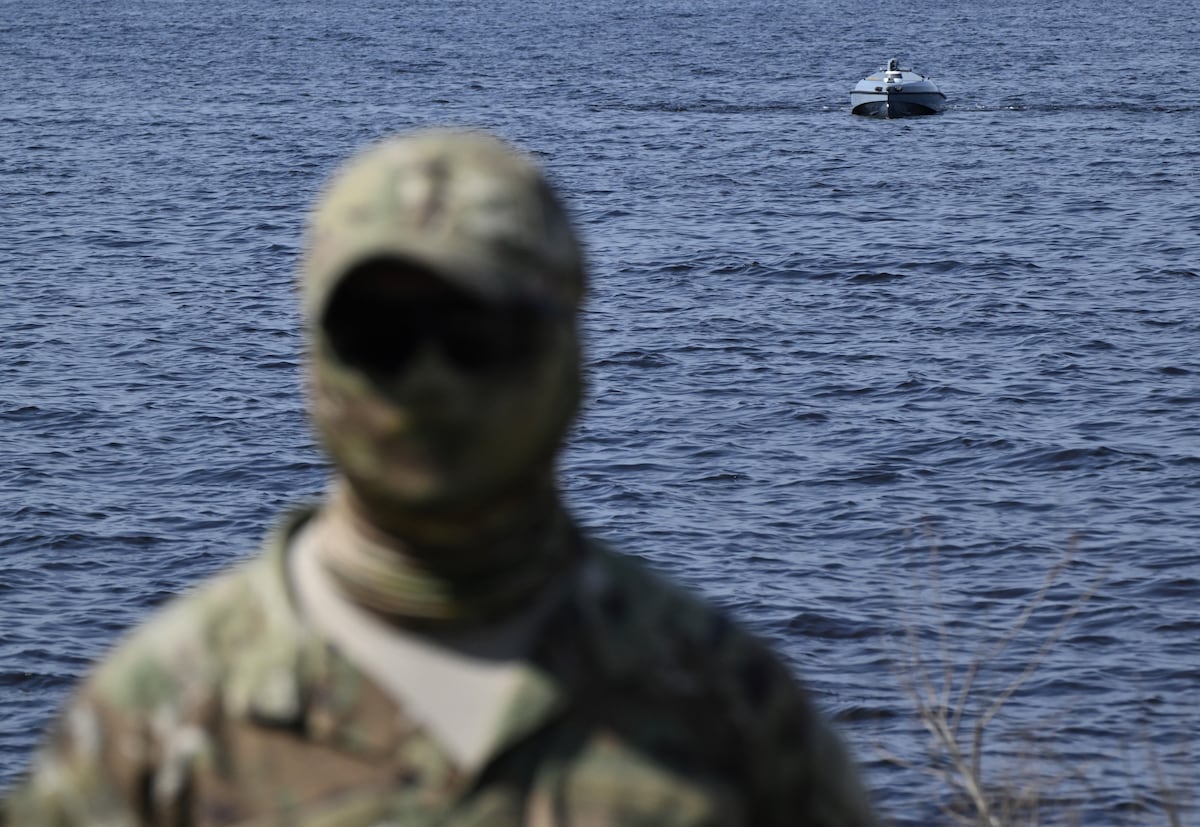
PARIS — A number of NATO countries are pursuing new naval concepts based on sea drones programmed to keep adversaries out of allied waters, a nod to Ukraine’s pursuits with such weapons against Russian ships.
The alliance nations belong to the so-called Joint Capability Group for Maritime Unmanned Systems, or JCGMUS. The group, created following the 2018 NATO summit in Brussels, comprises more than a dozen nations considered full members, partners or observers.
Every September, member countries stage one of the largest experimentation exercises with naval unmanned systems – the drill is abbreviated REPMUS – in concert with the Portuguese Navy to help accelerate drone technology testing and interoperability among allies.
Next year, the emphasis will fall on using unmanned systems to keep adversary forces at a distance, a new tack for the group.
“The roadmap of REPMUS will focus in 2025 on non-traditional sea denial – that is limiting an adversary’s maritime freedom of action, including through anti-access, area denial and disruptive and dispersible capabilities, based in part on of what we’ve seen in Ukraine,” Craig Sawyer, chair of JCGMUS said during a panel discussion at the Euronaval defense exhibition here on Nov. 5.
One of the elements that allowed the Ukrainian Navy to create an anti-access perimeter was the deployment of different types of unmanned surface vessels, which in some cases drove straight into Russian vessels at sea or in port to neutralize them.
The NATO official also added that one of the ambitions for next year’s drill will be to deliver an anti-submarine warfare barrier project demonstrator, an initiative established in 2020 and led by the United Kingdom.
“The ASW barrier seeks to develop a technical demonstrator comprising both legacy and interoperable maritime uncrewed systems to securely provide a force multiplying anti-submarine warfare capability,” Sawyer said during his presentation.
The project involves 12 other countries, including Italy, Canada, France, Germany, Spain, the U.S., Portugal, Denmark, the Netherlands, Norway, Sweden and Australia.
The widespread use of drones seen in Ukraine across all domains has spurred greater investments in these technologies, with many countries having launched national tenders to acquire new platforms.
While procuring more unmanned assets is a necessity for many nations, Sawyer warned of the risk of tackling them alone.
“The need for standards and interoperability becomes critical when you realize the mass and scale UxS [unmanned systems] represent – we will never be able to manage thousands of assets as individual cases and programs,” he said.
Elisabeth Gosselin-Malo was a Europe correspondent for Defense News. She covers a wide range of topics related to military procurement and international security, and specializes in reporting on the aviation sector. She is based in Milan, Italy.
巴黎——一些北约国家正在研发基于海上无人艇的新型海军概念,旨在阻止敌方进入盟军水域,这呼应了乌克兰利用此类武器对抗俄罗斯舰船的做法。
这些联盟国家隶属于所谓的“海上无人系统联合能力小组”(JCGMUS)。该小组是在2018年布鲁塞尔北约峰会后成立的,由十几个国家组成,这些国家被视为正式成员、伙伴或观察员。
每年九月,成员国都会与葡萄牙海军联合举行规模最大的海军无人系统试验演习之一——该演习简称 REPMUS——以帮助加快盟友之间的无人机技术测试和互操作性。
明年,重点将放在使用无人系统与敌军保持距离上,这对该组织来说是一种新的策略。
“REPMUS 的路线图将在 2025 年重点关注非传统海上拒止——即限制对手的海上行动自由,包括通过反介入、区域拒止以及破坏性和可分散能力,部分依据是我们在乌克兰看到的情况,”美国联合海上军事指挥与发展司令部 (JCGMUS) 主席克雷格·索耶 (Craig Sawyer) 在 11 月 5 日于此地举行的欧洲海军防务展的小组讨论中表示。
乌克兰海军能够建立反介入/区域隔离圈的要素之一是部署不同类型的无人水面舰艇,在某些情况下,这些舰艇直接驶向海上或港口的俄罗斯舰艇,以使其失去战斗力。
这位北约官员还补充说,明年演习的目标之一是交付反潜战屏障项目演示样机,这是一项于 2020 年启动、由英国牵头的倡议。
索耶在演讲中表示:“反潜屏障旨在开发一种技术演示器,该演示器包含传统和可互操作的海上无人系统,以安全地提供倍增反潜作战能力。”
该项目还涉及其他 12 个国家,包括意大利、加拿大、法国、德国、西班牙、美国、葡萄牙、丹麦、荷兰、挪威、瑞典和澳大利亚。
乌克兰在各个领域广泛使用无人机,刺激了对这些技术的更大投资,许多国家已经启动国家招标来采购新的平台。
虽然对许多国家来说,采购更多无人资产是必要的,但索耶警告说,单凭一己之力应对这些问题存在风险。
他说:“当你意识到无人系统(UxS)所代表的规模和数量时,标准和互操作性的需求就变得至关重要——我们永远无法将成千上万的资产作为单独的案例和项目来管理。”
伊丽莎白·戈斯林-马洛曾任《防务新闻》欧洲通讯员。她的报道涵盖军事采购和国际安全等广泛领域,尤其擅长航空领域的报道。她常驻意大利米兰。