French, German defense leaders urge European unity after Trump win法国和德国国防领导人在特朗普胜选后呼吁欧洲团结
The call for unity and increased defense spending comes at a tenuous time for both nations.
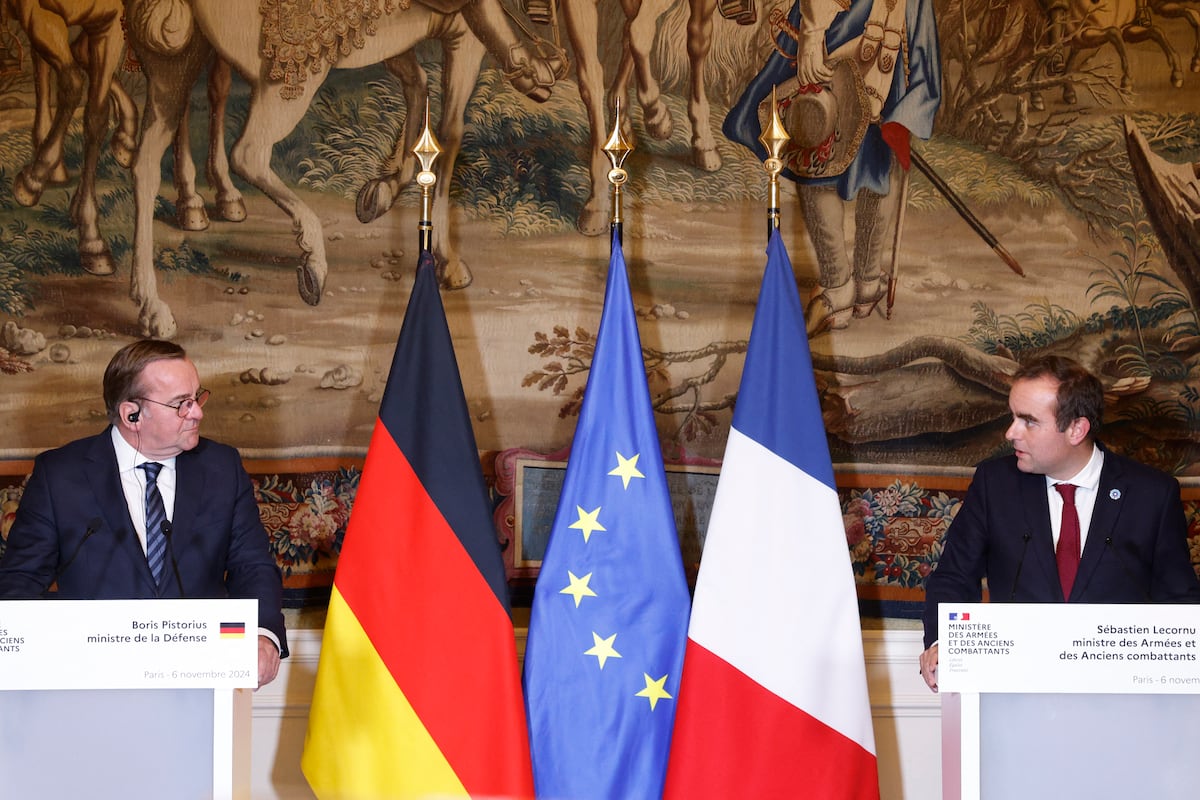
PARIS — France and Germany emphasized the need to keep up military spending and for unity on European security, including with the U.K., following a meeting between the two countries’ defense ministers in response to Donald Trump’s victory in the 2024 U.S. presidential election.
NATO members need to translate defense spending into a tangible contribution in the coming years, with troops, ships and aircraft that show their citizens the alliance is a military organization, not just a political one, French Armed Forces Minister Sébastien Lecornu said in a press briefing with German Defense Minister Boris Pistorius, after they met in Paris on Wednesday.
During his first term, Trump regularly slammed European countries for not spending enough on defense, saying they were taking advantage of U.S. military power. At a campaign rally in February, the former president said he would encourage Russia to “do whatever they hell they want” to NATO members that didn’t meet their financial obligations to the alliance.
“The question of multilateralism is at stake, the question of how we as Europeans position ourselves in this world order,” Pistorius said. “We have to close ranks in order to be able to fully develop our strength. In the future, this will be even more important than in the past.”
Germany and France have a significant contribution to make on defense, as the European Union’s largest economies, but Poland also has a central role to play as NATO’s largest country in Eastern Europe, Pistorius said. The U.K and Italy should also be part of defense cooperation, and the German minister said he and Lecornu will invite their counterparts from Warsaw, London and Rome for a meeting of the five countries in Berlin within the next two weeks.
The U.S. will remain an important partner – “it can’t be any different” – Pistorius said. The EU and the U.S. have shared interests, and geopolitical challenges such as upholding international law, guaranteeing free trade, security of the seas and freedom of movement can only be tackled by the NATO partners sticking together, according to the minister.
The call for unity comes at a tenuous time for both nations. France held snap elections this year that resulted in a parliament without any majority, and a government without a clear mandate that nevertheless has announced billions of spending cuts to reign in a galloping budget deficit.
Lecornu emphasized the need for France to pursue its 2024-2030 defense spending plan regardless of the country’s domestic difficulties.
In the German capital, as Pistorius was speaking in Paris, the governing coalition collapsed, with social-democratic Chancellor Olaf Scholz pushing to oust Finance Minister Christian Lindner of the Free Liberals. Differences had come to a head within the three-party coalition over Lindner’s resistance against emergency spending on everything from energy price caps to Ukraine assistance, Scholz said in statement Wednesday evening.
The incoming U.S. President has been skeptical about continuing to support Ukraine as it fights off a Russian invasion, and European leaders and defense analysts are worried about how to avoid a Ukrainian defeat should Trump decide to cut aid to the embattled nation.
The war waged by Russian President Vladimir Putin in Ukraine makes clear that Europe can’t afford to have any defense capability gaps, according to Pistorius. Ukraine will continue to need the support of European nations, with the military situation “anything but promising at the moment,” the German minister said.
Trump’s anticipated victory creates “considerable uncertainty” for both Ukraine and its international partners, said Matthew Savill, military sciences director at the U.K.’s Royal United Services Institute, in an emailed comment. Europe and NATO should consider whether they can do more for Ukraine, as Trump’s desire for a peace deal “does not bode well for sustained U.S. support.”
NATO will have to focus on keeping the alliance together, rather than on the growing threat of Russia, said Ed Arnold, RUSI’s senior research fellow for European security. If neither NATO or the EU can step up quickly to continue support for Ukraine, “then European coalitions of the willing must step up, requiring bold leadership which has been lacking for several years,” Arnold said.
Europe has to be able to do more to defend itself, as well as protect its defense industries, Lecornu said. He said the first necessity, “and this will come as no surprise, is to continue re-arming.”
Sebastian Sprenger in Cologne, Germany, contributed to this report.
Rudy Ruitenberg is a Europe correspondent for Defense News. He started his career at Bloomberg News and has experience reporting on technology, commodity markets and politics.
巴黎——在唐纳德·特朗普赢得2024年美国总统大选后,法国和德国国防部长举行会晤,会晤中,两国强调需要继续维持军费开支,并在欧洲安全问题上保持团结,包括与英国保持团结。
法国武装部队部长塞巴斯蒂安·勒科尔努周三在巴黎与德国国防部长鲍里斯·皮斯托里乌斯会晤后举行的新闻发布会上表示,北约成员国需要在未来几年将国防开支转化为切实的贡献,部署军队、舰艇和飞机,向其公民表明北约是一个军事组织,而不仅仅是一个政治组织。
在第一任期内,特朗普经常抨击欧洲国家国防开支不足,称它们在利用美国的军事实力。今年2月的一次竞选集会上,这位前总统表示,他将鼓励俄罗斯对那些不履行北约财政义务的成员国“为所欲为”。
皮斯托瑞斯表示:“多边主义问题岌岌可危,我们欧洲人如何在这个世界秩序中定位自身也至关重要。我们必须团结一致,才能充分发挥自身实力。未来,这一点将比以往任何时候都更加重要。”
皮斯托里乌斯表示,作为欧盟最大的两个经济体,德国和法国在国防领域可以做出重大贡献,而波兰作为北约在东欧最大的成员国,也应发挥核心作用。他还表示,英国和意大利也应参与国防合作。这位德国部长说,他和莱科尔努将在未来两周内邀请华沙、伦敦和罗马的对口官员在柏林举行五国会议。
皮斯托里乌斯表示,美国仍将是重要的合作伙伴——“这一点毋庸置疑”。他指出,欧盟和美国拥有共同利益,而维护国际法、保障自由贸易、海上安全和人员自由流动等地缘政治挑战,只有北约伙伴国团结一致才能应对。
两国此刻都处于岌岌可危的境地,此时呼吁团结显得尤为重要。法国今年提前举行大选,结果产生了一个没有多数席位的议会,以及一个缺乏明确民意授权的政府,尽管如此,政府还是宣布削减数十亿欧元的开支,以遏制不断飙升的预算赤字。
勒科尔努强调,无论法国国内面临何种困难,法国都必须继续执行其 2024-2030 年国防开支计划。
在皮斯托瑞斯于巴黎发表讲话的同时,德国首都柏林的执政联盟宣告瓦解。社会民主党总理奥拉夫·朔尔茨力主罢免自由党财政部长克里斯蒂安·林德纳。朔尔茨在周三晚间的一份声明中表示,三党执政联盟内部的分歧最终激化,林德纳反对在包括能源价格上限和乌克兰援助在内的所有领域进行紧急支出。
即将上任的美国总统对继续支持乌克兰抵御俄罗斯入侵持怀疑态度,欧洲领导人和国防分析人士担心,如果特朗普决定削减对这个陷入困境的国家的援助,该如何避免乌克兰战败。
皮斯托里乌斯表示,俄罗斯总统普京在乌克兰发动的战争清楚地表明,欧洲不能承受任何国防能力上的缺口。这位德国部长说,乌克兰将继续需要欧洲国家的支持,因为目前的军事形势“远非乐观”。
英国皇家联合军种研究所军事科学主任马修·萨维尔在一封电子邮件评论中表示,特朗普的预期胜利给乌克兰及其国际伙伴都带来了“相当大的不确定性”。他认为,鉴于特朗普渴望达成和平协议,“这对美国持续支持乌克兰而言并非好兆头”,欧洲和北约应该考虑是否能为乌克兰提供更多帮助。
皇家联合军种研究所(RUSI)欧洲安全高级研究员埃德·阿诺德表示,北约必须将重点放在维护联盟团结上,而不是应对俄罗斯日益增长的威胁。阿诺德说,如果北约和欧盟都不能迅速加大力度继续支持乌克兰,“那么欧洲的自愿联盟就必须挺身而出,这就需要多年来一直缺失的果断领导力。”
莱科尔努表示,欧洲必须增强自身防御能力,并保护其国防工业。他指出,首要任务是“继续进行军备竞赛,这一点不足为奇”。
德国科隆的塞巴斯蒂安·斯普伦格对本报道亦有贡献。
鲁迪·鲁伊滕贝格是《防务新闻》的欧洲记者。他的职业生涯始于彭博新闻社,拥有报道科技、大宗商品市场和政治方面的经验。