Malaysia unveils six homegrown chips worth RM300m as it shifts from making to designing semiconductors马来西亚推出六款价值3亿令吉的本土芯片,标志着该国从半导体制造转向半导体设计。
KUALA LUMPUR, Oct 16 — Malaysia today unveiled six homegrown semiconductor innovations with an estimated combined sales potential of RM300 million, as the government seeks to...
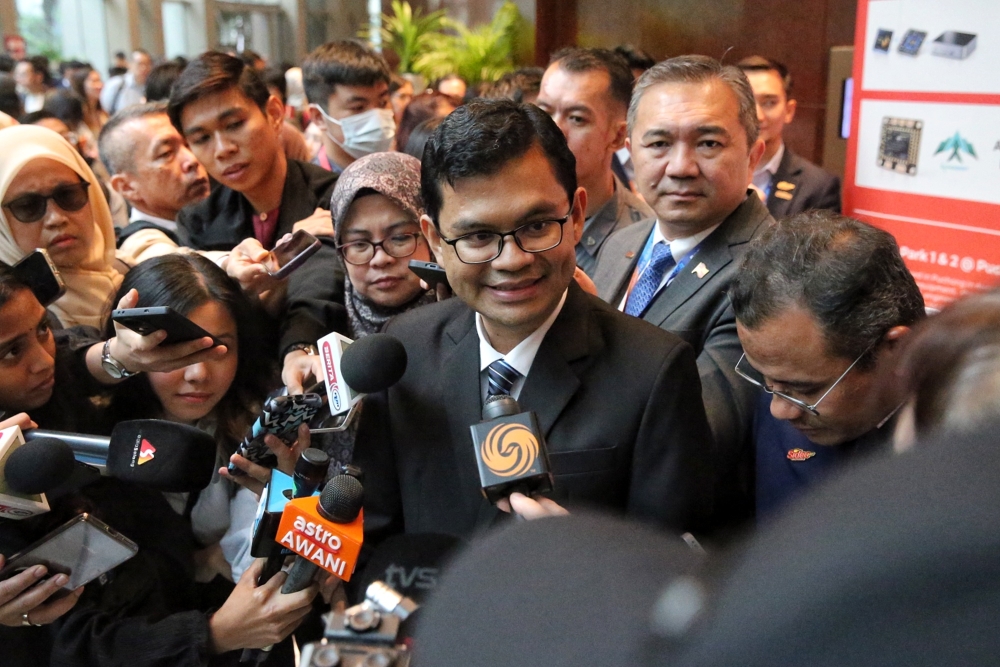
Malaysia has unveiled six homegrown semiconductor innovations with a sales potential of RM300 million, aiming to advance beyond chip manufacturing into technology design and ownership.
Economy Minister Akmal Nasrullah Nasir emphasized the need for customer adoption and industry qualification to commercially succeed, acknowledging the role of national and state coordination in strengthening the country's semiconductor ecosystem.
The government is focusing on talent development, partnership collaborations, and market expansion as part of its National Semiconductor Strategy, aspiring to train 60,000 engineers and support semiconductor startups.
KUALA LUMPUR, Oct 16 — Malaysia today unveiled six homegrown semiconductor innovations with an estimated combined sales potential of RM300 million, as the government seeks to move the country beyond chip manufacturing into designing and owning its own technology.
Economy Minister Akmal Nasrullah Nasir said the six innovations demonstrated the growing capabilities of Malaysian companies, although further work was needed to secure customers, meet industry qualification requirements and turn the designs into commercially successful products.
“The next milestone is to secure customer adoption, meet industry qualification requirements and scale these innovations into successful commercial products,” he said in his speech at the launch of the six chips at the Grand Hyatt here.
The innovations were developed by companies operating within the Malaysia Semiconductor IC Design Park, with applications ranging from artificial intelligence (AI) and automotive electronics to satellites and autonomous drones.
SkyeChip’s MARS1000 is an edge-AI processor intended for use in cameras, robots and factory systems, while MaiStorage’s aiDAPTIV+ provides storage solutions for AI personal computers and servers.
SiliconX unveiled what was described as Malaysia’s and Southeast Asia’s first homegrown field-programmable gate array (FPGA), a reprogrammable semiconductor device designed for industrial and automotive applications.
The other innovations are Infinecs’ Maxwell, an automotive-grade power regulator for vehicle electronics; Weeroc Space’s power controller chip for satellites and other space systems; and Alphaswift’s FC Mini flight controller for autonomous drones.
Akmal said Malaysia was building on its established strengths in semiconductor packaging, testing and related manufacturing activities, while expanding into integrated circuit (IC) design through partnerships, talent development and investment.
“Over the past decade, we have proven our expertise in testing, documentation and packaging. At the same time, looking at those strengths, Malaysia has embarked on collaboration with Arm Limited, for example, to gain access to IP design,” he told reporters after the event.
He said the government was also investing in talent development and working with industry partners to complete the semiconductor ecosystem, adding that turning the six designs into viable products would be a long journey.
Malaysia’s National Semiconductor Strategy aims to train and upskill 60,000 engineers, while the Arm On-Demand Training programme targets 10,000 Malaysian talents in specialised IC design skills over four years.
Akmal said the government also needed to develop markets for locally designed chips so that Malaysian products could attract more customers and encourage further investment in the industry.
“The effort is not just to create, but also to continue to build up markets so that what we produce will continue to open up space for additional companies to be interested in our chips,” he said.
Selangor Menteri Besar Datuk Seri Amirudin Shari said the two Malaysia Semiconductor IC Design Parks in Puchong and Cyberjaya housed 407 engineers across 20 companies, including Malaysian firms and international partners from Taiwan, France, Japan and Australia.
The Puchong park, which opened in August 2024, was almost full, while the Cyberjaya facility, launched in November 2025, was preparing to expand from one occupied floor to three, he said.
Amirudin said the development of local chip-design capabilities depended on bringing together talent, technology and capital.
He cited the Advanced Semiconductor Academy of Malaysia, which has trained around 850 engineers in collaboration with more than 100 universities, and the Ehsan Semiconductor Fund, which aims to raise RM100 million to invest in early-stage semiconductor start-ups and AI application companies.
Akmal also said federal and state governments needed to coordinate their efforts to strengthen Malaysia’s overall semiconductor ecosystem, rather than view investments in different states as competing initiatives.
Responding to a question about Sarawak’s recent unveiling of a locally designed gallium nitride chip, he said each state could contribute different strengths and expertise to the industry.
“For us as a small country, definitely we need to rely on each other’s strengths,” he said, adding that investments in individual states could create value nationally if supported by better coordination.
“We need to further coordinate so that everyone will actually amplify our strength as a nation.”
Children’s Court closes case of five teenage girls accused of verbally abusing Zara Qairina, submissions set for Nov 16
‘Until he retracts, go away’: Tuanku Muhriz rebukes Negeri Sembilan MB in public
Heavy downpour triggers flash floods across Kuching, roads and Sarawak Plaza basement swamped
马来西亚推出了六项本土半导体创新技术,销售潜力达 3 亿令吉,旨在超越芯片制造,迈向技术设计和所有权领域。
经济部长阿克马尔·纳斯鲁拉·纳西尔强调了客户接受度和行业资质认证对于商业成功的重要性,并承认国家和州级协调在加强该国半导体生态系统方面发挥的作用。
作为其国家半导体战略的一部分,政府正着力于人才培养、伙伴关系合作和市场拓展,目标是培养 6 万名工程师并支持半导体初创企业。
吉隆坡,10 月 16 日——马来西亚今天发布了六项本土半导体创新技术,预计总销售潜力达 3 亿令吉。政府希望借此推动马来西亚从芯片制造领域走向自主设计和拥有自主技术。
经济部长阿克马尔·纳斯鲁拉·纳西尔表示,这六项创新表明马来西亚企业的能力不断增强,但还需要进一步努力来获得客户、满足行业资格要求并将设计转化为商业上成功的产品。
“下一个里程碑是确保客户接受这些创新,满足行业认证要求,并将这些创新成果转化为成功的商业产品,”他在君悦酒店举行的六款芯片发布会上发表讲话时说道。
这些创新技术由马来西亚半导体集成电路设计园区内的公司开发,应用范围涵盖人工智能 (AI)、汽车电子、卫星和自主无人机等领域。
SkyeChip 的 MARS1000 是一款边缘 AI 处理器,旨在用于相机、机器人和工厂系统,而 MaiStorage 的 aiDAPTIV+ 为 AI 个人电脑和服务器提供存储解决方案。
SiliconX 发布了据称是马来西亚和东南亚首款本土研发的现场可编程门阵列 (FPGA),这是一种专为工业和汽车应用而设计的可重编程半导体器件。
其他创新包括英飞凌的 Maxwell,一款用于汽车电子设备的汽车级电源调节器;威洛克空间的用于卫星和其他空间系统的电源控制器芯片;以及 Alphaswift 的 FC Mini,一款用于自主无人机的飞行控制器。
阿克马尔表示,马来西亚正在巩固其在半导体封装、测试及相关制造活动方面的既有优势,同时通过合作、人才培养和投资,拓展到集成电路(IC)设计领域。
“过去十年,我们在测试、文档编制和包装方面证明了我们的专业能力。同时,基于这些优势,马来西亚已开始与Arm有限公司等公司开展合作,以获取知识产权设计,”他在活动结束后告诉记者。
他表示,政府也在投资人才培养,并与行业伙伴合作完善半导体生态系统,并补充说,将这六项设计转化为可行的产品将是一个漫长的过程。
马来西亚国家半导体战略旨在培训和提升 6 万名工程师的技能,而 Arm 按需培训计划的目标是在四年内培养 1 万名马来西亚专业 IC 设计技能人才。
阿克马尔表示,政府还需要为本地设计的芯片开发市场,以便马来西亚产品能够吸引更多顾客,并鼓励对该行业进行更多投资。
他说:“我们努力的目的不仅在于创造,还在于不断拓展市场,以便我们生产的产品能够继续为更多公司对我们的芯片感兴趣而创造空间。”
雪兰莪州务大臣拿督斯里阿米鲁丁沙里表示,位于蒲种和赛城的两个马来西亚半导体IC设计园容纳了20家公司的407名工程师,其中包括马来西亚公司以及来自台湾、法国、日本和澳大利亚的国际合作伙伴。
他说,蒲种公园于 2024 年 8 月开放,几乎已经满员;而赛城公园于 2025 年 11 月开放,目前正准备从一层扩建到三层。
阿米鲁丁表示,发展本地芯片设计能力取决于人才、技术和资金的整合。
他提到了马来西亚先进半导体学院,该学院与 100 多所大学合作,培训了约 850 名工程师;他还提到了 Ehsan 半导体基金,该基金旨在筹集 1 亿令吉,投资于早期半导体创业公司和人工智能应用公司。
阿克马尔还表示,联邦政府和州政府需要协调努力,以加强马来西亚的整体半导体生态系统,而不是将不同州的投资视为相互竞争的举措。
针对砂拉越最近推出的本地设计的氮化镓芯片的问题,他表示,每个州都可以为该行业贡献不同的优势和专业知识。
“对于我们这样一个小国来说,我们肯定需要依靠彼此的优势,”他说道,并补充说,如果能得到更好的协调,对各个州的投资可以在全国范围内创造价值。
“我们需要进一步协调,让每个人都能真正增强我们国家的实力。”
儿童法庭结束了对五名少女被控言语辱骂扎拉·凯里娜的案件审理,庭审陈述定于11月16日进行。
“在他收回之前,走开”:端姑慕力兹公开斥责森美兰州议员
暴雨引发古晋多地突发洪水,道路和砂拉越广场地下室被淹。