Friday protests by anti IMF World Bank activists continue after overnight camp event in central Bangkok周五,反国际货币基金组织和世界银行的活动人士在曼谷市中心举行通宵营地活动后,抗议活动仍在继续。
Bangkok’s IMF–World Bank summit faces angry street protests as police block a march and demonstrators occupy roads overnight. Campaigners attack corporate influence and public debt,… Read More ›
新闻视频
October 16, 2026 at 11:03 am
in Economy , Living , Media , Politics , Thailand
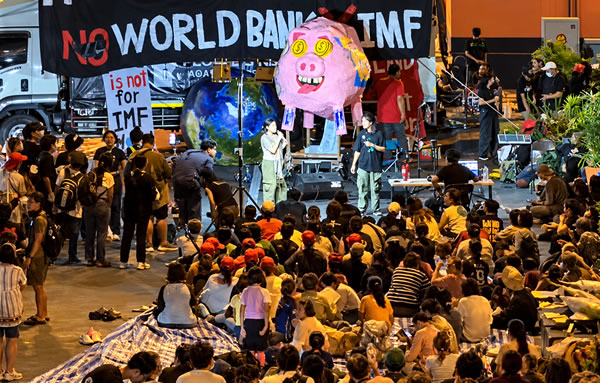
Protesters clashed with police and occupied a central Bangkok road overnight as anger mounted outside the IMF–World Bank summit. Hundreds accused global financial institutions and Thailand’s political establishment of protecting corporate interests while ordinary people shoulder debt and environmental damage. They demanded sweeping economic reforms, debt cancellation and an end to corporate dominance. Meanwhile, another 1,000 farmers and activists prepared to march on the heavily guarded venue on Friday. The protests directly challenge Prime Minister Anutin Charnvirakul’s investment drive, exposing fierce opposition to Thailand’s economic policies as world financial leaders gather in Bangkok.
Bangkok protesters clash with police at the IMF–World Bank summit. Another 1,000 farmers prepare to march, challenging Prime Minister Anutin Charnvirakul’s investment drive. ( Source: Matichon )
Hundreds of protesters occupied Ratchadapisek Road in central Bangkok overnight on Thursday after police blocked their march towards the IMF–World Bank Annual Meetings. Farmers, workers and environmental campaigners accused international financial institutions and successive Thai governments of serving powerful corporate interests.
They demanded sweeping changes to public borrowing, energy ownership, welfare and economic policy. Meanwhile, a separate international farmers’ coalition prepared to march on the conference venue on Friday, October 16. Organisers expected approximately 1,000 participants from movements representing farmers across more than 60 countries.
The overnight protest began on Thursday, October 15, near the Khlong Toei intersection. Demonstrators gathered as the International Monetary Fund (IMF) and World Bank continued their Annual Meetings in Bangkok. The conference runs from October 12 to 18 at the Queen Sirikit National Convention Centre.
Police block Bangkok march as protesters challenge IMF and World Bank policies at annual meetings
Inside, government representatives and international financial institutions discussed economic development and investment. Outside, protesters challenged the policies promoted by those institutions and demanded greater public control over economic decisions.
The People’s Network Against the World Bank and IMF organised Thursday’s demonstration. Its membership included farmers, workers, women’s organisations, ethnic groups, urban poor communities and environmental campaigners.
Additionally, the coalition represented people affected by major infrastructure projects, industrial pollution and disputes over natural resources. Supaporn Malailoy, a prominent spokesperson, demanded greater transparency over government negotiations with international financial institutions. The network was also working with the NGO Coordinating Committee on Development.
On Thursday, demonstrators marched from Khlong Toei towards the convention centre. However, police erected barricades near Rama IV intersection, blocking their approach to the conference venue. A confrontation followed when activists attempted to display protest banners from a pedestrian bridge. Officers and demonstrators became involved in brief scuffles. Nevertheless, available reports did not establish any major violence.
Overnight Bangkok protest draws hundreds as activists accuse financial institutions of corporate bias
Accounts of the turnout differed. The Bangkok Post reported approximately 600 demonstrators, while Thai PBS cited around 700. Another account placed participation above 1,000. Following the confrontation, protesters established an overnight camp on Ratchadapisek Road.
They announced plans to continue speeches, discussions and symbolic demonstrations throughout Friday. The occupation was scheduled to conclude at approximately 7 pm.
Organisers described the demonstration as civil disobedience and declared that “the streets are their parliament”. Their grievances extended beyond opposition to IMF lending. Instead, the coalition challenged Thailand’s economic development model, corporate influence, public debt and political power. Notably, protesters described the international gathering as a “financial Olympics”. They accused governments and financial institutions of making economic decisions while excluding affected communities.
The declaration issued on Thursday identified three structural problems. These concerned political influence, the distribution of economic benefits and damage associated with development projects. The first was described as the “Neoliberal Capitalist Crisis and the Blue Regime”.
Under this heading, protesters accused powerful business groups, political networks and state institutions of controlling economic decisions. They claimed these relationships allowed corporations to exploit resources while restricting opposition from affected communities.
Protesters accuse powerful business networks of controlling Thailand’s economic development policies
Specifically, the declaration criticised connections between capital groups, influential political families, state agencies and what it termed special powers. The movement accused these networks of invoking national security and Thailand’s international reputation to restrict public opposition.
Furthermore, it claimed human rights defenders faced intimidation when challenging major development projects. Its accusations focused on political influence over resource allocation, investment decisions and the treatment of communities resisting development schemes.
The second criticism concerned economic growth and private investment. Protesters questioned the reliance on GDP figures as the principal measure of economic success. They argued that headline growth failed to reflect costs imposed on poorer communities.
In particular, the declaration criticised plans to mobilise more than $112 billion in private capital during fiscal 2026. The network described this approach as “public-subsidised neoliberalism”, claiming public resources supported private investment while corporations retained profits.
According to the movement, taxpayers and affected communities absorbed financial risks, public debt and environmental damage. By contrast, major businesses received the economic benefits. The coalition also challenged government borrowing for projects it believed primarily served corporate interests.
Moreover, it accused international lending arrangements of reinforcing economic dependence and restricting public influence over national development decisions.
Dams, mining and pollution dominate protest grievances as campaigners demand compensation and reform
The third criticism concerned the consequences of infrastructure and industrial development. The declaration cited the Pak Mun Dam and Bang Lang Dam among projects associated with community grievances.
It also identified potash mining, flooding, industrial pollution in eastern Thailand and evictions affecting poorer urban communities. Together, these examples formed the movement’s case against development policies it considered damaging to local populations.
The coalition argued that affected communities deserved compensation and environmental restoration. It also demanded accountability from institutions involved in financing or approving damaging projects.
In its declaration, the network maintained that the World Bank and governments owed communities a debt of justice. It rejected further financial burdens on people already affected by development decisions.
The protesters subsequently issued seven demands directed at the Thai government, international financial institutions and major corporations. Their first demand concerned public control over development decisions.
The network accused government agencies of conducting consultations after important decisions had already been settled. Consequently, it demanded genuine community participation before projects received approval. Its proposals covered land use, infrastructure, natural resources and other decisions affecting local livelihoods.
Protesters demand changes to energy ownership, public borrowing and universal welfare in Thailand
The second demand addressed energy ownership and corporate influence. Protesters called for an end to public subsidies supporting dominant energy companies. In addition, they demanded changes to ownership structures allowing greater community control over energy resources.
The declaration called for fairer ownership arrangements and stronger local participation in energy decisions. Its proposals directly challenged the concentration of economic power within major energy businesses.
Third, the coalition demanded cancellation of debts it considered unfair. It called for full disclosure of government loan agreements and greater public scrutiny of borrowing decisions. Separately, protesters opposed loans they believed primarily benefited large corporations.
The network also accused international lending arrangements of restricting national economic sovereignty. Its declaration demanded an end to borrowing policies that transferred financial risks to ordinary citizens.
The fourth demand concerned universal welfare and the recognition of caregiving. Protesters called for guaranteed welfare rights and fair compensation for care workers. Importantly, their proposals included both paid and unpaid caregivers. The network demanded recognition of caregiving within Thailand’s economic and social policies. It also challenged arrangements that left essential care work without adequate compensation.
Environmental compensation and assembly rights feature in demands to restructure Thailand’s economy
The fifth demand addressed environmental damage and compensation. The coalition called for the World Bank, IMF, governments and corporations to accept responsibility for damage associated with development projects. It demanded ecosystem restoration and fair financial remedies for affected communities.
Specifically, its complaints included dams, mining operations, industrial pollution and projects disrupting local livelihoods. The movement argued that affected populations should not finance repairs for damage caused by development decisions.
The sixth demand concerned political rights and the treatment of activists. Protesters called for protection of peaceful assembly and an end to harassment of human rights defenders. They also referred directly to violence surrounding the 2022 APEC summit.
As part of this demand, the network sought safeguards against similar incidents. The issue acquired immediate relevance following Thursday’s confrontation between police and demonstrators near the conference venue.
The final demand concerned Thailand’s broader economic and political structure. Protesters called for restructuring what they described as the Blue Regime economy. They demanded revisions to Thailand’s 14th National Economic and Social Development Plan.
Furthermore, their proposals included decentralising political power and redistributing control over economic resources. The network sought greater community authority over land, water, forests, seas and energy resources.
Seven-point declaration calls for economic restructuring as international farmers prepare Bangkok march
Taken together, the seven demands challenged public borrowing, corporate influence, welfare provision and control over development decisions. The declaration also called for environmental compensation and stronger protections for political activity.
Its proposals extended from individual development projects to national economic planning. The movement maintained that affected communities should have greater authority over decisions shaping their livelihoods.
The declaration concluded with an explicit commitment to civil disobedience. It stated: “We are engaging in civil disobedience. The streets are the people’s parliament. Peaceful action is love in action, bringing justice to fruition. The future is not something handed to us by the state and capital, but something the people must create themselves!”
In parallel, a second protest movement prepared a major demonstration for Friday morning. The Assembly of the Poor and La Via Campesina planned to march from Lumpini Park towards the convention centre. Organisers anticipated approximately 1,000 participants, including representatives of farming movements operating across more than 60 countries. Assembly instructions specified an 8 am gathering, although a spokesperson had previously announced a 9 am march.
International farmers seek debt relief and food sovereignty ahead of planned march on Bangkok summit
The two movements shared opposition to IMF and World Bank policies but organised separate activities. La Via Campesina represents farmers, peasants and agricultural workers internationally. Its Thai allies include the Assembly of the Poor, which campaigns over land rights, rural poverty and development projects. The planned demonstration brought these domestic grievances together with demands from an international agricultural movement.
Paitoon Saloisod, secretary-general of the Assembly of the Poor, criticised agricultural policies associated with the World Bank. He argued that these policies had contributed to farmer indebtedness and the separation of rural families.
Elsewhere, Assembly adviser Baramee Chaiyarat explained the planned march’s objectives. He said demonstrators intended to publicise damage communities attributed to IMF and World Bank policies. However, he maintained that protesters did not intend to prevent the international meetings from proceeding.
French activist Morgan Ody, a prominent La Via Campesina representative, adopted a more radical position. She argued that the IMF and World Bank could not be reformed to serve ordinary people. Instead, she called for both institutions to be dismantled.
The international movement demanded debt cancellation, public audits of foreign borrowing and stronger taxation of corporations and wealthy individuals. Other proposals included greater democratic control over economic policy and protection of food sovereignty.
Police restrictions remain at 24 sites as farmers prepare to approach IMF and World Bank conference
Friday’s planned march followed Thursday’s confrontation between protesters and police near the conference venue. Meanwhile, extensive security arrangements remained in force around locations associated with the international meetings.
Police had imposed restrictions on public gatherings at 24 conference-related locations. Those measures were scheduled to remain until October 20, two days after the meetings concluded. On another front, foreign activists complained of intimidation and intrusive security checks, according to reporting by Devex on Thursday.
The available information did not establish whether Friday’s international farmers’ march had begun. Nor did it confirm any further confrontation between police and demonstrators. The People’s Network intended to continue its occupation until approximately 7 pm.
Separately, the Assembly of the Poor and La Via Campesina planned to approach the conference venue during the morning. Both movements were seeking responses to their demands while the international meetings continued.
Anutin promotes investment as protesters criticise corporate influence and Thailand’s development plan
The demonstrations coincided with Prime Minister Anutin Charnvirakul’s efforts to promote Thailand as an investment destination. Anutin has used the IMF–World Bank meetings to outline his economic vision and encourage international investment.
His proposals emphasise stronger growth, higher productivity and increased investment. By comparison, protesters challenged development policies they accused of concentrating economic benefits among major corporations.
Their criticism specifically included the Eastern Economic Corridor, industrial pollution and household debt. The coalition also questioned corporate influence over government decisions and the allocation of public resources. Additionally, protesters challenged the direction of Thailand’s 14th National Economic and Social Development Plan. Their declaration demanded changes to public borrowing, energy ownership and the distribution of economic power.
Inside the convention centre, international financial institutions and government representatives discussed investment and economic development. Outside, farmers, workers and environmental campaigners demanded changes to policies they blamed for debt and environmental damage.
The overnight occupation also highlighted longstanding disputes involving dams, mining and industrial development. In turn, Friday’s planned farmers’ march introduced another organised demonstration involving Thai rural communities and international agricultural movements.
Bangkok protests enter final conference days with farmers’ march planned and police restrictions extended
The IMF–World Bank Annual Meetings were scheduled to conclude on Sunday, October 18. Police restrictions around conference locations, however, were due to remain until October 20. The immediate developments concerned Friday’s planned march, access to the convention centre and police handling of demonstrations. Protesters were also seeking responses from the Thai government, IMF and World Bank.
By Thursday night, the campaign had moved beyond declarations to an overnight occupation of a central Bangkok road. Its demands covered public debt, corporate influence, welfare, energy ownership, environmental compensation and political rights.
At the same time, a separate coalition prepared to bring approximately 1,000 farmers and supporters towards the conference. Both movements planned further activities on Friday as the IMF and World Bank entered the final days of their Bangkok meetings.
Prime Minister Anutin talks of an economy driven by ‘quality growth’ at the Bangkok IMF World Bank forum
Protests at the IMF World Bank meetings turn violent but Bangkok police strongly deny being heavy handed
Police chief says Bangkok is ready for World Bank and IMF meetings with over 18,000 delegates visiting
Thailand struggles economically even with revised World Bank GDP growth for 2026 coming in at 2% for 2026
Vietnam’s economic growth races ahead of Thailand’s putting it on track to overtake its net GDP by 2029
Vietnam is taking Thailand’s quality tourists in huge numbers while Bangkok flails about with crackdowns
Thailand’s once mighty tourism industry is failing but now faces further damage from overvalued baht
Economists baffled by extraordinary and damaging rise of the baht in 2025 hitting tourism and exports
Top Thai banker launches blistering attack on present state of the economy calling for more inclusion
Joseph Anthony is an expat from Ireland who has lived in Thailand for the last decade. He has worked extensively in the media including editorial positions in Ireland and Thailand. He is focused on economic and business stories in Thailand as well as the expat lifestyle.
All posts by Joseph O' Connor
Thai UK beauty wins Ms Global title. Highly educated marketing whiz stormed to victory in home pageant October 13, 2026 Beauty, brains and grit! Thai-British Saffron Maya
People’s Party bigwig calls on Pheu Thai to put the country first in the forthcoming no confidence vote October 12, 2026 Anutin faces a political showdown as the
Two Nigerians arrested for cocaine possession in Pattaya as police launch a crackdown on illicit drugs October 12, 2026 Police raid a Pattaya condo and discover cocaine
Thaksin’s mansion and bulletproof cars on the line as court reserves decision on tax debt injunction to halt collection October 11, 2026 Thaksin battles to stop a ฿17.6 billion tax
5 Chinese man gang departs Thailand within hours of a 37 million baht heist in Pattaya of Turkish target October 11, 2026 One month watching their target. Six hours to escape
Failing foreign tourism sector at war over tourist levy and exactly who benefits from the billions raised October 11, 2026 Deputy Prime Minister and Commerce Minister Suphajee
Eleven arrested in Saturday property raids linked to foreigners with links to criminality across Bangkok October 10, 2026 Police raid Bangkok’s luxury estates, targeting
Burmese drug kingpin with multiple identities and lives linked to massive cash seizure in Chiang Rai October 10, 2026 Dead in 2022. Arrested in South Korea in 2026. Noo
Thailand reels at story of mother taken against her will to a prison like nursing home with caged beds for inmates October 9, 2026 Police probe a family nightmare as Mother Phat, 63,
51 year old Frenchman arrested in Chiang Mai for running a tourist hostel through a nominee company October 9, 2026 Frenchman arrested after police raid a Chiang Mai
Queen is first Thai woman to fly a Swedish Gripen fighter jet. King in Surat Thani to congratulate her October 9, 2026 From Boeing jets to a supersonic fighter: Queen
Justice Minister and other cabinet members lead raids on Jewish centres in Bangkok as financial case grows October 8, 2026 A tiny Bangkok office registered to six entities, 61
Licenced online gambling site abroad linked to the husband of a government MP raises legal quandary October 8, 2026 A ฿1.9bn wealth controversy threatens to engulf
Horror care centre closed in Kanchanaburi where patients were locked into caged beds and prison cells October 7, 2026 Steel cage beds, barred rooms and psychiatric patients
New tourist tax of 450 baht a step closer with officials targeting early 2027 after cabinet approval is obtained October 7, 2026 Foreign tourists face a ฿450 Thai entry charge from
Corruption and crime crusader carted off to Bangkok Remand Prison after court refused last minute bail October 5, 2026 Atchariya is behind bars after losing bail as cyber
Vietnam’s economic growth races ahead of Thailand’s putting it on track to overtake its net GDP by 2029 October 5, 2026 Thailand’s economic lead is under pressure as
Upmarket Thai prostitution racket smashed by Hong Kong police. 16 people arrested in separate swoops October 13, 2026
Air force monitors Chinese base operation in Laos as Beijing strengthens military ties with neighbours October 12, 2026
Tourist police reach out to Russian Embassy to inform tourists visiting Thailand about laws and customs October 12, 2026
Police chief says Bangkok is ready for World Bank and IMF meetings with over 18,000 delegates visiting October 12, 2026
Indian YouTube on tour of Thailand with no money hits a snag at Udon Thani temple and is asked to leave October 11, 2026
Chiang Rai river basin findings ramp up the pressure on Thailand to act over poison flowing from Burma October 11, 2026
Horrorific work incident saw woman (49) decapitated by a lift on Saturday. Police investigation underway October 10, 2026
Counterfeiting racket selling on TikTok and Lazada busted in Samut Sakhon. Six foreigners arrested on site October 10, 2026
PM says he can explain. Denies power over impartial agencies as a no confidence motion is filed in House October 10, 2026
Murder in Trang over meth tablet dealing. Two men arrested after burned remains found near reservoir October 9, 2026
Commerce Minister says that a November signing of a US Thai trade deal is in sight as exporters stand by October 9, 2026
Armed police action in Nonthaburi as man wanted for attempted murder sought to evade an arrest warrant October 9, 2026
Thailand struggles economically even with revised World Bank GDP growth for 2026 coming in at 2% for 2026 October 8, 2026
New taxes simply for going in and out of Thailand in addition to higher airport tax already implemented October 8, 2026
Thaksin comes to Tax Court in Bangkok seeking temporary injunction to halt Revenue Department’s enforcement October 7, 2026
Senators from the ‘blue’ camp move against dissident Election Commissioner Sitthichot Intrawises October 6, 2026
Thai Airways defeats flood crisis but finds itself in a brewing crisis of confidence over its management October 5, 2026
Grab delivery driver strikes rich in Phuket by using trade to burgle 2 homes netting 3.69 million baht October 5, 2026
USS George HW Bush arrives in Phuket one day early and berths 3.3km offshore. Sailors landing ashore in holiday mode October 5, 2026
Police investigate a Burmese kingpin who entered Thailand by plane from India and had access to wealth October 4, 2026
Thai industrial base hammered by flooding crisis. Over 4k firms report a need for financial assistance October 4, 2026
House Committee chair Rome to call Bhumjaithai MP and Australian husband on Wednesday over wealth October 4, 2026
© 2026 Thai Examiner. All rights reserved.
2026年10月16日上午11:03
经济、生活、媒体、政治、泰国
在国际货币基金组织-世界银行峰会召开之际,抗议者与警方发生冲突,并连夜占领了曼谷市中心的一条道路。数百名抗议者指责全球金融机构和泰国政治建制派维护企业利益,而普通民众却要承受债务和环境破坏的重压。他们要求进行全面的经济改革,取消债务,并结束企业垄断。与此同时,另有1000名农民和活动人士准备于周五向戒备森严的峰会会场进发。这些抗议活动直接挑战了泰国总理阿努廷·查恩维拉库尔的投资计划,也暴露了世界金融领袖齐聚曼谷之际,泰国经济政策所面临的强烈反对。
在国际货币基金组织-世界银行峰会期间,曼谷的抗议者与警方发生冲突。另有1000名农民准备游行,挑战总理阿努廷·查恩维拉库尔的投资计划。(来源:Matichon)
周四晚间,数百名抗议者占领了曼谷市中心的拉差达披色路,此前警方阻止了他们前往国际货币基金组织-世界银行年会的游行。农民、工人和环保人士指责国际金融机构和历届泰国政府为强大的企业利益服务。
他们要求对公共借贷、能源所有权、福利和经济政策进行全面改革。与此同时,另一个国际农民联盟准备于10月16日星期五游行至会议会场。组织者预计将有来自60多个国家农民运动的约1000名参与者。
这场通宵抗议活动于10月15日星期四在孔堤路口附近开始。当时,国际货币基金组织(IMF)和世界银行正在曼谷举行年会,示威者聚集于此。此次年会于10月12日至18日在诗丽吉王后国家会议中心举行。
曼谷警方封锁了抗议游行,抗议者在国际货币基金组织和世界银行年会上质疑其政策。
会场内,政府代表和国际金融机构就经济发展和投资问题展开讨论。会场外,抗议者对这些机构推行的政策提出质疑,并要求赋予公众对经济决策更大的控制权。
周四的示威活动由反对世界银行和国际货币基金组织的“人民网络”组织。其成员包括农民、工人、妇女组织、少数民族团体、城市贫民社区和环保人士。
此外,该联盟还代表受重大基础设施项目、工业污染和自然资源纠纷影响的民众。其重要发言人苏帕蓬·马拉伊洛伊要求政府与国际金融机构的谈判更加透明。该联盟还与非政府组织发展协调委员会开展合作。
周四,示威者从孔堤街游行至会议中心。然而,警方在拉玛四路交叉口附近设置路障,阻止了他们前往会场。随后,示威者试图在人行天桥上展示抗议横幅,双方发生冲突。警员和示威者之间出现短暂扭打。不过,现有报告并未显示发生任何重大暴力事件。
曼谷一夜之间爆发抗议活动,数百人参与,活动人士指责金融机构存在企业偏见。
关于参与人数的说法不一。《曼谷邮报》报道称约有600名示威者,而泰国公共电视台(Thai PBS)则称约有700人。另有报道称参与人数超过1000人。冲突结束后,抗议者在拉差达披色路(Ratchadapisek Road)上搭建了营地过夜。
他们宣布计划在周五继续举行演讲、讨论和象征性示威活动。占领行动预计将于晚上7点左右结束。
组织者将此次示威活动描述为公民不服从运动,并宣称“街头就是他们的议会”。他们的不满不仅限于反对国际货币基金组织(IMF)的贷款。该联盟还挑战了泰国的经济发展模式、企业影响力、公共债务和政治权力。值得注意的是,活动人士将此次国际会议形容为“金融奥运会”。他们指责各国政府和金融机构在制定经济决策时将受影响的群体排除在外。
周四发布的声明指出了三个结构性问题。这些问题涉及政治影响力、经济利益分配以及发展项目带来的损害。第一个问题被描述为“新自由主义资本主义危机和蓝色政权”。
在此标题下,抗议者指责强大的商业集团、政治网络和国家机构控制着经济决策。他们声称,这些关系使得企业能够掠夺资源,同时限制受影响社区的反对声音。
抗议者指责强大的商业网络控制着泰国的经济发展政策。
具体而言,该宣言批评了资本集团、有影响力的政治家族、国家机构以及其所谓的特殊权力之间的联系。该运动指责这些网络以国家安全和泰国国际声誉为由,压制公众反对意见。
此外,报告还声称人权捍卫者在质疑大型发展项目时面临恐吓。报告的指控主要集中在政治因素对资源分配、投资决策以及对待抵制发展计划的社区的方式的影响上。
第二点批评涉及经济增长和私人投资。抗议者质疑将GDP数据作为衡量经济成功的主要指标。他们认为,表面上的增长未能反映贫困社区所承受的成本。
尤其值得一提的是,这份备受争议的宣言计划在 2026 财年调动超过 1120 亿美元的私人资本。该组织将这种做法描述为“公共补贴的新自由主义”,声称公共资源支持私人投资,而企业则保留了利润。
该运动认为,纳税人和受影响的社区承担了财务风险、公共债务和环境破坏,而大型企业却获得了经济利益。该联盟还质疑政府为他们认为主要服务于企业利益的项目举债。
此外,它还指责国际贷款安排加剧了经济依赖,限制了公众对国家发展决策的影响。
水坝、采矿和污染是抗议活动中最为突出的问题,抗议者要求赔偿和改革。
第三项批评涉及基础设施和工业发展带来的后果。声明中列举了帕蒙水坝和邦朗水坝等项目,指出它们引发了社区的不满。
报告还指出,泰国东部地区钾肥开采、洪水泛滥、工业污染以及影响贫困城市社区的拆迁问题十分严重。这些例子共同构成了该运动反对其认为会损害当地居民利益的发展政策的理由。
该联盟认为,受影响的社区理应获得赔偿和环境修复。它还要求参与资助或批准破坏性项目的机构承担责任。
该组织在声明中坚持认为,世界银行和各国政府对社区负有伸张正义的义务。它反对给已经受到发展决策影响的人们增加额外的经济负担。
随后,抗议者向泰国政府、国际金融机构和大型企业提出了七项诉求。他们的第一项诉求是希望公众能够控制发展决策。
该组织指责政府机构在重要决策已定之后才进行磋商。因此,该组织要求在项目获得批准前,必须真正实现社区参与。其提议涵盖土地利用、基础设施、自然资源以及其他影响当地居民生计的决策。
抗议者要求泰国改革能源所有权、公共借贷和全民福利制度。
第二项诉求涉及能源所有权和企业影响力。抗议者呼吁停止对占据主导地位的能源公司提供公共补贴。此外,他们还要求改革所有权结构,使社区能够更好地控制能源资源。
该宣言呼吁建立更公平的能源所有权安排,并加强地方在能源决策中的参与度。其提议直接挑战了大型能源企业对经济权力的集中。
第三,该联盟要求取消其认为不公平的债务。它呼吁全面公开政府贷款协议,并加强公众对借贷决策的监督。此外,抗议者还反对他们认为主要惠及大型企业的贷款。
该组织还指责国际贷款安排限制了国家的经济主权。其声明要求停止将金融风险转移给普通民众的借贷政策。
第四项诉求涉及全民福利和对照护工作的认可。抗议者呼吁保障照护人员的福利权利和公平报酬。值得注意的是,他们的提议涵盖了有偿和无偿照护人员。该组织要求在泰国的经济和社会政策中承认照护工作,并质疑那些导致基本照护工作得不到充分报酬的制度。
环境补偿和集会权是泰国经济结构调整诉求中的组成部分。
第五项诉求涉及环境破坏和赔偿。该联盟呼吁世界银行、国际货币基金组织、各国政府和企业承担发展项目造成的环境破坏责任。它要求恢复生态系统,并为受影响的社区提供公平的经济补偿。
具体而言,该运动的诉求包括水坝建设、采矿作业、工业污染以及扰乱当地居民生计的项目。该运动认为,受影响的民众不应为发展决策造成的损害承担修复费用。
第六项诉求涉及政治权利和维权人士的待遇。抗议者呼吁保护和平集会,并停止骚扰人权捍卫者。他们还直接提及了2022年亚太经合组织峰会期间发生的暴力事件。
作为这项诉求的一部分,该组织寻求采取措施防止类似事件再次发生。周四在会议场地附近发生的警方与示威者冲突,使这个问题立即变得尤为重要。
最后一项诉求涉及泰国更广泛的经济和政治结构。抗议者呼吁重组他们所谓的“蓝色政权”经济。他们要求修改泰国第十四个国家经济和社会发展计划。
此外,他们的提议还包括分散政治权力,重新分配经济资源的控制权。该组织寻求赋予社区对土地、水、森林、海洋和能源资源更大的自主权。
国际农民准备在曼谷举行游行,一份七点宣言呼吁进行经济结构调整。
这七项诉求共同挑战了公共借贷、企业影响力、福利供给以及对发展决策的控制。该宣言还呼吁进行环境补偿,并加强对政治活动的保护。
其提议涵盖范围从个人发展项目到国家经济规划。该运动坚持认为,受影响的社区应该在影响其生计的决策中拥有更大的自主权。
宣言最后明确承诺将采取公民不服从行动。宣言指出:“我们正在进行公民不服从运动。街头是人民的议会。和平行动是爱的体现,是实现正义的途径。未来不是国家和资本赐予我们的,而是人民自己创造的!”
与此同时,另一场抗议运动也准备在周五上午举行大规模示威游行。穷人大会和农民之路计划从隆比尼公园游行至会议中心。组织者预计将有约1000人参加,其中包括来自60多个国家的农民运动代表。大会指示集会时间为上午8点,但此前一位发言人曾宣布游行将于上午9点开始。
国际农民在计划前往曼谷峰会前夕,寻求债务减免和粮食主权。
这两个运动都反对国际货币基金组织和世界银行的政策,但各自组织活动。“农民之路”(La Via Campesina)代表国际上的农民、佃农和农业工人。其在泰国的盟友包括“穷人大会”(Assembly of the Poor),该组织致力于争取土地权利、消除农村贫困和推动发展项目。此次计划中的示威活动将这些国内诉求与国际农业运动的诉求结合起来。
穷人大会秘书长派顿·萨洛伊索德批评了与世界银行相关的农业政策。他认为,这些政策加剧了农民负债,并导致农村家庭离散。
另一方面,议会顾问巴拉米·柴亚拉特解释了此次游行的目的。他说,示威者意在宣传国际货币基金组织和世界银行政策对社区造成的损害。但他同时强调,抗议者无意阻止国际会议的进行。
法国活动家摩根·奥迪是“农民之路”运动的知名代表,她采取了更为激进的立场。她认为,国际货币基金组织和世界银行无法进行改革以服务于普通民众。相反,她呼吁解散这两个机构。
国际运动要求取消债务、对外国借款进行公开审计,并对企业和富裕个人征收更重的税。其他提议包括加强对经济政策的民主控制以及保护粮食主权。
农民们正准备参加国际货币基金组织和世界银行会议,警方在24个地点仍然实施管制。
周五计划举行的游行是在周四抗议者与警方在会议场地附近发生冲突之后进行的。与此同时,与国际会议相关的地点周围仍然保持着严密的安保措施。
警方对24个与会议相关的地点实施了公共集会限制。这些措施原计划持续到10月20日,即会议结束两天后。另一方面,据Devex周四报道,外国活动人士抱怨遭到恐吓和侵入式安全检查。
现有信息无法确定周五的国际农民游行是否已经开始,也无法证实警方与示威者之间是否发生了进一步冲突。“人民网络”组织计划继续占领行动,直至晚上7点左右。
此外,穷人大会和农民之路计划在上午前往会议举办地。这两个组织都希望在国际会议进行期间,对其诉求得到回应。
阿努廷鼓励投资,而抗议者则批评企业影响力以及泰国的发展计划。
此次示威活动恰逢泰国总理阿努廷·查恩维拉库尔致力于将泰国打造为投资目的地。阿努廷曾利用国际货币基金组织和世界银行会议的机会阐述其经济愿景并鼓励国际投资。
他的方案强调更强劲的经济增长、更高的生产力和更大的投资。相比之下,抗议者则质疑那些他们指责将经济利益集中在大型企业手中的发展政策。
他们的批评主要集中在东部经济走廊、工业污染和家庭债务等方面。该联盟还质疑企业对政府决策和公共资源分配的影响。此外,抗议者还对泰国第十四个国家经济和社会发展计划的方向提出质疑。他们的声明要求改革公共借贷、能源所有权和经济权力分配。
在会议中心内,国际金融机构和政府代表就投资和经济发展问题展开讨论。而在会场外,农民、工人和环保人士则要求改变他们认为造成债务和环境破坏的政策。
此次夜间占领行动也凸显了长期以来围绕水坝、采矿和工业发展等问题的争议。反过来,周五计划举行的农民游行又引发了一场由泰国农村社区和国际农业运动共同参与的有组织的示威活动。
曼谷抗议活动进入最后阶段,农民计划举行游行,警方限制措施延长。
国际货币基金组织-世界银行年会原定于10月18日星期日闭幕。然而,会议地点周围的警戒措施将持续到10月20日。事态的直接焦点在于周五计划的游行、进入会议中心的通道以及警方对示威活动的应对。抗议者还要求泰国政府、国际货币基金组织和世界银行作出回应。
到周四晚间,这场运动已从发表宣言演变为彻夜占领曼谷市中心一条道路。他们的诉求涵盖公共债务、企业影响力、社会福利、能源所有权、环境补偿和政治权利等多个方面。
与此同时,另一个联盟准备带领约1000名农民及其支持者前往参加会议。随着国际货币基金组织和世界银行曼谷会议进入最后阶段,这两个组织都计划在周五开展进一步的活动。
阿努廷总理在曼谷举行的国际货币基金组织和世界银行论坛上谈到,经济应以“高质量增长”为驱动。
国际货币基金组织和世界银行会议期间发生抗议活动,并演变为暴力事件,但曼谷警方强烈否认使用暴力手段。
曼谷警察局长表示,曼谷已做好迎接世界银行和国际货币基金组织会议的准备,预计将有超过18000名代表到访。
即使世界银行将泰国2026年的GDP增长率修正为2%,泰国的经济仍然面临困境。
越南经济增长速度超过泰国,有望在2029年实现净GDP超过泰国。
越南正大量吸引泰国的优质游客,而曼谷却在打击非法游客的行动中束手无策。
泰国曾经强大的旅游业正在衰落,如今又面临泰铢高估带来的进一步打击。
经济学家对泰铢在2025年出现异常且破坏性的上涨感到困惑,认为这将重创旅游业和出口。
泰国顶级银行家猛烈抨击当前经济状况,呼吁加强包容性经济。
约瑟夫·安东尼是一位来自爱尔兰的侨民,过去十年一直居住在泰国。他曾在爱尔兰和泰国的媒体行业担任过编辑职务,拥有丰富的媒体从业经验。他主要关注泰国的经济和商业新闻,以及侨民的生活方式。
约瑟夫·奥康纳的所有帖子
泰英混血佳人摘得环球小姐桂冠。这位受过高等教育的营销奇才在本土选美大赛中一举夺魁(2026年10月13日)。美貌、智慧与毅力兼备!泰英混血的萨弗伦·玛雅
人民党重量级人物呼吁为泰党在即将于2026年10月12日举行的不信任投票中将国家利益放在首位。阿努廷面临一场政治摊牌。
2026年10月12日,芭堤雅警方展开打击非法毒品行动,两名尼日利亚人因持有可卡因而被捕。警方突袭芭堤雅一处公寓,查获可卡因。
他信的豪宅和防弹车岌岌可危,法院暂缓对一项旨在阻止税款征收的禁令作出裁决(2026年10月11日)。他信正努力阻止一项176亿泰铢的税款征收。
2026年10月11日,五名中国男子组成的犯罪团伙在芭堤雅抢劫了一名土耳其目标人物价值3700万泰铢的财物后数小时内逃离泰国。他们监视目标长达一个月,并计划用六小时逃脱。
外国旅游业举步维艰,围绕旅游税的征收问题陷入僵局,究竟谁能从筹集的数十亿资金中获益? 2026年10月11日 副总理兼商务部长苏帕吉
2026年10月10日,曼谷警方周六突击搜查多处房产,逮捕11名与涉嫌犯罪活动有关联的外国人。警方突击搜查了曼谷的豪华住宅区,目标是这些外国人。
缅甸毒枭,拥有多个身份和多条人命,与2026年10月10日清莱发生的巨额现金查获案有关。2022年死亡。2026年在韩国被捕。Noo
泰国震惊于一名母亲被强行送往如同监狱般的养老院,院内床位如同笼子一般,病人被关在笼子里。2026年10月9日,警方调查这起家庭噩梦:63岁的帕特母亲被强行送往养老院,院内床位如同笼子。
2026年10月9日,一名51岁的法国男子在清迈因通过代理公司经营旅游旅馆被捕。警方突袭清迈一家旅馆后,该法国男子被捕。
泰国王后成为首位驾驶瑞典鹰狮战斗机的泰国女性。国王于2026年10月9日前往素叻他尼府祝贺她。从波音喷气式飞机到超音速战斗机:王后
2026年10月8日,司法部长和其他内阁成员突击搜查曼谷的犹太中心,财务案件不断扩大。一家位于曼谷的小型办公室注册在六个实体名下,涉案金额达61美元。
一家与政府议员丈夫有关联的海外持牌在线赌博网站引发法律难题 2026年10月8日 19亿泰铢的财富纠纷或将席卷整个行业
2026年10月7日,北碧府一家恐怖的护理中心被关闭,该中心曾将病人锁在笼状床铺和牢房中。照片显示,该中心内有钢笼床、铁栅栏房间和精神病患者。
泰铢450泰铢的新旅游税计划在获得内阁批准后,于2027年初正式实施,距离实施又近了一步。2026年10月7日,外国游客将面临450泰铢的入境费。
反腐败和打击犯罪斗士阿查里亚(Atchariya)因网络犯罪被法院拒绝保释,于2026年10月5日被送往曼谷拘留监狱。
越南经济增长速度超过泰国,有望在2029年净GDP超过泰国(2026年10月5日)。泰国的经济领先地位正面临压力。
香港警方捣毁泰国高档卖淫团伙,16人于2026年10月13日分批出动逮捕。
美国空军密切关注中国在老挝的军事基地运作,北京正加强与邻国的军事联系 2026年10月12日
旅游警察联系俄罗斯大使馆,向前往泰国的游客介绍当地的法律和习俗(2026年10月12日)
曼谷警察局长表示,曼谷已为2026年10月12日举行的世界银行和国际货币基金组织会议做好准备,预计将有超过18000名代表到访。
2026年10月11日,一名身无分文的印度YouTube博主在泰国旅行时,在乌隆他尼寺庙遭遇阻碍,被要求离开。
清莱河流域调查结果加大了泰国应对缅甸毒物流入的压力 2026年10月11日
周六发生一起骇人听闻的工作场所事故,一名49岁女子被电梯斩首。警方已于2026年10月10日展开调查。
沙没沙空府警方捣毁了一个在TikTok和Lazada上销售假冒商品的团伙。2026年10月10日,六名外国人在现场被捕。
首相表示他可以解释。他否认对公正机构拥有权力,此前众议院于2026年10月10日提交了不信任动议。
董里府因冰毒片剂交易发生谋杀案。2026年10月9日,两名男子在水库附近发现被焚烧的尸体后被捕。
商务部长表示,美泰贸易协议有望在11月签署,出口商已做好准备。(2026年10月9日)
2026年10月9日,暖武里府警方对一名因涉嫌谋杀未遂而被通缉的男子采取武装行动,该男子试图逃避逮捕令。
即使世界银行将泰国2026年的GDP增长率修正为2%,泰国经济依然举步维艰。(2026年10月8日)
除了已经实施的更高机场税之外,泰国还将对进出境征收新的税费,该税项已于2026年10月8日生效。
他信于2026年10月7日向曼谷税务法庭申请临时禁令,以阻止税务部门的执法行动。
来自“蓝营”的参议员们对持不同政见的选举专员西提乔特·因特拉怀斯采取行动 2026年10月6日
泰国航空克服了洪灾危机,但却发现自己正面临着管理层信任危机(2026年10月5日)
2026年10月5日,一名Grab外卖员在普吉岛利用行窃机会入室盗窃两户人家,共盗走369万泰铢。
“乔治·H·W·布什”号航空母舰提前一天抵达普吉岛,停泊在离岸3.3公里处。水兵们于2026年10月5日以度假模式上岸。
警方正在调查一名缅甸黑帮头目,他于2026年10月4日从印度乘飞机进入泰国,并拥有雄厚的财力。
泰国工业基础遭受洪灾重创。超过4000家企业表示需要财政援助。(2026年10月4日)
众议院委员会主席罗姆将于2026年10月4日星期三致电泰国议员布姆贾伊泰及其澳大利亚籍丈夫,讨论财富问题。
© 2026 Thai Examiner。版权所有。