The Army’s Aborted XM8 “Starship Troopers” Rifle Lived On In The Hands Of Malaysian Frogmen陆军夭折的XM8“星河战队”步枪在马来西亚蛙人手中得以延续。
The hugely publicized modular firearms family had been on its way toward becoming the Army's small arms crown jewel in the early 2000s.
新闻视频
By Joseph Trevithick
Updated Apr 30, 2020 9:56 AM EDT
Very often, the decision by a country with a large, professional military, such as the United States, to adopt some new type of weapon or other military equipment leads to sales of those systems , or variants thereof , to other nations. Systems that do not have this kind of official stamp of approval or, worse, get rejected by the original intended customer , are often doomed to failure on the international market. Still, there are occasions where another country will see what is otherwise a failed project and give it a new lease on life. This is exactly what happened with the curious case of a Malaysian naval special operations unit fielding variants of the Heckler and Koch XM8 , a much-touted family of 5.56mm small arms that the U.S. Army had abandoned as potential replacements for various weapons, including its M16 rifles and M4 carbines .
The Royal Malaysian Navy’s Pasukan Khas Laut , which translates to English as Naval Special Warfare Forces and is more commonly abbreviated PASKAL, first began using the XM8 series around 2010, five years after the Army officially suspended the project. Pictures are available online showing PASKAL operators carrying rifle and carbine variants, as well as examples of the especially rare personal defense weapon (PDW) configuration.
PASKAL is roughly analogous to the U.S. Navy SEALs and routinely trains with that American unit, as well as other U.S. and international special operations forces. It traces its history the Royal Malaysian Navy’s decision to create a Naval Commando Unit within its Security Regiment Organization in 1977. This element officially became the country’s Naval Special Warfare Forces in 1981.
The unit trains to carry out various typical maritime special operations missions, such as raiding ships and boats and conducting long-range reconnaissance missions in coastal environments. However, its personnel also train to perform a host of unconventional warfare activities behind enemy lines or for internal defense, such as training counter-guerrilla forces, more in line with the traditional mission set of U.S. Army Special Forces units . PASKAL is also on call to conduct various internal security and counter-terrorism operations at sea and on land.
It not clear how or why PASKAL acquired the XM8s. The purchase appears to have been part of a larger shopping spree with Heckler and Koch, which also included orders for 5.56mm G36 and HK 416 rifles , 7.62mm HK 417 rifles , .45 caliber UMP submachine guns , and 4.7mm MP7 personal defense weapons . It’s unclear if Heckler and Koch ever made any XM8s for any other purpose beyond the approximately 200 it made for U.S. trials. So, it’s possible that these guns were either leftover from those tests or were assembled from the remaining parts that the company had made to support those efforts.
A PASKAL operator with an XM8 rifle, at left, next to another individual with a G36K carbine., Rizuan via Wikimedia
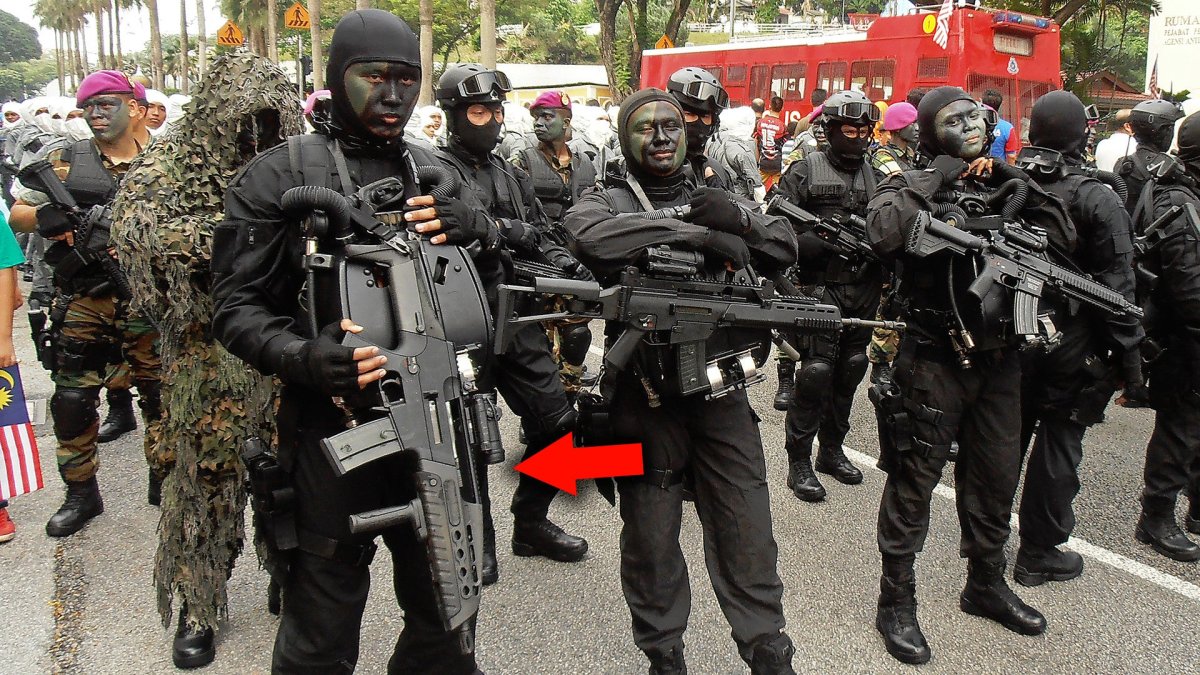
PASKAL operators take part in Malaysia’s 57th National Day Parade in 2014. The three individuals in the foreground are carrying, from left to right, an XM8 carbine, a G36 rifle, and an HK 416 rifle. Another individual with an XM8 rifle is seen near the end of the front row, second from the right., Rizuan via Wikimedia
Another PASKAL operator in 2014 carrying a PDW version of the XM8., Rizuan via Wikimedia
An XM8 carbine with an under-barrel 40mm grenade launcher on display during a PASKAL open day event in 2016., Rizuan via Wikimiedia
The XM8 itself traces its origins back to the 1990s and a series of over-arching Army plans to field a variety of new and advanced infantry weapons and equipment. This included a program to develop a standard infantry weapon that would combine a compact 5.56mm gun with a 20mm grenade launcher capable of firing programmable ammunition that could be set to airburst above enemy forces hiding behind hard cover.
A Heckler and Koch-led development team ultimately won the contract to build what was formally known as the XM29 Objective Infantry Combat Weapon . Technical issues, particularly work to reduce the overall weight and bulk of the ambitious gun, led the Army to reorganize the program and attempt to develop the two components first as separate weapons in 2004.
The 5.56mm weapon became known as the XM8. The 20mm grenade launcher, which later evolved into a 25mm weapon, became the XM25, also known as the Punisher, which you can read about more in this past War Zone piece .
The very first version of the XM8 was a heavily modified version of the G36C carbine, part of the G36 rifle family that Heckler and Koch had first developed for the German military. The new gun made significant use of polymers in its construction and used a physical gas piston to cycle the operating mechanism. This helps keep unburnt gunpowder and other particulate matter out of the inner workings of the gun, reducing the likelihood of jams or other malfunctions, especially are long periods of use without cleaning. The M16 and M4 series of guns have so-called direct impingement systems that siphon off propellant gas and use that to cycle the action directly.
The very first XM8 prototype., Jim Schatz via HKPRO.com
Army Brigadier General James Moran, then head of the service’s Program Executive Office Soldier, complained that the original design looked too much like the German G36 for a weapon that American soldiers would carry, according to the late Jim Schatz , a long-time employee of Heckler and Koch’s U.S. subsidiary. Army officials specifically asked if the gunmaker could make it look “more Starship Troopers,” a reference to the loose 1997 film adaptation of the 1959 Robert Heinlein science fiction novel of the same name, according to firearms researcher Ian McCollum , who runs the website ForgottenWeapons.com .
The futuristic-looking prop guns in that movie were built around modified Ruger AC-556 rifles in a so-called “bullpup” configuration , with the magazine and main action placed behind the pistol grip. The rifle versions also had a modified Ithaca M37 12-gauge shotgun mounted under the barrel.
The “Morita” assault rifle., TriStar Pictures capture
Heckler and Koch did refine the design into a sleeker, futuristic-looking package. The final XM8 prototype design, though formally designated as a carbine, was actually an impressive modular firearms concept that was in many ways ahead of its time. The Army’s Modular Handgun System program, which led to the adoption of variants of the 9mm Sig Sauer P320 pistol, followed a similar philosophy .
The XM8 family had a common receiver design to which armorers could add different length barrels, handguards, buttstocks, and other features. The XM8 had an integrated sighting system, as did the G36 that it was derived from, as well. The gunmaker also eventually added accessory rails, which were not as widespread in the early-to-mid 2000s as they are now, to later iterations of some of the handguard options and the top of the carry handles for the rifle and carbine variants.
An infographic showing the proposed XM8 family for the US Army., Heckler and Koch
The guns performed relatively well in testing. For a time looked set to become the Army’s next standard infantry weapon and possibly enter service with the other branches of the U.S. military, as well. The XM8, or other guns clearly inspired by it, was a staple of video games in the 2000s and replicas also appeared in the movies Children of Men and District 13: Ultimatum .
However, a combination of Army requirements demands and political factors, including a push by members of Congress to open the XM8 program up to other contenders, including American-headquarter gun manufacturers, together with debates about whether the new gun offered substantial enough improvements to justify the cost of adopting a new standard infantry weapon, ultimately conspired to kill the program in 2005.
A US Army soldier with an XM8 carbine with a 40mm under-barrel grenade launcher, at left, and one with a full-length rifle variant, at bottom., US Army
Heckler and Koch offered further refined variants, known as the XM8-Rs, which were more visually similar to the earlier generation of G36-looking guns, to U.S. Special Operations Command for its Special Operations Forces Combat Assault Rifle (SCAR) program. The U.S. Navy, which was overseeing that effort, refused to accept the company’s submission after its proposal package arrived five days after the deadline. The American subsidiary of Belgian gunmaker FN subsequently won that competition.
The XM8-R for the SCAR program., Jim Schatz via HKPRO.com
In 2007, the Army bowed to pressure , particularly from some members of Congress, to test the FN SCAR and Heckler and Koch HK 416 rifle, the latter of which is a derivative of the M16 pattern that used a gas piston instead of direct impingement, as potential new service rifles. The service also included some of the XM8s, which it still had in storage, in the tests.
The Army ultimately decided to stick with its existing M4 carbines, though the HK 416 became popular with U.S. special operations forces . The U.S. Marine Corps has also adopted versions in the infantry automatic rifle and designated marksman roles and is now looking to make it their standard infantry rifle . Special operators, as well as regular Army forces, have also now adopted designated marksman variants of the larger HK 417 .
With the exception of Malaysia’s PASKAL, no other country has adopted any variant of the XM8. Heckler and Koch has had greater success with its HK 416 and HK 417 product lines than it has with its G36, as well. The company did take lessons learned from all of these guns in developing its latest HK 433 .
It’s not clear if PASKAL has ever used its XM8s during actual operations, or how many it might still have in inventory in any configuration, either. Since 2010, it has conducted counter-piracy operations near Somalia and made deployments in support of the NATO-led coalition in Afghanistan. In 2015, the unit also deployed personnel as part of the response to the hijacking of the tanker MT Orkim Harmony in the South China Sea. In that case, the hijackers eventually abandoned the ship without harming any of the crew on board.
The guns are also notably absent from 2018’s PASKAL: The Movie . During the production of that film, some of the actors trained with PASKAL operators , including making a visit to the Lapang Sasar Abdul Samad shooting range at the unit’s home base in the port city of Lumut. This is also notably the location where the video of the individual shooting the XM8 PDW, seen near the top of this story, was shot. That video was uploaded in 2018 and it’s unclear if this was related to the filming of the movie or not.
Whatever the case, PASKAL’s decision to adopt the various variants of the XM8, even on a limited level, is a fascinating epilogue to the story of a gun that once stood looked like it would be the future of U.S. Army infantry small arms.
After the publication of our story, Twitter user @amimJK let us know that the Malaysian Army Forces (MAF), as well as the Royal Malaysia Police (RMP), had trialed variants of the XM8 themselves in 2007. They also shared pictures from a local magazine at the time, showing variants in identical configurations to the ones that PASKAL operators were later seen carrying.
This makes it more likely than not that the naval special operators received these XM8s after those trials concluded and the MAF and the RMP both decided against adopting the guns. It’s still not clear whether or not Heckler and Koch built entirely new weapons for these trials.
Contact the author: joe@thedrive.com
Comments couldn’t be loaded. Please refresh the page.
作者:约瑟夫·特雷维西克
更新于美国东部时间2020年4月30日上午9:56
通常情况下,像美国这样拥有庞大专业军队的国家一旦决定采用某种新型武器或其他军事装备,就会将这些系统或其衍生型号出售给其他国家。而那些没有获得此类官方认可,甚至被最初目标客户拒绝的系统,往往注定在国际市场上失败。然而,也有一些时候,其他国家会慧眼识珠,看到一些原本注定失败的项目,并赋予它们新的生命。马来西亚海军特种作战部队装备的赫克勒-科赫XM8系列衍生型号就是一个典型的例子。XM8是备受瞩目的5.56毫米口径轻武器系列,但美国陆军曾放弃将其作为包括M16步枪和M4卡宾枪在内的多种武器的替代品。
马来西亚皇家海军特种作战部队(Pasukan Khas Laut,简称PASKAL)于2010年左右开始使用XM8系列步枪,而陆军早在五年前就已正式停止了该项目。网上有图片显示,PASKAL队员携带XM8步枪和卡宾枪,以及极其罕见的个人防卫武器(PDW)配置。
马来西亚海军特种作战部队(PASKAL)大致相当于美国海军海豹突击队,并经常与该部队以及其他美国和国际特种作战部队进行联合训练。其历史可追溯至1977年马来西亚皇家海军在其安全部队组织内组建海军突击队的决定。该部队于1981年正式成为马来西亚海军特种作战部队。
该部队接受训练,执行各种典型的海上特种作战任务,例如袭击舰船和在沿海环境中进行远程侦察。此外,其人员还接受一系列非常规作战行动的训练,包括在敌后或内部防御行动,例如训练反游击部队,这更符合美国陆军特种部队的传统任务模式。PASKAL 还随时待命,执行海上和陆地上的各种内部安全和反恐行动。
目前尚不清楚PASKAL是如何或为何获得这些XM8步枪的。此次采购似乎是其向黑克勒-科赫公司(Heckler & Koch)订购的一系列武器装备的一部分,这些装备还包括5.56毫米口径的G36和HK 416步枪、7.62毫米口径的HK 417步枪、.45口径的UMP冲锋枪以及4.7毫米口径的MP7个人防卫武器。目前尚不清楚黑克勒-科赫公司除了为美国测试生产约200支XM8步枪外,是否还出于其他目的生产过其他用途的XM8步枪。因此,这些步枪很可能是测试的剩余部件,或者是由该公司为支持测试而生产的剩余零件组装而成。
左侧是一名手持XM8步枪的PASKAL特战队员,旁边是另一名手持G36K卡宾枪的队员。(图片来自Wikimedia,Rizuan提供)
2014年,马来西亚第57届国庆阅兵式上,PASKAL特警队员正在参加阅兵式。照片前景中的三人从左至右分别携带XM8卡宾枪、G36步枪和HK 416步枪。前排末尾右侧第二位可以看到另一名携带XM8步枪的队员。(图片来自Wikimedia Rizuan)
2014 年另一家 PASKAL 运营商携带 XM8 的 PDW 版本。, Rizuan 来自 Wikimedia
2016年PASKAL开放日活动上展出的一支XM8卡宾枪,枪管下方装有40毫米榴弹发射器。(图片来自Rizuan via Wikimiedia)
XM8的起源可以追溯到20世纪90年代,当时陆军制定了一系列总体计划,旨在部署各种新型先进的步兵武器装备。其中包括一项研发标准步兵武器的项目,该项目将一门紧凑型5.56毫米机枪与一个20毫米榴弹发射器相结合,该榴弹发射器能够发射可编程弹药,并可设置为在敌军掩体后空爆。
由黑克勒-科赫公司牵头的研发团队最终赢得了合同,负责建造当时名为XM29目标步兵作战武器的武器。由于技术问题,特别是如何减轻这款雄心勃勃的武器的整体重量和体积,陆军于2004年重组了该项目,并尝试先将两个部件作为独立的武器进行研发。
5.56毫米武器被称为XM8。20毫米榴弹发射器后来演变为25毫米武器,成为XM25,也称为惩罚者,你可以在之前的《战区》文章中阅读更多相关内容。
XM8 的最初版本是在 G36C 卡宾枪的基础上大幅改进而来,而 G36C 卡宾枪又是黑克勒-科赫公司最初为德国军方开发的 G36 系列步枪之一。这款新枪大量采用聚合物材料,并使用物理导气活塞来驱动枪机。这有助于防止未燃尽的火药和其他颗粒物进入枪械内部,从而降低卡壳或其他故障的发生概率,尤其是在长时间未清洁的情况下。M16 和 M4 系列步枪则采用所谓的直接冲击式供弹系统,该系统利用导气式系统直接驱动枪机。
第一辆XM8原型车。(图片来自HKPRO.com,Jim Schatz摄)
据已故的吉姆·沙茨(Jim Schatz)所述,时任陆军士兵项目执行办公室主任的詹姆斯·莫兰准将抱怨说,最初的设计看起来太像德国G36步枪,不适合美国士兵携带。沙茨是黑克勒-科赫美国子公司的长期员工。据枪械研究员伊恩·麦科勒姆(Ian McCollum)称,陆军官员曾特别要求枪械制造商让枪械看起来“更像《星河战队》(Starship Troopers)”,这里指的是1997年根据罗伯特·海因莱因1959年同名科幻小说改编的电影。麦科勒姆运营着网站ForgottenWeapons.com。
那部电影中造型极具未来感的道具枪是以改装过的鲁格AC-556步枪为基础,采用所谓的“无托”结构,弹匣和主枪机都位于握把后方。此外,这些步枪还在枪管下方安装了一支改装过的伊萨卡M37 12号口径霰弹枪。
“森田”突击步枪,三星影业拍摄
赫克勒-科赫公司对设计进行了改进,使其成为一款外观更流畅、更具未来感的枪械。最终的XM8原型设计虽然正式名称为卡宾枪,但实际上却是一款令人印象深刻的模块化枪械概念产品,在许多方面都超越了时代。美国陆军的模块化手枪系统项目(该项目最终采用了9毫米西格绍尔P320手枪的各种衍生型号)也遵循了类似的理念。
XM8系列步枪采用通用机匣设计,枪械制造商可在此基础上加装不同长度的枪管、护木、枪托及其他配件。XM8步枪配备了集成式瞄准系统,其原型G36步枪也同样如此。枪械制造商后来还在部分护木以及步枪和卡宾枪型号的提把顶部加装了附件导轨,这种导轨在2000年代初中期并不像现在这样普及。
一张信息图展示了美国陆军拟建的XM8系列步枪。(赫克勒-科赫公司)
这些枪械在测试中表现相对出色。一度看来,它们有望成为陆军下一代制式步兵武器,并有可能也列装到美国其他军种中。XM8,或者其他明显受其启发而设计的枪械,在2000年代的电子游戏中屡见不鲜,其复制品也出现在电影《人类之子》和《暴力街区13:终极版》中。
然而,陆军的需求和政治因素的综合作用,包括国会议员推动将 XM8 项目开放给其他竞争者(包括美国本土的枪支制造商),以及关于新枪是否提供了足够实质性的改进以证明采用新的标准步兵武器的成本是合理的争论,最终导致该项目在 2005 年夭折。
左侧是一名美军士兵,他手持一支装有40毫米枪管下挂式榴弹发射器的XM8卡宾枪;下方是一名士兵,他手持一支全尺寸步枪型XM8卡宾枪。(美军)
赫克勒-科赫公司向美国特种作战司令部提交了进一步改进的改进型XM8-R步枪,该枪外观更接近早期G36型步枪,用于其特种作战部队战斗突击步枪(SCAR)项目。然而,负责该项目的美国海军在赫克勒-科赫公司提交的方案迟到五天后拒绝接受。最终,比利时枪械制造商FN的美国子公司赢得了该项目的竞标。
XM8-R 为 SCAR 项目而设计。(图片来自 Jim Schatz,HKPRO.com)
2007年,迫于压力,特别是来自部分国会议员的压力,陆军对FN SCAR和HK 416步枪进行了测试,后者是M16系列步枪的衍生型号,采用导气活塞式而非直接冲击式,作为潜在的新型制式步枪。陆军还将一些仍处于封存状态的XM8步枪也纳入了测试范围。
尽管HK 416步枪在美国特种作战部队中颇受欢迎,但陆军最终还是决定继续使用现有的M4卡宾枪。美国海军陆战队也采用了HK 416的步兵自动步枪和精确射手步枪版本,并正计划将其作为制式步兵步枪。此外,特种作战部队以及正规陆军部队也开始装备HK 417的精确射手步枪版本。
除了马来西亚的PASKAL之外,没有其他国家采用过XM8的任何衍生型号。黑克勒-科赫公司(Heckler & Koch)的HK 416和HK 417系列产品也比G36系列更成功。该公司在开发最新型HK 433时,吸取了所有这些枪械的经验教训。
目前尚不清楚帕斯卡尔是否曾在实际行动中使用过其XM8型反海盗导弹系统,也不清楚其库存中究竟还有多少辆(无论配置如何)。自2010年以来,该系统在索马里附近海域开展了反海盗行动,并曾部署人员支援北约领导的驻阿富汗联军。2015年,该系统还曾派遣人员参与应对南海“奥尔金和谐号”油轮劫持事件。在该事件中,劫持者最终弃船,船上船员均未受伤。
值得注意的是,2018 年的电影《PASKAL:电影版》中也没有出现枪支。在影片拍摄期间,部分演员接受了 PASKAL 特警队员的训练,包括前往位于港口城市卢穆特的 PASKAL 总部所在地——拉邦萨萨尔阿卜杜勒萨马德射击场进行训练。值得一提的是,本文开头附近出现的 XM8 PDW 射击视频也是在此拍摄的。该视频上传于 2018 年,目前尚不清楚是否与电影拍摄有关。
无论如何,PASKAL 决定采用 XM8 的各种型号,即使是在有限的范围内,也为这款曾经被视为美国陆军步兵轻武器未来的枪支的故事画上了一个引人入胜的句号。
在我们报道此事后,推特用户@amimJK告知我们,马来西亚陆军部队(MAF)以及马来西亚皇家警察(RMP)早在2007年就曾试用过XM8的各种型号。他们还分享了当时当地杂志上的照片,照片显示这些型号的配置与后来PASKAL特警队员携带的型号完全相同。
这使得海军特种作战部队很可能是在试验结束后才收到这些XM8机枪的,而马来西亚空军和皇家宪兵队都决定不采用这种机枪。目前尚不清楚黑克勒-科赫公司是否为这些试验专门制造了全新的武器。
联系作者:joe@thedrive.com
评论加载失败,请刷新页面。