Rare condition leaves teen’s nerves without protective covering, slowing nerve signals这种罕见疾病会导致青少年神经失去保护层,从而减缓神经信号传导。
Rare condition leaves Singapore teen with congenital hypomyelinating neuropathy and no protective nerve covering, slowing signals Read more at straitstimes.com.
Medical Mysteries is a series that spotlights rare diseases or unusual conditions.
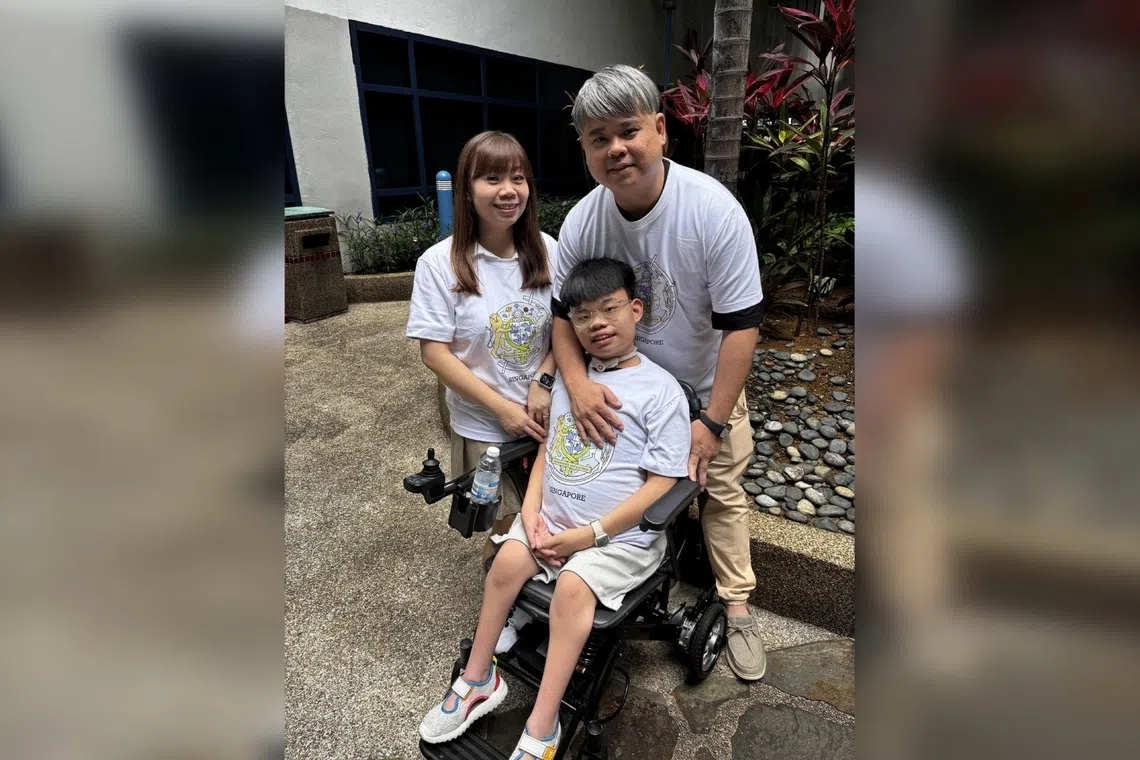
Jarren Ng has congenital hypomyelinating neuropathy, a rare hereditary disorder that causes severe muscle weakness due to a lack of myelin around the nerves. He is seen with his parents, Dawn Lee and Kelvin Ng.
ST PHOTO: JUDITH TAN
Published Oct 17, 2026, 12:00 PM
Updated Oct 17, 2026, 12:00 PM
Jarren Ng was born with congenital hypomyelinating neuropathy, a very rare nerve disorder. It causes weak muscles, low tone, and breathing problems.
Doctors first thought he had muscular dystrophy, but tests showed CHN. He has needed ICU care, tube feeding, a tracheostomy, and long-term ventilator support.
Now 16, Jarren is under a multidisciplinary team at KKH. Despite grim odds, he has finished his N Levels and hopes to work and become independent.
SINGAPORE – When secretary Dawn Lee was in her 29th week of pregnancy 16 years ago, she suffered a fever of 42 deg C and had to undergo an emergency caesarean.
“When I asked the nurse to bring my baby Jarren to be breast-fed, I was told he was in intensive care and had been diagnosed with a genetic condition,” Lee, 45, said.
His father, Kelvin Ng, remembered that the baby was in an incubator and receiving oxygen when he first set eyes on him.
“When I picked him up to carry him, he was very floppy, unlike his older brother Junius. He was then quickly pushed into NICU (neonatal intensive care unit),” recalled the 46-year-old information technology engineer.
Koh Ai Ling, a consultant with the Department of Genomic Medicine at KK Women’s and Children’s Hospital (KKH), said Jarren had low muscle tone, or hypotonia, at birth and needed breathing and feeding support.
It was initially thought that Jarren had muscular dystrophy, a genetic disorder that causes progressive muscle weakness, loss of muscle mass, and impaired mobility over time. However, his battery of tests pointed to a different diagnosis.
Koh said: “(Jarren) underwent various investigations, including blood investigations, brain imaging, muscle biopsy, electromyography (a test that measures muscle and nerve activity), a nerve conduction study and genetic testing. It was his nerve conduction study that was suggestive of congenital hypomyelinating neuropathy (CHN).”
She said CHN is a rare neurological disorder that affects the function of the peripheral nerves, which carry signals between the brain, spinal cord and the rest of the body.
“In CHN, the protective covering around the nerves, called myelin, does not develop normally. Myelin acts a little like the insulation around an electrical wire, helping nerve signals travel quickly and efficiently. When myelin is missing or poorly developed, nerve signals can be slowed or disrupted.
“Affected individuals may experience muscle weakness, low muscle tone, and breathing or swallowing difficulties,” Koh added.
By the age of six, Jarren (in the wheelchair) had already been through 14 operations. PHOTO: ST FILE
By the age of six, Jarren (in the wheelchair) had already been through 14 operations.
Lee said Jarren was frequently admitted to ICU, with each stay lasting months.
CHN is extremely rare, occurring in fewer than one in a million live births globally. There is no routine antenatal screening test specifically for the condition, as its symptoms can overlap with those of many other conditions, Koh said.
“In more severe cases, doctors notice signs during pregnancy or soon after birth. Reduced fetal movement, low muscle tone or weakness in a newborn may raise concerns about a neuromuscular disorder. (But) the severity can vary.
“Some babies show obvious weakness from birth, while others initially present with subtle signs that may go undetected. This means the diagnosis requires putting together several pieces of information over time,” Koh explained.
If a particular genetic cause is already known in a family, prenatal genetic testing may be possible. However, in Jarren’s case, Koh said the various genetic tests performed did not identify a genetic cause.
A condition with no cure
Like many rare genetic disorders, Jarren’s condition has no cure.
He was tube-fed through a nasogastric tube until he was two, when he underwent an operation to insert a PEG feeding button into his stomach. This is a short, flat feeding device that sits against the skin of his abdomen.
He also underwent a tracheostomy procedure that same year, and, due to the severity of his condition, Jarren relies on a ventilator for respiratory support, which is monitored by his respiratory physician.
He undergoes a sleep study every year to monitor his sleeping issues, especially at night, so that the doctors can adjust his ventilator settings when required.
Jarren is under the care of a multidisciplinary team from the Children’s Complex and Home Care Services, including allied health specialists in physiotherapy, occupational therapy, speech and language therapy and dietetics.
His main doctor, senior consultant Cristelle Chow of the General Paediatrics Service (Children’s Complex and Home Care Services), said: “The active interventions for Jarren include nocturnal ventilator support through a tracheostomy and a motorised wheelchair.
“The therapists regularly assess his physical and mobility needs, as well as the support he may need with everyday activities such as dressing, bathing, eating and moving around. A dietitian addresses his nutritional needs, which change as he grows older.”
Chow, on the other hand, looks after his general health and routine care needs, such as vaccinations, school and psychological needs, and physical symptoms.
Jarren currently undergoes an annual microlaryngobronchoscopy, a procedure that uses a tiny camera and scope to examine the inside of a patient’s breathing passages. The procedure may not be needed when he becomes an adult.
While some medical literature says that, depending on the severity of the condition and the specific genetic mutation involved, some babies with CHN do not live past the age of three, Jarren has beaten those odds.
At 16, having completed his N-level exams, Jarren hopes to pursue a career in cybersecurity “to defend Singapore from cyberattacks”, he said.
“I am also looking forward to making new friends at ITE (Institute of Technical Education) next year.”
ST Medical Mysteries
KK Women's and Children's Hospital
《医学谜案》是一档聚焦罕见疾病或不寻常病症的系列节目。
吴嘉伦患有先天性髓鞘形成不足性神经病,这是一种罕见的遗传性疾病,由于神经周围缺乏髓鞘而导致严重的肌肉无力。他和他的父母李晓雯和吴凯文一起就诊。
《海峡时报》照片:朱迪思·谭
发布于2026年10月17日下午12:00
更新于2026年10月17日中午12:00
贾伦·吴出生时患有先天性髓鞘形成不良性神经病,这是一种非常罕见的神经系统疾病。它会导致肌肉无力、肌张力低下和呼吸困难。
医生最初认为他患有肌营养不良症,但检查结果显示为先天性神经营养不良。他需要重症监护、管饲、气管切开术和长期呼吸机支持。
现年16岁的贾伦在KKH医院接受多学科团队的治疗。尽管面临重重困难,他还是完成了N水准考试,并希望将来能够工作,实现经济独立。
新加坡——16年前,秘书李晓雯怀孕29周时,发烧至42摄氏度,不得不接受紧急剖腹产手术。
“当我要求护士把我的宝宝贾伦抱过来喂母乳时,我被告知他正在重症监护室,并且被诊断出患有遗传性疾病,”45岁的李说。
他的父亲 Kelvin Ng 回忆说,他第一次见到孩子时,孩子正在保温箱里吸氧。
“我抱起他的时候,他软绵绵的,跟他哥哥朱尼厄斯完全不一样。然后他就被迅速送进了新生儿重症监护室(NICU)。”这位46岁的信息技术工程师回忆道。
KK妇女儿童医院(KKH)基因组医学科顾问许爱玲表示,贾伦出生时肌肉张力低下,需要呼吸和喂养支持。
最初人们认为贾伦患有肌营养不良症,这是一种遗传性疾病,会导致进行性肌肉无力、肌肉量减少和行动不便。然而,一系列检查结果指向了另一种诊断。
Koh说:“(Jarren)接受了各种检查,包括血液检查、脑部影像检查、肌肉活检、肌电图(一种测量肌肉和神经活动的检查)、神经传导研究和基因检测。他的神经传导研究结果提示他可能患有先天性髓鞘形成不足性神经病(CHN)。”
她说,CHN 是一种罕见的神经系统疾病,会影响周围神经的功能,而周围神经负责在大脑、脊髓和身体其他部位之间传递信号。
“在先天性神经性麻痹症(CHN)中,包裹神经的保护层——髓鞘——发育异常。髓鞘的作用类似于电线的绝缘层,帮助神经信号快速有效地传递。当髓鞘缺失或发育不良时,神经信号的传递速度会减慢或中断。”
Koh补充说:“受影响的人可能会出现肌肉无力、肌肉张力低下以及呼吸或吞咽困难等症状。”
六岁时,坐在轮椅上的贾伦已经接受了14次手术。照片:ST档案
六岁时,坐在轮椅上的贾伦已经接受了 14 次手术。
李说,贾伦经常被送进重症监护室,每次住院时间长达数月。
Koh表示,先天性中性粒细胞减少症(CHN)极其罕见,全球活产婴儿中发病率低于百万分之一。由于其症状与其他许多疾病的症状重叠,目前尚无针对该病的常规产前筛查。
“在更严重的情况下,医生会在怀孕期间或出生后不久注意到一些迹象。胎动减少、新生儿肌肉张力低下或无力可能引起对神经肌肉疾病的担忧。(但是)严重程度可能有所不同。”
“有些婴儿出生时就表现出明显的虚弱,而另一些婴儿最初出现的症状则比较轻微,可能难以察觉。这意味着诊断需要随着时间的推移,将多种信息整合起来,”Koh解释道。
如果家族中已知存在某种特定的遗传病因,则可以进行产前基因检测。然而,科赫表示,在贾伦的案例中,所进行的各种基因检测均未能确定遗传病因。
一种无法治愈的疾病
和许多罕见的遗传疾病一样,贾伦的病情目前无法治愈。
他两岁之前一直通过鼻饲管进食,之后接受了手术,在胃部植入了一个经皮内镜下胃造瘘术(PEG)喂食装置。这是一种短而扁平的喂食装置,贴合在他腹部的皮肤上。
同年,他还接受了气管切开术。由于病情严重,贾伦需要依靠呼吸机进行呼吸支持,他的呼吸科医生会对其进行监测。
他每年都会接受睡眠研究,以监测他的睡眠问题,尤其是夜间睡眠问题,以便医生在必要时调整他的呼吸机设置。
贾伦目前由儿童综合护理和家庭护理服务部门的多学科团队负责照料,其中包括物理治疗、职业治疗、言语和语言治疗以及营养学等专职医疗人员。
他的主治医生,普通儿科服务(儿童综合及家庭护理服务)高级顾问 Cristelle Chow 说:“对 Jarren 的积极干预措施包括通过气管切开术进行夜间呼吸机支持和使用电动轮椅。
“治疗师会定期评估他的身体状况和行动能力,以及他在穿衣、洗澡、吃饭和活动等日常活动中可能需要的帮助。营养师会根据他年龄增长而变化的营养需求来制定治疗方案。”
另一方面,周先生负责照顾他的整体健康和日常护理需求,例如接种疫苗、学校和心理需求以及身体症状。
贾伦目前每年都要接受一次显微喉支气管镜检查,这项检查使用微型摄像头和内窥镜来检查患者呼吸道的内部情况。他成年后可能就不需要再做这项检查了。
虽然一些医学文献指出,根据病情的严重程度和所涉及的具体基因突变,一些患有先天性肾病的婴儿活不过三岁,但贾伦打破了这种局面。
16岁的贾伦已经完成了N水准考试,他希望从事网络安全方面的工作,“以保护新加坡免受网络攻击”,他说。
“我也很期待明年在工艺教育学院(ITE)结交新朋友。”
ST 医学谜案
KK妇女儿童医院