America’s Elite Flying Unit That Made The Recent Long-Range Hostage Rescue In Africa Possible美国精英飞行部队促成了近期在非洲的远程人质营救行动
The Nigerian rescue mission shows how CV-22B Ospreys and MC-130J Commando IIs based in the UK are truly America's "9-1-1" force.
Updated Nov 27, 2020 6:02 PM EST
A dramatic mission conducted in the early hours of October 31, 2020, saw members of the elite SEAL Team Six rescue American citizen Philip Walton, who was kidnapped in the northwest African country of Niger and then taken to neighboring Nigeria. News of Walton’s safe extraction threw the spotlight directly upon U.S. Special Operations Command (SOCOM) as reports, including here at The War Zone , revealed the daring mission brought together a raft of air assets, including CV-22B Ospreys and MC-130J Commando IIs , as well as KC-135R tankers to support their long-range mission.
Unconfirmed reports now indicate that the raiding party of special operators parachuted into an area near where Walton was being held, probably from the MC-130Js, with the CV-22Bs then safely recovering the assault team and the hostage.
The special operations Ospreys and their MC-130J Commando II companion aircraft used in October’s mission came from the 352nd Special Operations Wing (SOW) and the KC-135R tankers came from the 100th Air Refueling Squadron, all of which are based at RAF Mildenhall, in the UK. This unique and elite team is tailored to swiftly execute exactly this kind of high-stakes mission as America’s regional “9-1-1” emergency response force for Europe and Northern Africa.
A 352nd SOW CV-22B moves in to receive fuel from an MC-130J., Jamie Hunter
Assembling the required assets for the rescue detail saw the activation of as many as six Ospreys and no less than four MC-130Js, which dashed from their base in the United Kingdom to Naval Air Station Rota, in Spain. Four of these forward-deployed Ospreys were subsequently launched for the clandestine long-range, round-trip to Nigeria, where Walton was being held. Four KC-135Rs joined the assault, and these were used to refuel the MC-130Js, which in turn topped-up the fuel tanks of the Ospreys in order to facilitate such a long-range rescue, that spanned at least 1,700 miles each way. The mission also included an AC-130J gunship , which was likely to have provided top cover during the actual extraction phase, along with a U.S. Navy P-8A Poseidon , which likely employed its sensors and communications to provide command and control and overwatch support.
This mission clearly illustrates why Air Force Special Operations Command (AFSOC) placed so much importance on procurement of the CV-22, a requirement that largely rose out of the ashes of a failed attempt to rescue American hostages held by Iranian revolutionaries on April 24, 1980. Operation Eagle Claw involved eight RH-53D Sea Stallion helicopters and six C-130s, three MC-130E Combat Talon special operations transports and three EC-130E Airborne Battlefield Command and Control Center (ABCCC) aircraft, which were used for an ambitious rescue attempt that ended in disaster when one of the RH-53s crashed into a parked EC-130E during a remote refueling operation deep in the Iranian desert, killing five 8th Special Operations Squadron Airmen and three Marines.
Speaking at a memorial ceremony in 2017 , the then vice commander of AFSOC Maj Gen Mike Plehn said: “I would tell you that all of those who participated in that daring mission deserve our unwavering gratitude, for they changed the way American special operations forces are organized, trained, equipped, and conducted.” Lessons learned from Eagle Claw laid the foundation of future U.S. special operations forces capabilities, including the eventual introduction of the Osprey decades later.
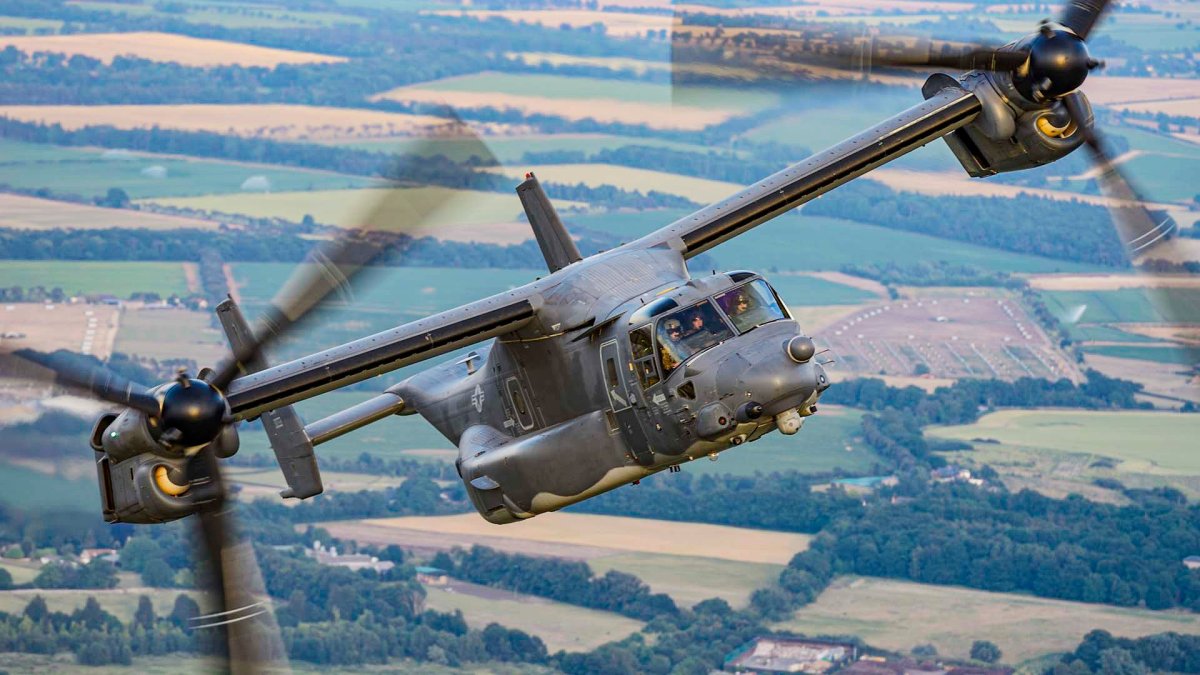
A CV-22B Osprey flies on a low-level mission from RAF Mildenhall., Jamie Hunter
Mildenhall’s modern AFSOC team
Today, the 352nd SOW is AFSOCs emergency service for Special Operations Command Europe ( SOCEUR ), and Special Operations Command Africa ( SOCAFRICA ). It supports all manner of covert and clandestine missions and short-notice calls to action during any number of crises, as evidenced by this rescue.
A popular saying within this wing is: “If they know we are coming, we are too late.” It’s a mantra that lends itself well to its bread and butter operations, which are often conducted in some of the most hostile regions on the planet.
The Bell-Boeing CV-22B Osprey entered service with the 1st SOW at Hurlburt Field, Florida, in early 2007 and its first operational deployment began in March 2010, when six Ospreys headed into battle in Afghanistan. Many of the senior officers in today’s CV-22 community are former Sikorsky MH-53 Pave Low operators. While some were initially skeptical, most will probably concede that the popular MH-53 could never perform the kind of long-range missions, which often occur in the dark of night and at low-level , that the CV-22B now takes in stride.
The 352nd SOW came into being in 2015 at RAF Mildenhall when the 352nd Special Operations Group was redesignated and expanded amid a major recapitalization effort that saw Lockheed Martin MC-130J Commando IIs replace aging MC-130H Combat Talon IIs and MC-130P Combat Shadows, and CV-22B Ospreys effectively replacing the Sikorsky MH-53M Pave Low IV, which had actually been retired since 2008. The first of 10 CV-22Bs for the wing arrived at Mildenhall in June 2013 . The CV-22B and the MC-130J now provide the cornerstone for a whole new level of forward-based aerial special operations transport capability for AFSOC.
The arrival of the CV-22B in Europe to join Mildenhall’s 7th Special Operations Squadron (SOS) opened up a raft of operational scenarios for AFSOC. Today’s Osprey is a battle-proven workhorse with many years of hard fighting in very harsh conditions behind it. The most obvious improvement over the MH-53 came in terms of speed and range. The CV-22B can travel up to 2,100 nautical miles (3,889 kilometers) with a single aerial refueling. This tiltrotor is tailor-made for inserting special operations teams, combining the speed and range of a fixed-wing aircraft, with the ability to transition into vertical flight and disgorge troops on the ground like a helicopter. The act of inserting special operators can also be achieved at higher altitude via parachute, or near the ground via fast-roping.
Special operators fast-rope from a CV-22B., Jamie Hunter
Versatility is a powerful attribute of the Osprey. Its cabin can be configured for up to 24 troops. The CV-22B can take all the special ops “toys” into the fight, including small tactical vehicles and motorcycles. It can even carry snowmobiles, small boats, and jet skis, plus litter kits for humanitarian or medical evacuation (medevac) roles.
The CV-22B is bristling with technology, with terrain-following radar, satellite communications, advanced countermeasures, and electronic surveillance systems. The 7th SOS routinely flies low-level training missions in the United Kingdom, and, with the current mission systems, pilots typically set the terrain-following radar and fly the aircraft manually, using the radar indications to climb or descend. Typically, one of the flight engineers will assist the pilot and co-pilot by providing a lookout during high workload sections of the mission.
While the 7th SOS is not a dedicated Personnel Recovery (PR) squadron, like the HH-60G Pave Hawk Rescue Squadrons of Air Combat Command, this is an important sub-mission for the CV-22 community. Indeed, the advent of the Osprey opened up the potential to undertake long-range PR missions within AFSOC like never before.
When it comes to PR missions, such as recovering a downed pilot, speed is truly of the essence. Ospreys are able to react faster to urgent taskings, arriving on-scene from farther away and quicker than traditional helicopters. Its speed and range offer additional survivability, as well. The 7th SOS has personnel on a high state of alert to rapidly deploy, if required.
The MC-130J and CV-22B work as a close team, with the Commando II able to refuel the Osprey in flight., Jamie Hunter
As well as SEAL Team Six , it’s very possible that members of the 321st Special Tactics Squadron at Mildenhall were also aboard the 352nd SOW aircraft for this mission. This unit includes pararescuemen (PJs) and combat controllers, the latter of which can secure assault zones and provide pop-up air traffic control and long-range secure command and control communications. The PJs are highly-skilled operators and focus is on the medical side — they are known for their skills in battlefield trauma care.
In-flight refueling is a critical factor in maximizing the range of the CV-22Bs. The 67th SOS “Night Owls” at Mildenhall traded their MC-130P Combat Shadows for brand new MC-130J Commando IIs. These support this type of long-range operation by Ospreys, with the Hercules’ providing fuel in flight, whilst also being able to penetrate hazardous areas to conduct infiltration, exfiltration, and resupply of special operations forces via airdrop or landing on austere strips, if required. They can even be used as gas stations on the ground, providing fuel to thirsty aircraft as part of a forward arming and refueling point (FARP) , deep inside contested areas.
AFSOC MC-130J crews typically consist of two pilots, two loadmasters, and a Combat Systems Officer (CSO). The CSO handles mission management, provides an extra pair of eyes while flying a low-level, and runs the in-flight refueling portion of a flight.
Initially, the MC-130J lacked some of the advanced mission systems that were fielded by the MC-130H predecessor , notably a terrain-following/terrain-avoidance radar system for use while flying at low-level at night and in harsh weather conditions. Pilots had to instead rely on Night Vision Goggles (NVGs) and a Forward-Looking Infrared (FLIR) sensor, which limits the conditions in which low-level flight can be executed.
A 67th SOS MC-130J flying near RAF Mildenhall., Jamie Hunter
Development of the Raytheon AN/APQ-187 Silent Knight terrain-following/terrain avoidance radar was a priority for the MC-130J, and you can read more about it here in this previous War Zone piece. Silent Knight is a critical capability for both the Commando II and the CV-22B, and beginning in 2021, the AFSOC Ospreys will start receiving this system to replace the existing AN/APQ-186 Multi-Mode Radar (MMR) as part of the Block 30 upgrade.
Trials of the Silent Knight system were conducted this summer on a CV-22B. “This capability is vital for the CV-22 mission and one of the most important differentiators between the Air Force model and the other services,” said Capt Megan Burk, team lead and flight test engineer with the 413th FLTS at Eglin Air Force Base, Florida.
Missions like the one undertaken on October 31 are fraught with danger. Niger, where the U.S. military formally opened a new base last year, is a major hub for counter-terrorism operations in the region. Nigeria has been battling the Islamist terrorist group Boko Haram , and its splinter faction, the Islamic State’s West Africa Province (ISWAP), for years now, and Nigeria has also been an important regional partner for the U.S. in combating terrorism in northwest Africa. It is understood that Marine Corps special operations units deployed in northwest Africa, along with the Central Intelligence Agency (CIA) provided details as to the whereabouts of Mr. Walton that made the raid possible.
Underlining the risks involved, an AC-130J Ghostrider gunship provided precision top cover for the mission. Unlike the U.S. Marine Corps, which has aspirations to enable its MV-22s to swing into a limited Close Air Support (CAS) role if required, AFSOC prefers to use the CV-22B as part of a mission package. Its primary CAS platform is the AC-130 , which is typically expected to fly overhead as the team presses into the assault area. Its massive arsenal of weaponry, advanced sensors, and ability to provide fire support with surgical precision, make it ideal for keeping any threats from interfering with the assault team.
The view from the cockpit as an MC-130J prepares to refuel from a KC-135R., Jamie Hunter
Illustrating the inherent risks, a similar mission on December 21, 2013, nearly ended in disaster. On that occasion, CV-22Bs were drafted in to conduct a rescue mission in southern Sudan. Three CV-22Bs from the 8th SOS flew from Camp Lemonnier, Djibouti, towards the city of Bor, where fighting had trapped 30 American civilians. About to touchdown at a planned landing site, in what had been briefed as a safe location at a United Nations compound, a barrage of ground fire enveloped the Ospreys.
According to a report released by the 1st SOW, the three aircraft suffered severe damage and four SEALs on the lead Osprey suffered critical injuries as rounds penetrated the cabin. The damaged CV-22Bs made for Entebbe airport in Uganda, some 500 miles away, refueling from an MC-130 en route. Air Force Major Benjamin Fingarson , who was flying one of the CV-22s, later commented: “There is not another aircraft in the world that could have done what we did that day.”
Teaming CV-22B Ospreys with MC-130Js gives AFSOC a powerful ability to rapidly undertake missions such as the one conducted in the early hours of October 31. Regular training is imperative in order to ensure that when these assets come together, they can work coherently.
Inside the cockpit of an MC-130J Commando II., Jamie Hunter
For the CV-22B, this mission illustrates once again how the tilt-rotor has come of age. It entered service amid criticism and concerns over cost and reliability. Yet today, these awkward-looking machines show up all over the world and pull off their complex missions successfully.
The type of mission that was launched on October 31 reflects a focus for AFSOC over the past two decades, having largely concentrated on countering violent extremist organizations. AFSOC hosted a weapons and tactics conference between August 24 – Sept. 3, 2020, as part of an overall tactics review and designed around the mantra of “Competing Now and in the Next Conflict — SOF Operations in the Joint Fight.”
“Pre 9-11, we were executing rapid crisis response, conducting short-duration contingency operations, and most frequently, supporting the larger joint force with specialized capabilities,” commented AFSOC commander Lieutenant General Jim Slife, adding that AFSOC post 9-11 transitioned from short-duration crisis and contingency response to sustained combat operations. “We are at another inflection point and the strategic landscape has shifted fundamentally, yet again underneath us,” Slife noted, underscoring an overall shift towards preparing for high-end, near-peer threats.
Part of that shift involved AFSOC supporting other branches of the USAF such as Air Combat Command. Indeed, AFSOC has recently exercised the rapid set-up of austere locations for agile basing of fighter aircraft.
A CV-22B slips away from a landing zone under the cover of darkness., Jamie Hunter
At RAF Mildenhall, AFSOC has been gearing up for other major changes around plans to close in the base by 2027, with the 352nd SOW planned to relocate to Continental Europe. However, the decision has now been made to retain Mildenhall as it has been deemed as “crucial to operational efficiency” of U.S. forces in Europe. Instead, the U.S plans to close bases in Germany . Air Force Colonel Robert Horton, Vice Commander for the 352nd Special Operations Wing said recently: “One of our most important missions is to provide worldwide responsive combat airpower and support to the European theatre… Our Air commandos stay ready to support the full spectrum of SOF missions, any time, any place.”
Notably, the kind of dynamic low-level flying training, which is so important to AFSOC CV-22B and MC-130 crews, isn’t permitted in Germany, where the 352nd SOW was due to relocate. Therefore, it makes perfect sense to retain this special ops team in the United Kingdom, so it can make good use of the extensive low-level and other flight training areas around the country.
A pair of AFSOC CV-22Bs on a day into night mission., Jamie Hunter
Maintaining readiness by effectively training together means that when the call to action comes, the CV-22B/MC-130J team is able to swing into action and swiftly deliver the kind of decisive action that was seen on October 31.
Above all else, this most recent and highly-successful very long-range hostage rescue mission was really a showcase of how the special operations community can combine to pull off what just a decade ago would not have been impossible. The 352nd SOW, with its nest in Europe’s doorstep, along with its colocated KC-135R tankers, sit ready to rapidly reach out thousands of miles to deal with rapidly evolving situations in a manner that only they can. They truly provide a 9-1-1 rescue and direct action transport force for combatant commanders that are tasked with operations in Europe and Africa.
As was made abundantly clear in late October, when that emergency phone rings, they certainly answer the call, and then some.
Contact the editor: Tyler@thedrive.com
Comments couldn’t be loaded. Please refresh the page.
更新于美国东部时间2020年11月27日下午6:02
2020年10月31日凌晨,美国特种部队第六分队执行了一项惊心动魄的任务,成功解救了在非洲西北部国家尼日尔被绑架并被带到邻国尼日利亚的美国公民菲利普·沃尔顿。沃尔顿安全获救的消息迅速将美国特种作战司令部(SOCOM)推向风口浪尖。包括《战区》(The War Zone)在内的多家媒体报道称,此次大胆的行动动用了大量空中力量,包括CV-22B“鱼鹰”倾转旋翼机、MC-130J“突击队员II”运输机以及KC-135R加油机,为远程救援行动提供支援。
未经证实的报道显示,特种作战突击队可能乘坐 MC-130J 飞机空降到沃尔顿被关押地点附近的区域,然后 CV-22B 飞机安全地接回了突击队和人质。
参与10月份任务的特种作战“鱼鹰”倾转旋翼机及其MC-130J“突击队员II”型伴飞机来自第352特种作战联队(SOW),KC-135R加油机则来自第100空中加油中队,所有这些单位都驻扎在英国米尔登霍尔皇家空军基地。这支精锐的独特队伍,正是为迅速执行此类高风险任务而量身打造的,作为美国在欧洲和北非地区的“911”紧急救援力量。
第352特种作战联队的一架CV-22B飞机正在从一架MC-130J加油机上接收燃料。——杰米·亨特
为了集结救援所需的资源,美军动用了多达六架“鱼鹰”倾转旋翼机和至少四架MC-130J运输机,从英国基地迅速飞往西班牙罗塔海军航空站。随后,四架前沿部署的“鱼鹰”被派往尼日利亚,执行秘密的长途往返任务,营救被关押在那里的沃尔顿。四架KC-135R加油机也加入了救援行动,它们为MC-130J加油,MC-130J再为“鱼鹰”加油,以确保此次单程至少1700英里的长途救援行动顺利进行。此外,行动中还包括一架AC-130J炮艇机,它很可能在实际撤离阶段提供空中掩护;以及一架美国海军P-8A“海神”反潜巡逻机,它很可能利用其传感器和通信设备提供指挥控制和空中支援。
这次任务清楚地表明了空军特种作战司令部(AFSOC)为何如此重视采购CV-22,这一需求很大程度上源于1980年4月24日营救被伊朗革命者扣押的美国人质行动的失败。“鹰爪行动”动用了8架RH-53D“海种马”直升机、6架C-130运输机、3架MC-130E“战斗爪”特种作战运输机和3架EC-130E空中战场指挥控制中心(ABCCC)飞机,执行一项雄心勃勃的营救行动。然而,行动最终以灾难告终:一架RH-53直升机在伊朗沙漠深处进行远程加油作业时撞上一架停放的EC-130E,导致5名第8特种作战中队空军人员和3名海军陆战队员丧生。
在2017年的一次纪念仪式上,时任美国空军特种作战司令部副司令迈克·普莱恩少将说道:“我要告诉大家,所有参与那次英勇任务的人都值得我们由衷的感激,因为他们改变了美国特种作战部队的组织、训练、装备和作战方式。” “鹰爪行动”汲取的经验教训为未来美国特种作战部队的能力奠定了基础,包括数十年后最终引进的“鱼鹰”倾转旋翼机。
一架CV-22B“鱼鹰”倾转旋翼机从英国皇家空军米尔登霍尔基地执行低空飞行任务。(杰米·亨特摄)
米尔登霍尔的现代化 AFSOC 团队
如今,第352特种作战联队是美国空军特种作战司令部欧洲特种作战司令部(SOCEUR)和非洲特种作战司令部(SOCAFRICA)的紧急支援部队。它支持各种秘密行动和突发危机中的紧急行动,正如这次救援行动所证明的那样。
该部门内部流传着一句谚语:“如果他们知道我们要来,那就太迟了。” 这句格言非常契合其主要行动的宗旨,这些行动通常是在地球上一些最危险的地区进行的。
贝尔-波音CV-22B“鱼鹰”倾转旋翼机于2007年初在佛罗里达州赫尔伯特机场的第1特种作战联队服役,并于2010年3月首次投入作战部署,当时六架“鱼鹰”前往阿富汗参战。如今CV-22部队的许多高级军官都曾是西科斯基MH-53“铺路低空”直升机的操作员。虽然最初有些人持怀疑态度,但大多数人可能会承认,广受欢迎的MH-53根本无法执行CV-22B如今轻松应对的那种远程任务,尤其是那些通常在夜间低空进行的飞行任务。
第352特种作战联队于2015年在英国皇家空军米尔登霍尔基地成立,当时第352特种作战大队在一次大规模的装备更新换代中进行了重新命名和扩编。此次更新换代中,洛克希德·马丁公司的MC-130J“突击队员II”运输机取代了老旧的MC-130H“战斗爪II”和MC-130P“战斗阴影”运输机,而CV-22B“鱼鹰”倾转旋翼机则有效地取代了西科斯基公司的MH-53M“铺路低空IV”直升机(该机型实际上已于2008年退役)。该联队订购的10架CV-22B中的第一架于2013年6月抵达米尔登霍尔基地。如今,CV-22B和MC-130J为美国空军特种作战司令部(AFSOC)前沿部署的空中特种作战运输能力奠定了全新的基础。
CV-22B抵达欧洲加入米尔登霍尔空军基地的第7特种作战中队(SOS)后,为美国空军特种作战司令部(AFSOC)开辟了一系列作战场景。如今的“鱼鹰”倾转旋翼机久经沙场,在极其恶劣的环境下经历了多年的艰苦战斗。与MH-53相比,最显著的改进体现在速度和航程上。CV-22B单次空中加油即可飞行2100海里(3889公里)。这款倾转旋翼机专为特种作战小队部署而设计,它兼具固定翼飞机的速度和航程,并能像直升机一样垂直起降,将部队投放至地面。此外,特种作战人员还可以通过降落伞在高空投放,或通过快速绳降在近地面投放。
特种作战人员从CV-22B运输机上快速绳降。——杰米·亨特
多功能性是“鱼鹰”倾转旋翼机的一大优势。其座舱最多可容纳24名士兵。CV-22B能够携带所有特种作战“装备”投入战斗,包括小型战术车辆和摩托车。它甚至可以运载雪地摩托、小型船只和水上摩托艇,以及用于人道主义救援或医疗后送的担架包。
CV-22B 搭载了众多先进技术,包括地形跟踪雷达、卫星通信系统、先进的对抗措施和电子监视系统。第7特种作战中队经常在英国进行低空训练任务。在目前的任务系统中,飞行员通常需要设置地形跟踪雷达并手动操控飞机,根据雷达指示进行爬升或下降。通常情况下,一名飞行工程师会在任务高负荷阶段协助飞行员和副驾驶进行瞭望。
虽然第7特种作战中队并非像空战司令部的HH-60G“铺路鹰”救援中队那样专门执行人员救援任务,但这对于CV-22部队来说是一项重要的子任务。事实上,“鱼鹰”的出现使美国空军特种作战司令部(AFSOC)以前所未有的方式开展远程人员救援任务。
在救援坠机飞行员等公共关系任务中,速度至关重要。鱼鹰运输机能够更快地响应紧急任务,比传统直升机从更远的距离更快抵达现场。其速度和航程也提高了生存能力。第7特种作战中队人员保持高度戒备状态,以便在需要时迅速部署。
MC-130J 和 CV-22B 配合默契,其中“突击队员 II”能够为“鱼鹰”倾转旋翼机进行空中加油。——杰米·亨特
除了海豹突击队第六分队之外,驻扎在米尔登霍尔的第321特种战术中队的成员很可能也搭乘了第352特种作战联队的飞机执行此次任务。该部队包括伞降救援队员(PJs)和战斗控制员,后者负责确保突击区域的安全,并提供临时空中交通管制和远程安全指挥控制通信。伞降救援队员是训练有素的特种作战人员,他们的重点是医疗方面——他们以战场创伤救护技能而闻名。
空中加油是最大化CV-22B航程的关键因素。驻扎在米尔登霍尔的第67特种作战中队“夜猫子”用全新的MC-130J“突击队员II”型飞机替换了原有的MC-130P“战斗阴影”型飞机。这些新飞机支持“鱼鹰”倾转旋翼机执行此类远程作战任务,大力神运输机可在空中为其提供燃料,同时还能深入危险区域,执行渗透、撤离和特种作战部队的补给任务,必要时可通过空投或在简易跑道上降落。它们甚至可以作为地面加油站,在敌对区域深处的前沿武器和加油点(FARP)为需要燃料的飞机提供燃料。
AFSOC MC-130J机组通常由两名飞行员、两名装卸长和一名作战系统官(CSO)组成。作战系统官负责任务管理,在低空飞行时提供额外的观察视角,并负责飞行中的空中加油部分。
最初,MC-130J缺少其前身MC-130H所配备的一些先进任务系统,特别是用于夜间和恶劣天气条件下低空飞行的地形跟踪/地形规避雷达系统。飞行员只能依靠夜视镜(NVG)和前视红外(FLIR)传感器,这限制了低空飞行的适用条件。
一架第67特种作战中队的MC-130J飞机在米尔登霍尔皇家空军基地附近飞行。(杰米·亨特摄)
雷神公司AN/APQ-187“静默骑士”(Silent Knight)地形跟踪/地形规避雷达的研发是MC-130J的优先事项,您可以在之前的《战区》(War Zone)文章中了解更多相关信息。“静默骑士”雷达对于“突击队员II”(Commando II)和CV-22B“鱼鹰”(Osprey)倾转旋翼机来说都是至关重要的能力。从2021年开始,作为Block 30升级的一部分,美国空军特种作战司令部(AFSOC)的“鱼鹰”倾转旋翼机将开始接收该系统,以替换现有的AN/APQ-186多模式雷达(MMR)。
今年夏天,CV-22B 进行了“寂静骑士”系统的试验。“这项能力对于 CV-22 的任务至关重要,也是空军机型与其他军种机型之间最重要的区别之一,”佛罗里达州埃格林空军基地第 413 飞行试验中队团队负责人兼飞行测试工程师梅根·伯克上尉说道。
像10月31日执行的那种任务充满危险。尼日尔是该地区反恐行动的重要枢纽,美国军方去年在那里正式开设了一个新基地。尼日利亚多年来一直在与伊斯兰恐怖组织博科圣地及其分裂派系“伊斯兰国西非省”(ISWAP)作战,尼日利亚也是美国在西北非打击恐怖主义的重要区域伙伴。据了解,部署在西北非的海军陆战队特种作战部队与中央情报局(CIA)提供了沃尔顿先生的下落信息,使得这次突袭行动成为可能。
为了凸显任务风险,一架AC-130J“幽灵骑士”炮艇机为此次任务提供了精准的空中掩护。与美国海军陆战队希望在必要时使其MV-22能够承担有限的近距离空中支援(CAS)任务不同,美国空军特种作战司令部(AFSOC)更倾向于将CV-22B作为任务组合的一部分。其主要的近距离空中支援平台是AC-130,通常会在突击队进入突击区域时进行空中巡逻。AC-130拥有大量的武器装备、先进的传感器以及精准的火力支援能力,使其成为防止任何威胁干扰突击队行动的理想选择。
从驾驶舱看到的景象:一架MC-130J正在准备从一架KC-135R加油机进行空中加油。(杰米·亨特摄)
为了说明此类任务固有的风险,2013年12月21日的一次类似任务险些酿成灾难。当时,CV-22B倾转旋翼机被派往苏丹南部执行救援任务。隶属于第8特种作战中队的3架CV-22B从吉布提的莱蒙尼尔营地起飞,前往博尔市,那里有30名美国平民被困在战斗中。飞机即将降落在预定的联合国营地内,该营地此前被告知是一个安全的着陆点,然而突然遭到地面猛烈火力袭击,三架“鱼鹰”倾转旋翼机瞬间被包围。
根据第一特种作战联队发布的报告,三架飞机严重受损,领头的“鱼鹰”倾转旋翼机上的四名海豹突击队员因炮弹穿透机舱而身负重伤。受损的CV-22B倾转旋翼机飞往约500英里外的乌干达恩德培机场,途中由一架MC-130加油机进行空中加油。驾驶其中一架CV-22的空军少校本杰明·芬格森后来评论道:“世界上没有任何其他飞机能够完成我们那天所做的一切。”
将 CV-22B 鱼鹰倾转旋翼机与 MC-130J 运输机编队部署,使美国空军特种作战司令部具备了快速执行任务的强大能力,例如 10 月 31 日凌晨执行的任务。定期训练至关重要,以确保这些资源协同作战时能够有效配合。
在MC-130J“突击队员II”型飞机的驾驶舱内,杰米·亨特
对于CV-22B而言,这次任务再次证明了倾转旋翼机已经发展成熟。它投入使用时曾饱受批评,人们也对其成本和可靠性表示担忧。然而如今,这些外形略显笨拙的机器已遍布世界各地,并成功完成了各种复杂的任务。
10月31日发起的这次任务体现了美国空军特种作战司令部(AFSOC)过去二十年来的重点,即主要致力于打击暴力极端组织。作为整体战术评估的一部分,AFSOC于2020年8月24日至9月3日举办了一次武器战术会议,会议围绕“在当下和未来冲突中竞争——联合作战中的特种作战部队行动”这一主题展开。
“9·11事件前,我们执行的是快速危机应对、短期应急行动,以及最常见的以专业能力支援大型联合部队,”美国空军特种作战司令部司令吉姆·斯莱夫中将评论道。他补充说,9·11事件后,美国空军特种作战司令部从短期危机和应急应对转向持续作战行动。“我们正处于另一个转折点,战略格局再次发生了根本性的变化,”斯莱夫指出,强调了整体战略重心正转向应对高端、势均力敌的威胁。
这一转变的一部分涉及空军特种作战司令部(AFSOC)对美国空军其他部门(例如空战司令部)的支持。事实上,AFSOC近期已演练了在简陋地点快速部署战斗机的机动能力。
一架CV-22B在夜幕掩护下悄悄离开了着陆区。——杰米·亨特
在英国皇家空军米尔登霍尔基地,空军特种作战司令部(AFSOC)一直在为基地关闭计划做准备,原计划于2027年前关闭该基地,并安排第352特种作战联队迁往欧洲大陆。然而,现在决定保留米尔登霍尔基地,因为它被认为对驻欧美军的“作战效率至关重要”。相反,美国计划关闭在德国的基地。第352特种作战联队副指挥官、空军上校罗伯特·霍顿近日表示:“我们最重要的任务之一是为欧洲战区提供全球快速响应的作战空中力量和支援……我们的空军突击队员随时准备在任何时间、任何地点支援特种作战部队的各项任务。”
值得注意的是,对于美国空军特种作战司令部(AFSOC)的CV-22B和MC-130机组人员来说至关重要的动态低空飞行训练,在原计划第352特种作战联队迁往的德国是不允许的。因此,将这支特种作战部队留在英国是完全合理的,这样他们就可以充分利用英国境内丰富的低空及其他飞行训练场地。
两架美国空军特种作战司令部CV-22B飞机正在执行昼夜任务。——杰米·亨特
通过有效的共同训练保持战备状态,意味着当行动的号召到来时,CV-22B/MC-130J 团队能够迅速投入行动,并迅速采取像 10 月 31 日那样果断的行动。
最重要的是,最近这次极其成功的远程人质营救任务充分展现了特种作战部队如何协同作战,完成十年前几乎不可能完成的任务。驻扎在欧洲近郊的第352特种作战联队及其配套的KC-135R加油机随时待命,能够迅速抵达数千英里之外,以他们独有的方式应对瞬息万变的局势。他们真正为负责欧洲和非洲作战的指挥官提供了一支如同“911”般的救援和直接行动运输力量。
十月下旬的情况已经充分表明,当紧急电话响起时,他们不仅会接听电话,还会做得更多。
联系编辑:Tyler@thedrive.com
评论加载失败,请刷新页面。