This Old Tanker Looks Like It’s About To Sink, But It’s Just Doing Its Job For The Marines这艘老旧的油轮看起来像是要沉没了,但它只是在为海军陆战队执行任务。
The antique ship has an odd way of doing its business, but it's still one of the best assets for supplying Marines with gobs of fuel ashore.
新闻视频
Updated Dec 1, 2019 7:13 AM EST
The SS Petersburg (T-AOT-9101), a 56-year-old Chesapeake class tanker operated by U.S. Maritime Administration, put to sea as part of a month-long exercise to demonstrate amphibious logistical capabilities that can be put to use in the Arctic environment. Arctic Expeditionary Capabilities Exercise (AECE) 2019 is mainly taking place in and around Alaska, including the Aleutian Islands, but elements of it are also being executed much further south. In SS Petersburg’s case, it left its mooring in Suisun Bay off Benicia, California, to exercise its core mission set—that being moving huge quantities of fuel from sea to shore—off of Coronado, California as part of the exercise. Exactly how it goes about doing this is pretty bizarre and looks even stranger to the average landlubber, to say the least.
The antique ship uses a massive device called a Single-Anchor Leg Mooring (SALM) buoy to work as a nexus of sorts that conveys fuel from ship all the way to the shore. The system’s barge-like apparatus sinks to the seafloor while leaving a buoy on the surface connecting it to the ship. Lines then carry large quantities of fuel from the ship to the barge and then to a weighted conduit that extends out all the way to shore—up to four miles away—laying along the bottom of the sea. That conduit ascends up the beach to a mobile receiving and distribution installation called a Beach Termination Unit (BTU) that is ferried ashore. The SALM can support up to four tankers offloading their fuel at once.
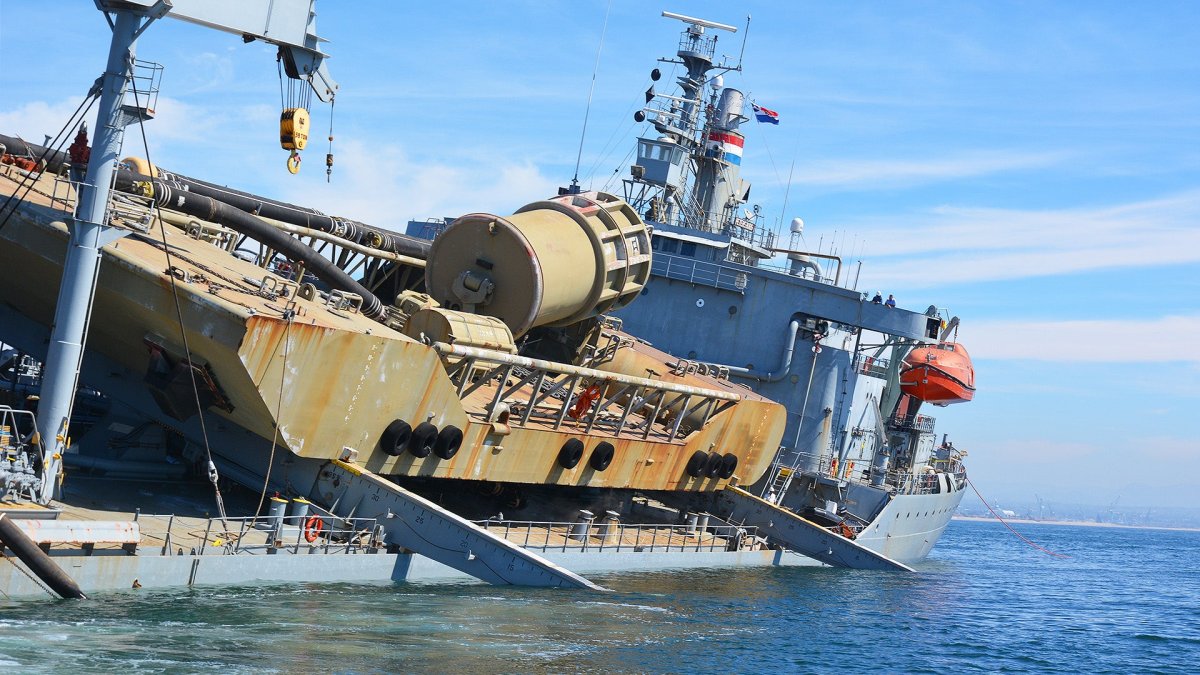
At first glance, it’s an odd and complex system, but it’s also effective and well-proven. Similar counterparts exist in the commercial world, as well. Petersburg can move a staggering 1,200,000 gallons of refined petroleum to an austere beachhead in a single day. But before the SALM can be put to work and the ship’s 225,000 barrels of fuel—as well as fuel from other tankers—can be sent ashore persistently, the huge SALM barge has to get from the ship’s deck into the ocean. That’s where the whole listing maneuver comes in to play.
The ship is built to be able to trim itself to list up to 15 degrees to port so that the SALM barge and buoy system can be shifted from its tilting deck platform into the ocean. The whole affair is bizarre if not downright unnerving looking:
Petersburg is one of five Offshore Petroleum Discharge System (OPDS) tankers that were built in the late 1950s and early 1960s that eventually found themselves assigned to the Ready Reserve Force. The tiny fleet was divided between three classes. Today, SS Petersburg is the last of the OPDSs, with her sistership SS Chesapeake , having been taken out of service in 2009.
SS Chesapeake listing 14 degrees in order to get her SALM barge into the water. The photo was taken in 2008, not long before she was put out of service for good., USN
The USMC currently relies on a number of methods for moving vast amounts of fuel from ship to shore. Remember that without gas, the modern Corps can’t fight and all of its vehicles and generator-dependent systems require copious amounts of fuel on a daily basis. A single new commercial ship under Military Sealift Command’s control, the MV Vice Adm. K.R. Wheeler , was introduced in 2007 to accomplish a similar role as SS Petersburg , but it is not a tanker and relies on other vessels to supply the fuel, acting as a node for transferring it from their holds to shore.
The Marines also leverage Navy LCAC hovercraft and landing ships to move fuel bladders and tanks ashore. The Navy’s new Expeditionary Transfer Docks will also come in handy for quickly transferring gas to the beach as needed. For higher volume, sustained operations, the Amphibious Bulk Liquid Transfer System (ABLTS) is used. It’s a far more modular and adaptable system—it can also pump fresh water—than what the SS Petersburg represents, but it isn’t as powerful and doesn’t have as long of a reach. It can be installed on different ships and can be rapidly deployed around the globe as required.
Amphibious Bulk Liquid Transfer System (ABLTS) in use during an exercise off of South Korea in 2017., USMC
Still, even with these newer capabilities, as it sits now, the SS Petersburg’s combined tanker and fuel transfer capabilities are unique and will cease to exist within the Pentagon’s portfolio when she is finally retired sometime in the future. The Marines have posited other concepts to replace some of this capability and to augment the capabilities they already have, but no firm plans for the Pentagon to procure additional dedicated vessels, and especially anything like the Petersburg, appear to be in place at this time.
A USMC document from 2016 displays a possible future concept for moving large amounts of fuel from ship to shore and then distributing it throughout an island system located within a contested environment., USMC
In many ways, SS Petersburg is a relic of times that may have finally passed us by—an age when massive beach landings were still seen as a highly plausible eventuality in a time of war. Fast forward to today and even smaller beach landings are becoming far less plausible. In fact, after years of debate, those at the top of the USMC’s power structure are admitting this and redesigning their procurement and combat strategies to focus less on amphibious landing operations and more on distributed forms of warfare across the maritime environment. You can read all about this new and controversial initiative in this past feature of ours .
Regardless of the highly questionable possibility of huge amphibious landings in the future, the need to move fuel from sea to shore without elaborate dock and transfer facilities hasn’t and won’t go away. In fact, the ability to do so more flexibly and numerously with smaller vessels and teams will likely define such a capability going forward, and not just for combat operations, but also for disaster relief and other contingency operations.
But until the Kennedy-era SS Petersburg pumps her last gallon, in the event that gobs of fuel are needing to be transferred from the sea to the beach, it’s still among the very best ships, if not the best ship for the job—even though it looks like it is about to sink while doing it.
Comments couldn’t be loaded. Please refresh the page.
更新于美国东部时间2019年12月1日上午7:13。
由美国海事管理局运营的56年船龄的切萨皮克级油轮“彼得斯堡”号(T-AOT-9101)出海,参与为期一个月的北极两栖后勤演习,旨在展示可在北极环境下使用的两栖后勤能力。2019年北极远征能力演习(AECE)主要在阿拉斯加及其周边地区(包括阿留申群岛)进行,但部分演习内容也在更南边的地区展开。“彼得斯堡”号此次离开位于加利福尼亚州贝尼西亚附近苏伊森湾的泊位,前往加利福尼亚州科罗纳多附近海域,演练其核心任务——将大量燃料从海上运送到岸上。其具体操作方式相当奇特,对于普通陆地居民来说,更是匪夷所思。
这艘古董船使用一种名为单锚腿系泊(SALM)浮标的大型装置,作为连接船舶和岸边的枢纽。该系统的驳船状装置沉入海底,同时在水面留下一个浮标与船舶连接。然后,缆绳将大量燃料从船舶输送到驳船,再输送到一条延伸至岸边(最远可达四英里)的加重管道,该管道铺设在海底。这条管道沿着海滩向上延伸至一个名为海滩终端单元(BTU)的移动式接收和分配装置,该装置由渡船运送至岸上。SALM装置最多可同时支持四艘油轮卸载燃料。
乍看之下,这套系统奇特而复杂,但它也十分有效且久经考验。商业领域也有类似的系统。圣彼得堡号一天之内就能将惊人的120万加仑精炼石油运送到简陋的滩头阵地。但在SALM系统投入使用,将船上22.5万桶燃料以及其他油轮的燃料持续输送到岸上之前,巨大的SALM驳船必须先从船甲板驶入大海。这就是整个倾斜操作发挥作用的地方。
这艘船的设计使其能够向左舷倾斜最多15度,以便将SALM驳船和浮标系统从其倾斜甲板平台移入海中。整个过程看起来十分怪异,甚至令人不安。
“彼得斯堡”号是五艘海上石油排放系统(OPDS)油轮之一,这些油轮建于20世纪50年代末至60年代初,最终被分配到预备役部队。这支小型船队分为三个级别。如今,“彼得斯堡”号是最后一艘OPDS油轮,其姊妹船“切萨皮克”号已于2009年退役。
为了将SALM驳船放入水中,切萨皮克号蒸汽船倾斜了14度。这张照片拍摄于2008年,不久之后,该船便永久退役了。(美国海军)
美国海军陆战队目前依赖多种方式将大量燃料从舰船运送到岸上。要知道,没有燃料,现代海军陆战队就无法作战,其所有车辆和依赖发电机的系统每天都需要大量的燃料。2007年,隶属于军事海运司令部的一艘新型商船“K·R·惠勒中将”号投入使用,其作用与“彼得堡”号油轮类似,但它并非油轮,而是依靠其他船舶供应燃料,充当燃料从货舱输送到岸上的中转站。
海军陆战队还利用海军的LCAC气垫登陆艇和登陆舰将燃料囊和油箱运送到岸上。海军新型的远征转运码头也能在需要时快速将燃料输送到海滩。对于更大容量、持续性的作业,则使用两栖散装液体输送系统(ABLTS)。与“彼得堡号”所代表的系统相比,ABLTS系统模块化程度更高,适应性更强——它还可以输送淡水——但其功率和输送距离都略逊一筹。ABLTS系统可以安装在不同的舰艇上,并可根据需要快速部署到全球各地。
2017年,美国海军陆战队在韩国附近海域进行演习时,使用了两栖散装液体输送系统(ABLTS)。
即便具备了这些新能力,就目前而言,“彼得堡”号的油轮和燃料转运能力仍然独一无二,而且随着它未来退役,五角大楼的此类能力也将不复存在。海军陆战队已经提出了一些方案来替代部分能力并增强现有能力,但目前五角大楼似乎还没有采购更多专用舰艇,尤其是类似“彼得堡”号的舰艇的明确计划。
一份2016年的美国海军陆战队文件展示了一种未来可能的概念,即在冲突环境中,将大量燃料从舰船运送到岸上,然后分发到岛屿系统的各个角落。
在许多方面,“圣彼得堡”号战列舰都像是早已逝去的时代的遗物——在那个时代,大规模海滩登陆在战争时期仍被视为极有可能发生的行动。而如今,即使是规模较小的海滩登陆也变得越来越不可能。事实上,经过多年的争论,美国海军陆战队高层也承认了这一点,并正在重新设计其采购和作战战略,减少对两栖登陆作战的依赖,更多地关注在海上环境中开展分布式作战。您可以在我们之前的专题报道中了解这项备受争议的新举措。
尽管未来大规模两栖登陆的可能性极低,但在没有复杂码头和转运设施的情况下将燃料从海上运送到岸上的需求依然存在,而且不会消失。事实上,未来此类能力的关键在于能够利用小型舰艇和团队更灵活、更高效地完成燃料运输,这不仅对作战行动至关重要,对灾难救援和其他应急行动也同样重要。
但是,在肯尼迪时代的“圣彼得堡号”邮轮耗尽最后一加仑燃油之前,如果需要将大量燃料从海上转移到海滩,它仍然是最好的船只之一,即使不是最好的——尽管它看起来像是在执行这项任务时即将沉没。
评论加载失败,请刷新页面。