See North Korea’s alleged ‘radioactive tsunami’ weapon test at sea观看朝鲜据称在海上进行的“放射性海啸”武器试验
The North has fired more than 20 ballistic and cruise missiles across 10 launch events this year as it tries to diversify its delivery systems.
SEOUL, South Korea — North Korea claimed Friday to have tested a nuclear-capable underwater drone designed to generate a gigantic “radioactive tsunami” that would destroy naval strike groups and ports. Analysts were skeptical that the device presents a major new threat, but the test underlines the North’s commitment to raising nuclear threats.
The test this week came as the United States reportedly planned to deploy aircraft carrier strike groups and other advanced assets to waters off the Korean Peninsula. Military tensions are at a high point as the pace of both North Korean weapons tests and U.S.-South Korea joint military exercises accelerated in the past year in a cycle of tit-for-tat responses.
Pyongyang’s official Korean Central News Agency said the new weapon, which can be deployed from the coast or towed by surface ships, is built to “stealthily infiltrate into operational waters and make a super-scale radioactive tsunami through an underwater explosion” to destroy enemy naval strike groups and ports.
The report came hours before South Korean President Yoon Suk Yeol pledged to make North Korea pay for its “reckless provocations” as he attended a remembrance service honoring 55 South Korean troops killed during major clashes with the North near their western sea border in past years.
The testing of the purported “nuclear underwater attack drone” was part of a three-day exercise that simulated nuclear attacks on unspecified South Korean targets, which also included cruise missile launches Wednesday.
The North Korean government released this image of what it says is a Hwasal strategic cruise missile seen during an exercise in the country's South Hamgyong province on March 22, 2023. (Korean Central News Agency/Korea News Service via AP)
KCNA said the North’s latest tests were aimed at alerting the United States and South Korea of a brewing “nuclear crisis” as they continue with their “intentional, persistent and provocative war drills.” It said the tests were supervised by North Korean leader Kim Jong Un, who vowed to make his rivals “plunge into despair.”
The U.S. and South Korea completed an 11-day exercise Thursday that included their biggest field training in years, and are preparing another round of joint naval drills that will reportedly involve a U.S. aircraft carrier.
Hours after the North Korean report, South Korea’s Air Force released details of a five-day joint aerial drill with the United States that began Monday and concluded Friday above waters off South Korea’s western coast, which included live-fire demonstrations of air-to-air and air-to-ground weapons.
The Air Force said the exercise, which involved various South Korean fighter jets and at least one U.S. A-10 attack plane, was aimed at verifying precision strike capabilities and reaffirming the credibility of Seoul’s “three-axis” strategy against North Korean nuclear threats — preemptively striking sources of attacks, intercepting incoming missiles, and neutralizing the North’s leadership and key military facilities.
The North Korean drone is named “Haeil,” a Korean word meaning tidal waves or tsunamis. The North’s Rodong Sinmun newspaper published photos of Kim smiling next to a large, torpedo-shaped object at an unspecified indoor facility, but didn’t identify it.
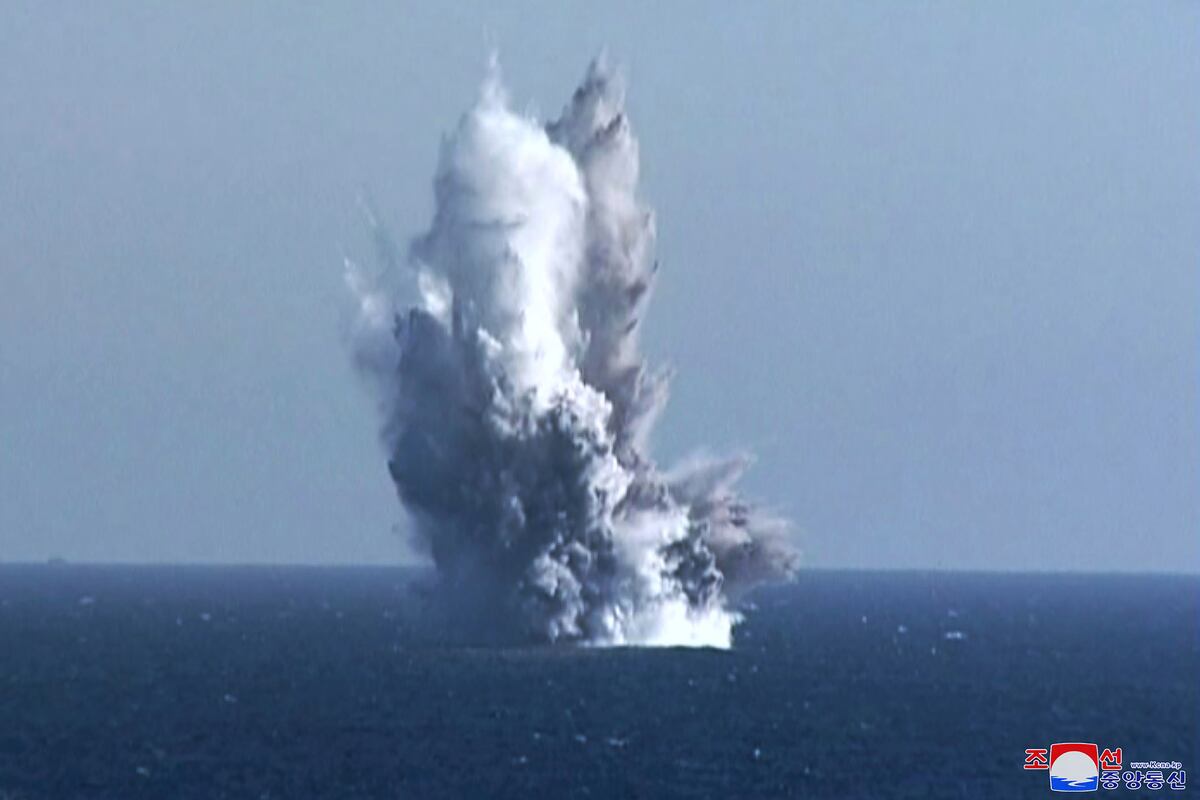
Other photos published with the same article showed sea-surface tracks supposedly caused by the drone’s underwater trajectory and a pillar of water exploding up into the air, possibly caused by what state media described as an underwater detonation of a mock nuclear weapon carried by the drone.
The North Korean government alleges this is an underwater blast of a test warhead loaded to an unmanned underwater nuclear attack craft, dubbed Haeil, seen during an exercise around Hongwon Bay in the waters off North Korea's eastern coast on March 23, 2023. (Korean Central News Agency/Korea News Service via AP)
KCNA said the drone was deployed Tuesday off the North’s eastern coast, traveled underwater for nearly 60 hours and detonated a test warhead at a target standing for an enemy port. It said the test verified the operational reliability of the drone, which it said the North has been developing since 2012 and tested more 50 times in the past two years, although the weapon was never mentioned before in state media until Friday.
Kim Dong-yub, a professor at Seoul’s University of North Korean Studies, said that it’s impossible to verify North Korea’s claims about the drone’s capabilities or that it had tested the system dozens of times. But, he said, the North is intending to communicate that the weapon has enough range to reach all South Korean ports.
Ankit Panda, a senior analyst at the Carnegie Endowment for International Peace, questioned the wisdom of North Korea devoting resources to the drone system as a means of delivery versus its ballistic missiles when it has limited amounts of nuclear materials suitable for weapons.
“This uncrewed underwater vehicle will be vulnerable to anti-submarine warfare capabilities if it were to deploy beyond North Korea’s coastal waters. It will also be susceptible to preemptive strikes when in port,” Panda said. “Indeed, the U.S. and South Korea would have incentives in a crisis to preempt any such systems before they could deploy.”
North Korea is believed to have dozens of nuclear warheads and may be capable of fitting them on older weapons systems, such as Scuds or Rodong missiles. However, there are different assessments on how far it has advanced in engineering those warheads to fit on the new weapons it has developed at a rapid pace, which might require further technological upgrades and nuclear tests.
Speaking to lawmakers on Thursday, South Korean Defense Minister Lee Jong-Sup said the North probably hasn’t yet mastered the technology to place nuclear arms on its most advanced weapons, but acknowledged the country was making “significant progress.”
On Wednesday, North Korea also test-fired cruise missiles in launches that were detected and publicized by South Korea’s military. It also staged another nuclear attack simulation with a short-range ballistic missile on Sunday and flight-tested an intercontinental ballistic missile last week that may be able to reach the continental United States.
KCNA said Wednesday’s tests were of four cruise missiles and two different types. The missiles flew for more than two hours in patterns over the sea while demonstrating an ability to strike targets 1,500 kilometers (932 miles) and 1,800 kilometers (1,118 miles) away. It said the missiles’ mock nuclear warheads were detonated 600 meters (1,969 feet) above their targets, which supposedly verified the reliability of their nuclear explosion control devices and warhead detonators.
KCNA said Kim Jong Un was satisfied with the three-day drills and directed unspecified additional tasks to counter the “reckless military provocations” of his rivals, indicating North Korea will further ramp up its military displays.
He “expressed his will to make the U.S. imperialists and the [South] Korean puppet regime plunge into despair” with powerful demonstrations of his military nuclear program to make his rivals understand “they are bound to lose more than they get” with the expansion of their joint drills.
Kim issued similar language Sunday after a test-firing of a short-range ballistic missile from what was possibly a silo dug into the ground. The North’s media said a mock nuclear warhead placed on the missile detonated 800 meters above water, an altitude that would maximize damage.
The North has fired more than 20 ballistic and cruise missiles across 10 launch events this year as it tries to diversify its delivery systems and display the ability to conduct nuclear strikes on both South Korea and the U.S. mainland.
North Korea already is coming off a record year in testing activity, with more than 70 missiles fired in 2022, as Kim accelerated a campaign aimed at negotiating badly needed sanctions relief from a position of strength and forcing the United States to accept the idea of the North as a nuclear power.
韩国首尔——朝鲜周五声称测试了一种可携带核弹头的水下无人潜航器,该潜航器旨在制造巨大的“放射性海啸”,摧毁海军打击群和港口。分析人士对该装置能否构成重大新威胁持怀疑态度,但此次试验凸显了朝鲜提升核威胁的决心。
本周的核试验正值美国据报道计划向朝鲜半岛附近海域部署航母打击群和其他先进装备之际。过去一年来,朝鲜武器试验和美韩联合军演的步伐均有所加快,双方针锋相对的回应循环往复,导致军事紧张局势达到顶峰。
朝鲜官方的朝中社称,这种新型武器可以从海岸部署或由水面舰艇拖曳,其设计目的是“隐蔽地渗透到作战水域,并通过水下爆炸制造超大规模的放射性海啸”,以摧毁敌方海军打击群和港口。
就在韩国总统尹锡悦出席悼念仪式,缅怀在过去几年中于韩国西部海域与朝鲜发生重大冲突中丧生的55名韩国士兵的仪式几个小时前,该报告发布。尹锡悦在仪式上誓言要让朝鲜为其“鲁莽的挑衅”付出代价。
据称测试的“核水下攻击无人机”是为期三天的演习的一部分,该演习模拟了对韩国未指明目标的核攻击,演习还包括周三的巡航导弹发射。
朝鲜政府公布了这张照片,称照片显示的是2023年3月22日在该国咸镜南道举行的一次演习中出现的“华萨尔”战略巡航导弹。(朝中社/韩国新闻社 via AP)
朝中社称,朝鲜最新进行的核试验旨在向美国和韩国发出警告,表明一场“核危机”正在酝酿之中,因为两国仍在继续进行“蓄意、持续和挑衅性的战争演习”。朝中社还称,这些试验由朝鲜领导人金正恩监督,金正恩誓言要让他的对手“陷入绝望”。
美国和韩国周四结束了为期 11 天的联合演习,其中包括多年来规模最大的实地训练,目前正在准备新一轮联合海军演习,据报道,届时将有一艘美国航空母舰参与。
在朝鲜发布报告数小时后,韩国空军公布了与美国在韩国西部沿海水域举行的为期五天的联合空中演习的细节。演习从周一开始,到周五结束,其中包括空对空和空对地武器的实弹演示。
空军表示,此次演习出动了韩国多架战斗机和至少一架美国A-10攻击机,旨在验证精确打击能力,并重申首尔针对朝鲜核威胁的“三轴”战略的可靠性——先发制人地打击攻击源头、拦截来袭导弹以及摧毁朝鲜领导层和关键军事设施。
朝鲜无人机名为“海日”(Haeil),在韩语中意为海啸或巨浪。朝鲜《劳动新闻》刊登了金正恩在某室内设施内与一个大型鱼雷状物体合影的照片,但并未说明该物体的具体位置。
同一篇文章中发布的其他照片显示,海面上出现了据称是无人机水下轨迹造成的痕迹,以及一道水柱冲天而起,这可能是官方媒体所描述的由无人机携带的模拟核武器在水下引爆造成的。
朝鲜政府声称,这是2023年3月23日在朝鲜东海岸洪原湾附近海域演习期间,一艘名为“海日”的无人水下核攻击艇上装载的试验性核弹头的水下爆炸。(朝中社/韩国新闻社 via AP)
朝中社报道称,朝鲜周二在东部沿海部署了一架无人机,该无人机在水下航行了近60个小时,并向一个模拟敌方港口的目标引爆了一枚试验弹头。报道称,此次试验验证了该无人机的运行可靠性。朝中社还称,朝鲜自2012年以来一直在研发该无人机,并在过去两年中进行了50多次试验,但直到上周五,朝鲜官方媒体才首次提及该武器。
首尔朝鲜大学教授金东烨表示,无法核实朝鲜关于无人机性能或其已进行数十次测试的说法。但他指出,朝鲜意在表明该武器的射程足以覆盖韩国所有港口。
卡内基国际和平基金会高级分析师安基特·潘达质疑,朝鲜拥有数量有限的、适合制造武器的核材料,却将资源投入无人机系统作为运载手段,而不是发展弹道导弹,这种做法是否明智。
“如果这种无人水下航行器部署到朝鲜近海以外的海域,它将很容易受到反潜作战能力的攻击。即使在港口,它也容易遭到先发制人的打击,”熊猫说。“事实上,在危机情况下,美国和韩国有动机在任何此类系统部署之前就将其摧毁。”
据信朝鲜拥有数十枚核弹头,并可能将其适配到诸如飞毛腿导弹或劳动导弹等较老的武器系统上。然而,对于朝鲜在将这些核弹头适配到其快速研发的新型武器方面取得了多大进展,各方评估不一。这可能需要进一步的技术升级和核试验。
韩国国防部长李钟燮周四在国会作证时表示,朝鲜可能尚未掌握在其最先进的武器上安装核武器的技术,但他承认朝鲜正在取得“重大进展”。
周三,朝鲜还试射了巡航导弹,韩国军方探测到此次发射并予以公布。此外,朝鲜还在周日进行了另一次核攻击模拟演习,发射了一枚短程弹道导弹;上周,朝鲜还试射了一枚洲际弹道导弹,该导弹可能能够打到美国本土。
朝中社周三报道称,此次试射共测试了四枚巡航导弹,分为两种类型。导弹在海上进行了两个多小时的编队飞行,展示了打击1500公里(932英里)和1800公里(1118英里)外目标的能力。报道称,导弹的模拟核弹头在目标上方600米(1969英尺)处引爆,据称此举验证了核爆炸控制装置和弹头引信的可靠性。
朝中社称,金正恩对为期三天的演习表示满意,并指示执行未指明的额外任务,以应对其对手的“鲁莽军事挑衅”,这表明朝鲜将进一步加强军事展示。
他“表达了要让美国帝国主义者和(韩国)傀儡政权陷入绝望的决心”,通过强有力的核军事计划展示,让他的对手明白,随着联合演习的扩大,“他们注定会损失比得到更多”。
周日,金正恩发表了类似的言论。此前,朝鲜可能从地下发射井试射了一枚短程弹道导弹。朝鲜媒体称,导弹上搭载的模拟核弹头在水面以上800米处引爆,这一高度足以最大限度地造成破坏。
今年以来,朝鲜已进行了 10 次发射活动,发射了 20 多枚弹道导弹和巡航导弹,试图使其运载系统多样化,并展示对韩国和美国本土进行核打击的能力。
朝鲜刚刚经历了创纪录的一年,2022年发射了70多枚导弹。金正恩加快了旨在从自身优势地位谈判解除急需制裁的行动,并迫使美国接受朝鲜作为核大国的理念。