Lithuanian startup rushes strike drones to Ukraine – in fluffy padding立陶宛初创公司紧急向乌克兰运送攻击无人机——装在蓬松的衬垫里
“It comes down to the tiniest considerations – for example, the packs that the drones are transported in," said Granta Autonomy's Laurynas Litvinas.
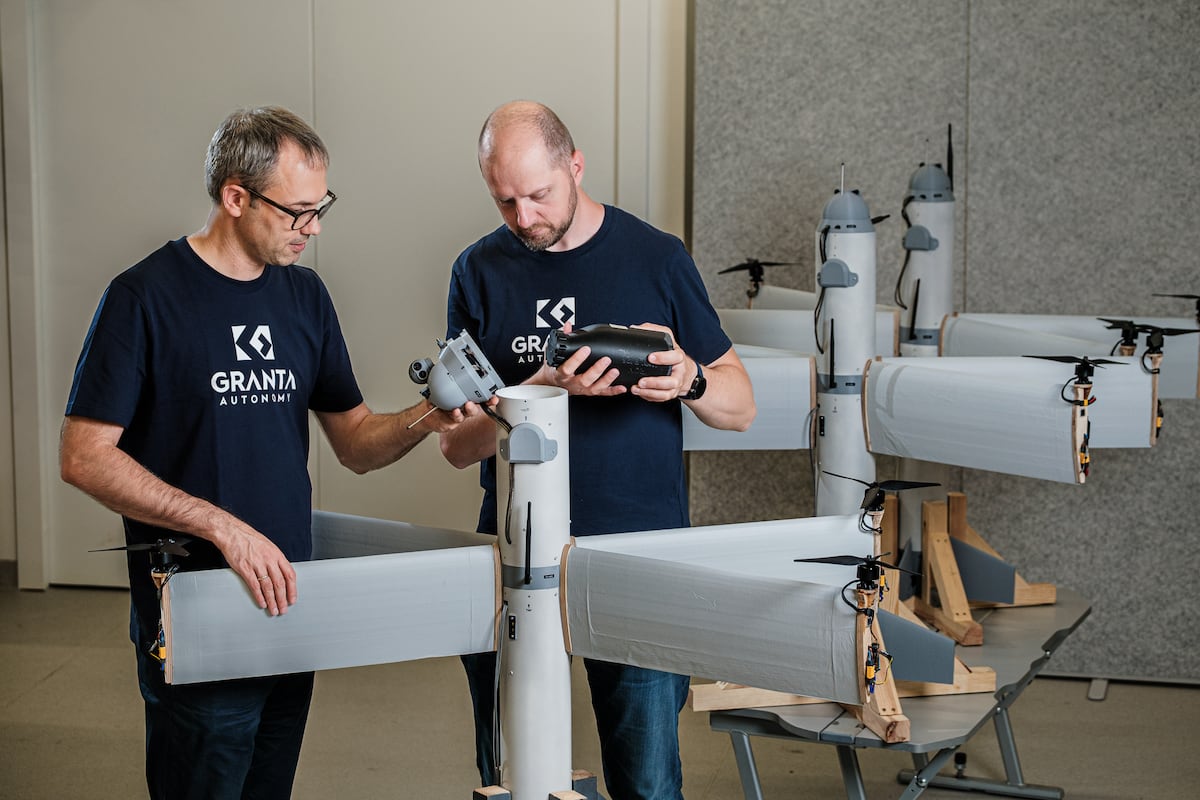
VILNIUS, Lithuania — Less than 200 kilometers from Belarus and about 300 kilometers from Russia, a sleek all-white Lithuanian drone factory with 40 employees works around the clock, sending hundreds of drones to Ukraine.
Granta Autonomy’s latest innovation is its vertical take-off and landing X-Wing loitering munition, which was unveiled this year and has already been tested by Ukraine, with hundreds of units on order. The strike drone is equipped with a four-kilogram warhead and will be integrated with Ukrainian-made components, including electronics used on navigation systems.
“Recently tested in Ukraine against their own jammers, it took off, navigated, and was successfully controlled,” Laurynas Litvinas, technical director at Granta Autonomy, told Defense News during a visit to the company’s facilities on Nov. 19. “Battlefield testing closer to the frontline is planned for the near future.”
Its warhead contains shrapnel for softer targets like radars and anti-aircraft systems, but its size also makes effective against harder targets such as main battle tanks.
According to the company, it recently flew up to an altitude of 6,000 meters in tests carried out in Lithuania. The system does not require any infrastructure to launch, and several drones can be launched simultaneously.
Over the last few weeks, Lithuania closed its border due to incursions by weather balloons flying from Belarus that disrupted air traffic and even prompted the closing of the capital’s airport on multiple occasions. Lithuanian officials have said the balloons were reportedly flown by smugglers transporting contraband cigarettes and called it a form of “hybrid attack.”
The Baltic state has ramped up its drone defenses by testing, procuring and developing a wide-range of new capabilities. These investments have been in response to increased border incursions, including an incident in July where Shahed-type drones entered Lithuanian airspace, and the broader conflict in Ukraine.
Granta Autonomy is drawing on its first-hand experience on the Ukrainian battlefield to fuel its systems development and deliver technology to the Lithuanian armed forces.
According to Litvinas, the company sent over 1,000 drones to Ukraine last year, including 100 of its Hornet XR intelligence drones and around 1,000 GA-FPV quadcopters used across multiple units of the Ukrainian Armed Forces.
“Russia is our common enemy, for us it’s crucial to travel to the frontline to put our systems to the test, perform experiments and get direct exposure to see how they operate in such conditions,” he said.
On-the-ground experience is central to the company’s approach, helping drive operations in Ukraine and ensuring every detail of weapon security is considered.
“It comes down to the tiniest considerations – for example, the packs that the drones are transported in. In the combat zone, roads often don’t exist. Vehicles forge new paths along the side, but they are very bumpy, and you have to drive at 120–150 km/h, or an FPV drone can kill you,” Litvinas said.
“Being there made us realize we had to upgrade the foam in the transport suitcases to keep all the drone spare parts secure,” he added.
The Hornet XR uses the same datalink as the X-Wing, which was developed in-house by the manufacturer and is reportedly effective against Russian jammers, according to Litvinas.
The components of the intelligence, surveillance and reconnaissance drone are sourced mostly from Lithuania and other European Union countries. The aircraft is designed to operate even when radio-frequency and GPS signals are jammed.
Litvinas noted that a key challenge his drones are facing in Ukraine is operating in fog and bad weather, especially during winter.
Strong winds can cause smaller aircraft to drift, making them easier to detect with thermal cameras. In conditions of poor visibility, many drones rely more heavily on GPS or radio datalinks, which makes them more vulnerable in environments with intense jamming.
“If you cannot operate where your enemy has jammers, tests are useless. Most countries don’t even have jammers equivalent to those we see on the frontline, and many are easy to bypass. If so, how can you claim your drones are resilient to jamming?” Litvinas asked.
Editor’s note: This story was updated after publication with details about the new drone’s warhead characteristics.
Elisabeth Gosselin-Malo was a Europe correspondent for Defense News. She covers a wide range of topics related to military procurement and international security, and specializes in reporting on the aviation sector. She is based in Milan, Italy.
立陶宛维尔纽斯——距离白俄罗斯不到 200 公里,距离俄罗斯约 300 公里,一家拥有 40 名员工的时尚全白立陶宛无人机工厂日夜不停地运转,向乌克兰运送数百架无人机。
格兰塔自主公司最新推出的创新产品是其垂直起降型X翼巡飞弹,该弹于今年首次亮相,并已在乌克兰进行过测试,目前已有数百架订单。这款攻击型无人机配备4公斤重的弹头,并将集成乌克兰制造的组件,包括导航系统使用的电子设备。
“最近在乌克兰进行了测试,对抗了他们自己的干扰器,它成功起飞、导航并被控制,”格兰塔自主技术公司技术总监劳里纳斯·利特维纳斯在11月19日参观该公司设施时告诉《防务新闻》。“计划在不久的将来在更靠近前线的地方进行战场测试。”
它的弹头含有用于攻击雷达和防空系统等较软目标的弹片,但由于其体积较大,也能有效攻击主战坦克等较硬的目标。
据该公司称,该系统最近在立陶宛进行的测试中飞行高度达到了6000米。该系统无需任何基础设施即可发射,并且可以同时发射多架无人机。
过去几周,由于来自白俄罗斯的气象气球入侵立陶宛,扰乱了空中交通,甚至导致首都机场多次关闭,立陶宛因此关闭了边境。立陶宛官员称,这些气球据称是由走私者用来运输违禁香烟的,并称之为一种“混合攻击”。
这个波罗的海国家通过测试、采购和研发一系列新技术,加强了无人机防御能力。这些投资是为了应对日益增多的边境入侵事件,包括7月份“沙赫德”型无人机进入立陶宛领空的事件,以及乌克兰更广泛的冲突。
Granta Autonomy 正在利用其在乌克兰战场上的第一手经验来推动其系统开发,并向立陶宛武装部队提供技术。
据 Litvinas 称,该公司去年向乌克兰运送了 1000 多架无人机,其中包括 100 架 Hornet XR 智能无人机和约 1000 架 GA-FPV 四旋翼无人机,这些无人机被乌克兰武装部队的多个单位使用。
他说:“俄罗斯是我们的共同敌人,对我们来说,前往前线测试我们的系统、进行实验并亲身体验,看看它们在这样的条件下是如何运作的,至关重要。”
实地经验是该公司方法的核心,有助于推动在乌克兰的运营,并确保武器安全的每一个细节都得到考虑。
“这最终取决于最细微的考量——例如,无人机的运输包装。在战区,道路往往不存在。车辆只能沿着路边开辟新路,但路面非常颠簸,你必须以120-150公里/小时的速度行驶,否则FPV无人机就能把你撞死,”利特维纳斯说。
“亲身经历让我们意识到,我们必须升级运输箱内的泡沫材料,以确保所有无人机备件的安全,”他补充道。
据 Litvinas 称,Hornet XR 使用与 X-Wing 相同的数据链,该数据链由制造商内部开发,据称对俄罗斯干扰器有效。
这款情报、监视和侦察无人机的零部件主要来自立陶宛和其他欧盟国家。该无人机设计成即使在无线电频率和GPS信号受到干扰的情况下也能正常运行。
利特维纳斯指出,他的无人机在乌克兰面临的一个主要挑战是在雾天和恶劣天气下作业,尤其是在冬季。
强风会导致小型无人机漂移,使其更容易被热成像摄像机探测到。在能见度低的情况下,许多无人机更加依赖GPS或无线电数据链路,这使得它们在干扰强烈的环境中更容易受到攻击。
“如果敌方部署了干扰器,而你又无法在敌方部署干扰器的情况下进行作战,那么测试就毫无意义。大多数国家甚至都没有像我们在前线看到的那种级别的干扰器,而且很多干扰器都很容易被绕过。如果真是这样,你又怎么能声称你的无人机能够抵御干扰呢?”利特维纳斯问道。
编者按:本文发表后进行了更新,添加了有关新型无人机弹头特性的详细信息。
伊丽莎白·戈斯林-马洛曾任《防务新闻》欧洲通讯员。她的报道涵盖军事采购和国际安全等广泛领域,尤其擅长航空领域的报道。她常驻意大利米兰。