Combat mass and speed: Europe moves to unlock Ukraine’s drone insights作战规模与速度:欧洲着手获取乌克兰无人机技术信息
Kyiv has amassed powerful knowledge on drone warfare as its forces battle Russia's invasion. Can allies tap into it?
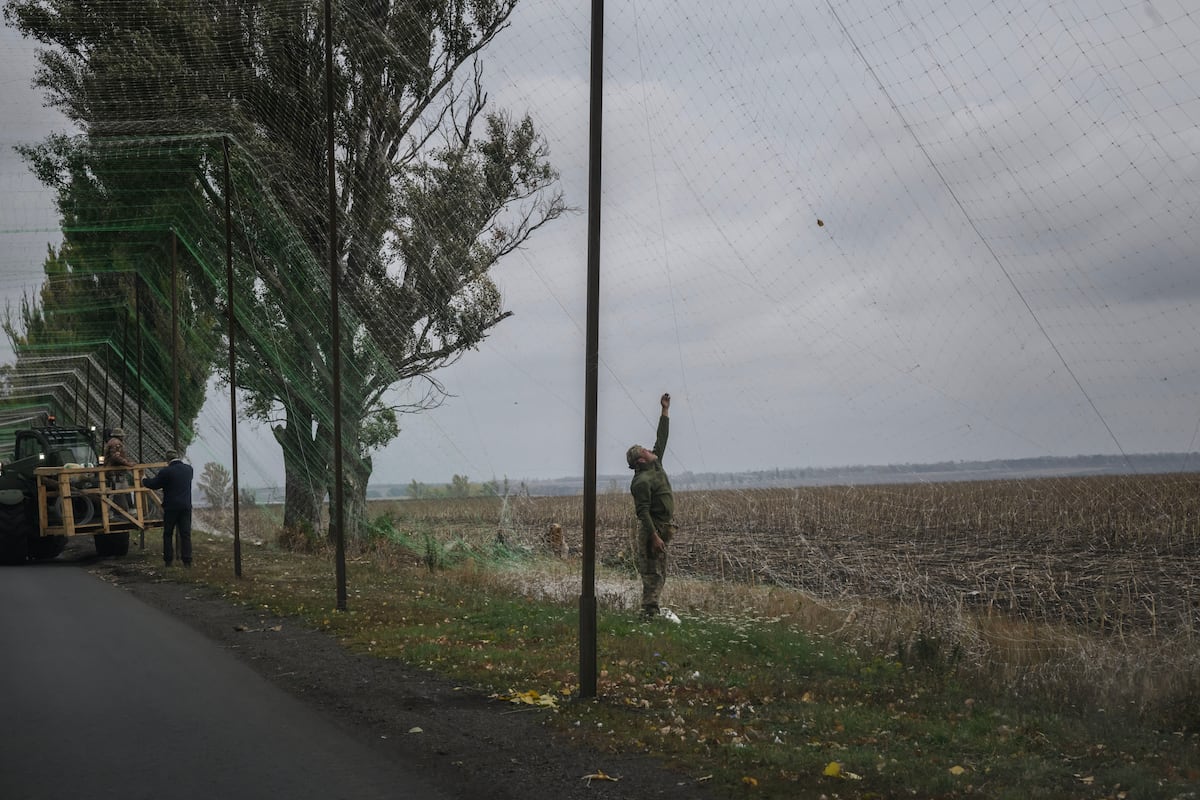
MILAN — Western countries scrambling to counter rising aerial threats should move beyond the simple stockpiling of countermeasures and adopt Ukraine’s faster, cheaper and battle-tested drone warfare model, experts say.
At the Warsaw Security Forum, organized in the Polish capital on Sept. 29-30, Ukrainian President Volodymyr Zelenskyy proposed to his NATO partners that they build a “joint, truly reliable shield” against Russian aerial threats, stating that he stood ready to offer advice.
Several European countries have recently become the target of suspicious, unidentified drone activities near critical infrastructure, which has prompted the European Union to flirt with just such an idea: a defensive “wall” against drones that would build on Kyiv’s amassed knowledge.
Experts say that while foreign militaries are not required to copy all Ukrainian tactics, they should still integrate key know-how shared with them, starting with the ability to build defensive systems quickly.
“No one should be thinking they can store millions of drones [or countermeasures], they can’t just store them in a warehouse, and even if they did, they shouldn’t expect them to be useful given how quickly things are evolving,” Scott Boston, senior defense analyst at RAND, said.
“The Ukrainian way is cheaper, faster and being live-tested against an active adversary, as well as the insights from the electromagnetic spectrum are hugely relevant, since Russia is frequently adjusting and introducing new electronic-warfare techniques,” he added.
In a recent speech, Zelenskyy reported that Kyiv’s potential in the drone and missile production sector will reach $35 billion in 2026, with approximately 40% of the weapons currently deployed on the frontlines manufactured locally or with the participation of local companies.
One area of knowledge transfer that would benefit Western forces is the operationalization of counter-drone systems, both at a tactical and higher-command level.
That means integrating counter-drone capabilities into existing military units, as some countries have already begun doing, and spreading the responsibility to engage drones throughout the force.
Federico Borsari, non-resident fellow at the Center for European Policy Analysis, notes that Ukraine has gained experience about optimal combinations of sensors and interceptors, such as low-cost guided rockets, wide-band jamming and anti-aircraft guns cued by a multispectral grid of sensors.
Following drone incursions last month, both Poland and Denmark opted to call in Ukrainian experts to help them train their troops better in responding to these incidents.
According to Yevgeniya Gaber, non-resident senior fellow at Atlantic Council, such visits constitute a practice that could become more widespread as a means to transfer knowledge.
“No simulation, exercise or observation can replicate what happens when thousands of drones, missiles, and EW systems operate simultaneously in a real war environment – for operational learning, Ukrainian instructors and drone operations can help to train [other] European forces,” she said.
She highlighted that it will also be crucial to include visits to Ukraine so European drone apprentices gain a concrete understanding of the way counter-drone systems operate in combat.
In the short term, experts say this partnership could play out through direct industrial cooperation and investing into Ukrainian capabilities to ramp up production of proven systems.
For European companies, accessing Ukrainian performance data gleaned from combat engagements will be hugely valuable for tweaking their own technologies, said Borsari.
“But for this to happen, there need to be incentives in place regarding joint market opportunities and the safeguard of intellectual property,” he added.
The EU recently committed to spending a total of €2 billion on drones with Ukraine, a potential win-win situation that would allow the war-torn country to scale up its manufacturing and the bloc to benefit from the technology.
Their collaboration could also entail co-developing new systems with Ukrainian engineers or investing in them at the design stage, Gaber said.
Things are already moving in that direction. Denmark and Ukraine signed an agreement on Oct. 6 that will allow Ukrainian defense firms to set up joint production in the Nordic nation, a move that is meant to come with technology exchange baked in.
Elisabeth Gosselin-Malo was a Europe correspondent for Defense News. She covers a wide range of topics related to military procurement and international security, and specializes in reporting on the aviation sector. She is based in Milan, Italy.
米兰——专家表示,西方国家争相应对日益增长的空中威胁,应该超越简单地储备反制措施,转而采用乌克兰更快、更便宜、经过实战检验的无人机作战模式。
在 9 月 29 日至 30 日于波兰首都华沙举行的华沙安全论坛上,乌克兰总统弗拉基米尔·泽连斯基向北约伙伴提议,他们应该建立一个“联合的、真正可靠的盾牌”,以抵御俄罗斯的空中威胁,并表示他随时准备提供建议。
最近,一些欧洲国家成为关键基础设施附近可疑、不明无人机活动的目标,这促使欧盟考虑建立这样一个想法:利用基辅积累的知识,建立一道防御无人机的“墙”。
专家表示,虽然外国军队无需完全照搬乌克兰的所有战术,但仍应整合与其分享的关键技术诀窍,首先是快速构建防御系统的能力。
兰德公司高级国防分析师斯科特·波士顿表示:“任何人都不应该认为他们可以储存数百万架无人机(或反制措施),他们不可能把它们存放在仓库里,即使他们真的这么做了,鉴于形势发展如此迅速,他们也不应该指望这些无人机会派上用场。”
“乌克兰的方式更便宜、更快捷,并且已经过与活跃对手的实战检验,此外,从电磁频谱中获得的见解也非常重要,因为俄罗斯经常调整和引入新的电子战技术,”他补充道。
泽连斯基在最近的一次讲话中表示,基辅在无人机和导弹生产领域的潜力将在 2026 年达到 350 亿美元,目前部署在前线的武器中约有 40% 是本地制造或由本地公司参与制造的。
西方军队可以从知识转移中获得益处的一个领域是反无人机系统的作战应用,无论是在战术层面还是在更高指挥层面。
这意味着要将反无人机能力整合到现有的军事单位中(一些国家已经开始这样做),并将打击无人机的责任分散到整个部队中。
欧洲政策分析中心非常驻研究员费德里科·博尔萨里指出,乌克兰在传感器和拦截器的最佳组合方面积累了经验,例如低成本制导火箭、宽带干扰和由多光谱传感器网格引导的防空炮。
继上个月无人机入侵事件发生后,波兰和丹麦都选择邀请乌克兰专家帮助他们训练部队更好地应对此类事件。
据大西洋理事会非常驻高级研究员叶夫根尼娅·加贝尔称,这种访问做法可能会变得更加普遍,成为知识转移的一种手段。
“任何模拟、演习或观察都无法复制数千架无人机、导弹和电子战系统在真实战争环境中同时运行的情况——为了进行作战学习,乌克兰教官和无人机操作可以帮助训练(其他)欧洲部队,”她说。
她强调,访问乌克兰也至关重要,这样欧洲无人机学员才能具体了解反无人机系统在战斗中的运作方式。
专家表示,短期内,这种伙伴关系可以通过直接的工业合作和投资乌克兰的能力来提高成熟系统的产量来实现。
博尔萨里表示,对于欧洲公司而言,获取从乌克兰作战行动中收集到的性能数据,对于调整自身技术将具有巨大的价值。
“但要实现这一点,就需要有关于联合市场机会和知识产权保护的激励措施,”他补充道。
欧盟最近承诺向乌克兰投资 20 亿欧元用于无人机项目,这可能是一个双赢的局面,既能让饱受战争蹂躏的乌克兰扩大其制造业规模,又能让欧盟从这项技术中受益。
Gaber表示,他们的合作还可能包括与乌克兰工程师共同开发新系统,或者在设计阶段进行投资。
事情已经朝着这个方向发展。10月6日,丹麦和乌克兰签署了一项协议,允许乌克兰国防企业在丹麦建立联合生产基地,此举旨在促进技术交流。
伊丽莎白·戈斯林-马洛曾任《防务新闻》欧洲通讯员。她的报道涵盖军事采购和国际安全等广泛领域,尤其擅长航空领域的报道。她常驻意大利米兰。