Britain’s Shackleton Radar Plane Was Born As An Already Antiquated Cold War Dinosaur英国的沙克尔顿雷达飞机诞生之时,已然是冷战时期遗留下来的过时老古董。
The RAF’s future E-7 early warning aircraft will now be headed for the Shackleton’s old stomping grounds at RAF Lossiemouth.
新闻视频
Published Dec 24, 2020 12:48 PM EST
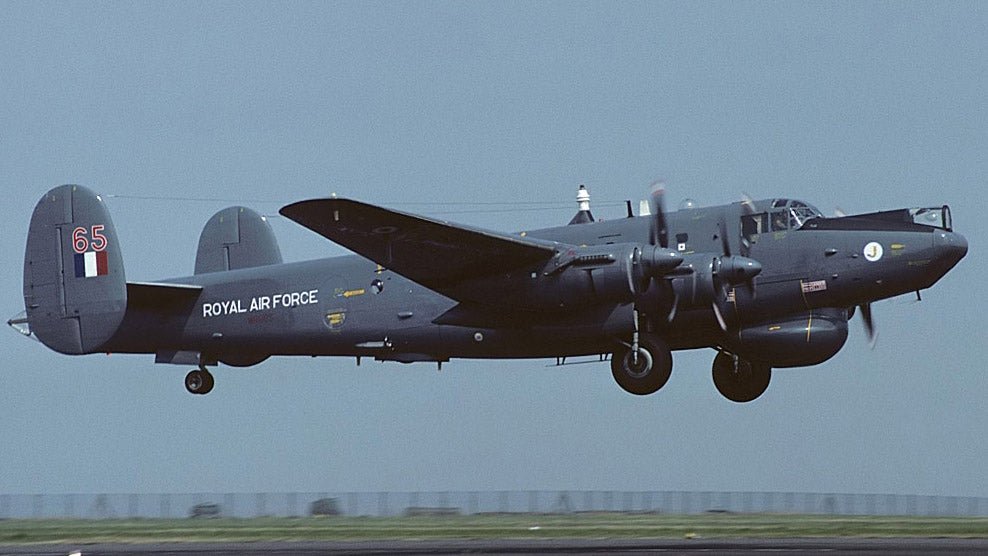
The British Royal Air Force announced recently that its forthcoming E-7 Wedgetail airborne early warning and control aircraft will be based at RAF Lossiemouth in Scotland. This is a move that will see the new aircraft operate alongside another 737-derived platform, the Royal Air Force P-8 Poseidon , but it’s also a base with its own unique airborne early warning history. Up until the end of the Cold War, Lossiemouth was home to an extraordinary, almost Rube Goldberg-esque radar plane, the Avro Shackleton AEW2, which ended up defending British airspace for far longer than was reasonable.
The airborne early warning (AEW) version of the Mk 2 variant of the Shackleton maritime patrol aircraft, hence the designation AEW2, only began to be fielded in 1973, a full 24 years after the aircraft had made its first flight. The underlying airframe of all Shackletons traced its DNA all the way back to the Avro Lincoln four-engine bomber, first flown during World War II, and which was itself a further development of the iconic Avro Lancaster heavy bomber.
A Shackleton AEW2 at RAF Alconbury in 1988., Mike Freer/Wikimedia Commons
The Shackleton inherited the wings and undercarriage of the Lincoln bomber, but got a new, roomier fuselage and replaced the previous Merlin engines with more powerful Griffon engines , driving six-bladed contra-rotating propellers. When the decision was made to use the platform for the aerial early warning role, production of the aircraft had long come to an end, so a dozen Shackleton MR2 maritime patrollers were instead modified for the surveillance role, gaining a “guppy” radome below the forward fuselage. Another three Shackleton MR2 aircraft were prepared to serve as crew trainers, without the radar fitted.
The first iteration of the Shackleton to enter service was the MR1, seen in RAF Coastal Command service in 1953., RuthAS/Wikimedia Commons
The radar inside that radome was the AN/APS-20, which had originally entered U.S. Navy service onboard adapted Grumman Avengers way back in the final months of World War II. The radar and radome both were taken from the Royal Navy’s Gannet AEW3s , carrier-based airborne early warning and control aircraft that had entered service in 1960, but began being withdrawn at the end of that decade after the United Kingdom decided to get rid of its conventional catapult-configured aircraft carriers.
The Royal Navy Gannet AEW3 was the source of the APS-20 radar used on the Shackleton AEW2., Mike Freer/Wikimedia Commons
While the airborne early warning role was considered vital to the defense of the United Kingdom, the AN/APS-20 was antiquated even when the Shackleton AEW2 entered service and it lacked a height-finding capability. Its performance overall was variable and depended on factors including altitude, weather, sea state, as well as the skills of the operators. Ultimately, the radar had been selected as the cheapest solution, although they were at least rebuilt and updated before being installed in the Shackletons. A number of former Royal Navy Gannet AEW3 radar operators were also transferred to the RAF, to build up skills.
Other equipment on the converted Shackletons included the Orange Harvest broadband electronic countermeasures receiver — a passive detection device originally installed to locate surface ships or submarines — as well the AN/APX-7 identification friend or foe (IFF) interrogator.
A Shackleton AEW2 at RAF Lossiemouth. The radar was mounted directly below the flight deck., Mike Freer/Wikimedia Commons
The crew itself typically comprised of two pilots, two navigators, an engineer, and four radar operators. The way these airmen went about their tasks also had much in common with a previous era, the radar requiring constant “knob-turning,” while grease pencils stood in for computer screens.
One of the first pilots assigned to No 8 Squadron, the Shackleton AEW2 unit, was Bill Howard, who describes the unusual crew composition in Ian Shaw and Sérgio Santana’s Beyond the Horizon , The History of Airborne Early Warning:
The front-end crews were hairy old Coastal Command/maritime types — pilots, flight engineers, and navigators — who would rather have been chasing submarines or doing a rewarding SAR [search and rescue] job, while the rear-end chaps were a mix of Royal Navy/RAF radar operators, sorely piqued at the loss of their beloved aircraft carriers, and who were appalled at the prospect of spending up to 10 hours in a cold, noisy Shackleton. Somehow, however, we managed to get it all together.
A Shackleton AEW2 taxiing for departure from RAF Fairford., Mike Freer/Wikimedia Commons
The primary role of the Shackleton AEW2 was to keep watch over the airspace off the northern coasts of the United Kingdom, where Soviet bombers and maritime patrol aircraft were expected to launch their potential attacks against the country. Since ground-based radars provided only a limited detection capability, especially against low-altitude intruders, the Shackletons were expected to fill the gaps, working alongside RAF interceptors. At the height of operations, the Shackletons were managing the interception of at least six Soviet aircraft per week. In response, a quick reaction alert (QRA) system was set up, under which a Shackleton had to get airborne as rapidly as possible after the first detection of a Soviet aircraft by ground-based radar, or by another NATO asset.
Bill Howard provides the following account of the QRA mission from Lossiemouth:
We held a QRA capability at ‘Lossie’, with a target of getting airborne within two hours after being activated, depending on the day and the time. If it were a normal working day then the response would be much faster. However, if it was a weekend or out of hours, with crew members off base at home, then nearly two hours would be needed. We would be given a target time to arrive ‘on station’ and would aim to arrive at that time, there being no point in arriving too early and wasting fuel while waiting for ‘trade’. Around the UK, we would work with GCI [ground controlled intercept] controllers from RAF Buchan [also in Scotland]. Before going on task we would normally carry out a gentle climb, continuously recording the outside air temperature, looking particularly for evidence of an inversion, which might affect radar performance. Depending on the height of the target, we would plan to operate the barrier at an appropriate level. Normally the expected target would be high level and hence we would aim to be above any inversion layer, flying a racetrack pattern with straight legs of around 40 nautical miles, generally at right angles to the expected target track. The Mk 9 autopilot was pretty basic and a bit fiddly, requiring constant adjustment. Most pilots preferred to hand-fly the aircraft. As long as you trimmed the aircraft well, it was quite responsive to hand flying. We would cruise and operate in the 5,000 to 10,000 feet bracket as the aircraft was unpressurized.
While working alongside RAF, or occasionally other NATO fighters, was a key part of the Shackleton AEW2 mission, the aircraft could not work as a true fighter controller, like a modern airborne early warning and control platform. Instead, the crew provided only advisory guidance to the interceptors, which they communicated with using discreet frequencies on UHF radios.
The antenna of the AN/APS-20 radar., Hammersfan/Wikimedia Commons
Early on in the life of the Shackleton AEW2, it had been planned that the aircraft would also provide protection for Royal Navy operations, which had been deprived of AEW cover after the drawdown of the Gannet AEW3 fleet. However, this proved overly ambitious and the Royal Navy task force that retook the Falkland Islands in 1982 did so without an AEW component, an omission that has been blamed, at least in part, for the heavy losses the British sustained.
Nicknamed “Growler” by their crews, on account of its thunderous engines, the Shackleton AEW2 provided a less-than-comfortable working environment for the crew, with noise and vibration adding to their fatigue on long missions, which could last up to 12 hours, ranging far out over the North Sea. In fact, some of the previous soundproofing had been removed from the aircraft to save weight. What is more, the power demands of the radar meant the Griffon engines had to be operated much of the time at almost maximum power, making things even noisier.
A Shackleton AEW2 over RAF Mildenhall., Mike Freer/Wikimedia Commons
As well as noisy and cramped working conditions, the Shackleton AEW2 was seriously limited by its performance — with a ceiling of just 20,000 feet, the maximum line-of-sight radar radius was initially around 80 miles, compared to approximately 250 miles for a high-flying jet. In 1973, an airborne moving-target indication mode was added to the radar.
More reminiscent of a World War II-era bomber, the taildragger landing gear was another of the Shackleton AEW2’s anachronisms, as Bill Howard recalled:
The Mk 2 tailwheel ‘Shack’ was a notoriously tricky beast to land for the uninitiated and even the ‘old hands’ were capable of ‘hairy’ landings from time to time. The important thing was to know how to rescue a bad landing, as failure to take timely corrective action could further exacerbate an already unsettling situation. One such incident of a mishandled landing, during a training sortie, resulted in the write-off of one of our two MR2 training ‘hacks’. The fuselage was salvaged, set on concrete plinths, and ingeniously converted into a static crew-training simulator for the navigation/radar crew.
There were plans to replace the Shackleton AEW2 with an airborne early warning and control version of the jet-powered Nimrod maritime patrol aircraft from 1982, but the failure of the Nimrod AEW3 meant the Shackleton had to soldier on for far longer than anticipated. By this time, the Shackleton AEW2 fleet had been reduced by half due to budget cuts.
A Nimrod AEW3., Mike Freer/Wikimedia Commons
Ultimately, the United Kingdom ordered the E-3D Sentry AWACS to replace the Shackleton AEW2 and finally provide a modern airborne early warning and control capability. The first of the RAF Sentry aircraft arrived at its base of RAF Waddington, Lincolnshire, in 1990 and the Shackleton AEW2 was finally retired in July 1991, Lossiemouth in the process losing its function as an AEW base.
An RAF Sentry AEW1 as night falls on its RAF Waddington base., Crown Copyright
All said, the fact that the piston-engine Shackleton AEW2 was still patrolling the northern approaches to the United Kingdom as late as 1991 is little short of remarkable.
The last airworthy Shackleton was AEW2 serial number WL970, belonging to the Pima Air & Space Museum , Tucson, Arizona., Mike LaChance/Wikimedia Commons
Now, Lossiemouth is set to receive the RAF’s E-7 Wedgetails, also marking the return to the base of No 8 Squadron, the Shackleton AEW2 unit, after an absence of 30 years. While it is currently uncertain if all five of the planned E-7s will ultimately be purchased, you can read all about the background to the Wedgetail deal here .
With this latest development, the Scottish base will once again take on the vital airborne early warning and control role, with the new Boeing Wedgetail jets continuing in the tradition of the “Growler.”
Contact the author: thomas@thedrive.com
Comments couldn’t be loaded. Please refresh the page.
发布于美国东部时间2020年12月24日下午12:48。
英国皇家空军近日宣布,即将服役的E-7“楔尾”预警机将部署在苏格兰的洛西茅斯皇家空军基地。此举意味着这款新飞机将与另一款基于737平台的皇家空军P-8“海神”反潜巡逻机协同作战。但洛西茅斯基地本身也拥有独特的预警机历史。在冷战结束前,这里曾驻扎着一架结构精巧、堪称“鲁布·戈德堡式”的雷达飞机——阿弗罗·沙克尔顿AEW2预警机。这架飞机为英国领空保卫的时间远远超过了合理期限。
沙克尔顿海上巡逻机Mk 2型的空中预警(AEW)版本,即AEW2,直到1973年才开始服役,距离该机型首飞已整整24年。所有沙克尔顿飞机的机身设计都源自二战期间首飞的阿弗罗林肯四引擎轰炸机,而林肯本身又是标志性的阿弗罗兰开斯特重型轰炸机的进一步发展型。
1988年,一架沙克尔顿AEW2预警机停放在英国皇家空军阿尔康伯里基地。(图片来源:Mike Freer/Wikimedia Commons)
沙克尔顿飞机沿用了林肯轰炸机的机翼和起落架,但采用了更宽敞的新机身,并将原有的梅林发动机更换为动力更强劲的格里芬发动机,驱动六叶反向旋转螺旋桨。当决定将该平台用于空中预警任务时,该机型的生产早已停止,因此十几架沙克尔顿MR2海上巡逻机被改装为监视飞机,并在机身前部下方加装了“古比鱼”雷达罩。另有三架沙克尔顿MR2飞机被改装为机组人员训练机,未安装雷达。
沙克尔顿飞机的首款服役型号是MR1,于1953年在英国皇家空军海岸司令部服役。(图片来源:RuthAS/Wikimedia Commons)
雷达罩内的雷达是AN/APS-20型,它最初于二战末期在美国海军改装的格鲁曼复仇者轰炸机上服役。雷达和雷达罩均来自英国皇家海军的“塘鹅”AEW3预警机,这是一种舰载空中预警和控制飞机,于1960年服役,但随着英国决定淘汰其传统的弹射式航母,该型飞机在60年代末开始退役。
皇家海军塘鹅 AEW3 是沙克尔顿 AEW2 上使用的 APS-20 雷达的来源。, Mike Freer/Wikimedia Commons
尽管空中预警任务对英国国防至关重要,但AN/APS-20雷达即使在沙克尔顿AEW2预警机服役时也已过时,而且缺乏测高能力。其整体性能不稳定,受多种因素影响,包括飞行高度、天气、海况以及操作员的技能。最终,该雷达被选为最经济的解决方案,尽管在安装到沙克尔顿预警机之前,至少都经过了重建和升级。一些原皇家海军“塘鹅”AEW3预警机的雷达操作员也被调往英国皇家空军,以提升技能。
改装后的沙克尔顿飞机上的其他设备包括橙色收获宽带电子对抗接收器(一种最初安装用于定位水面舰艇或潜艇的被动探测装置)以及 AN/APX-7 敌我识别 (IFF) 询问器。
一架停放在洛西茅斯皇家空军基地的沙克尔顿AEW2预警机。雷达安装在飞行甲板正下方。(图片来源:Mike Freer/Wikimedia Commons)
机组通常由两名飞行员、两名领航员、一名工程师和四名雷达操作员组成。这些飞行员的工作方式也与以往时代有很多相似之处,例如需要不断地“转动旋钮”来操作雷达,而油性铅笔则用来代替电脑屏幕。
被分配到第 8 中队(沙克尔顿 AEW2 部队)的首批飞行员之一是比尔·霍华德,他在伊恩·肖和塞尔吉奥·桑塔纳的《超越地平线:空中预警的历史》一书中描述了不寻常的机组组成:
前端机组人员都是些毛发蓬乱的老派海岸司令部/海事人员——飞行员、飞行工程师和导航员——他们宁愿去追击潜艇或从事更有意义的搜救工作;而后端机组人员则是皇家海军/皇家空军的雷达操作员,他们对心爱的航空母舰的损失耿耿于怀,一想到要在寒冷嘈杂的沙克尔顿号上待上十个小时就感到恐惧。然而,不知怎么的,我们最终还是把一切都安排妥当了。
一架沙克尔顿AEW2预警机正在从英国皇家空军费尔福德基地滑行准备起飞。(图片来源:Mike Freer/Wikimedia Commons)
沙克尔顿AEW2预警机的主要任务是监视英国北部沿海空域,苏联轰炸机和海上巡逻机预计将从该空域对英国发动潜在袭击。由于地面雷达的探测能力有限,尤其难以探测低空入侵者,沙克尔顿预警机被寄予厚望,与英国皇家空军的拦截机协同作战,填补这一空白。在行动高峰期,沙克尔顿预警机每周至少拦截六架苏联飞机。为此,英国建立了一套快速反应警报(QRA)系统,根据该系统,一旦地面雷达或其他北约装备首次探测到苏联飞机,沙克尔顿预警机必须以最快的速度升空。
比尔·霍华德对洛西茅斯的快速反应警戒任务作了如下描述:
我们在“洛西”(Lossie)基地具备快速反应警戒(QRA)能力,目标是在接到任务后两小时内升空,具体时间取决于当天和具体时间。如果是正常工作日,响应速度会快得多。但如果是周末或非工作时间,机组人员不在家,则需要近两个小时。我们会接到到达“指定位置”的目标时间,并力争准时到达,因为过早到达会浪费燃料等待“目标”。在英国境内,我们会与位于苏格兰的布坎皇家空军基地(RAF Buchan)的地面控制拦截(GCI)管制员合作。执行任务前,我们通常会进行一次缓慢爬升,持续记录外部气温,尤其关注是否存在逆温现象,因为逆温可能会影响雷达性能。根据目标的高度,我们会计划在适当的高度操作障碍物。通常情况下,预期目标是高空飞行,因此我们会尽量保持在逆温层之上,以直线航线飞行,每段航程约40海里,通常与预期目标航迹呈直角。Mk 9自动驾驶仪相当简陋,操作也有些繁琐,需要不断调整。大多数飞行员更喜欢手动驾驶飞机。只要配平得当,手动驾驶的响应就相当灵敏。由于飞机没有增压,我们会在5000到10000英尺的高度巡航和飞行。
与英国皇家空军或偶尔与其他北约战斗机协同作战是沙克尔顿AEW2任务的关键部分,但该机无法像现代空中预警和控制平台那样真正发挥战斗机管制员的作用。相反,机组人员仅向拦截机提供咨询引导,并通过超高频无线电上的隐蔽频率与其通信。
AN/APS-20雷达的天线。(图片来源:Hammersfan/Wikimedia Commons)
在沙克尔顿AEW2早期,曾计划该机也为皇家海军的行动提供保护,因为在塘鹅AEW3机队退役后,皇家海军失去了预警机的支援。然而,事实证明这一计划过于雄心勃勃。1982年收复福克兰群岛的皇家海军特遣部队没有配备预警机,这一疏忽被认为是造成英国遭受重大损失的部分原因。
由于发动机轰鸣声震耳欲聋,机组人员给沙克尔顿AEW2预警机起了个绰号叫“咆哮者”。这架飞机的工作环境并不舒适,噪音和震动加剧了机组人员在长达12小时、飞越北海的漫长任务中的疲劳。事实上,为了减轻重量,飞机上原有的一些隔音材料已被拆除。此外,雷达的耗电量意味着“狮鹫”发动机大部分时间都必须以接近最大功率运转,这使得噪音更加严重。
一架沙克尔顿AEW2预警机飞越米尔登霍尔皇家空军基地。(图片来源:Mike Freer/Wikimedia Commons)
除了嘈杂狭窄的工作环境外,沙克尔顿AEW2雷达的性能也受到严重限制——由于其飞行高度上限仅为20,000英尺,其最大视距雷达探测半径最初只有约80英里,而高空喷气式飞机的探测半径约为250英里。1973年,该雷达增加了机载移动目标指示模式。
比尔·霍华德回忆说,沙克尔顿AEW2的尾轮式起落架更像是二战时期轰炸机的风格,这也是它的一个时代错位之处:
对于新手来说,Mk 2 型尾轮飞机“Shack”的着陆难度极高,即使是经验丰富的飞行员也难免会遇到险情。关键在于掌握如何挽救糟糕的着陆,因为未能及时采取纠正措施可能会使本已岌岌可危的局面雪上加霜。在一次训练飞行中,我们两架MR2训练飞机中的一架就因着陆操作失误而报废。飞机残骸被回收,放置在混凝土基座上,并巧妙地改造成导航/雷达机组的静态机组训练模拟器。
1982年,美国曾计划用喷气式“猎迷”海上巡逻机的空中预警与控制版本“沙克尔顿”AEW2取代“沙克尔顿”AEW2,但由于“猎迷”AEW3的失败,“沙克尔顿”AEW2不得不比预期服役更长时间。此时,由于预算削减,“沙克尔顿”AEW2机队已经缩减了一半。
Nimrod AEW3.,图片来自 Mike Freer/Wikimedia Commons
最终,英国订购了E-3D“哨兵”预警机,以取代“沙克尔顿”AEW2预警机,从而最终具备了现代化的空中预警和控制能力。首架皇家空军“哨兵”预警机于1990年抵达位于林肯郡沃丁顿的皇家空军基地,而“沙克尔顿”AEW2预警机则于1991年7月正式退役,洛西茅斯基地也因此失去了预警机基地的功能。
夜幕降临,一架英国皇家空军哨兵AEW1预警机停在瓦丁顿皇家空军基地。(英国皇家版权所有)
总而言之,直到 1991 年,活塞式发动机的沙克尔顿 AEW2 仍在英国北部海域巡逻,这实在令人惊叹。
最后一架适航的沙克尔顿飞机是AEW2型,序列号为WL970,现藏于亚利桑那州图森市的皮马航空航天博物馆。(图片来源:Mike LaChance/Wikimedia Commons)
现在,洛西茅斯空军基地即将接收英国皇家空军的E-7“楔尾”预警机,这也标志着第8中队(沙克尔顿AEW2预警机部队)在阔别30年后重返该基地。虽然目前尚不确定计划中的五架E-7最终是否会全部采购,但您可以在这里阅读有关“楔尾”交易的全部背景信息。
随着这一最新进展,苏格兰基地将再次承担起至关重要的空中预警和控制任务,新型波音楔尾战斗机将继续传承“咆哮者”的传统。
联系作者:thomas@thedrive.com
评论加载失败,请刷新页面。