Canada to plug surveillance gaps with Aussie over-the-horizon radar加拿大将利用澳大利亚的超视距雷达填补监视漏洞
The system is called the Arctic Over-The-Horizon Radar (A-OTHR), and the deal is worth some US$1.75 billion to Australia.
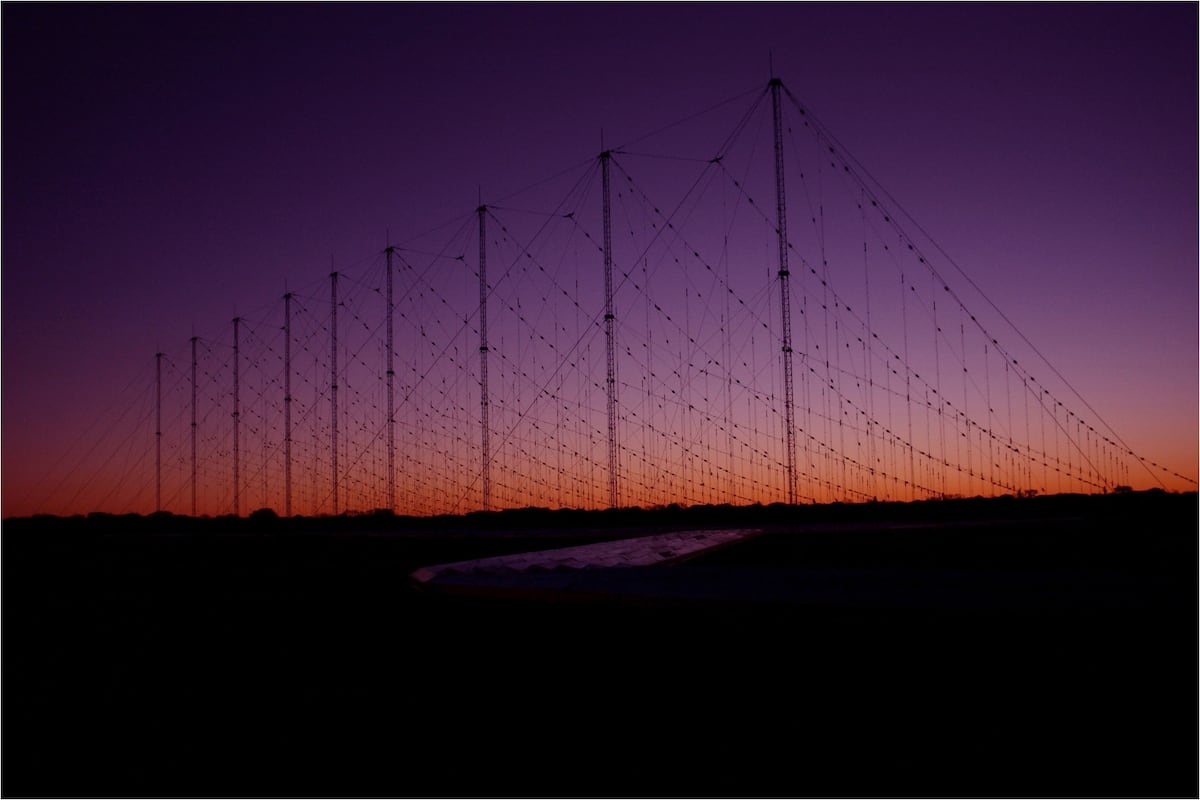
CHRISTCHURCH, New Zealand — The North American Aerospace Defense Command ( NORAD ), operated by Canada and the United States, has gaping holes in its airspace radar coverage. Ottawa went some way to filling those gaps when it signed four related agreements in June for a new radar system sourced from Australia.
The system is called the Arctic Over-The-Horizon Radar (A-OTHR), and the deal is worth some US$1.75 billion to Australia.
Gordon Frazer – Founder and CEO of the Australia-based HF radar technical services company FrazerLab – told Defense News Canada’s decision would fill an urgent need.
“I used to say to people, you could fly a jumbo jet from Beijing to Canberra if it had its transponders off and no one would know,” he said, arguing the same is likely true for Canada.
“Russia could fly a Tu-95 from one of their bases, Engels Air Base or something like that, to Canada and possibly no one would know.”
He added, “That’s why NORAD is so concerned, and why they’ve been pushing so hard to get this sort of technology done.”
Frazer was formerly an engineer involved in Australia’s OTHR program known as the Jindalee Operational Radar Network (JORN).
Expanded surveillance coverage
While NORAD maintains the North Warning System, a line of microwave radars in Canada’s frozen north, Frazer said it would be “almost a trivial problem to defeat it” by flying at low altitude between these known and stationary radar sites.
Instead, because OTHR bounces high-frequency signals off the ionosphere, it can look down on airborne targets — and sometimes even surface vessels — with ease, including aircraft and missiles.
An over-the-horizon radar results in radar coverage stretching far beyond what traditional line-of-sight radars can achieve due to the curvature of the Earth.
With its particular A-OTHR contract, BAE Systems Australia will transfer technology and expertise for Canada to build its own OTHR radar sites to monitor its periphery. Officially, Canberra says JORN can detect targets 3,000 kilometers (1,700 miles) away, but its capability almost certainly reaches far beyond that.
Ottawa stated in a press release: “The signing formalizes Canada’s partnership with Australia and enables the delivery of Australia’s proven OTHR technology in support of Canada’s A-OTHR program. It marks a major milestone in the program, transitioning A-OTHR from the planning phase into delivery phase.”
Canada has already been researching the application of OTHRs in its north, where environmental and solar conditions are far different than they are in Australia.
Furthermore, significant differences exist between operating OTHRs in equatorial, mid-latitude, high-latitude and polar areas. Frazer pointed out that Canada, despite the “Arctic” in the A-OTHR nomenclature, is actually buying a high-latitude system.
Polar regions present even more complicated challenges for OTHRs due to the Earth’s magnetic field, which creates serious background clutter. In fact, some 40% of Canadian territory lies above the Arctic Circle.
Although it may sound counterintuitive, Frazer said Canada’s A-OTHR radar facilities would be built as far south as possible. This is in order to bounce radar signals off the ionosphere ahead of the zone where the worst distortion occurs.
However, Canada will also have the future opportunity to expand its OTHR network with trans-polar coverage, which would allow it to see deep into Russia.
Positioned thus, the technology could enable NORAD to see Russian strategic bombers taking off or ballistic missiles being launched, for example.
If Canada does seek transpolar radar coverage, it would likely want to place those radar installations as far north as possible, Frazer explained.
Australia has three JORN radar sites, but it is unclear how many sites Canada will establish. In North America, Frazer expects the Pacific west coast will be covered by an American system, the Atlantic east coast will be covered by Canada, and then an additional system can cover the north. If NORAD wants 360-degree coverage, Frazer suggested five or six radar installations would be needed.
Australian expertise
Craig Lockhart, CEO of BAE Systems Australia, said: “Canada’s acquisition of a cutting-edge Australian OTHR system supports the strategic interests of both nations through enhanced detection and tracking of threats to North America, strengthening Five Eyes situational awareness.”
Frazer said Australia developed world-leading OTHR talent “because of multi-generational consistency” in its investment in the technology.
The New Zealand-born engineer pointed out that around 15% of the cost of OTHR technology sits in equipment to inform human operators how to set the radar’s parameters to account for constantly changing atmospheric conditions.
Frazer highlighted that OTHRs are bespoke, national systems built only once per generation. However, he hopes the Canadian deal will benefit both countries.
“I think you’re starting to get the critical mass of being able to keep the technology pipeline from design to sustainment to upgrade to far-reaching tech.”
Because over-the-horizon radar coverage can vary drastically due to solar conditions, other methods help plug surveillance gaps.
Airborne early-warning aircraft, for example, are complementary to OTHR. In May, Canada selected Saab’s GlobalEye as its future airborne early-warning platform.
Canada expects its A-OTHR to reach an initial operational capability by December 2029.
Gordon Arthur is an Asia correspondent for Defense News. After a 20-year stint working in Hong Kong, he now resides in New Zealand. He has attended military exercises and defense exhibitions in about 20 countries around the Asia-Pacific region.
新西兰基督城——由加拿大和美国共同运营的北美防空司令部(NORAD)的空域雷达覆盖范围存在巨大漏洞。今年6月,渥太华签署了四项相关协议,从澳大利亚采购一套新的雷达系统,在一定程度上弥补了这些漏洞。
该系统名为北极超视距雷达(A-OTHR),这笔交易对澳大利亚来说价值约 17.5 亿美元。
总部位于澳大利亚的 HF 雷达技术服务公司 FrazerLab 的创始人兼首席执行官 Gordon Frazer 告诉《国防新闻》,加拿大的这项决定将满足迫切的需求。
“我以前常跟人说,就算你把一架巨型喷气式客机的应答器关掉,从北京飞到堪培拉,也没人会知道,”他说,并认为加拿大的情况可能也是如此。
“俄罗斯可以从他们的某个基地,比如恩格斯空军基地之类的,派一架图-95飞机飞往加拿大,可能没有人会知道。”
他补充说:“这就是北美防空司令部如此关注的原因,也是他们一直努力推动这项技术研发的原因。”
弗雷泽曾是一名工程师,参与了澳大利亚的 OTHR 项目,即金达利作战雷达网络 (JORN)。
扩大监控范围
弗雷泽表示,虽然北美防空司令部维护着北方预警系统(位于加拿大冰天雪地的北部的一系列微波雷达),但只要在这些已知的固定雷达站之间低空飞行,就能“轻松破解”该系统。
相反,由于 OTHR 从电离层反射高频信号,因此它可以轻松地俯视空中目标,有时甚至可以俯视水面舰艇,包括飞机和导弹。
由于地球曲率,超视距雷达的雷达覆盖范围远远超出了传统视距雷达所能达到的范围。
根据其与澳大利亚BAE系统公司签订的A-OTHR合同,该公司将向加拿大转让技术和专业知识,以帮助加拿大建设自己的OTHR雷达站,用于监控其周边地区。堪培拉官方称,JORN雷达可以探测到3000公里(1700英里)外的目标,但其探测能力几乎肯定远超这个范围。
渥太华在一份新闻稿中表示:“此次签约正式确立了加拿大与澳大利亚的合作伙伴关系,并将澳大利亚成熟的OTHR技术应用于加拿大的A-OTHR项目。这标志着该项目的一个重要里程碑,使A-OTHR项目从规划阶段过渡到交付阶段。”
加拿大一直在研究在其北部地区应用OTHR技术,那里的环境和太阳条件与澳大利亚截然不同。
此外,在赤道、中纬度、高纬度和极地地区运行的OTHR系统存在显著差异。弗雷泽指出,尽管A-OTHR的命名中包含“北极”字样,但加拿大实际上购买的是一套高纬度系统。
由于地球磁场会产生严重的背景干扰,极地地区给光学遥感器(OTHR)带来了更为复杂的挑战。事实上,加拿大约40%的领土位于北极圈内。
弗雷泽表示,虽然这听起来可能违反直觉,但加拿大的A-OTHR雷达设施将尽可能建在更南的地方。这是为了使雷达信号能够从电离层反射,从而避开畸变最严重的区域。
不过,加拿大未来还有机会扩展其 OTHR 网络,实现跨极地覆盖,这将使其能够深入俄罗斯境内。
这样一来,这项技术可以让北美防空司令部(NORAD)看到俄罗斯战略轰炸机起飞或弹道导弹发射等情况。
弗雷泽解释说,如果加拿大确实需要跨极地雷达覆盖,它可能会希望将这些雷达设施尽可能地部署在更北的地方。
澳大利亚拥有三个JORN雷达站,但加拿大将建设多少个雷达站尚不清楚。弗雷泽预计,在北美,太平洋西海岸将由美国系统覆盖,大西洋东海岸将由加拿大覆盖,而北部地区则可由另一个系统覆盖。弗雷泽认为,如果北美防空司令部(NORAD)想要实现360度全方位覆盖,则需要五到六个雷达站。
澳大利亚的专业知识
BAE Systems Australia 首席执行官 Craig Lockhart 表示:“加拿大采购澳大利亚最先进的 OTHR 系统,通过增强对北美威胁的探测和跟踪,支持了两国的战略利益,并加强了五眼联盟的态势感知。”
弗雷泽表示,澳大利亚之所以能够培养出世界领先的OTHR人才,是因为其在技术投资方面保持了“几代人的一致性”。
这位出生于新西兰的工程师指出,OTHR 技术成本的约 15% 用于告知操作人员如何设置雷达参数以应对不断变化的大气条件的设备。
弗雷泽强调,OTHR(远程医疗)系统是定制化的、国家层面的系统,每代人只能建造一次。但他希望加拿大的这项协议能够使两国都受益。
“我认为你们正在逐渐积累足够的实力,能够保持技术从设计到维护再到升级,最终应用于影响深远的技术。”
由于太阳活动条件的变化会导致超视距雷达覆盖范围发生巨大变化,因此其他方法有助于弥补监视空白。
例如,空中预警飞机与OTHR系统相辅相成。今年5月,加拿大选择萨博公司的GlobalEye作为其未来的空中预警平台。
加拿大预计其 A-OTHR 将于 2029 年 12 月达到初始作战能力。
戈登·阿瑟是《防务新闻》的亚洲特派记者。在香港工作20年后,他现居新西兰。他曾到访亚太地区约20个国家,参加过军事演习和防务展览。