France’s Macron doesn’t rule out sending troops to Ukraine法国总统马克龙不排除向乌克兰派兵的可能性。
European leaders are weighing five new initiatives to help Ukraine, with some steps requiring "some elements of deployment," the French president said.
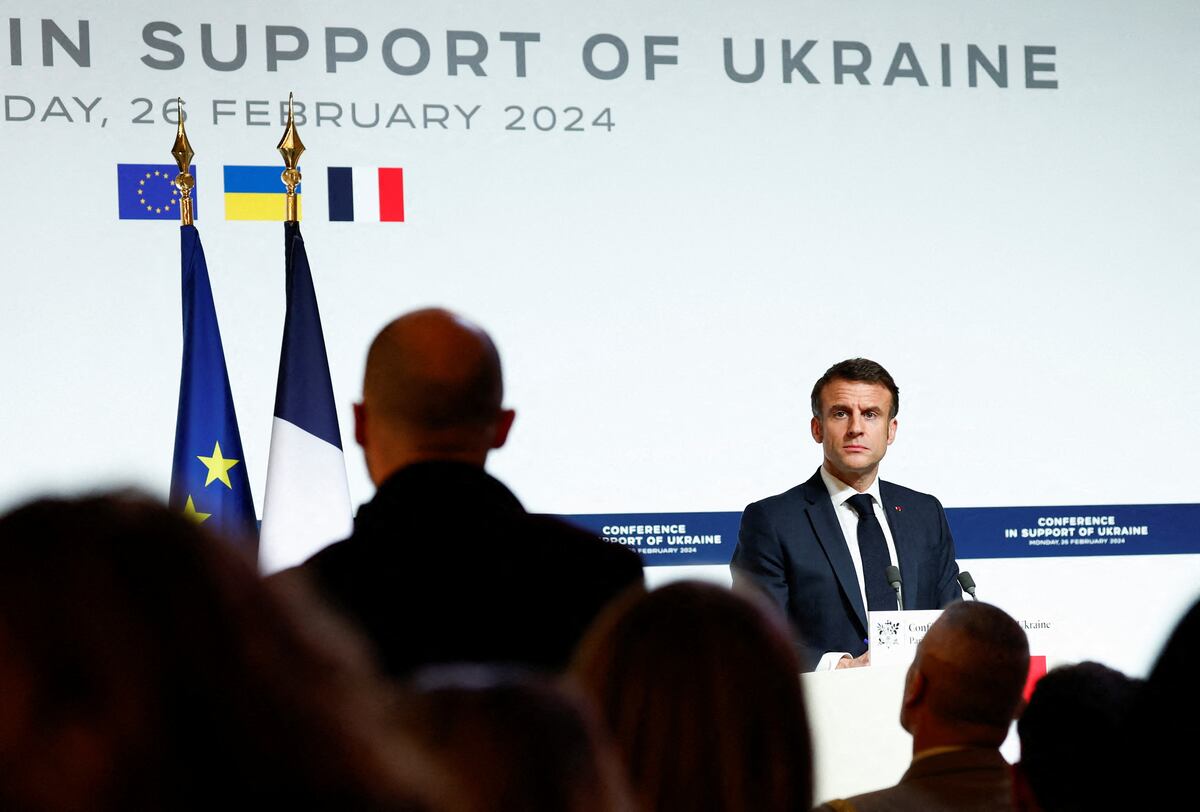
PARIS — French President Emmanuel Macron left open the option of putting European troops on the ground in Ukraine, saying nothing should be ruled out to defeat Russia’s aggression against the country.
Macron said the issue of sending troops to Ukraine was among topics discussed during a meeting of 27 countries in Paris, including 21 heads of state, on how to aid the embattled nation.
“There’s no consensus today to send ground troops in an official, assumed and endorsed way, but in terms of dynamics, nothing should be excluded,” Macron said in a press conference Monday night after the meeting. “We will do whatever it takes so that Russia cannot win this war.”
Two years after Russia’s invasion, Ukraine in recent weeks has been pushed back along some parts of the frontline, after a counteroffensive last year failed to achieve a breakthrough. Macron said Russia’s defeat in Ukraine is “indispensable” to the security and stability of Europe.
Macron declined to say which countries supported the idea of sending troops to Ukraine, and rejected a suggestion that France wasn’t in favor. The meeting included German Chancellor Olaf Scholz, Poland’s President Andrzej Duda and Dutch Prime Minister Mark Rutte.
“I’m not going to clear up the ambiguity of tonight’s debates by naming names, I’m saying that it was mentioned among the options,” the French president said.
According to Poland’s Duda, the most heated discussion at the meeting was about whether to send troops to Ukraine and “there was no agreement on the matter,” and no decisions taken, the Associated Press reported.
Macron said at the start of the meeting that there had been a “hardening” of Russia in recent months, also in its internal politics, and he said almost all the countries gathered in Paris had faced increased cyber and information attacks in recent months. He said the collective analysis is that “within the next few years, we have to be prepared for Russia to attack these countries.”
“The lucidity is here, and the collective realization is that basically all of our security is now at stake.”
The countries discussed the need to “do things differently,” according to Macron. He said the war in Ukraine is a European war, and it’s up to the European countries to make a “strategic leap.”
“Ukraine is under enormous pressure, and we must not simply react, but help Ukraine to take the initiative, at a time when there are strategic uncertainties on the American capacity to decide on additional aid, based on the outcome of the American elections.”
Macron said there was a consensus for “new initiatives” on cyber defense; co-production of arms and munitions in Ukraine; defending countries threatened by Russia’s invasion of Ukraine, in particular Moldova; supporting Ukraine on its border with Belarus with non-military forces; and demining operations.
If the five consensus points were fully implemented, they might require a number of security measures that would “justify some elements of deployment,” Macron said.
The countries gathered in Paris agreed on a new coalition to provide Ukraine with long-range strike capacity , by providing medium- and long-range missiles and bombs, according to Macron. The governments also agreed to strengthen existing coalitions for munitions and air-ground defense.
France isn’t in discussion with Ukraine about delivering Mirage jets, but continues to train pilots as part of the F-16 coalition, Macron said.
Macron backed an Estonian proposal for a joint European loan to set up a defense investment fund. He said a similar solution to the financing of the Covid crisis would be “relevant,” with a common guarantee backed by national budgets that would allow the European Union to issue debt.
The EU promise to deliver one million artillery shells to Ukraine by March “was no doubt an imprudent commitment,” because the stocks weren’t there, Macron said. Countries at the Monday meeting agreed to pool their efforts to source ammunition, including from non-EU countries, and they’ll provide “a clear response with a serious agenda” on the ammunition issue in the next ten days, he said.
He said finding the available ammunition is the main problem, the question of financing is secondary. Macron said explosive powder is “what’s really lacking today.”
Rudy Ruitenberg is a Europe correspondent for Defense News. He started his career at Bloomberg News and has experience reporting on technology, commodity markets and politics.
巴黎——法国总统马克龙表示,不排除向乌克兰派遣欧洲军队的可能性,称为了击败俄罗斯对乌克兰的侵略,任何手段都不应被排除。
马克龙表示,向乌克兰派遣军队的问题是27个国家(包括21位国家元首)在巴黎举行的会议上讨论的议题之一,会议讨论了如何援助这个陷入困境的国家。
马克龙在周一晚间会后举行的新闻发布会上表示:“目前尚未就以官方、默认和认可的方式派遣地面部队达成共识,但就局势发展而言,任何可能性都不应排除。我们将竭尽全力阻止俄罗斯赢得这场战争。”
俄罗斯入侵乌克兰两年后,乌克兰近几周在部分前线地区遭到击退,此前去年的反攻未能取得突破。马克龙表示,俄罗斯在乌克兰的失败对欧洲的安全与稳定“至关重要”。
马克龙拒绝透露哪些国家支持向乌克兰派兵,并否认法国反对派兵的说法。出席会晤的还有德国总理奥拉夫·朔尔茨、波兰总统安杰伊·杜达和荷兰首相马克·吕特。
“我不会通过指名道姓来消除今晚辩论中的歧义,我只是想说,它曾被列入选项之一,”法国总统说道。
据美联社报道,波兰总统杜达表示,会议中最激烈的讨论是关于是否向乌克兰派兵,“对此没有达成任何协议”,也没有做出任何决定。
马克龙在会议伊始表示,近几个月来,俄罗斯的立场有所“强硬”,其内部政治也呈现这种趋势。他还指出,几乎所有与会国家都面临着网络和信息攻击日益增多的局面。他表示,各方分析认为,“未来几年内,我们必须做好应对俄罗斯攻击这些国家的准备。”
“现在大家都清醒了,也都意识到,我们所有的安全都岌岌可危。”
据马克龙称,各国讨论了“改变行事方式”的必要性。他表示,乌克兰战争是一场欧洲战争,欧洲各国有责任实现“战略飞跃”。
“乌克兰正面临巨大的压力,我们不能只是被动应对,而应该帮助乌克兰掌握主动权。目前,美国能否根据美国大选结果决定是否提供额外援助存在战略上的不确定性。”
马克龙表示,各方就网络防御、在乌克兰共同生产武器弹药、保卫受俄罗斯入侵乌克兰威胁的国家(特别是摩尔多瓦)、以非军事力量支持乌克兰与白俄罗斯的边境以及开展排雷行动等“新举措”达成共识。
马克龙表示,如果五项共识要点得到全面落实,可能需要采取一些安全措施,这将“证明某些部署措施的合理性”。
据马克龙称,在巴黎召开会议的各国同意组建新的联盟,通过提供中远程导弹和炸弹,为乌克兰提供远程打击能力。各国政府还同意加强现有的军火和空地防御联盟。
马克龙表示,法国并未与乌克兰就交付幻影战机进行讨论,但作为F-16联盟的一部分,法国将继续为乌克兰飞行员提供训练。
马克龙支持爱沙尼亚提出的设立联合欧洲贷款以建立国防投资基金的方案。他表示,类似的方案也适用于应对新冠疫情危机,即由各国预算提供共同担保,使欧盟能够发行债券。
马克龙表示,欧盟承诺在3月前向乌克兰交付100万发炮弹“无疑是一项不明智的承诺”,因为当时并没有足够的库存。他指出,各国在周一的会议上同意共同努力采购弹药,包括从非欧盟国家采购,并将在未来十天内就弹药问题给出“明确的回应和切实可行的方案”。
他表示,寻找可用弹药是主要问题,资金问题是次要的。马克龙说,炸药才是“目前真正缺乏的”。
鲁迪·鲁伊滕贝格是《防务新闻》的欧洲记者。他的职业生涯始于彭博新闻社,拥有报道科技、大宗商品市场和政治方面的经验。