National Wages Council recommends 6% to 8% pay rise for lower-wage workers全国工资委员会建议低收入工人加薪6%至8%。
Singapore NWC recommends 6% to 8% pay rise for lower-wage workers and urges employers to build AI skills Read more at straitstimes.com.
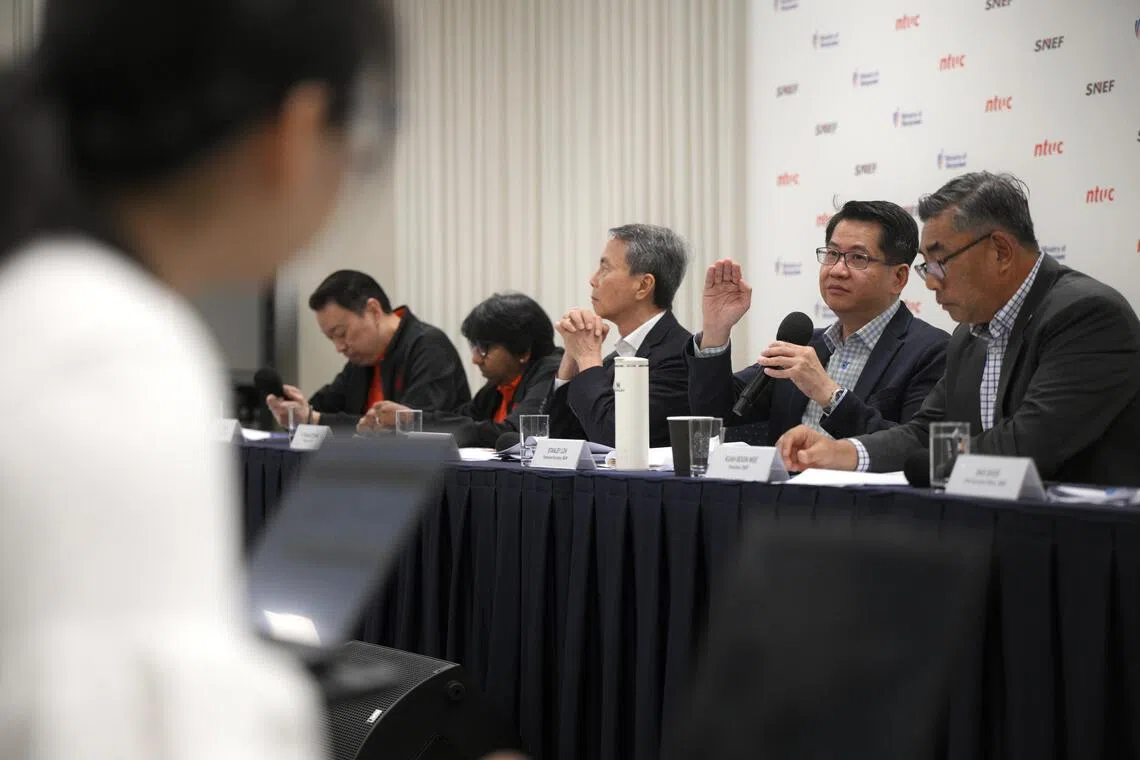
(From left) NTUC assistant secretary-general Melvin Yong, NTUC president K. Thanaletchimi, National Wages Council chairman Hsieh Fu Hua, MOM permanent secretary Stanley Loh and SNEF president Kuah Boon Wee at a press conference on Oct 19.
ST PHOTO: MARK CHEONG
Published Oct 19, 2026, 02:00 PM
Updated Oct 19, 2026, 07:03 PM
National Wages Council recommends 6% to 8% pay rises for lower-wage workers earning up to $2,800 a month.
The council recommends a pay bump of $135 to $170 for stronger firms and at least $120 for those who have not done well.
The council also called for more AI-related training and job redesign, and for employers to provide employees with protected time for training and upskilling.
SINGAPORE – Lower-wage workers earning up to $2,800 a month should be given a salary increase of 6% to 8%, or at least $120, said the National Wages Council (NWC).
Employers whose businesses have done well should give their employees a pay rise within the 6% to 8% range or at least $135 to $170, whichever is higher, the council said on Oct 19, in its annual guidelines on pay and employment issues.
Businesses that have not done well but are profitable should give their lower-wage workers a built-in wage increase at the lower end of the 6% to 8% range or at least $120, whichever is higher.
Those that have not done well and are unprofitable should still provide a salary bump of at least $120. This is a new category in the council’s guidelines, created in recognition of the economic difficulties faced by employers.
Bosses should review salaries and consider further pay increases for lower-wage workers if business prospects improve.
At a press conference held at the Ministry of Manpower (MOM) office on Oct 19, the ministry’s permanent secretary Stanley Loh said about a quarter of employers adopted the guidelines NWC proposed in 2025 , which called for a 5.5% to 7.5% pay rise for lower-wage workers .
However, about 60% of employers provided wage increases in 2025, but not up to the levels in the proposed NWC guidelines.
Singapore National Employers Federation (SNEF) president Kuah Boon Wee said many companies expressed difficulty in giving employees the proposed 5.5% to 7.5% increment in 2025.
“That’s why we came up with a category that hopefully will allow the percentage of adoption to go up,” Kuah said, adding about 20% of the resident workforce are earning a monthly salary of $2,800 and below.
More broadly, for all workers, NWC said companies that have done well should reward their employees with built-in wage increases and variable payments such as one-off payments.
Those that have not done well, however, can “exercise wage restraint, with management leading by example”.
Employers that have not done well but face positive business prospects should also consider setting out future variable payments linked to appropriate business indicators, said NWC.
The business performance period considered by NWC was March 2025 to March 2026, in line with the reference period for the Survey on Annual Wage Changes by MOM’s Manpower Research and Statistics Department.
NTUC president K. Thanaletchimi said there are safety measures in place, such as the Industrial Relations Act, to ensure employers are transparent with their financial performance.
“When you are transparent, you build trust with your workers,” she said.
The guidelines, for the period from Dec 1, 2026, to Nov 30, 2027, apply to all employees in unionised and non-unionised firms in both public and private sectors.
They were accepted by the Government but are not compulsory.
The council, which consists of Government, employer and labour movement representatives, convened from August to October 2026 to formulate the guidelines.
“The 2026/2027 guidelines adopt a positive-leaning posture for recommended wage increases, recognising both the stronger-than-expected overall performance of the Singapore economy and continued uncertainty in the economic outlook,” NWC said in its statement.
Council chairman Hsieh Fu Hua noted that business performance and productivity growth have not been consistent across sectors, and said employers should have the flexibility to calibrate wage increases to their specific business performance and prospects.
Gross domestic product growth for the rest of the year will be supported by outward-oriented segments and sectors that are plugged into the artificial intelligence (AI) technology cycle despite continued weakness in sectors affected by Middle East supply disruptions, said the council.
Kuah added: “Notably, the food and beverage is a sector that has been struggling. That’s why for this year, achieving a balance is important because no employers are the same.”
Meanwhile, the council urged all employers to implement the Flexible Wage System (FWS) in full, which comprises both the annual variable component and the monthly variable component, if they have not done so.
The FWS enables employers to maintain wage flexibility during adverse business conditions to sustain their businesses by cutting costs rather than jobs, NWC added.
Building AI-related capabilities
The guidelines also proposed that bosses and workers build the capabilities needed to thrive in an AI-enabled economy .
“AI presents significant opportunities to raise productivity, create new sources of value and strengthen Singapore’s competitiveness,” said NWC in its press statement.
According to data from an employer supported training survey by MOM, the proportion of employers who provided structured training to employees fell to 64% in 2025, down from 66.4% in 2024. The proportion of employees receiving structured training also dipped from 52.6% in 2024 to 48.1% in 2025.
MOM’s Loh emphasised the Government’s support for NWC’s call for employers to take a proactive approach to invest in enterprise transformation, and for employees to update their skills.
For employers, the council recommended helping employees prepare for future job roles such as an AI ethics officer or green tech specialist, and equip them with new skills as industries evolve.
This includes supporting employee-initiated training and tapping subsidies provided for Skills and Workforce Development Agency-funded training programmes.
Employers should also adopt AI effectively and responsibly, and redesign jobs in tandem with business transformation to increase productivity. Employers can do so by leveraging transformation support such as through NTUC’s job placement support and training programmes.
Another proposal was encouraging human resources (HR) practitioners to upskill and obtain the Institute for Human Resource Professionals (IHRP) Certification , strengthening capabilities to support work transformation.
For workers, they should strengthen their AI literacy alongside domain expertise, judgment and human skills to become “AI bilingual” individuals . These AI-relevant skills will enable them to access opportunities across firms and sectors.
NTUC’s Thanaletchimi urged employers to provide workers with protected time to build relevant skills and take on a higher-value added job, especially in the area of AI.
“In practical terms, this means planning workloads and work arrangements so that employees can attend relevant training without having to compromise their work responsibilities or solely rely on their personal time.”
Sharon Salim is a business correspondent at The Straits Times, with a focus on jobs, workplace culture and trends.
Ministry of Manpower
AI/artificial intelligence
(从左至右)全国职工总会助理秘书长杨明文、全国职工总会主席K·塔纳莱奇米、全国工资理事会主席谢福华、人力部常任秘书罗志强和新加坡全国职工联合会主席郭文伟于10月19日举行新闻发布会。
《海峡时报》照片:张马克
发布于2026年10月19日下午2:00
更新于2026年10月19日晚上7:03
全国工资委员会建议,对于月收入不超过 2800 美元的低收入工人,工资应提高 6% 至 8%。
委员会建议,对于业绩较好的公司,加薪幅度为 135 至 170 美元;对于业绩不佳的公司,至少加薪 120 美元。
该委员会还呼吁加强人工智能相关的培训和工作重新设计,并要求雇主为员工提供受保护的培训和技能提升时间。
新加坡——全国工资理事会(NWC)表示,月收入不超过 2800 新元的低收入工人应该获得 6% 至 8% 的加薪,或至少 120 新元。
该委员会在 10 月 19 日发布的年度薪酬和就业问题指导方针中表示,经营状况良好的雇主应该给员工加薪 6% 至 8%,或者至少加薪 135 美元至 170 美元,以较高者为准。
经营不善但盈利的企业应该给低收入员工提供固定的工资增长,增长幅度应在 6% 到 8% 的较低水平,或者至少达到 120 美元,以较高者为准。
那些经营不善且不盈利的企业仍应至少给员工加薪120美元。这是理事会指导方针中的一项新类别,旨在考虑到雇主面临的经济困难。
如果业务前景改善,老板应该重新审视薪资水平,并考虑进一步提高低收入员工的工资。
10 月 19 日,人力部常任秘书 Stanley Loh 在人力部办公室举行的新闻发布会上表示,约有四分之一的雇主采纳了全国工人委员会在 2025 年提出的指导方针,该方针要求低收入工人的工资上涨 5.5% 至 7.5%。
然而,约有 60% 的雇主在 2025 年提高了工资,但并未达到 NWC 拟议指导方针中的水平。
新加坡全国雇主联合会(SNEF)主席郭文伟表示,许多公司表示难以在2025年给员工提供拟议的5.5%至7.5%的加薪。
“这就是为什么我们想出了一个类别,希望能够提高收养率,”库阿说,并补充说,大约 20% 的居民员工月薪在 2800 美元及以下。
更广泛地说,NWC表示,对于所有劳动者而言,业绩良好的公司应该通过固定工资增长和浮动奖金(例如一次性奖金)来奖励员工。
然而,那些业绩不佳的公司可以“采取工资克制措施,管理层以身作则”。
NWC表示,业绩不佳但前景乐观的雇主也应考虑制定与适当业务指标挂钩的未来浮动付款计划。
NWC 考虑的业务绩效期为 2025 年 3 月至 2026 年 3 月,与人力部人力研究与统计局年度工资变化调查的参考期一致。
全国职工总会主席K·塔纳莱奇米表示,目前已有诸如《工业关系法》等安全措施,以确保雇主在财务业绩方面保持透明。
“当你保持透明时,你就能赢得员工的信任,”她说。
该指导方针适用于 2026 年 12 月 1 日至 2027 年 11 月 30 日期间的所有员工,无论其是否加入工会,也无论其是否属于公共或私营部门。
这些措施已被政府接受,但并非强制性的。
该委员会由政府、雇主和劳工运动代表组成,于 2026 年 8 月至 10 月召开会议,制定指导方针。
“2026/2027 年的指导方针对建议的工资增长采取了积极的态度,既考虑到新加坡经济整体表现强于预期,也考虑到经济前景持续存在不确定性,”全国工资委员会在声明中表示。
委员会主席谢福华指出,各行业的企业业绩和生产力增长并不一致,并表示雇主应有灵活性,根据其具体的企业业绩和前景来调整工资增长。
该委员会表示,尽管受中东供应链中断影响的行业持续疲软,但今年剩余时间的国内生产总值增长将得到面向外部市场的行业和与人工智能 (AI) 技术周期相关的行业的支持。
Kuah补充道:“值得注意的是,餐饮业一直举步维艰。因此,今年实现收支平衡至关重要,因为每个雇主的处境都不尽相同。”
与此同时,该委员会敦促所有雇主全面实施灵活工资制度(FWS),该制度包括年度可变部分和月度可变部分(如果他们尚未这样做的话)。
NWC补充说,FWS使雇主能够在不利的商业环境下保持工资灵活性,通过削减成本而不是裁员来维持业务。
构建人工智能相关能力
该指南还建议,老板和员工应培养在人工智能经济中蓬勃发展所需的能力。
NWC在新闻稿中表示:“人工智能为提高生产力、创造新的价值来源和增强新加坡的竞争力提供了重大机遇。”
根据新加坡人力部一项雇主支持培训调查的数据,到2025年,为员工提供结构化培训的雇主比例将下降至64%,低于2024年的66.4%。接受结构化培训的员工比例也将从2024年的52.6%下降至2025年的48.1%。
人力部部长罗强调,政府支持全国工人大会的呼吁,即雇主应采取积极主动的方式投资企业转型,员工应不断更新技能。
对于雇主而言,该委员会建议帮助员工为未来的工作角色做好准备,例如人工智能伦理官或绿色技术专家,并随着行业的演变为他们提供新的技能。
这包括支持员工自主培训,以及利用技能和劳动力发展署资助的培训计划所提供的补贴。
雇主也应有效且负责任地采用人工智能,并配合业务转型重新设计工作岗位,以提高生产力。雇主可以通过利用转型支持来实现这一点,例如通过全国职工总会(NTUC)的就业安置支持和培训计划。
另一项提议是鼓励人力资源从业人员提升技能并获得人力资源专业人员协会 (IHRP) 认证,从而增强支持工作转型的能力。
对于劳动者而言,他们应该在提升领域专业知识、判断力和人际交往能力的同时,加强人工智能素养,成为“人工智能双语者”。这些与人工智能相关的技能将使他们能够在各个公司和行业中获得发展机会。
全国职工总会主席塔纳莱奇米敦促雇主为员工提供受保护的时间,让他们培养相关技能并从事更高附加值的工作,尤其是在人工智能领域。
“从实际角度来看,这意味着要规划工作量和工作安排,以便员工能够在不影响工作职责或完全依赖个人时间的情况下参加相关培训。”
Sharon Salim 是《海峡时报》的商业记者,主要关注就业、职场文化和趋势。
人力部
人工智能