Army feels ‘growing pains’ as it integrates Anduril NGC2 tech with older comms陆军在将Anduril NGC2技术与旧式通信系统整合的过程中感受到“成长的烦恼”
“It wasn't seamless, and we learned a lot,” Brig. Gen. Shane Taylor told Breaking Defense.
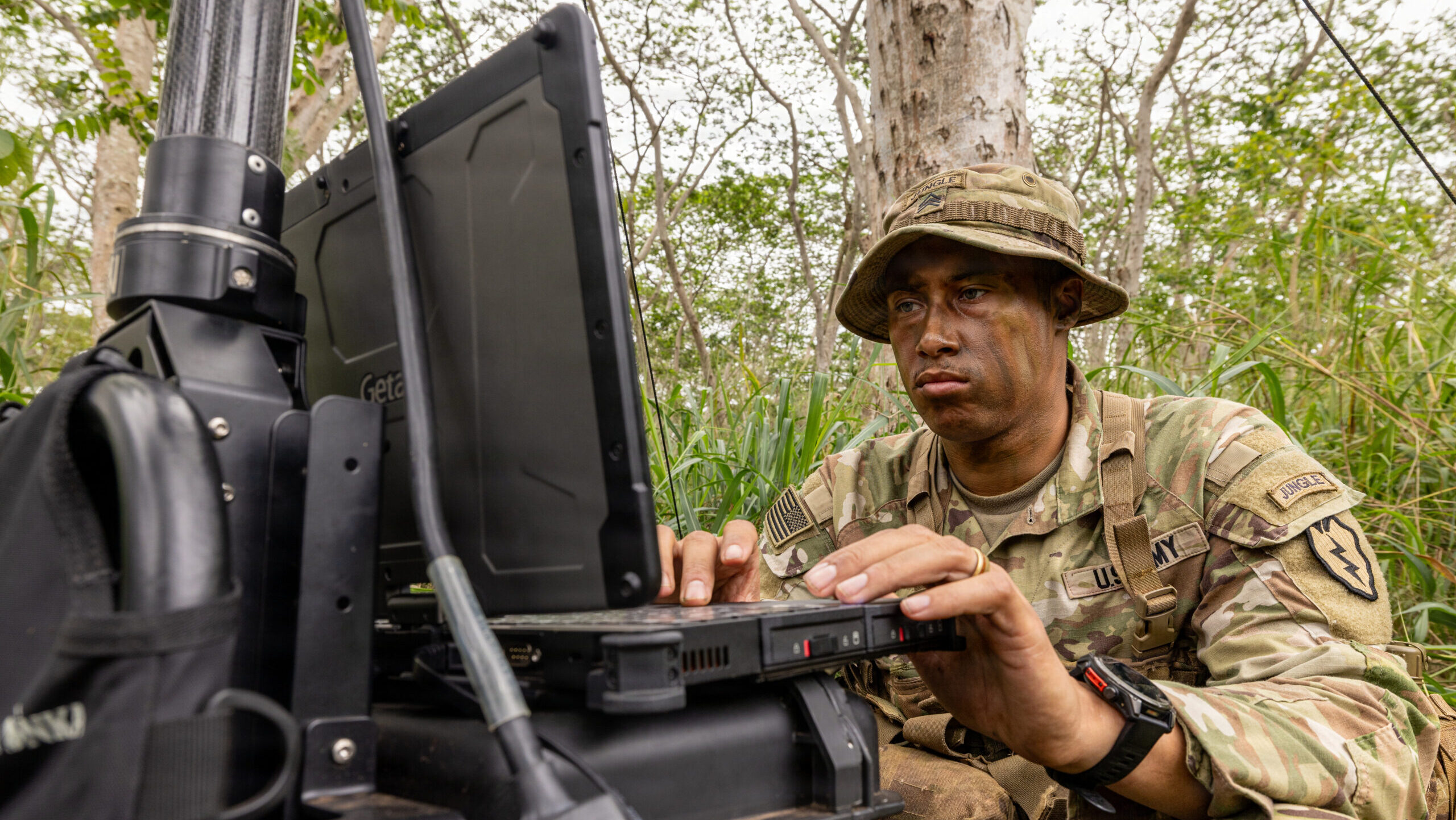
U.S. Army Sgt. Jeffrey Davis, an electronic warfare specialist with the 3rd Infantry Brigade Combat Team, 25th Infantry Division, operates a dismounted spectrum awareness system during Exercise Lightning Surge 1 at Schofield Barracks, Hawaii, Jan. 22, 2026. The system provides real-time situational awareness of the electromagnetic spectrum, feeding critical data into the Army's Next Generation Command and Control (NGC2) ecosystem for commanders to make more informed decisions. (U.S. Army photo by Sgt. Duke Edwards)
WASHINGTON — When the Army for the first time attempted to integrate Next Generation Command and Control (NGC2) tech from defense firm Anduril into its existing comms systems, not everything went exactly to plan, Army and company officials revealed to Breaking Defense this week.
“It wasn’t seamless, and we and we learned a lot,” Brig. Gen. Shane Taylor, Portfolio Management Executive for Command and Control Information Network (C2IN), said on the sidelines of the annual AUSA conference this week. “There’s always growing point pains in these. I just think that a lot of the things that we saw out there were normal, like all right, we’re putting … a group that hasn’t necessarily worked together, so it’s just that normal growing pains with that.”
The test had come in September, when the Army’s 25th Infantry Division attempted to use Anduril’s Lattice platform during Lightning Surge 5 in Hawaii, which the Army described as a “multi-phase campaign to modernize its command-and-control architecture.” Up until then, Anduril’s NGC2 tech had been used by the 4th ID in Colorado where it was paired with new, mostly commercial hardware and software.
Lockheed Martin, which is leading the integration on the 25th ID’s portion of the NGC2 architecture , served as the integrator for Anduril’s platform. Chandra Marshall, vice president of multi-domain combat solutions at the defense giant, told Breaking Defense the company expected “it would be a challenge.”
“I would say outside of Lockheed Martin, yes, I think some people are surprised at how much of a challenge it has been,” Marshall said in an interview at the AUSA conference.
She explained scaling with Lattice was an issue passing data through the system “just is not at the state it should be right now with bringing in the Lattice product.”
An Anduril official, for his part, acknowledged the growing pains, but noted that they discovered technical limitations with the communications architecture writ large.
“It was our first time with a host of technologies at the 25th [ID],” James Craven, Program Manager for NGC2 for Anduril, said in an interview Wednesday. “Working on TSM radios that were not the same waveform or configuration that we had used at 4th ID, and [Lightning Surge] was also several novel mission threads as well.”
Getting Lattice and the older comms structure on the same page will be key to the Army’s NGC2 efforts, as Army and industry officials noted that the 25th ID’s architecture is largely representative of what they’ll have to build on top of as they begin to baseline and field other units within I Corps throughout the upcoming fiscal year.
“The major difference between the 4th Infantry Division and the 25th, is that [25th] will continue to preserve some legacy capabilities … and we’re going to make sure that that we maintain seamless integrations with legacy equipment because not everybody’s going to get a fresh fielding like the 4th Infantry Division,” Craven said.
Lockheed’s Marshall said that for its part, the company is making sure the 25th ID gets “back to working operational architecture so that we can continue to build on the capabilities.”
New Environment, Different Technology
Part of the challenge, Army and company officials said, was also just the vastly different environment the tech was called to operate in and on what mobile platforms.
For example, Fort Carson, Colo., where 4th ID is based, is a much more open, plain environment as opposed to the dense jungle in Hawaii with 25th ID. Moreover, 4th ID is a heavier unit, with soldiers operating out of Strykers, while 25th ID’s primary platforms are lighter Infantry Squad Vehicles.
“We don’t have the same type of permissiveness from putting equipment on platforms perspective that we do with like Stryker brigades,” Joseph Welch, the Army’s portfolio acquisition executive for Command and Control (C2) and Counter C2, said in an interview at AUSA. “We’ve had to work through what does that really mean for a mobile infantry unit in terms of what types of transport solutions and what type of compute capacity we can put at echelon. … There’s probably some additional tweaks and optimizations we’re going to make that’s based on just the reality of the formation type.”
As for working with other legacy tech, Cravens said Anduril has been partnering with radio providers, C2IN and 25th ID to on the operational configurations such as how big the channels are, how to separate data from voice channels on radios, how to ensure the appropriate soldiers within a unit have beyond line of sight communications such as Starshield , all in order to provide a “fight tonight” capability for the data layer.
One of the key lessons at Lightning Surge 5, Craven said, was filling the request to go smaller on things like edge computing capabilities. While they integrated Lattice onto the Mounted Family of Computer Systems at 4th ID, last month was the first time they did it on tablets.
However, that integration was requested and done in the middle of the exercise, Craven said, hoping that next time, they’ll have a chance to work that integration before they get out to the field.
Outfitting More Divisions With NGC2
Following the decision to field I Corps with the NGC2 architecture and associated capabilities, the Army is in the process of providing the corps headquarters capabilities and applications while looking to baseline the other divisions.
Taylor echoed the idea that 25th ID is an important first step in that journey given a more representative approach to how the Army will have to field given many of the other formations are closer to them having not received any equipment.
“I think the 25th one was very helpful because those ITN divisions, when we come in with the Next Gen C2 capabilities, that’s the integration that we’re going to do,” he said.
Though, Welch said they’ll continue to upgrade 4th ID with some “burn down items” that came out of Project Convergence over the summer, they need to address in terms of systems to bring forward or leave behind.
Welch noted that the importance of testing over the past year with the ITN equipment in 25th has helped ensure the baseline is solid and they have good configurations.
While there is no definitive timeline in terms of when the other divisions under I Corps will get baselined, Welch said it will occur within the fiscal year. The continuing resolution is having some impact on that, he said, acknowledging they’ll have to look at “pacing” some systems.
Additionally, there are logistics the Army will have to take into consideration in terms of moving systems forward to the divisions, with units spanning up to Alaska and in the Pacific.
Overall, they’re trying to not overwhelm these units with new capabilities.
“We are trying not to have NGC2 coming in there as a disruptor to their mission focus, but as an enabler of it. As you know, NGC2 is a multi-layered stack capability. So our teams are in routine communications for the planning aspect of when we’re going to start introducing those,” he said. “It’s really more aligned to the opportunities that we have when we try to align to their exercises and their training.”
2026年1月22日,在夏威夷斯科菲尔德兵营举行的“闪电突袭1”演习中,美国陆军第25步兵师第3步兵旅战斗队的电子战专家杰弗里·戴维斯中士正在操作一套徒步频谱感知系统。该系统可提供电磁频谱的实时态势感知,并将关键数据传输到陆军的下一代指挥与控制(NGC2)系统,以便指挥官做出更明智的决策。(美国陆军照片,摄影:杜克·爱德华兹中士)
华盛顿——本周,陆军和安杜里尔公司官员向《防务新闻》透露,当陆军首次尝试将国防公司安杜里尔的下一代指挥与控制(NGC2)技术集成到其现有的通信系统中时,并非一切都按计划进行。
“过程并非一帆风顺,我们从中也学到了很多,”指挥与控制信息网络(C2IN)项目组合管理执行官谢恩·泰勒准将本周在AUSA年度会议间隙表示。“任何项目在发展过程中都会遇到一些问题。我认为我们遇到的很多情况都很正常,比如,我们正在组建一个之前从未合作过的团队,所以出现这些问题也是正常的。”
这次测试发生在9月份,当时陆军第25步兵师在夏威夷举行的“闪电突击5”演习中尝试使用安杜瑞尔公司的Lattice平台。陆军将此次演习描述为“旨在实现指挥控制架构现代化的多阶段行动”。在此之前,安杜瑞尔公司的NGC2技术已在科罗拉多州的第4步兵师使用,并搭配了新的、主要为商用硬件和软件。
洛克希德·马丁公司负责第25步兵师NGC2架构部分的集成工作,同时也是Anduril平台的集成商。这家国防巨头的多域作战解决方案副总裁钱德拉·马歇尔告诉《防务新闻》,公司预料到“这将是一个挑战”。
“我想说,除了洛克希德·马丁公司之外,是的,我认为有些人对面临的挑战之大感到惊讶,”马歇尔在 AUSA 会议上接受采访时说道。
她解释说,使用 Lattice 进行扩展存在一个问题,即通过系统传递数据“目前还没有达到引入 Lattice 产品后应有的状态”。
安杜里尔的一位官员承认了成长的烦恼,但他指出,他们发现通信架构整体上存在技术局限性。
“这是我们第25步兵师首次使用如此多的技术,”安杜里尔NGC2项目经理詹姆斯·克雷文周三在接受采访时表示。“我们使用的TSM无线电的波形和配置与我们在第4步兵师使用的都不同,而且[闪电涌动]任务也涉及几个全新的任务方向。”
让 Lattice 和旧的通信结构保持一致,对于陆军的 NGC2 工作至关重要。陆军和业界官员指出,第 25 步兵师的架构在很大程度上代表了他们在即将到来的财政年度开始为第一军的其他部队建立基线和部署时必须在此基础上构建的架构。
克雷文说:“第4步兵师和第25步兵师的主要区别在于,第25步兵师将继续保留一些传统能力……我们将确保与传统装备保持无缝集成,因为不是每个人都能像第4步兵师那样获得全新的装备。”
洛克希德公司的马歇尔表示,该公司正在确保第 25 步兵师“恢复正常的作战架构,以便我们能够继续增强其能力”。
新环境,不同技术
陆军和公司官员表示,部分挑战还在于这项技术需要在截然不同的环境中运行,以及需要在不同的移动平台上运行。
例如,驻扎在第4步兵师的科罗拉多州卡森堡,与驻扎在夏威夷茂密丛林的第25步兵师相比,地形要开阔平坦得多。此外,第4步兵师是一支装备更精良的部队,士兵们乘坐斯特瑞克装甲车作战,而第25步兵师的主要作战平台是较轻型的步兵班组车辆。
“从装备部署的角度来看,我们在平台部署方面不像在‘斯特瑞克’旅那样拥有同样的权限,”陆军指挥与控制(C2)和反C2项目采购主管约瑟夫·韦尔奇在AUSA年会上接受采访时表示。“我们必须仔细研究这对机动步兵部队来说究竟意味着什么,包括我们可以在各级部署哪些类型的运输方案和计算能力……我们可能还会根据部队类型的实际情况进行一些额外的调整和优化。”
至于与其他传统技术的合作,克雷文斯表示,安杜里尔一直在与无线电供应商、C2IN 和第 25 步兵师合作,研究操作配置,例如信道的大小、如何在无线电上将数据信道与语音信道分开、如何确保单位内合适的士兵拥有超视距通信(例如 Starshield),所有这些都是为了向数据层提供“今晚开战”的能力。
克雷文表示,第五届“闪电浪潮”演习的关键经验之一是满足客户对边缘计算等小型化需求。虽然他们已将Lattice集成到第四步兵师的车载计算机系统中,但上个月是他们首次将其集成到平板电脑上。
克雷文表示,不过,这项整合是在演习过程中提出的要求,并已完成。他希望下次演习时,他们有机会在实地演练之前就进行这项整合。
为更多部门配备NGC2
在决定为第一军部署 NGC2 架构及相关能力之后,陆军正在为该军总部提供能力和应用,同时也在考虑为其他师建立基线。
泰勒也赞同第 25 步兵师是这一征程中的重要第一步,因为考虑到其他许多部队尚未收到任何装备,第 25 步兵师更能代表陆军的部署方式。
“我认为第 25 次会议非常有帮助,因为当我们引入下一代 C2 能力时,ITN 部门的整合就是我们要做的,”他说。
韦尔奇表示,虽然他们将继续对第四步兵师进行升级,包括利用夏季“融合项目”中产生的一些“淘汰项目”,但他们需要解决哪些系统需要升级,哪些系统需要淘汰的问题。
韦尔奇指出,过去一年在 25th 使用 ITN 设备进行的测试非常重要,这有助于确保基线稳固,并且他们拥有良好的配置。
虽然目前尚无第一军团下属其他部门何时完成基线评估的明确时间表,但韦尔奇表示,这项工作将在本财政年度内完成。他指出,持续拨款决议对此产生了一定影响,并承认他们需要调整一些系统的进度。
此外,陆军还需要考虑后勤问题,才能将系统向前运送到各师,这些部队的足迹遍布阿拉斯加和太平洋地区。
总的来说,他们尽量避免让这些部队承担过多的新功能。
“我们力求让NGC2的引入不成为他们任务重点的干扰因素,而是成为其助力。正如您所知,NGC2是一个多层级的综合能力。因此,我们的团队会定期沟通,规划何时开始引入这项能力,”他说道。“这实际上更符合我们与他们的演习和训练相契合的机会。”