Ukrainian defense firms get creative to try and break through export restrictions乌克兰国防企业绞尽脑汁,试图突破出口限制
Speaking to Breaking Defense in Washington and Lviv, companies made clear that reform efforts to allow weapons exports have not gone far enough.
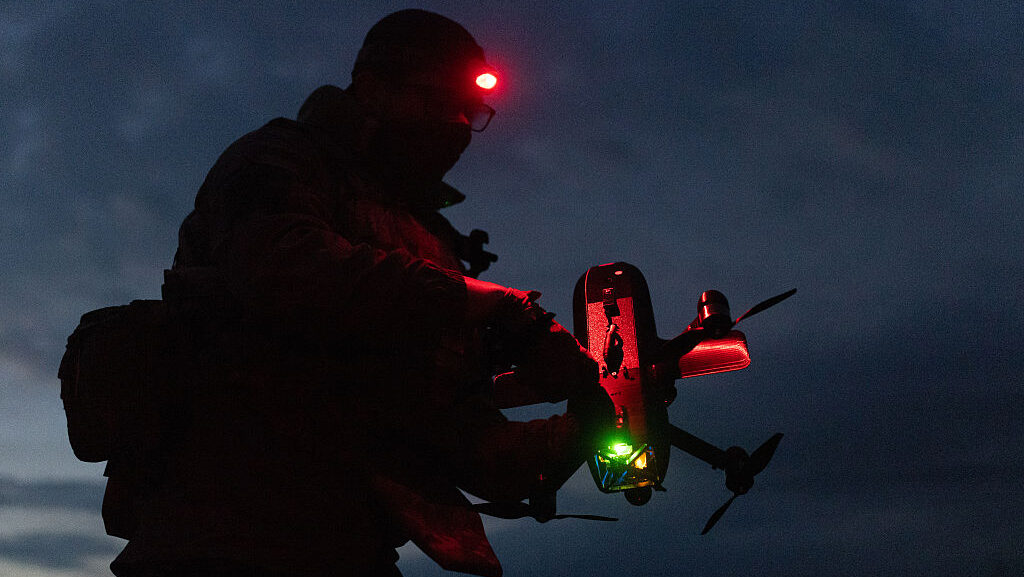
A soldier of the Unmanned Systems Forces prepares a drone 'Salut' for flight by connecting cables to the system on March 31, 2026 in Kharkiv, Ukraine. (Photo by Nikoletta Stoyanova/Getty Images)
WASHINGTON — Ukraine recorded its largest presence ever at AUSA this year, with 14 companies attending as part of the stand-alone Ukrainian defense pavilion. This marked the country’s first return to the show since 2017, before Russia launched its full-scale invasion.
But despite the presence of these firms at America’s largest defense conference, a longstanding challenge remains: exporting weapon systems from Ukraine is inherently complicated.
“For Ukrainian defense companies, bringing our innovations to international markets is a pretty complex regulatory environment,” Yurii Hundych, chief commercial officer at Meta Bureau, told Breaking Defense on the sidelines of the show.
In April, in a long-awaited move, Ukrainian President Volodymyr Zelenskyy announced that the war-torn country would change its current export regime, which since 2022 has prohibited the transfer of military goods to other countries, to partially allow the sale of some domestically produced weapons to allies deemed non-cooperative with Russia.
At the time, the head of state stated in an X post that Ukrainian companies would receive “a real opportunity to enter partner countries’ markets,” provided that the country’s armed forces were entitled to obtain the required amount of weapons first and “only what companies can produce beyond state orders will be exported.”
However, six months later, Ukrainian firms tell Breaking Defense that a simple path forward has yet to materialize.
“There is a significant gap between the formal procedure and its practical implementation,” a spokesperson for Phantom Defense, who wished to remain anonymous for security reasons, told Breaking Defense in Lviv last month. “The industry is still gaining practical experience with the new export licensing process, and companies are exploring ways to navigate it. … But the licensing procedure can be a bottleneck for companies looking to start exporting.”
Localizing tactical communications for sovereign, NATO-ready C3I
Beyond foreign sales, Rafael’s model enables tech transfer, local engineering, and is a template for NATO partners.
Instead, companies are left to pursue a variety of bureaucratic options, with no clear understanding of what will work or what won’t at any given time.
“While obtaining a traditional export license is a challenging process, we are exploring new innovative opportunities for international cooperation,” Hundych said during AUSA.
So how are companies trying to get around these obstacles? Industry officials say there are a number of ways.
Denys Nikolayenko, CEO and co-founder of Oko Camera, a Ukrainian manufacturer of thermal and infrared cameras for drones and unmanned ground vehicles on the frontline, highlighted that the rules are different for dual-source companies such as his . He explained that since the company is registered and classified as a dual-use company, it has been exporting to European and non-European customers with much greater ease than his contemporaries, who are pure defense companies.
“For other defense companies, the [export] license process has been more complex to navigate and is essentially stuck. In fact, there is currently no working export [procedure] for Ukrainian defense tech: draft laws that will form policies on this matter are still pending,” Nikolayenko told Breaking Defense. “As a result, some Ukrainian producers are either not operating at full-capacity or reducing their production volumes, as government contracts currently do not cover all production of Ukrainian companies.”
Of course, pure military firms can’t simply claim to be dual-use and get around current restrictions, which leaves them looking for other solutions, including trying to get selected for defense efforts abroad.
For Meta Bureau, which claims over 30 Ukrainian brigades use its AI-powered drones, that includes participating in the US Department of Defense’s Drone Dominance program. “We see DDP as a promising way to build partnerships and expand our international presence,” Hundych said. (Hundych didn’t explain further how joining DDP would change exportability, but Kyiv, always eager to deepen ties with Washington, would likely allow Ukrainian drones selected by the Pentagon to move abroad.)
Another model that Ukrainian manufacturers have at their disposal are international partnership agreements signed with other allies.
Ukrainian firms have sought to sign cooperation agreements with foreign companies. Phantom Defense appears to be one such company, being present this week for the first time at the AUSA conference in Washington, promoting some of its counter-drone and electronic warfare systems abroad.
But, the spokesperson said, few of these agreements have actually resulted in sales: “According to analytical studies, there are more than 180 international partnerships in the Ukrainian defense industry, but more than 20 [percent] are still at the MoU stage and have not yet moved into practical implementation,” he said.
Other avenues for international cooperation that companies can consider, he added, include localizing production, where foreign government funding supports collaboration between a Ukrainian producer and an industrial partner outside Ukraine, and the “ Danish model ,” where another country funds Ukrainian firms to produce weapons which are then used both by Ukraine and sold back to the partner country.
“The Danish model — direct procurement of Ukrainian systems financed by foreign governments — based on publicly available information, this one has provided a practical mechanism for authorities abroad to procure Ukrainian defense systems,” the Phantom representative said.
Unfortunately for these companies and others, an easy path forward doesn’t appear to be coming anytime soon.
According to Impact Law, a Ukrainian law firm, on July 8, the country’s Cabinet of Ministers formally adopted Resolution No. 875, dubbed “Certain Matters of International Transfer of Goods for the Duration of Martial Law in Ukraine,” covering both military and dual-use goods. Specifically, the resolution addressed the Drone Deal format, a separate, long-term partnership between Ukraine and allies focused on joint production or supply agreements in the field of unmanned systems.
In a report, the law firm explained that this new resolution “does not repeal the general export control procedures for military and dual-use goods” and that, to qualify for these exports, the State Service for Export Control must issue a license. The manufacturer must submit an application, along with other supporting documents, and the review period may not exceed 30 calendar days.
Breaking Defense Video
Hegseth talks autonomy at AUSA, a key show focus
Army doubles down on autonomy, stakes out Indo-Pacific role: AUSA Day 2
Telle talks ‘manufacturing rodeo,’ supply chain ‘weak links’: AUSA Day 1
New leaders, new drone command: What we expect from AUSA 2026
Unpacking Boeing’s F/A-XX win, plus a report from wartime Ukraine
How Hegseth envisions a new Autonomous Warfare Command
What Europe’s military air fleets will look like in 30 years
Riyadh gets closer to F-35s, Damascus presses sovereignty and an expert take on Iran
Drone-hunting on the border, plus turmoil at an Air Force think tank
The future of European airpower might be unmanned
2026年3月31日,在乌克兰哈尔科夫,一名无人系统部队士兵正在为“致敬”无人机连接电缆,准备起飞。(图片来源:Nikoletta Stoyanova/Getty Images)
华盛顿——今年,乌克兰在AUSA展会上规模空前,共有14家公司参展,组成独立的乌克兰防务展馆。这是自2017年俄罗斯全面入侵乌克兰之前,乌克兰首次重返该展会。
尽管这些公司参加了美国最大的防务会议,但一个长期存在的挑战依然存在:从乌克兰出口武器系统本质上是复杂的。
“对于乌克兰国防公司来说,将我们的创新成果推向国际市场是一个相当复杂的监管环境,”Meta Bureau 首席商务官 Yurii Hundych 在展会间隙告诉 Breaking Defense。
今年 4 月,乌克兰总统泽连斯基宣布,这个饱受战争蹂躏的国家将改变其现行的出口制度。自 2022 年以来,该制度一直禁止向其他国家转让军需品。改变后的制度将允许向被认为与俄罗斯不合作的盟友出售一些国产武器。
当时,国家元首在 X 论坛上表示,乌克兰公司将获得“进入伙伴国家市场的真正机会”,前提是该国武装部队首先有权获得所需数量的武器,“只有公司能够生产的超出国家订单范围的产品才能出口”。
然而,六个月后,乌克兰企业告诉《防务新闻》,一条简单的前进道路尚未出现。
“正式程序与实际执行之间存在显著差距,”幻影防务公司一位出于安全原因要求匿名的发言人上个月在利沃夫接受《防务新闻》采访时表示。“业界仍在积累新的出口许可流程的实践经验,各公司也在探索应对之策……但对于那些希望开展出口业务的公司而言,许可程序可能成为一大瓶颈。”
为主权、符合北约标准的C3I系统实现战术通信本地化
除了对外销售,拉斐尔的模式还实现了技术转让和本地工程,并为北约合作伙伴提供了一个模板。
相反,企业只能寻求各种官僚主义的选择,却不清楚在任何特定时间哪些方法有效,哪些无效。
“虽然获得传统的出口许可证是一个具有挑战性的过程,但我们正在探索国际合作的新创新机会,”亨迪奇在AUSA会议上说。
那么,企业是如何试图克服这些障碍的呢?业内人士表示,方法有很多种。
乌克兰无人机和无人地面车辆热成像及红外摄像机制造商Oko Camera的首席执行官兼联合创始人丹尼斯·尼古拉延科强调,像他所在的公司这样的军民两用企业适用不同的规则。他解释说,由于公司已注册并被归类为军民两用企业,因此与那些纯粹的国防企业相比,该公司向欧洲和非欧洲客户出口产品要容易得多。
尼古拉延科告诉《防务新闻》:“对于其他国防企业而言,出口许可证的申请流程更加复杂,而且基本上陷入了停滞。事实上,目前乌克兰国防技术尚无有效的出口程序:相关政策草案仍在制定中。因此,一些乌克兰生产商要么无法满负荷运转,要么正在减产,因为政府合同目前并未涵盖乌克兰企业的所有生产。”
当然,纯粹的军工企业不能简单地声称自己是军民两用企业来规避当前的限制,这使得它们不得不寻找其他解决方案,包括努力争取参与海外的国防项目。
Meta Bureau公司声称,超过30个乌克兰旅正在使用其人工智能无人机,而参与美国国防部的“无人机优势计划”(Drone Dominance Program,简称DDP)正是其计划的一部分。“我们认为DDP是建立合作伙伴关系、拓展国际影响力的一个很有前景的途径,”Hundych表示。(Hundych并未进一步解释加入DDP将如何改变无人机的出口能力,但基辅一直渴望深化与华盛顿的关系,很可能会允许五角大楼选定的乌克兰无人机部署到国外。)
乌克兰制造商可以利用的另一种模式是与其他盟友签署国际合作协议。
乌克兰企业一直寻求与外国公司签署合作协议。幻影防御公司(Phantom Defense)似乎就是其中之一,该公司本周首次亮相华盛顿举行的美国陆军协会(AUSA)年会,并在海外推广其反无人机和电子战系统。
但发言人表示,这些协议中真正促成销售的寥寥无几:“根据分析研究,乌克兰国防工业有超过 180 项国际合作,但其中超过 20% 仍处于谅解备忘录阶段,尚未进入实际执行阶段。”他说。
他还补充说,企业可以考虑的其他国际合作途径包括本地化生产,即外国政府资助乌克兰生产商与乌克兰境外的工业伙伴合作;以及“丹麦模式”,即另一个国家资助乌克兰公司生产武器,这些武器既供乌克兰使用,也出售给伙伴国。
“丹麦模式——由外国政府出资直接采购乌克兰系统——基于公开信息,为外国当局采购乌克兰国防系统提供了一种切实可行的机制,”幻影公司代表表示。
不幸的是,对于这些公司和其他公司而言,短期内似乎不会出现一条轻松的出路。
据乌克兰律师事务所Impact Law称,7月8日,乌克兰内阁正式通过了第875号决议,题为“乌克兰戒严期间国际货物转让若干事项”,涵盖军用和军民两用货物。该决议特别提及了无人机协议模式,这是乌克兰与其盟友之间一项独立的长期合作机制,旨在就无人系统领域的联合生产或供应达成协议。
该律师事务所在一份报告中解释说,这项新决议“并未废除针对军用和两用物的通用出口管制程序”,并且,要符合出口条件,国家出口管制局必须颁发许可证。制造商必须提交申请及其他证明文件,审查期不得超过30个日历日。
突破性防御视频
Hegseth 在 AUSA 大会上谈到了自主性,这是本次大会的一个重点议题。
陆军加倍强调自主性,明确印太地区角色:AUSA第二天
特勒谈“制造业乱象”、供应链“薄弱环节”:AUSA第一天
新领导人,新无人机指挥部:我们对 AUSA 2026 的期待
深入剖析波音F/A-XX的竞标结果,以及来自战时乌克兰的报道
赫格塞斯设想的新型自主作战指挥部
30年后欧洲军用空军机队会是什么样子
利雅得距离F-35战机更近一步,大马士革强调主权,以及专家对伊朗的看法
边境无人机猎杀行动,以及空军智库的动荡
欧洲空军的未来或许在于无人化。