How Submarine Sonarmen Tirelessly Hunt For Enemies They Can’t Even See潜艇声呐兵如何不知疲倦地搜寻他们甚至看不见的敌人
The ability to fight and win in the high-stakes game of undersea warfare is all about the art of listening. Here's how it's done.
新闻视频
Updated Nov 27, 2020 6:34 PM EST
Sound analysis is a vital tool in naval operations. Sonar operators are a trained group of sailors who are responsible for managing a large amount of real-time acoustic information. They combine some natural ability with yearlong shore-based training before putting on a set of headphones at sea. The means and methods of the sonar operator’s job are one part of science combined with some individual talent to recognize acoustic patterns both audibly and visually. In this article, we will dive into what a sonar team provides the tactical decision-makers on board a vessel and how they go about providing it.
To understand how a sonarman analyzes acoustic detections , we must begin with understanding sound itself. Sound is energy moving through a medium, like water or air. It travels in sinusoidal waves radiating out in all directions from a source. These waves have both an amplitude energy level and a wavelength frequency. A sonar system will detect these waves and display them in different formats to the operator.
Editor’s note: For those new to the topic, this is a very basic and brief description of a submarine’s sonar. It is dated in a sort of wonderful way, but still worthwhile for a basic primer:
Sonar systems use a variety of arrays to detect energy. A single array is a group of elements that send information to the sonar beamformer. An element is a hydrophone that can be a piezoelectric device that is sensitive to sound or a more modern synthetic element that is much smaller. Smaller elements allow design engineers to add more receivers to an array while also shrinking its overall size.
The sonar array feeds data into signal conditioners like a preamplifier and equalizer. This signal ‘cleaning’ is carefully done by the processor so as not to strip any contact information from the raw signal. The data passes into the beamformer, where it is ‘sorted’ in the proper direction. Now the sonar signal is ready for display on the operator’s console.
The bow sonar arrays on the Seawolf class attack submarines. In addition to these primary arrays, modern submarines feature conformal arrays and towed arrays, which all contribute to the sonar ‘picture’ emanating out many miles from the submarines. , Penn State Navy ROTC Presentation Slide
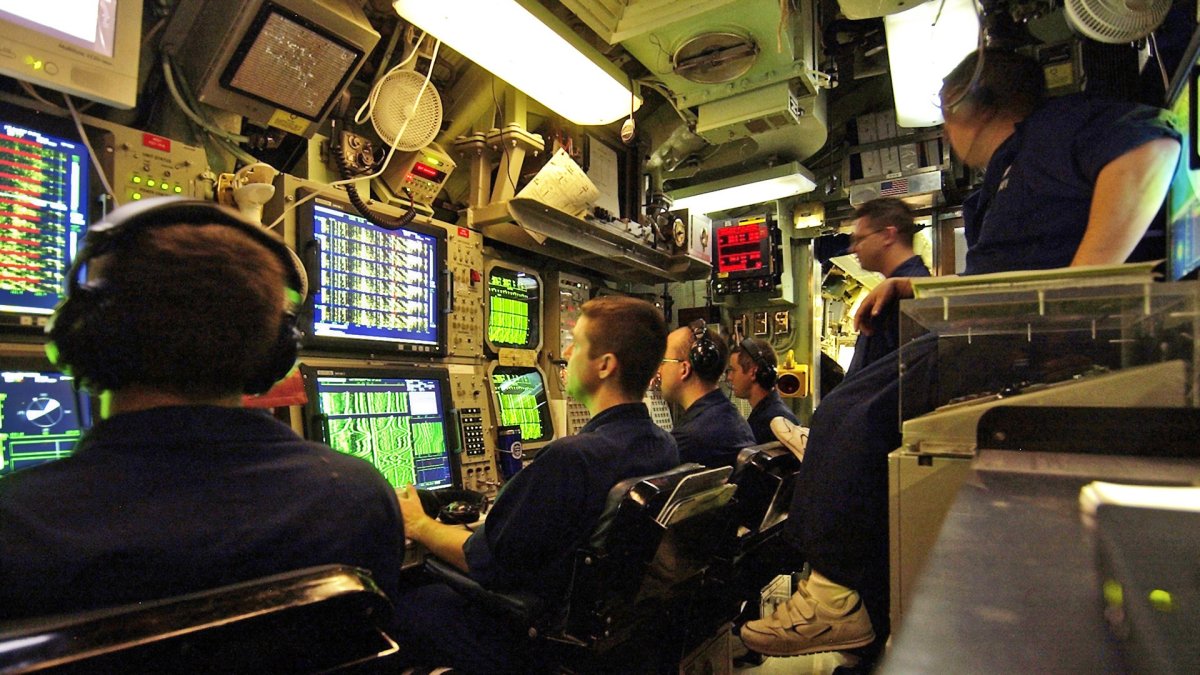
The sonar operator will analyze this signal on two general interfaces: the broadband display and narrowband display. The broadband shows the collective energy received by the array on a bearing over time in a ‘waterfall’ format, cascading down from top to bottom, like a digital scroll. Broadband sonar displays what areas around the array are louder than others. The sonarman can listen to each bearing and determine if the rise in background noise is a target or not. Modern sonar systems have multiple arrays displaying data at the same time in this format. When multiple arrays are involved, this requires two operators working together to manage the flow of real-time data and make tactical sense of it.
The narrowband processors take the broadband energy and divide it into individual frequencies that cross the full spectrum of the array. The array size and number of elements determine the frequency range of the information displayed. This operator must carefully investigate every bearing and every frequency from every array in real-time. Narrowband sonar displays are a collection of data pages that are examined continuously, zoomed, interrogated, and calculated for possible contact relations.
Sea environments vary greatly and have an enormous impact on sonar performance. Deep-sea oceans have unique characteristics like deep sound channels that trap noise and allow it to travel for hundreds of miles with very little loss of energy. Littoral areas have freshwater run-offs from rivers and snow melts create vertical sound barriers that reflect your own sound. It’s like sailing in a sonic hall of mirrors. Ice caps and marginal ice zones are noisy areas that can mask and reflect sonar signals from moment to moment as you pass beneath ice keels. It’s like walking through a forest blindfolded where you can only detect the tree when it’s at arm’s length.
USN via Seaforces.org
The sonar picture of the area around the platform (ship or submarine) is a tactical puzzle. Small, inconsistent, and unrelated data must be pieced together to determine if a contact is detected. Once one is, the sonar system will begin tracking the noise source for the operators. Several passive ranging techniques, speed calculation, and real-time bearing change formulas are used to generalize the target’s position. In a high contact environment, this can rapidly overwhelm an operator.
To help manage the flow of information, the Sonar Supervisor stands behind the operators where they can see all the displays. They act as a second set of eyes looking for things the operators may have missed. He or she is typically the most experienced operator on the team and can help classify and localize a new detection.
The Sonar Supervisor is the liaison between the raw acoustic data and the Approach Officer. The Approach Officer is typically the Captain, but can be any commissioned officer. The Sonar Supervisor is responsible for providing a clear picture of the real world tactical situation outside the submarine and to make sure that it matches the tactical fire control system’s report. There is a team of people working the fire control computers, this is the Fire Control Tracking Party, they set the target solution. This is the solution a weapon will be given before it’s launched. The sonar supervisor has an independent solution he calculates from the raw acoustic data. He is the check between the reality outside the submarine and what the fire control tracking party believes is happening.
The sonar system assists in target detection and classification. Automated and manually designated threat events are preloaded into the sonar computers. If the requirements are met, the sonar display will mark the detection to bring the operator’s attention to it. The automated tracking system tracks and stores contact history without operator action. When the sonarman assigns his tracker, the sonar computer already has the recent history of the target and offers it to the operator for analysis.
Let’s go through a hypothetical mission where all this comes together. Before we get underway we swing by the squadron building and pick up our package. It contains the latest weather projections for our operating area and any units that are not in port and maybe in the area. We get underway and update the sonar search plan with the probable threats we expect to encounter.
During our transit time, we are receiving radio traffic updating us with unit locations, both NATO and otherwise, that may be in our area. We attend daily ‘Warfighter Councils’ in the wardroom where we brief the Captain about our current environment and expected encounters, if any. This is were we deconflict the operating schedule of the submarine’s mission assignments. We can’t conduct noisy evolutions on the mission, so we get that done early while underway. Intelligence updates are discussed here and changes to the sonar search plan are discussed.
Just before the mission begins, we will pull into the nearest NATO or Pacific Fleet port and pick up a fresh pack of food, drop off any trash, and most importantly pick up the ‘Spooks.’ Spooks are crypto-radio sailors who spend most of their time locked inside the radio room’s exclusion area, but are vital to mission success. The Office of Naval Intelligence will also send us two or three specially trained sonarmen to assist us in tracking and recording the mission targets from the sonar perspective. A Submarine Group or admiral’s representative will ride with us as well.
Once on station, the sonar team manning is increased. We switch to eight hours on watch, eight hours off watch ‘Port and Starboard’ rotations. Half the 14-man sonar division is on watch at any time. This is required for recording verification, annotation, and documenting the events that are about to unfold. Each sonar operator is wearing headphones, listening to the low volume static-like white noise of the ocean. The watches are long and intense as each new update is vigorously scrutinized for detection. Patterns are matched and measured with onscreen tools and cursors. Automatic artificial intelligence algorithms flag potential targets for the sonar operators to verify.
Target acquisition in sonar begins a series of events. Trackers are assigned to the target from every array that correlates to the detection. Initial movements are closely monitored because no one is sure how close the new contact is to their own ship. ‘Quick quiet’ is announced silently by cycling the lights around the submarine. No one moves. The engine room watch stands in place with their logs in hand. The cooks in the galley are like statues with mitten gloves and serving pans. No one moves.
Generally speaking, Sonarmen are trained to detect changes in patterns. A sharp, metallic transient object is out of place in the natural undersea world. A narrowband frequency shift or a distant active sonar can be subtle, but the experienced sailor can quickly identify these changes. These are the audio and visual cues the trained sonar operator hunts for tirelessly while on watch.
Contact classification is done in two steps: First, the initial classification is the impression the operator gets when he first hears the target. General categories are biologics (fish and sea life), seismic (earthquakes), merchant, aircraft, trawler, warship, and submarine. It can also be a transit detection like a sharp metallic sound that is heard out of the blue or active sonar that lights up a display like it’s the holidays.
The second step in classification requires analysis. It takes 30 to 45 seconds to get a look at a new detection and discover what kind of engine she’s running, what kind of hydraulic pumps are online, and what screw blade configuration she is using. This second step is what confirms the initial classification or changes it to the correct one.
The analysis of information is a large part of the sonar team’s responsibility. Data is not just directed from the array to fire control. The experienced sonar team analyzes each detection for the contact’s characteristics. Target classification is a stepped process of assigning a general rating like biologic or merchant, then refining it into a specific classification as more information is available. The target solution begins with a general direction of motion and is improved to a particular course, speed, and range. Today’s military algorithms can solve these questions quickly, but they still must be verified by the sonar team.
Just outside our submarine, our target unknowingly passes along our port side. We wait as the contact passes through CPA (closest point of approach) and opens range. During this time, sonar data is sent to the fire control computers and a solution is set. When the Captain is ready, he will order us to come around and begin to trail the target.
In the control room, the target solution is laid down on a Fusion Plot. The Fusion Plot combines all the targets from every array on a single image anyone on the Tracking Party can use to get the contact picture around our submarine. Information like detailed frequency analysis from the target’s mechanical and electrical sources are also plotted and used to help confirm the solution. Target frequencies are recorded and plotted over time. As the target moves, the frequency shifts slightly due to its Doppler effect. Watching this Doppler shift is one method sonar ‘sees’ the contact and plots its position. A well-trained team will do this without direction. Contact classification and other updates are passed over sound powered circuits that allow quiet communication between stations.
At the sonar consoles, some operators are tasked with finding new contacts. Just because we found our high-value target doesn’t mean he’s alone. In fact, he’s probably not. Few countries outside NATO operate independently.
Tracking contacts while searching for new targets requires a disciplined operator. Contact maneuvers, changes in the environment, and automated tracker failures must be recognized immediately as not to ruin the contact solution with false data. The search for new contacts continues while the operator ensures a solid contact track is maintained. Every direction, elevation, frequency, and automated detection must be verified on each array. Then the search cycle begins again and is repeated for up to six hours at a time.
A sonar watch is exhausting and deserves a good shower afterward.
The intense cooperation of the sonar team and the sonar algorithms are necessary to be successful in the high data flow of today’s complex sonar environments. The sea is full of noise. Fishing trawlers, long voyage merchant ships, wind, rain, tectonic and biological activity is a constant backdrop the sonar operator must use their tools to peer through the deepsea veil and find the target.
Sonar employment is a hunt. Underway, the sonar team is planning tactical positions, taking advantage of the environment and topography to catch their prey. The target knows they are being hunted. They are planning their own ambush and have a lot of the same tools we have. This hunt is also addictive and keeps sonarmen coming back for more—studying the environment, looking for that acoustic advantage that may be the difference between success and being detected.
It’s a tactical game where the board is constantly changing. There is no procedure or checklist to follow at this point. When the sonarman dons their headphones, they must use initiative, intuition, and individual ability to execute their role within the sonar team in order to catch the target.
This is what it’s like to hunt on a submarine.
Dominating an engagement with superior ability and tactical execution is the reward that keeps these undersea hunters coming back. Once you experience victory at sea, nothing else can give you a similar feeling. It makes the hard work in the training simulators, hours of lecture, reading, and study worth the effort. Improved knowledge and practical experience give today’s sonarmen the confidence and ability to fight and win the next hunt.
Aaron Amick is a retired U.S. Navy submarine sonarman. He served in both Atlantic and Pacific Oceans on 688 Los Angles Class Fast Attack and Ohio class ballistic missile submarines. He has published two audiobooks on Cold War-era submarines, Akula SSN Project 971 Sub Brief and USS Nautilus SSN-571 Sub Brief . Now, Aaron manages a small Patreon page and contributes to The War Zone.
Contact the editor: Tyler@thedrive.com
Comments couldn’t be loaded. Please refresh the page.
更新于美国东部时间2020年11月27日下午6:34
声呐分析是海军作战中至关重要的工具。声呐操作员是一群训练有素的水兵,负责管理大量的实时声学信息。他们凭借一定的天赋,并在海上戴上耳机前接受长达一年的岸上训练。声呐操作员的工作方法和手段,既包含科学原理,也需要一定的个人才能来识别听觉和视觉上的声学模式。本文将深入探讨声呐小组为舰上战术决策者提供哪些信息,以及他们如何提供这些信息。
要了解声呐员如何分析声学探测结果,我们首先必须了解声音本身。声音是能量在介质(例如水或空气)中传播的一种形式。它以正弦波的形式从声源向各个方向辐射。这些波具有振幅能量和波长频率。声呐系统会探测这些波,并以不同的格式将其显示给操作员。
编者按:对于初次接触此主题的读者,本文是对潜艇声呐的简要概述。虽然内容略显过时,但作为入门读物仍然很有价值。
声呐系统利用各种阵列来探测能量。单个阵列由多个元件组成,这些元件将信息发送到声呐波束形成器。元件可以是水听器,它可以是压电式声波敏感器件,也可以是尺寸更小的现代合成元件。更小的元件尺寸使得设计工程师能够在阵列中添加更多接收器,同时缩小阵列的整体尺寸。
声呐阵列将数据传输到信号调理器,例如前置放大器和均衡器。处理器会仔细地进行信号“净化”,以确保原始信号中不丢失任何目标信息。数据随后进入波束形成器,在那里被“排序”到正确的方向。现在,声呐信号已准备好在操作员控制台上显示。
海狼级攻击型潜艇的艏部声呐阵列。除了这些主阵列外,现代潜艇还配备了保形阵列和拖曳阵列,所有这些阵列共同构成了从潜艇向外数英里发射的声呐“图像”。(宾夕法尼亚州立大学海军后备军官训练队演示幻灯片)
声呐操作员将通过两个通用界面分析该信号:宽带显示和窄带显示。宽带显示以“瀑布图”的形式,从上到下依次显示阵列在某一方位接收到的总能量,如同数字卷轴一般。宽带声呐会显示阵列周围哪些区域的噪声比其他区域更大。声呐操作员可以监听每个方位,判断背景噪声的增加是否为目标。现代声呐系统包含多个阵列,并同时以这种格式显示数据。当涉及多个阵列时,需要两名操作员协同工作,以管理实时数据流并进行战术解读。
窄带处理器接收宽带能量,并将其分解为覆盖阵列全频谱的各个频率。阵列尺寸和阵元数量决定了所显示信息的频率范围。操作员必须实时仔细地检查每个阵列的每个方位角和每个频率。窄带声呐显示屏由一系列数据页组成,需要持续检查、缩放、查询和计算,以确定可能的接触关系。
海洋环境千差万别,对声呐性能有着巨大的影响。深海拥有独特的特征,例如深邃的声道能够捕获噪声,使其传播数百英里而能量损失极小。近岸区域则有河流和融雪带来的淡水径流,形成垂直的声屏障,反射自身发出的声音。这就像在声波的镜厅中航行。冰盖和边缘冰区是噪声较大的区域,当船只从冰脊下方经过时,它们会不断地掩盖和反射声呐信号。这就像蒙着眼睛穿过森林,只有当树木近在咫尺时才能察觉到它的存在。
美国海军(通过 Seaforces.org)
声呐对平台(舰艇或潜艇)周围区域的探测图像就像一个战术谜题。必须将零散、不一致且互不相关的数据拼凑起来,才能确定是否探测到目标。一旦探测到目标,声呐系统就会开始追踪噪声源,供操作员参考。系统会运用多种被动测距技术、速度计算和实时方位角变化公式来大致确定目标位置。在高交战环境下,这些信息可能会迅速使操作员应接不暇。
为了更好地管理信息流,声呐主管站在操作员身后,他们可以透过显示屏看到所有信息。主管就像第二双眼睛,帮助操作员发现可能遗漏的信息。他/她通常是团队中最有经验的操作员,能够协助对新探测到的目标进行分类和定位。
声呐主管是原始声学数据与进近官之间的联络人。进近官通常是舰长,但也可能是任何一名军官。声呐主管负责提供潜艇外部真实战术态势的清晰图像,并确保其与战术火控系统的报告相符。有一个团队负责操作火控计算机,即火控跟踪小组,他们负责设定目标解算。这是武器发射前会收到的解算结果。声呐主管则拥有一个独立的解算结果,该结果由他根据原始声学数据计算得出。他负责核对潜艇外部的实际情况与火控跟踪小组的判断是否一致。
声呐系统辅助目标探测和分类。自动和手动指定的威胁事件预先加载到声呐计算机中。如果满足要求,声呐显示器会标记探测到的目标,以引起操作员的注意。自动跟踪系统无需操作员干预即可跟踪和存储目标接触历史记录。当声呐操作员指定跟踪目标时,声呐计算机已获取目标的近期历史记录,并将其提供给操作员进行分析。
让我们设想一个任务场景,看看所有这些环节是如何衔接起来的。出发前,我们先去中队大楼领取包裹。包裹里包含我们作战区域以及所有不在港口但可能在该区域活动的单位的最新天气预报。出发后,我们根据预计会遇到的威胁更新声呐搜索计划。
在航行期间,我们会接收无线电通讯,了解可能在我们附近海域的北约及其他部队的位置。我们每天都会在军官餐厅参加“作战人员会议”,向舰长汇报当前环境和可能遇到的情况。我们会在会上协调潜艇任务的执行计划,避免冲突。由于任务期间无法进行会产生噪音的演习,我们会提前在航行途中完成这些工作。此外,我们还会讨论情报更新和声呐搜索计划的变更。
任务开始前,我们会停靠在最近的北约或太平洋舰队港口,领取一份新鲜食物,丢弃垃圾,最重要的是接上“间谍”。“间谍”是负责加密无线电通信的水兵,他们大部分时间都待在无线电室的禁区内,但对任务的成功至关重要。海军情报局还会派两到三名受过专门训练的声呐兵,协助我们从声呐的角度追踪和记录任务目标。此外,潜艇部队或海军上将的代表也会随行。
到达指定位置后,声呐小组的人员配备会增加。我们实行八小时值班、八小时休息的“左舷和右舷”轮换制度。14名声呐人员中,任何时候都有一半处于值班状态。这是为了记录、验证、标注和记录即将发生的事件。每位声呐操作员都戴着耳机,聆听着海面低沉的、类似静电的白噪声。值班时间长,强度大,因为每一条新的更新信息都要经过仔细审查,以寻找目标。操作员使用屏幕上的工具和光标来匹配和测量各种模式。自动人工智能算法会标记出潜在目标,供声呐操作员核实。
声呐目标捕获启动一系列事件。所有探测到目标的阵列都会分配跟踪器指向该目标。由于无法确定新发现的目标与己方舰艇的距离,因此初始阶段的移动受到密切监控。潜艇周围的灯光循环闪烁,无声地发出“快速安静”的指令。所有人纹丝不动。机舱值班人员手持航海日志,坚守岗位。厨房里的厨师们戴着连指手套,端着盛菜的锅碗瓢盆,如同雕像一般。所有人纹丝不动。
一般来说,声呐兵接受过专门训练,能够探测到各种模式的变化。在自然的海底环境中,一个尖锐的金属状瞬态物体显得格格不入。窄带频率的偏移或远处的声呐活动可能很细微,但经验丰富的水手能够迅速识别这些变化。这些正是训练有素的声呐操作员在值班时孜孜不倦地搜寻的听觉和视觉线索。
联系目标分类分为两步:首先,初步分类是操作员首次听到目标时的第一印象。一般类别包括生物目标(鱼类和海洋生物)、地震目标(地震)、商船、飞机、拖网渔船、军舰和潜艇。此外,它还可以是对过境目标的探测,例如突然听到的尖锐金属声,或者像节日庆典般闪烁的主动声呐信号。
分类的第二步需要进行分析。这需要30到45秒的时间来查看新检测到的故障,并确定它正在运行哪种发动机、哪些液压泵处于工作状态以及它使用的螺旋桨叶片配置。第二步用于确认初始分类或将其更改为正确的分类。
信息分析是声呐小组的重要职责之一。数据并非仅仅从声呐阵列传输到火控系统。经验丰富的声呐小组会对每次探测到的目标进行分析,以确定其特征。目标分类是一个循序渐进的过程:首先赋予目标一个大致的分类,例如生物目标或商船目标;然后随着更多信息的获取,将其细化为具体的分类。目标定位从大致的运动方向开始,逐步细化到具体的航向、速度和距离。如今的军事算法可以快速解决这些问题,但仍然需要声呐小组进行验证。
就在我们潜艇外侧,目标悄无声息地从左舷掠过。我们等待目标通过最近接近点(CPA)并拉开距离。在此期间,声呐数据被发送到火控计算机,并进行解算。待艇长准备就绪后,他会命令我们转向并开始跟踪目标。
在控制室里,目标解算结果被绘制在融合图上。融合图将所有阵列的目标信息整合到一张图像上,跟踪小组的任何成员都可以利用这张图像获取我方潜艇周围的目标图像。目标机械和电子设备的详细频率分析等信息也会被绘制出来,用于辅助确认解算结果。目标频率会被记录并随时间变化绘制在融合图上。随着目标的移动,由于多普勒效应,其频率会发生轻微偏移。监测这种多普勒频移是声呐“探测”目标并确定其位置的一种方法。训练有素的团队无需指导即可完成这项工作。目标分类和其他更新信息通过声波供电电路传递,从而实现各站点之间的静音通信。
在声呐控制台,一些操作员的任务是寻找新的目标。找到高价值目标并不意味着他孤身一人。事实上,他很可能并非如此。北约以外的国家很少能独立行动。
在搜索新目标的同时跟踪目标需要操作人员具备高度的纪律性。目标的移动、环境变化以及自动跟踪器的故障都必须立即被识别,以免因错误数据而破坏目标解析。在确保保持稳定跟踪的同时,搜索新目标的工作仍在继续。每个阵列的每个方向、仰角、频率和自动检测结果都必须经过验证。然后,搜索周期再次开始,每次持续长达六小时。
声呐值班很累人,之后应该好好洗个澡。
在当今复杂的声呐环境中,海量数据涌动,声呐团队与声呐算法的密切合作至关重要。海洋充满各种噪声。渔船、远洋商船、风雨、地质构造和生物活动构成了持续不断的背景噪声,声呐操作员必须运用各种工具,穿透深海的迷雾,找到目标。
声呐的使用就像一场狩猎。在航行中,声呐小组会规划战术阵地,利用环境和地形优势来捕获目标。目标也知道自己正被猎杀。他们也在策划自己的伏击,并且拥有许多与我们相同的工具。这种狩猎也令人着迷,驱使着声呐员一次又一次地回到战场——研究环境,寻找那可能决定成败的声学优势。
这是一个瞬息万变的战术游戏。此时此刻,没有任何既定的流程或清单可供遵循。声呐兵戴上耳机后,必须运用主动性、直觉和个人能力,在声呐小组中扮演好自己的角色,才能成功锁定目标。
这就是在潜艇上狩猎的感觉。
凭借卓越的技能和战术执行力赢得战斗,正是这些水下猎手不断征战的动力所在。一旦体验过海上胜利,没有什么能与之媲美。它让训练模拟器上的刻苦训练、无数个小时的讲座、阅读和学习都变得无比值得。不断提升的知识和丰富的实战经验赋予了当今的声呐兵信心和能力,让他们能够赢得下一场战斗。
亚伦·阿米克是美国海军退役潜艇声纳兵。他曾在大西洋和太平洋服役,先后在洛杉矶级快速攻击潜艇(688型)和俄亥俄级弹道导弹潜艇上服役。他出版了两本关于冷战时期潜艇的有声读物:《阿库拉号核潜艇971项目简报》和《鹦鹉螺号核潜艇571项目简报》。如今,亚伦运营着一个小型Patreon页面,并为《战区》网站撰稿。
联系编辑:Tyler@thedrive.com
评论加载失败,请刷新页面。