Russia’s naval posture in the Mediterranean has ‘significantly decreased’: NATO official北约官员称,俄罗斯在地中海的海军态势已“显著减弱”。
Russia's maritime forces may be stretched thin now, but one analyst told Breaking Defense that's unlikely to be the case "longer term."
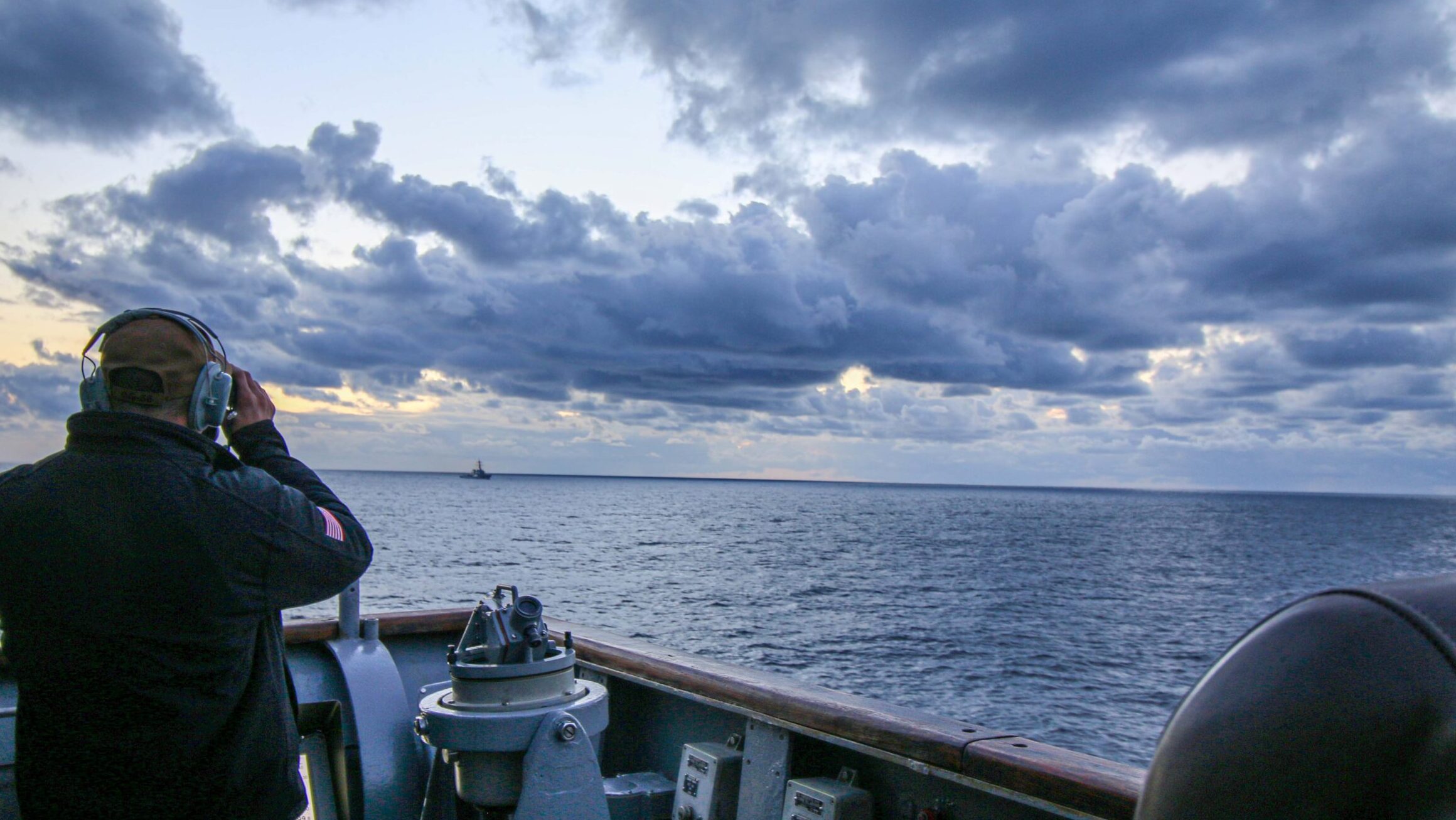
Seaman Tucker Thomas looks through binoculars while standing lookout on the bridge wing of the Ticonderoga class guided-missile cruiser USS San Jacinto (CG 56) in the Mediterranean Sea, Jan. 7, 2022. (U.S. Navy photo by Mass Communication Specialist 3rd Class Conner Foy)
MILAN — For the first time in a decade, no major Russian military vessels plied the waters of the Mediterranean for several weeks earlier this year, according to a NATO official, which could signal that Moscow’s maritime forces are stretched.
NATO has tracked a “significant decrease in Russian naval presence” in the strategic body of water, so much so that until early September, “there was a two-month gap with no Russian naval presence in the Mediterranean,” said the official, who spoke on the condition of anonymity. “The last time we saw a lack of any Russian presence there, specifically grey hulls or naval military vessels, was in 2016.”
The military official and two analysts told Breaking Defense that the reasons for the absence are myriad, ranging from the loss of access to a key Mediterranean base to the demands of protecting so-called “ shadow fleet ” vessels elsewhere.
Last year, Syria’s incoming government terminated Russia’s lease on the strategic port of Tartus, which directly weakened Moscow’s naval access to a nearby replenishment base. (A deal struck in August allows military facilities at Tartus and the coastal Hmeimem air base to be used as “joint training” centers for Russian and Syrian forces, according to The Associated Press.)
The NATO official also said the Russian Navy does not currently have a capable fleet of oilers or support vessels needed to sustain a substantial number of deployed forces over the long term.
“An example of this is that the Russian Navy has been positioning frigates in the English Channel continuously and in order to keep those supplied, they have been relying on an Amur-class repair ship designed to deliver parts or fix things on the ship — not as a replenishment one,” the official said. “So they have been forced to do hull-to-hull transfers, which are really dangerous.”
The alliance has also seen a “trend” of Kremlin military warships “escorting merchant vessels through the Baltic Sea and other areas around the Euro-Atlantic region, including the North and Mediterranean Seas,” the official added.
“These escorting activities take up valuable days at sea for the Russian Navy, and it places strain on their ability to generate naval forces for other missions,” the representative told Breaking Defense.
Basil Germond, a professor of international security at Lancaster University and a visiting fellow at the Royal Navy Strategic Studies Centre, agreed that Russia’s limited surface-combatant capacity appears to have been “increasingly being re-prioritized” to guard strategically important merchant vessels, including shadow fleet ones. He found that this reduces the number of warships readily available for a sustained Mediterranean presence .
Germond also pointed to restrictions imposed by Turkey on the transit of belligerent naval vessels through the Turkish Straits. That, he said, “prevents Russia from using the Black Sea Fleet to rotate vessels routinely into the Mediterranean,” and that the extended passage around Europe increases logistical demands.
Another expert, Federico Borsari, a fellow at the Center for European Policy Analysis, concurred with the pattern NATO identified. However, he pointed out that the overall state of the Russian Navy “is one of progressive decline” in terms of capabilities and operational availability, due in part to attrition from the war in Ukraine. Operational availability issues, specifically, are “almost exclusively to the Black Sea Fleet,” while the other fleets remain “almost untouched by the war.”
And as Russian vessels returned to the Mediterranean last month, Germond said it would be unwise for NATO to think Moscow was abandoning the critical sea routes there.
“In the longer-term, [however] Russia retains both the strategic interest and the residual capability to send warships into the Mediterranean — the current situation is neither a permanent shift nor a temporary anomaly; it is an outcome of the strategic and operational reality facing the Russian Navy,” he said.
Breaking Defense Video
Drones take over AUSA, plus the Army’s plan to bring in new vendors
Hegseth talks autonomy at AUSA, a key show focus
Army doubles down on autonomy, stakes out Indo-Pacific role: AUSA Day 2
Telle talks ‘manufacturing rodeo,’ supply chain ‘weak links’: AUSA Day 1
New leaders, new drone command: What we expect from AUSA 2026
Unpacking Boeing’s F/A-XX win, plus a report from wartime Ukraine
How Hegseth envisions a new Autonomous Warfare Command
What Europe’s military air fleets will look like in 30 years
Riyadh gets closer to F-35s, Damascus presses sovereignty and an expert take on Iran
Drone-hunting on the border, plus turmoil at an Air Force think tank
2022年1月7日,在地中海,水兵塔克·托马斯在提康德罗加级导弹巡洋舰“圣哈辛托”号(CG 56)的舰桥翼上站岗时,正用双筒望远镜观察。(美国海军三级大众传播专家康纳·福伊摄)
米兰——据一位北约官员称,今年早些时候,十年来首次有数周时间没有俄罗斯主要军舰在地中海水域航行,这可能表明莫斯科的海上力量捉襟见肘。
北约方面追踪到俄罗斯在这一战略水域的“海军存在显著减少”,以至于直到9月初,“地中海地区出现了长达两个月的俄罗斯海军缺席”,一位不愿透露姓名的官员表示。“上一次我们看到俄罗斯在该地区完全没有海军舰艇存在,特别是灰色船体或军舰,还是在2016年。”
一位军方官员和两位分析人士告诉《防务新闻》,缺席的原因有很多,从失去进入地中海关键基地的权限到保护其他地方所谓的“影子舰队”舰船的需求,不一而足。
去年,叙利亚新政府终止了俄罗斯对战略港口塔尔图斯的租约,这直接削弱了莫斯科海军利用附近补给基地的通道。(据美联社报道,8月份达成的一项协议允许将塔尔图斯港和沿海的赫梅梅姆空军基地的军事设施用作俄罗斯和叙利亚军队的“联合训练”中心。)
这位北约官员还表示,俄罗斯海军目前没有足够数量的油轮或支援舰艇,无法长期维持大量部署部队的运转。
“例如,俄罗斯海军一直在英吉利海峡部署护卫舰,为了保证这些护卫舰的补给,他们只能依靠一艘阿穆尔级维修舰,这艘舰艇的设计用途是运送零部件或维修舰艇,而不是作为补给舰,”这位官员说。“因此,他们不得不进行舰对舰的物资转运,这非常危险。”
该官员补充说,联盟还出现了一种“趋势”,即克里姆林宫的军舰“护送商船穿越波罗的海和欧洲-大西洋地区其他区域,包括北海和地中海”。
“这些护航活动会占用俄罗斯海军宝贵的海上时间,并对其调动海军力量执行其他任务的能力造成压力,”该代表告诉《防务新闻》。
兰卡斯特大学国际安全教授、英国皇家海军战略研究中心访问学者巴兹尔·杰蒙德也认为,俄罗斯有限的水面作战能力似乎“日益被重新分配”,用于保护具有重要战略意义的商船,包括影子舰队。他发现,这减少了俄罗斯可用于在地中海持续部署的军舰数量。
杰蒙德还指出,土耳其限制交战国海军舰艇通过土耳其海峡。他说,这“阻止了俄罗斯利用黑海舰队定期轮换舰艇进入地中海”,而且绕道欧洲的航程也增加了后勤保障方面的要求。
另一位专家,欧洲政策分析中心的研究员费德里科·博尔萨里也认同北约所指出的模式。但他指出,俄罗斯海军的整体状况“正在逐步恶化”,其能力和作战可用性均受到影响,部分原因是乌克兰战争造成的损耗。具体而言,作战可用性问题“几乎完全集中在黑海舰队”,而其他舰队“几乎未受战争影响”。
随着俄罗斯船只上个月重返地中海,杰蒙德表示,北约如果认为莫斯科正在放弃那里的重要海上航线,那就太不明智了。
“但从长远来看,俄罗斯仍然保持着向地中海派遣军舰的战略利益和剩余能力——目前的情况既不是永久性的转变,也不是暂时的异常现象;这是俄罗斯海军面临的战略和作战现实的结果,”他说。
突破性防御视频
无人机主导了美国陆军协会(AUSA)的会议,此外,陆军还计划引入新的供应商。
Hegseth 在 AUSA 大会上谈到了自主性,这是本次大会的一个重点议题。
陆军加倍强调自主性,明确印太地区角色:AUSA第二天
特勒谈“制造业乱象”、供应链“薄弱环节”:AUSA第一天
新领导人,新无人机指挥部:我们对 AUSA 2026 的期待
深入剖析波音F/A-XX的竞标结果,以及来自战时乌克兰的报道
赫格塞斯设想的新型自主作战指挥部
30年后欧洲军用空军机队会是什么样子
利雅得距离F-35战机更近一步,大马士革强调主权,以及专家对伊朗的看法
边境无人机猎杀行动,以及空军智库的动荡