Ghost Shark’s Ghost Shark Extra-Large Uncrewed Underwater Vehicles’ Payload Bay Seen For First TimeGhost Shark公司超大型无人水下航行器的有效载荷舱首次曝光
Ghost Shark will deploy aerial drones, lay mines, and execute seabed resupply missions as part of Australia’s new undersea arsenal. Ghost Shark will deploy aerial drones, lay mines, and execute seabed resupply missions as part of Australia’s new undersea arsenal.
新闻视频
Published Oct 20, 2026 12:48 PM EDT
Photo by Saeed KHAN / AFP via Getty Images
New photos provide an interesting first public look inside the payload bay of Australia’s Ghost Shark extra-large autonomous underwater vehicle (XL-AUV), and a glimpse of the highly modular concept at the heart of the Royal Australian Navy ’s emerging undersea warfare capability. Australian authorities had said in the past that they plan to use Ghost Sharks to conduct “persistent intelligence, surveillance, reconnaissance and strike” missions, but without any real elaboration.
The photographs were taken during a recent visit to the Anduril Australia factory in Sydney, New South Wales, by Pat Conroy, Australia’s Minister for Defense Industry. They emerged as the Australian government announced new details of payload development for Ghost Shark, the Speartooth large uncrewed underwater vehicle (LUUV), and the BlueBottle uncrewed surface vessel (USV), on October 19. While the announcement described the payloads in very broad terms, the photos plus additional details from the Anduril event reveal a more concrete picture of the missions Ghost Shark is being designed to perform.
Left to right: David Goodrich, CEO of Anduril Australia; Chief of Navy, Vice Admiral Matthew Buckley; Professor Tanya Monro, AC Chief Defense Scientist; and Pat Conroy, Minister for Defense Industry, stand in front of a Ghost Shark, with payload bay open, at the Anduril Australia factory in Sydney, New South Wales. Australian Department of Defense
The three previously undisclosed payload options include deploying up to 12 sea mines in a mission, leaving supply caches on the seabed, and launching Anduril’s ALTIUS aerial drones for reconnaissance or strike missions.
“Ghost Shark now has teeth, and will have the ability to inflict damage on any potential adversary,” Conroy said .
The payload bay image is significant in its own right. Ghost Shark’s modular design is intended to accommodate different mission-specific systems , allowing the Royal Australian Navy to configure the same underlying platform for different operational requirements. Ghost Shark was designed to be extremely modular, flexible, and readily reconfigurable. As part of this, the overall payload portion can be readily configured in different ways using different-sized modular hull sections. Since the nose and the tail are different pieces, with an expandable section in the middle, there is plenty of scope for different payloads as well.
Seeing the internal bay for the first time provides a more tangible look at that approach than earlier photographs of the submarine’s exterior.
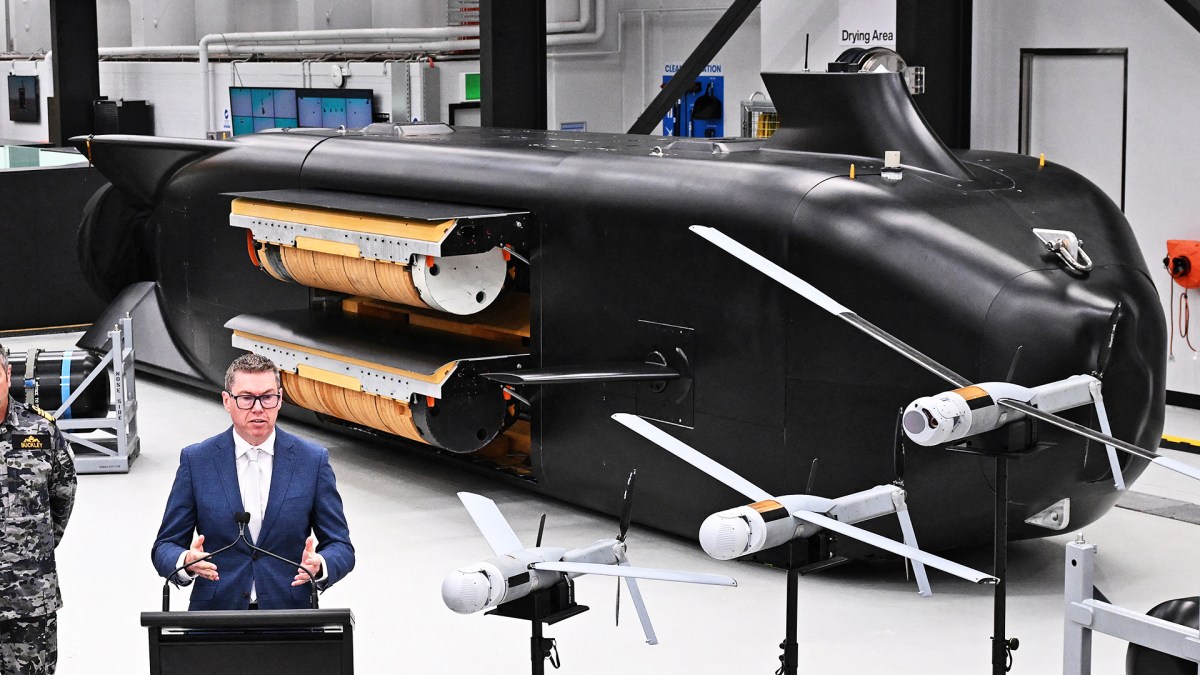
Chief of Navy, Vice Admiral Matthew Buckley, makes an address at the Anduril Australia factory in Sydney, New South Wales. The payload-bay spacers are seen immediately behind him. Australian Department of Defense
Inside the bay of one of the Ghost Sharks on display, there appear to be cylindrical spacers, formed in segments, rather than operational stores. These spacers, and other areas inside the bay, look as if they are fabricated from plywood or similar. Overall, this means it is not entirely clear if they represent the kind of ballast that would be loaded to take the place of actual payloads during trials, or whether they are part of a mockup.
Of the three payload options, the ability to deploy ALTIUS aerial drones is particularly noteworthy. An underwater vehicle capable of releasing aerial systems could extend a naval force’s intelligence, surveillance, and reconnaissance (ISR) reach beyond the submarine’s own sensors. Depending on the drone variant and mission configuration, it could also provide a means of delivering effects at a distance without putting personnel directly in harm’s way. Other roles could include stimulating enemy air defense networks, perhaps even responding to pop-up air defence threats as they appear and attacking them. The ability to put miniaturized satcom terminals, as well as AI, on small drones also greatly opens up the possibilities for UUV-launched aerial drones .
The Anduril ALTIUS-600 is displayed during a press conference at the Anduril Australia factory in Sydney, New South Wales. Australian Department of Defense
Which ALTIUS variants the Ghost Shark will be able to deploy has not been publicly disclosed. The models displayed at the Altus factory are all derivatives of the ALTIUS-600 family. Notable versions include the ALTIUS-600 for ISR, as well as the ALTIUS-600M, which is designed for strike missions. As you can read here , the basic drone has an overall weight of between 20 and 27 pounds, depending on its payload, which typically weighs between three and seven pounds. The ALTIUS-600 has a maximum range of around 275 miles and can remain airborne for at least four hours, according to its developer. Unarmed variants of the ALTIUS-600 are designed to be recoverable and reusable, although it is unclear how practical that would be after launch from a UUV.
There is another missing part of the payload puzzle, namely the kinds of capsules that would contain the ALTIUS UAVs for launch from the sub.
The Rheinmetall Asteria 533mm-diameter mine pictured alongside the Ghost Shark is not installed in the vehicle’s payload bay. Its appearance nevertheless provides an intriguing visual counterpart to the newly disclosed mine-delivery capability. According to the manufacturer, the Asteria can be deployed from surface vessels, aircraft, and submarines (normally via torpedo tubes). It can be remotely controlled via an acoustic link and is optimized for the defense of harbors, straits, ports, and other critical areas.
Professor Tanya Monro, AC Chief Defense Scientist, makes an address at the Anduril Australia factory, with the Rheinmetall Asteria mine behind her, immediately to her right, marked with a blue band. Australian Department of Defense
The seabed supply-cache concept points to a different operational role. Ghost Shark could position equipment and supplies underwater for later retrieval, potentially supporting forces operating in areas where conventional resupply is difficult or risky.
The notional supply cache payloads — which are under development by the Defense Science and Technology Group (DSTG) — don’t appear to be on display here. Alex Luck, a naval analyst who closely tracks submarine developments, told TWZ that the cache payloads would likely take the form of capsules, similar in shape to the Asteria mine, but containing whatever supplies need to be moved. It is not immediately clear who would use those caches. One option could be special operations forces , but if the payloads could later rise to the surface, they could be accessed by other forces, too.
It should also be noted that the U.S. Navy and U.S. Marine Corps, in particular, are envisioning future fleets of UUVs and USVs that can carry out kinetic attacks and employ electronic warfare and other non-kinetic effects, as well as emplace mines , providing a direct parallel with the planned mission set for Ghost Shark.
A rendering of a Ghost Shark in Royal Australian Navy service. Australian Defense Force
Some of the new payload capabilities are due to be featured in Exercise Maritime Big Play Pacific in San Diego, an AUKUS Pillar II activity focused on advanced maritime capabilities and interoperability. The Australian government says the development effort involves the Royal Australian Navy, Defense Science and Technology Group, the Advanced Strategic Capabilities Accelerator and defense industry.
As we have discussed in the past , Maritime Big Play has links to the U.S. military’s Technology Readiness Experimentation (T-REX) effort and NATO’s Robotic Experimentation and Prototyping Augmented by Maritime Unmanned Systems (REPMUS) exercise series, according to the Pentagon . The U.S. Navy has also been conducting a growing number of large-scale uncrewed-focused maritime exercises and demonstration events in recent years.
The Ghost Shark ‘Alpha’ first prototype was co-developed by Defense Science and Technology Group, the Royal Australian Navy, and Anduril Australia. Australian Department of Defense
Under AUKUS Pillar II, Australia is collaborating with the United Kingdom and the United States on Ghost Shark and its associated capabilities. While Pillar I centres on providing Australia with nuclear-powered submarines , Pillar II focuses on the joint development of advanced defence technologies, including artificial intelligence and autonomous systems.
Exactly how the Ghost Shark will be deployed during the Maritime Big Play Pacific exercise is unclear, but, speaking about the concept of operations, Conroy described examples of it being deployed from a shipping container or launched from the back of a small vessel using a crane. In the past, we have also seen the Ghost Shark loaded in a standard shipping container and transported in a Royal Australian Air Force C-17A Globemaster III airlifter.
A Ghost Shark loaded in a standard shipping container for transport in a Royal Australian Air Force C-17A. Anduril
Overall, U.S. military wargames have highlighted how uncrewed systems could shape a high-end conflict across the Pacific, particularly a fight over Taiwan. One set of Taiwan conflict simulations found that large swarms of relatively low-cost, networked drones could be decisive in helping locate and attack an invading force , while other wargaming by the Center for a New American Security has highlighted the severe challenges of defending the island against a Chinese assault. Maritime drones could also play a major role: the U.S. Navy has explored submarine-launched aerial drones that act as “flying periscopes,” extending sensor coverage and providing targeting data beyond a submarine’s own reach , while uncrewed underwater vehicles could conduct mine-laying and other asymmetric missions around key maritime chokepoints . The rapid growth and technological advances made by the Chinese submarine fleet also underscore the critical importance of anti-submarine capabilities, in which uncrewed systems can play a major role. Together, these developments underscore the potential value of autonomous systems for the Royal Australian Navy as it prepares to operate across the vast distances of the Indo-Pacific.
Australia’s 2026 National Defence Strategy and Integrated Investment Program allocate up to A$5.8 billion (approximately $4.05 billion) over the decade to autonomous and uncrewed undersea warfare capabilities, including A$1.7 billion (approximately $1.19 billion) for a new fleet of Australian-designed and built Ghost Shark vehicles.
The newly released imagery and payload details offer the clearest picture yet of how Australia intends to expand Ghost Shark beyond a conventional underwater surveillance role. The next key milestones should provide more details of how the payloads will be integrated into the vehicle, and how they might be deployed in practice.
Contact the author: thomas@thewarzone.com
Comments couldn’t be loaded. Please refresh the page.
发布于美国东部时间2026年10月20日下午12:48
图片来源:Saeed KHAN / AFP via Getty Images
最新照片首次向公众展示了澳大利亚“幽灵鲨”超大型自主水下航行器(XL-AUV)的有效载荷舱内部结构,并揭示了澳大利亚皇家海军新兴水下作战能力的核心——高度模块化的设计理念。澳大利亚当局此前曾表示,计划使用“幽灵鲨”执行“持续情报、监视、侦察和打击”任务,但并未提供任何具体细节。
这些照片是澳大利亚国防工业部长帕特·康罗伊近期访问位于新南威尔士州悉尼的安杜里尔澳大利亚工厂时拍摄的。10月19日,澳大利亚政府公布了“幽灵鲨”(Ghost Shark)、“矛牙”(Speartooth)大型无人水下航行器(LUUV)和“蓝瓶”(BlueBottle)无人水面艇(USV)有效载荷研发的最新细节,这些照片也随之曝光。虽然政府公告对这些有效载荷的描述较为笼统,但这些照片以及安杜里尔工厂提供的更多细节,让我们得以更清晰地了解“幽灵鲨”的设计任务。
从左至右:安杜里尔澳大利亚公司首席执行官大卫·古德里奇;海军司令马修·巴克利中将;澳大利亚国防部首席科学家坦尼娅·门罗教授;以及国防工业部长帕特·康罗伊,站在位于新南威尔士州悉尼的安杜里尔澳大利亚工厂内,一架有效载荷舱打开的“幽灵鲨”导弹发射车前。澳大利亚国防部
此前未公开的三种有效载荷选项包括:一次任务部署多达 12 枚水雷、在海底留下补给点,以及发射 Anduril 的 ALTIUS 无人机执行侦察或打击任务。
康罗伊说:“幽灵鲨现在有了牙齿,能够对任何潜在的对手造成伤害。”
有效载荷舱本身就意义非凡。“幽灵鲨”的模块化设计旨在容纳不同的特定任务系统,使澳大利亚皇家海军能够根据不同的作战需求配置同一平台。“幽灵鲨”的设计理念是高度模块化、灵活且易于重新配置。因此,整个有效载荷舱可以通过使用不同尺寸的模块化船体部分轻松配置成不同的形式。由于舰首和舰尾是独立的部件,中间部分可扩展,因此也为不同的有效载荷提供了充足的空间。
与之前拍摄的潜艇外部照片相比,第一次看到内部舱室,可以更直观地了解这种设计方法。
海军司令马修·巴克利中将在新南威尔士州悉尼的安杜里尔澳大利亚工厂发表讲话。有效载荷舱隔板就在他身后。澳大利亚国防部
在展出的其中一艘“幽灵鲨”潜艇的舱内,似乎有一些分段式的圆柱形隔片,而非实际使用的载荷。这些隔片以及舱内的其他区域看起来像是用胶合板或其他类似材料制成的。因此,目前尚不完全清楚这些隔片究竟是试验期间用来代替实际载荷的压载物,还是仅仅是模型的一部分。
在三种有效载荷选项中,部署ALTIUS无人机的能力尤为引人注目。这种能够投放空中系统的水下航行器可以将海军部队的情报、监视和侦察(ISR)范围扩展到潜艇自身传感器的覆盖范围之外。根据无人机型号和任务配置的不同,它还可以提供一种远距离投放目标的手段,而无需将人员直接置于危险之中。其他用途包括干扰敌方防空网络,甚至可以对突然出现的防空威胁做出反应并进行攻击。将小型卫星通信终端和人工智能系统安装在小型无人机上的能力也极大地拓展了无人水下航行器(UUV)发射无人机的可能性。
在位于新南威尔士州悉尼的安杜里尔澳大利亚工厂举行的新闻发布会上,安杜里尔ALTIUS-600型无人机亮相。澳大利亚国防部
“幽灵鲨”无人机将部署哪些ALTIUS无人机型号尚未公开。在Altus工厂展示的型号均为ALTIUS-600系列的衍生型号。值得关注的型号包括用于情报、监视和侦察(ISR)的ALTIUS-600,以及专为打击任务设计的ALTIUS-600M。正如您在此处所读到的,基本型无人机的总重量在20至27磅之间,具体取决于其有效载荷,而有效载荷的重量通常在3至7磅之间。据其开发商称,ALTIUS-600的最大航程约为275英里,并且可以在空中保持至少4小时。ALTIUS-600的非武装型号设计为可回收和可重复使用,但从无人水下航行器(UUV)发射后,其回收和重复使用的实际可行性尚不明确。
有效载荷难题还有另一个缺失的部分,即用于装载 ALTIUS 无人机的潜艇发射舱的类型。
图中与“幽灵鲨”潜艇并排展示的莱茵金属公司生产的直径533毫米的“阿斯特里亚”水雷并未安装在潜艇的有效载荷舱内。尽管如此,它的外观仍然与新近披露的布雷能力形成了一种引人注目的视觉呼应。据制造商称,“阿斯特里亚”水雷可从水面舰艇、飞机和潜艇(通常通过鱼雷发射管)上投放。它可以通过声学链路进行远程控制,并针对港口、海峡、码头和其他重要区域的防御进行了优化。
澳大利亚国防部首席国防科学家坦尼娅·蒙罗教授在安杜里尔澳大利亚工厂发表讲话,她身后右侧紧邻莱茵金属阿斯特里亚矿,该矿以蓝色条带标示。
海底补给库的概念表明了其不同的作战角色。“幽灵鲨”可以将设备和补给品部署在水下,以便日后回收,从而为在常规补给困难或风险较高的区域作战的部队提供潜在支持。
这些由国防科技集团(DSTG)正在研发的假想补给舱有效载荷似乎并未在此展出。密切关注潜艇发展的海军分析师亚历克斯·拉克告诉TWZ,这些补给舱有效载荷很可能采用胶囊形式,形状类似于阿斯特里亚水雷,但内部装有需要运输的任何物资。目前尚不清楚这些补给舱将由谁使用。一种可能是特种作战部队,但如果这些有效载荷之后能够浮出水面,其他部队也可以使用。
还应该指出的是,美国海军和美国海军陆战队尤其正在设想未来拥有能够执行动能攻击、运用电子战和其他非动能效应以及布设水雷的无人水下航行器 (UUV) 和无人水面航行器 (USV) 舰队,这与“幽灵鲨”计划的任务直接相似。
澳大利亚皇家海军服役的幽灵鲨战机模型。澳大利亚国防军
部分新型有效载荷能力将在圣地亚哥举行的“太平洋海上大演习”(Exercise Maritime Big Play Pacific)中亮相,该演习是AUKUS第二支柱项目的一部分,重点在于提升先进海上能力和互操作性。澳大利亚政府表示,这项研发工作由澳大利亚皇家海军、国防科技集团、先进战略能力加速器以及国防工业共同参与。
正如我们之前讨论过的,据五角大楼称,“海上大型演习”与美国军方的“技术准备实验”(T-REX)项目以及北约的“海上无人系统增强型机器人实验与原型开发”(REPMUS)系列演习存在关联。近年来,美国海军也开展了越来越多的以无人系统为重点的大规模海上演习和演示活动。
“幽灵鲨”阿尔法型首款原型机由国防科技集团、澳大利亚皇家海军和安杜里尔澳大利亚公司联合研发。澳大利亚国防部
在“奥库斯计划”第二支柱下,澳大利亚正与英国和美国合作研发“幽灵鲨”潜艇及其相关能力。第一支柱侧重于为澳大利亚提供核动力潜艇,而第二支柱则着重于联合开发先进国防技术,包括人工智能和自主系统。
目前尚不清楚“幽灵鲨”机器人将在“太平洋海上大演习”中如何部署,但康罗伊在谈到作战概念时举例说明了如何将其从集装箱中部署,或者使用起重机从小型船只的船尾吊装。此前,我们也曾看到“幽灵鲨”机器人被装入标准集装箱,并由澳大利亚皇家空军的C-17A“环球霸王III”运输机运输。
一架“幽灵鲨”装甲车被装入标准集装箱,准备由澳大利亚皇家空军的C-17A运输机运走。安杜里尔
总体而言,美国军事演习凸显了无人系统在太平洋地区高端冲突(尤其是台湾之争)中可能发挥的关键作用。一项针对台湾冲突的模拟研究发现,大量成本相对较低的联网无人机群在定位和攻击入侵部队方面可能起到决定性作用;而新美国安全中心开展的另一项军事演习则强调了保卫台湾免受中国进攻所面临的严峻挑战。海上无人机也可能发挥重要作用:美国海军已探索过潜射无人机,这种无人机可作为“飞行潜望镜”,扩展传感器覆盖范围,并提供潜艇自身探测范围之外的目标数据;此外,无人水下航行器可在关键海上咽喉要道附近执行布雷和其他非对称作战任务。中国潜艇舰队的快速发展和技术进步也凸显了反潜能力的重要性,而无人系统在其中可以发挥重要作用。这些进展共同凸显了自主系统对于澳大利亚皇家海军在广阔的印度-太平洋地区开展行动的潜在价值。
澳大利亚 2026 年国防战略和综合投资计划在未来十年内拨款高达 58 亿澳元(约合 40.5 亿美元)用于自主和无人水下作战能力,其中包括 17 亿澳元(约合 11.9 亿美元)用于建造一支由澳大利亚设计和制造的新型“幽灵鲨”水下航行器舰队。
最新公布的图像和有效载荷细节,让我们得以更清晰地了解澳大利亚计划如何将“幽灵鲨”水下机器人拓展到传统水下监视任务之外。接下来的关键里程碑将提供更多关于有效载荷如何集成到机器人内部,以及它们在实际应用中可能如何部署的细节。
联系作者:thomas@thewarzone.com
评论加载失败,请刷新页面。