Macron opens door to deploying French nuclear forces to European allies马克龙为向欧洲盟国部署法国核力量敞开了大门
The plan is a “major evolution” of France’s deterrence posture, the president said in a long-awaited speech at the Île Longue naval base in Brittany.
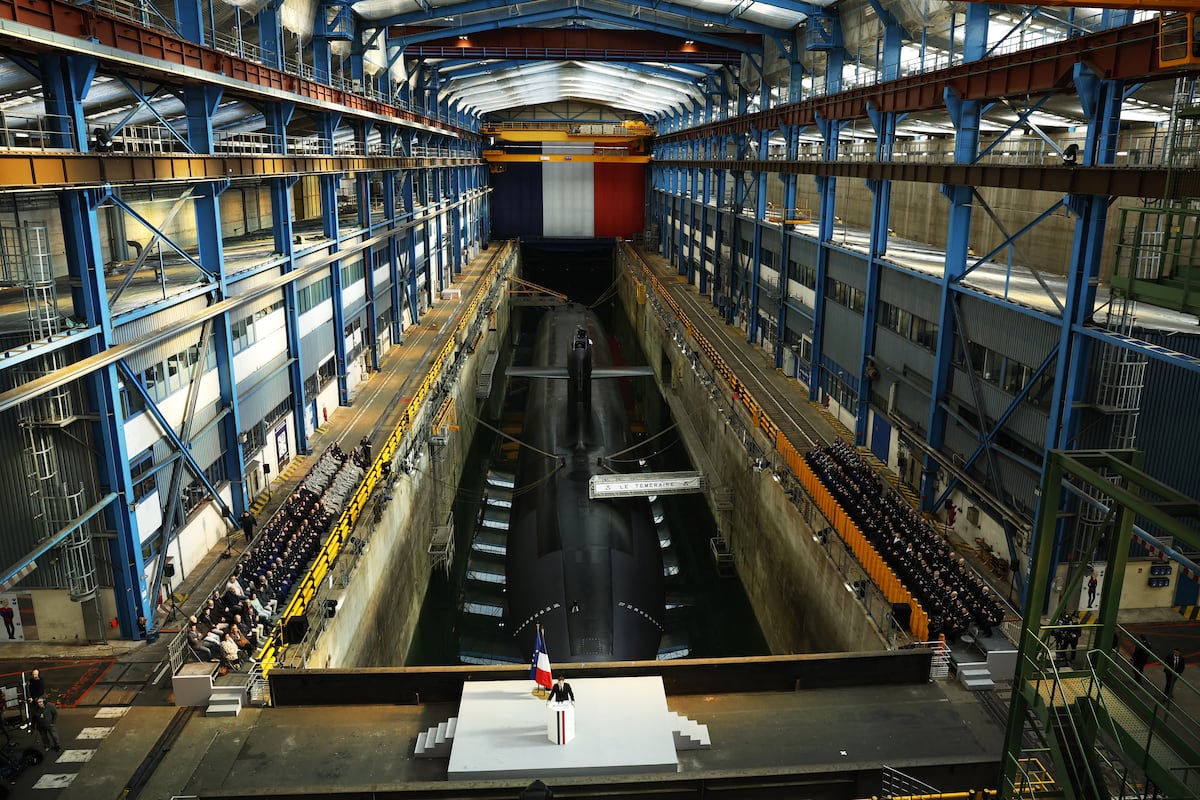
PARIS — France will expand its nuclear arsenal and implement a policy of “advanced deterrence” that could include deploying nuclear-capable forces to the territory of European allies, President Emmanuel Macron said Monday in a long-awaited speech on the country’s nuclear doctrine.
The plan is a “major evolution” of France’s deterrence posture, Macron said at the Île Longue naval base in Brittany, the home of France’s nuclear-powered ballistic missile submarines. The president said that in addition to Germany and the United Kingdom, another six European countries will join talks about greater nuclear cooperation.
“We must strengthen our nuclear deterrence in the face of the combination of threats, and we must consider our deterrence strategy in the depth of the European continent, with full respect for our sovereignty, with the gradual implementation of what I would call advanced deterrence.”
With an aggressive Russia on Europe’s borders and growing uncertainty about the solidity of American security guarantees, countries including Germany and Sweden have expressed interest in how France’s nuclear deterrence might be expanded. Successive French presidents have said the “vital interests” covered by French nuclear deterrence include a European dimension.
France will not share what it considers its “vital interests” and is therefore not providing a guarantee “in the strict sense of the term,” according to the president. Macron said in any case France will not share “the ultimate decision” to use nuclear weapons, which under the French constitution remains solely with the president.
General Charles de Gaulle, whose concept of strategic autonomy continues to frame France’s deterrence doctrine, first invoked the concept of vital interests, without ever defining exactly what those were. That ambiguity has remained a part of the French doctrine, leaving a potential adversary uncertain about what would trigger a response.
Macron said providing a rigid guarantee would be imprudent, lowering the nuclear threshold and reducing the uncertainty of adversaries. France will reserve its right to deliver a nuclear “final warning” to signal “very concretely” to an adversary that the nature of the conflict has changed, as a last chance to restore deterrence, the president said.
“France will therefore always take on alone, taking into account the interests of our allies, the deliberate crossing of the nuclear threshold,” Macron said.
The president said advanced deterrence will be a gradual process, first of all by allowing France’s partners to join in deterrence exercises, as well as what Macron called signaling, beyond French borders or with conventional participation by allies in France’s nuclear activities.
Ultimately, advanced deterrence could include the deployment of France’s strategic forces to allies, Macron said. That would allow France’s airborne nuclear deterrent to disperse across Europe, which “will complicate our adversaries’ calculations and give this advanced deterrence great value for us,” while giving French defenses “new strategic depth, consistent with the security challenges in Europe.”
“I believe it will also be of great value to the partners who join us in this approach, whose territory will gain a strong link with our deterrence,” Macron said. Any French effort would be a complement to NATO’s nuclear mission, the president said.
The airborne part of the French deterrent consists of nuclear-tipped cruise missiles carried by Rafale jets. The country got rid of its land-based intercontinental ballistic missiles in 1996.
The work on advanced deterrence with European allies is being carried out “in full transparency” with the United States and in close cooperation with the U.K., Macron said. Germany will be a key partner, while Poland, the Netherlands, Belgium, Sweden, Portugal and Denmark are also joining, the French president said.
“This is a genuine strategic convergence between our countries that will give real depth to the defense of our continent,” Macron said. France has opened talks with several other countries, and will continue in the coming weeks and months, he said.
With France creating “new strategic dilemmas” for Europe’s adversaries through advanced deterrence, partner countries can help strengthen European capabilities in early warning, expanded air defense and deep strike, according to Macron, who said that would be “a fair distribution of efforts” from which France would benefit.
“To be strong in our nuclear deterrence, we must be strong in our conventional capabilities, in all their dimensions,” Macron said.
The president said he has ordered to increase the number of nuclear warheads in the French arsenal, and France will no longer communicate on the size of its arsenal. The country previously said it has reduced its arsenal to less than 300 nuclear warheads, and the Stockholm International Peace Research Institute lists France as having 280 deployed warheads and about 10 in reserve.
France adheres to a principle of “strict sufficiency,” keeping its nuclear arsenal at the lowest possible level fitting the strategic context. France has been a nuclear power since 1960, when the country tested its first A-bomb in the Sahara, and first tested a hydrogen bomb on Mururoa atoll in French Polynesia in 1968.
France needs to increase its nuclear warhead count in the face of evolving defenses of competitors, emerging regional powers, possible coordination between adversaries and risks of proliferation, according to Macron, who said this is not about entering an arms race. He said France’s nuclear weapons remain exclusively strategic.
The key point “is that no adversary or combination of adversaries can contemplate the possibility of striking France without the certainty of suffering damage from which it would never recover,” Macron said. “There is no need for symmetry of arsenals to achieve this.”
Macron cited the threat from Russia developing new weapons, including hypersonic nuclear weapons, nuclear torpedoes and with plans to send nuclear weapons into space. The president also cited China’s military expansion, saying the country produces more weapons than any other nation.
There is an increased risk of conflicts going nuclear, as well as an increased intensity of conflict below the nuclear threshold, Macron said. He cited nuclear saber-rattling by Russian officials, with a trivialization of the discourse on nuclear weapons and reckless threats, and Russia’s use of dual-capable missiles such as the Oreshnik close to European borders.
“All of this is a major change that makes the risk of crossing the threshold more tangible,” Macron said. “At the same time, nuclear powers such as France must also become accustomed to the possibility of major conflicts below the nuclear threshold in their immediate environment.”
France’s four Le Triomphant-class strategic nuclear missile submarines make up the ocean-based part of the country’s nuclear deterrent, with doctrine prescribing a continuous-at-sea presence with at least one of the boats on patrol at any given time.
France has developed its ballistic missile technology domestically through ArianeGroup, while the French nuclear cruise missile was developed by MBDA. The United Kingdom relies on American-built Trident missiles for its ocean-based deterrent.
The country is in the midst of modernizing its nuclear deterrent, with a next-generation ballistic-missile submarine set to enter service starting in 2035. France is also developing the ASN4G hypersonic air-launched nuclear-tipped cruise missile to replace the current ASMPA, and preparing the next update of the M51 submarine-launched strategic ballistic missile.
France introduced the latest version of the M51 missile in October, with new nuclear warheads and greater range, accuracy and capability to penetrate enemy defenses. French on-duty ballistic missile submarines are equipped with 16 of the missiles, each consisting of a solid-propellant, three-stage launcher weighing more than 50 metric tons and 12 meters long, according to ArianeGroup.
While the exact range of the missile is undisclosed, ArianeGroup says the M51 reaches an altitude of more than 2,000 kilometers before reentering the atmosphere at a speed of Mach 20, carrying its payload of multiple nuclear warheads over a distance of “several thousand kilometers.”
The latest M51.3 version is estimated to have a range of more than 9,500 kilometers, compared to more than 9,000 kilometers for the prior model, according to the Bulletin of the Atomic Scientists .
Rudy Ruitenberg is a Europe correspondent for Defense News. He started his career at Bloomberg News and has experience reporting on technology, commodity markets and politics.
巴黎——法国总统埃马纽埃尔·马克龙周一在期待已久的关于法国核战略的讲话中表示,法国将扩大其核武库,并实施“先进威慑”政策,其中可能包括向欧洲盟国领土部署具备核能力的部队。
马克龙在位于布列塔尼的隆格岛海军基地(法国核动力弹道导弹潜艇的所在地)表示,该计划是法国威慑态势的“重大演进”。总统还表示,除德国和英国外,另有六个欧洲国家也将加入关于加强核合作的谈判。
“面对多种威胁,我们必须加强核威慑,并且必须在充分尊重我们主权的前提下,在欧洲大陆纵深地带考虑我们的威慑战略,逐步实施我所谓的先进威慑。”
鉴于俄罗斯在欧洲边境咄咄逼人,以及美国安全保障的可靠性日益受到质疑,包括德国和瑞典在内的多个国家都对法国如何扩大其核威慑力量表示出兴趣。历任法国总统都曾表示,法国核威慑所涵盖的“至关重要的利益”也包括欧洲层面。
法国不会分享其视为“核心利益”的事项,因此不会提供“严格意义上的”担保,马克龙总统表示。他还指出,无论如何,法国不会参与使用核武器的“最终决定”,根据法国宪法,这一决定权完全属于总统。
戴高乐将军提出的战略自主概念至今仍是法国威慑理论的基石。他最初提出“核心利益”的概念,但从未明确定义其具体含义。这种模糊性一直是法国战略的一部分,使得潜在对手难以确定何种行为会触发法国的应对措施。
马克龙表示,提供僵化的保证是不明智的,这会降低核门槛,并增加对手的不确定性。他指出,法国将保留发出核“最后警告”的权利,以“非常具体地”向对手表明冲突的性质已经改变,这是恢复威慑的最后机会。
“因此,法国将始终在顾及盟友利益的前提下,独自承担蓄意跨越核门槛的责任,”马克龙说。
总统表示,先进威慑将是一个循序渐进的过程,首先要允许法国的伙伴参与威慑演习,以及马克龙所说的在法国境外发出信号,或者让盟友以常规方式参与法国的核活动。
马克龙表示,最终,先进威慑可能包括将法国的战略力量部署到盟国。这将使法国的空中核威慑力量能够分散到整个欧洲,“这将使我们的对手难以计算,并赋予这种先进威慑对我们巨大的价值”,同时也将为法国的防御提供“新的战略纵深,以应对欧洲面临的安全挑战”。
马克龙表示:“我相信,对于与我们采取这种策略的伙伴国而言,这也将具有巨大价值,他们的领土将与我们的威慑力量紧密联系起来。”他还说,法国的任何努力都将是对北约核任务的补充。
法国空中威慑力量主要由阵风战斗机携带的核弹头巡航导弹构成。该国于1996年弃用了陆基洲际弹道导弹。
马克龙表示,与欧洲盟友开展先进威慑方面的工作,正与美国“完全透明”地进行,并与英国密切合作。他还表示,德国将是关键伙伴,波兰、荷兰、比利时、瑞典、葡萄牙和丹麦也将加入。
马克龙表示:“这是我们两国之间真正的战略契合,将极大地增强我们大陆的防御实力。” 他还说,法国已与其他几个国家展开对话,并将于未来几周和几个月内继续进行。
法国通过先进的威慑力量给欧洲的对手制造了“新的战略困境”,马克龙表示,伙伴国家可以帮助加强欧洲在预警、扩大防空和纵深打击方面的能力,这将是“公平的努力分配”,法国将从中受益。
马克龙说:“要想拥有强大的核威慑力,我们必须在常规能力的各个方面都保持强大。”
总统表示,他已下令增加法国核武库中的核弹头数量,法国将不再公开其核武库的规模。此前,法国曾表示已将其核武库削减至300枚以下,而斯德哥尔摩国际和平研究所的数据显示,法国目前部署了280枚核弹头,另有约10枚处于储备状态。
法国奉行“严格充足”原则,将其核武库维持在符合战略环境的最低水平。法国自1960年在撒哈拉沙漠进行首次原子弹试验以来,一直是核大国;1968年,法国在法属波利尼西亚的穆鲁罗阿环礁进行了首次氢弹试验。
面对竞争对手不断演变的防御体系、新兴地区强国的崛起、敌对势力之间可能出现的合作以及核扩散风险,法国需要增加其核弹头数量。马克龙强调,这并非要卷入军备竞赛,法国的核武器仍将完全用于战略用途。
马克龙表示,关键在于“任何对手或对手联盟都不能想象袭击法国而不遭受无法弥补的损失”。“要达到这个目的,并不需要双方拥有对称的武器库。”
马克龙指出,俄罗斯正在研发新型武器,包括高超音速核武器、核鱼雷,并计划将核武器送入太空,这构成了威胁。他还提到了中国的军事扩张,称中国生产的武器数量超过任何其他国家。
马克龙表示,冲突升级为核战争的风险增加,同时,核门槛以下的冲突强度也在加剧。他指出,俄罗斯官员大肆炫耀核武器,轻视核武器问题,发出鲁莽的威胁,并在欧洲边境附近使用“奥列什尼克”等双用途导弹。
马克龙表示:“所有这些都是重大变化,使得跨越核门槛的风险更加切实可见。与此同时,像法国这样的核大国也必须习惯于在其周边地区发生低于核门槛的重大冲突的可能性。”
法国的四艘“凯旋”级战略核导弹潜艇构成了该国核威慑力量的海洋部分,其作战理论规定,在任何特定时间,至少有一艘潜艇处于巡逻状态,保持持续的海上存在。
法国通过阿丽亚娜集团自主研发了弹道导弹技术,而法国的核巡航导弹则由MBDA公司研制。英国的海基威慑力量则依赖于美国制造的三叉戟导弹。
该国正处于核威慑力量现代化进程中,下一代弹道导弹潜艇将于2035年开始服役。法国还在研发ASN4G高超音速空射核巡航导弹,以取代现役的ASMPA导弹,并准备对M51潜射战略弹道导弹进行下一次升级。
法国于10月推出了最新型的M51导弹,该导弹配备了新型核弹头,射程更远、精度更高,穿透敌方防御的能力也更强。据阿丽亚娜集团称,法国现役弹道导弹潜艇共装备16枚该型导弹,每枚导弹均由一个固体燃料三级发射装置组成,重量超过50吨,长度达12米。
虽然导弹的确切射程尚未公开,但阿丽亚娜集团表示,M51 导弹在以 20 马赫的速度重返大气层之前,可以达到 2000 公里以上的高度,并携带多个核弹头有效载荷飞行“数千公里”。
据《原子科学家公报》报道,最新型的 M51.3 火箭预计射程超过 9500 公里,而之前的型号射程超过 9000 公里。
鲁迪·鲁伊滕贝格是《防务新闻》的欧洲记者。他的职业生涯始于彭博新闻社,拥有报道科技、大宗商品市场和政治方面的经验。