The U.S. Navy Tried to Turn Whale Songs Into Secret Code美国海军曾试图将鲸歌转化为秘密代码
The Cold War project cooked up an ingenious, but overly complicated method for submarines to send covert messages.
新闻视频
By Joseph Trevithick
Updated Jul 3, 2020 4:13 AM EDT
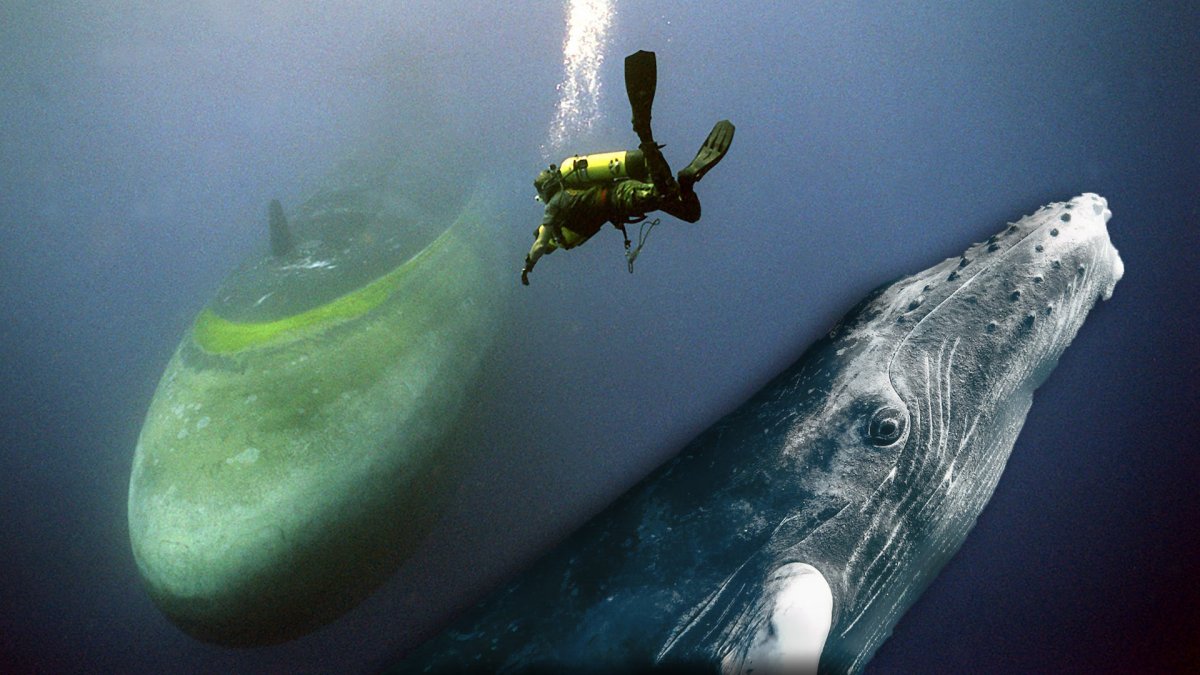
An American submarine desperately needs to get in contact with other ships in the U.S. Navy, but Soviet anti-submarine aircraft and warships are on the hunt, listening for any clues as to its whereabouts. During the search, the sonar operators hear a pod of whales singing to each other and don’t give it another thought. However, what they just heard was actually the sub using a secret, covert communication system that mimics sea mammal noises.
This wasn’t a scene from a spy novel or blockbuster Cold War submarine thriller—it was how the U.S. Navy once envisioned real life undersea operations. In 1959, the Navy Electronics Laboratory got to work on the concept as part of Project Combo. The work centered on the understanding that, under the right conditions, certain marine mammal sounds and the vibrations they generated might travel over very long distances underwater. More importantly, they’d appear so common as to go unnoticed by the enemy.
“Marine animal sounds are common and prominent components of the natural underwater sonic environment,” engineers at the Naval Ocean Systems Center (NOSC) explained in a report more than two decades later. “Military communications based on natural animal sounds confound detection by even informed enemy surveillance because the messages are but a small portion of the total biological chorus.”
A private individual obtained a copy of the review through a Mandatory Declassification Request. Government transparency website GovernmentAttic.org posted a copy online in December 2016.
Submariners and their boats have long proven their worth for patrolling large areas discreetly, performing surveillance missions, and quietly inserting elite troops and agents behind enemy lines. Roving ballistic missile submarines, which are especially hard for opponents to locate and target, are a key component of the America’s “ Nuclear Triad .” They call it the “silent service” for good reason.
But rapidly communicating and sharing information with other friendly forces was a persistent problem. One of the biggest underlying problems was that radio waves simply don’t travel well through salt water. As radars, sonars and other sensors continued to improve after World War II, a submarine riding on the surface sending signals home increasingly risked giving away its position and becoming a prime target.
The boats could use sounds to send messages while submerged. Unfortunately, sub hunters could keep their ears open for those artificial noises, too. Submarines could broadcast very-low frequency messages while submerged, but had to be relatively close to the surface. An antenna in a tethered buoy might allow crews to send and receive messages from greater depths, but enemy aircraft and ships could still intercept and zero in on the transmissions.
This is where the Combo gear came in.
The basic plan was to develop coded messages from recordings of whales, dolphins, sea lions, and seals. The submarine would broadcast the noises and a computer – the Combo Signal Recognizer (CSR) – would detect the specific patterns and decode them on the other end. In theory, this idea was relatively simple. As work progressed, the Navy found a number of complicated problems to overcome, the bulk of which centered on the authenticity of the code itself.
The message structure couldn’t just substitute the moaning of a whale or a crying seal for As and Bs or even whole words. In addition, the sounds Navy technicians recorded between 1959 and 1965 all had natural background noise. With the technology available, it would have been hard to scrub that out. Repeated blasts of the same sounds with identical extra noise would stand out to even untrained sonar operators.
And that’s not even getting into how not all sea life lives in the same regions or “talks” the same way. Using a whale or porpoise code in an area that those animals didn’t live might expose the whole system. You wouldn’t want to be broadcasting mating calls when it wasn’t mating season, either.
“These speculations presume a knowledgeable interpretor [sic],” NSOC noted. Nevertheless, it was a very real set of concerns for the Combo team.
In the end, the Navy recorded more than a dozen different species in the wild. Researchers determined that whales with a “cosmopolitan occurrence” in multiple regions, such as pilot and killer whales, would probably be best for Combo’s needs. Their songs remained more consistently audible underwater over reasonable distances than many smaller marine mammals, too.
In 1970, the Defense Advanced Research Agency (DARPA), the Pentagon’s top advanced research and development arm, became involved with Combo. The organization put up the funds to synthesize the recorded sounds into a useful audio library. Naval Ship Systems Command (NAVSHIPS) sponsored the work on the actual communications equipment.
Crafting a flexible code from the audio collection turned out to be too difficult. The ultimate solution was to match specific recordings to pre-determined messages. A submarine or other ship would play the sounds and the CSR or improved CSR-II would display an arbitrary numeric code. The receiving crew would then consult a code book to figure out the meaning.
To improve the reliability of the system, Combo’s gear would pump out the same message three times at varying frequencies. The CSR could then double check to make sure it had detected the right message. If the computer couldn’t figure things out, the LED display would light up the word “BAD.”
The Combo system could pump out pilot whale sounds on any of nine preset frequency bands. To protect the code’s integrity, depending on the particular day, the operators would only use specific frequencies as indicated in their code book. On top of that, the full recordings would bury the specific, meaningful notes inside a longer track full of arbitrary natural-sounding ambient noise.
The Navy understood that these messages would have to contain “low data,” such as “I am a friendly ship” or “mines ahead.” These pre-arranged communications would not be able to include detailed specifics.
In 1973, the service conducted two series of undersea tests near Santa Catalina Island, one of California’s Channel Islands near the city of Los Angeles. Static speakers and receivers sent and received six pre-configured messages at distances of five, 10 and 20 miles. In the first round, technicians placed all the devices at depths of approximately 150 feet. They almost doubled that to 250 feet for the second set of experiments.
USS Dolphin , which participated in Project Combo in 1974., USN
The equipment worked almost perfectly, according to NOSC. The original CSR computer successfully translated every sent message the five and 10 mile distances, and 90 percent of the sent messages at 20 miles.
The next year, the diesel-electric research submarine USS Dolphin successfully exchanged a number of messages with a ship on the surface. The noises even reportedly attracted a number of whales. In 1975, the Navy performed more static experiments with revised codes, but simply to gauge how much distortion there might be underwater as the sounds traveled between 3 and 16 miles from the source.
NOSC reported that messages could be viable out to a maximum distance of 50 miles. Additional experiments sought to determine whether standard sonobouys could receive the noises and pass them along via radio to a CSR or CSR-II for decoding. These demonstrations showed the floating beacons would pick up the whale songs between 5 and 7 miles away, and then pass them on successfully, all of which could have greatly expanded the range of the system.
Pilot Whales, like the ones shown here, had their unique “language” used as part of the Combo program., Jeff J Mitchell/Getty Images)
With these successes in hand, by 1980, engineers working on Combo recommended continued development of the equipment as part of an existing “Low Data Rate/Quick Response” communications program. They also wanted an extended library of marine animal sounds and related information.
We don’t know what ultimately became of the project’s work, but the Navy seemed to disagree when it came to its usefulness. There were also a number of parallel projects that could have doomed the whale song code.
The Navy might have just been disappointed with Combo’s range and message sizes. With research suggesting sea animal noises carrying across hundreds or even thousands of miles, sending a note to a ship 50 miles away would have been a major let down. Coding enough fixed, simplistic messages for the equipment to be truly useful might easily have been daunting task. And by 1980, engineers had already spent more than two decades just proving the system could work.
“It was never successful,” Dr. Christopher Willes Clark, founder of the Cornell Bioacoustics Research Program, wrote to Atlus Obscura in an email. “The process of projecting coded ‘whale’ sounds out to functional distances is not viable.”
It’s possible that Combo was the victim of decades of improvements in more conventional communications tools. In 1968, it had begun separate work on extremely-low frequency (ELF) radio transmitters that could reach submarines deep underwater. After a series of proposals and tests, work finally began on Project ELF in 1981. The final system became operational in 1989 with multiple ground-based transmission stations scattered around the globe.
Over the same period, the Navy had steadily improved a fleet of airborne very-low frequency (VLF) radio relays, as part of system of systems called Take Charge and Move Out (TACAMO). The main job of these flying command centers was— and still is —to get orders to ballistic missile submarines in a doomsday scenario where an enemy attack destroyed land-based communications sites. Of course, TACAMO never completely solved the sub-to-sub or ship-to-sub communication gap.
A TACAMO EC-130Q., USN
In 1989, the Navy began replacing its EC-130Q TACAMO planes, based on the C-130 Hercules cargo aircraft, with larger and more capable E-6A Mercuries. In 2004, it shut down the Project ELF sites altogether.
More than a decade later, improved E-6Bs were still flying, though the Pentagon was looking into a future replacement. In the near future, submarines may end up communication via further improved radio systems, with underwater drones as relay nodes, or even with beams of light .
There’s no indication the Navy is still interested in putting communication system based on animal sounds into service on submarines or any other warship. But if that ever changes, someone will probably have to go looking for the Combo tapes.
Contact the author: joe@thedrive.com
Comments couldn’t be loaded. Please refresh the page.
作者:约瑟夫·特雷维西克
更新于美国东部时间2020年7月3日凌晨4:13
一艘美国潜艇急需与美国海军其他舰艇取得联系,但苏联的反潜飞机和军舰正在搜寻,试图找到任何有关其行踪的线索。搜寻过程中,声呐操作员听到一群鲸鱼在互相鸣叫,他们并未在意。然而,他们听到的实际上是潜艇正在使用一种秘密的、隐蔽的通信系统,该系统能够模仿海洋哺乳动物的叫声。
这并非间谍小说或冷战时期潜艇惊悚大片中的场景——而是美国海军曾经设想的真实水下作战场景。1959年,海军电子实验室启动了“组合计划”(Project Combo),着手研究这一概念。该计划的核心理念是:在特定条件下,某些海洋哺乳动物的声音及其产生的振动可以在水下远距离传播。更重要的是,这些声音和振动听起来如此普通,以至于敌方难以察觉。
“海洋动物的声音是自然水下声环境中常见且突出的组成部分,”海军海洋系统中心(NOSC)的工程师在二十多年后的一份报告中解释道。“基于自然动物声音的军事通信能够迷惑即使是训练有素的敌方侦察人员,因为这些信息只是整个生物合唱的一小部分。”
一位私人人士通过强制解密申请获得了这份审查报告的副本。政府透明度网站 GovernmentAttic.org 于 2016 年 12 月将副本发布在了网上。
潜艇及其艇员早已证明了自身价值,它们能够隐蔽地巡逻大片区域,执行监视任务,并悄悄地将精锐部队和特工输送到敌后。游弋式弹道导弹潜艇尤其难以被对手定位和锁定,是美国“核三位一体”的关键组成部分。人们称之为“沉默部队”并非浪得虚名。
但与友军快速通信和共享信息始终是个难题。其中一个最大的根本问题是无线电波在海水中传播效果极差。二战后,随着雷达、声呐和其他传感器技术的不断进步,在水面航行的潜艇向母舰发送信号越来越容易暴露自身位置,成为敌方的主要目标。
这些潜艇可以在水下利用声音发送信息。不幸的是,反潜舰艇也能敏锐地捕捉到这些人工声音。潜艇可以在水下发射超低频信息,但必须保持在相对靠近水面的位置。系泊浮标上的天线或许能让艇员在更深的水域收发信息,但敌方飞机和舰艇仍然可以截获并锁定这些信号。
这时组合装备就派上用场了。
基本方案是利用鲸鱼、海豚、海狮和海豹的录音制作编码信息。潜艇会播放这些声音,而另一端的计算机——组合信号识别器(CSR)——则会检测出特定的模式并进行解码。理论上,这个想法相对简单。但随着工作的推进,海军发现需要克服许多复杂的难题,其中大部分都集中在编码本身的真实性上。
信息结构无法简单地用鲸鱼的呻吟或海豹的哭声来代替字母A和B,甚至无法代替完整的单词。此外,海军技术人员在1959年至1965年间记录的所有声音都带有自然背景噪音。以当时的技术水平,很难将其消除。即使是未经训练的声呐操作员,也能轻易分辨出重复出现的相同声音以及相同的背景噪音。
更何况,并非所有海洋生物都生活在同一区域,或者以相同的方式“交流”。在鲸鱼或海豚从未生活过的区域使用它们的“交流码”可能会暴露整个系统。你肯定也不想在非交配季节播放它们的求偶叫声吧。
NSOC指出:“这些推测的前提是译员具备一定的专业知识。”尽管如此,对于Combo团队来说,这确实是一系列非常现实的担忧。
最终,海军在野外记录到了十几种不同的鲸鱼物种。研究人员认为,像领航鲸和虎鲸这样在多个区域都有分布的鲸鱼,可能最符合Combo的需求。而且,与许多小型海洋哺乳动物相比,它们的鸣叫声在水下相当远的距离内也更容易被听到。
1970年,五角大楼最高级别的先进研发机构——国防高级研究局(DARPA)参与了Combo项目。该机构出资将录制的声音合成到一个实用的音频库中。海军舰艇系统司令部(NAVSHIPS)则负责实际通信设备的研发工作。
从音频资料中构建灵活的密码过于困难。最终的解决方案是将特定的录音与预先设定的信息进行匹配。潜艇或其他舰船播放这些声音后,CSR 或改进型 CSR-II 会显示一个任意的数字代码。接收方船员随后查阅密码本来解读代码的含义。
为了提高系统的可靠性,Combo 的设备会以不同的频率重复发送相同的消息三次。客服代表可以再次核对,确保接收到正确的消息。如果计算机无法识别,LED 显示屏会亮起“BAD”字样。
这套组合系统可以在九个预设频段中任意一个频段播放领航鲸的声音。为了保护编码的完整性,操作员会根据具体情况,仅使用编码手册中指定的特定频率。此外,完整的录音会将那些特定的、有意义的音符隐藏在一段较长的、充满任意自然环境噪音的音轨中。
海军明白这些信息必须包含“低数据量”,例如“我是友军舰艇”或“前方有水雷”。这些预先安排的通信无法包含详细细节。
1973年,美国海军在加利福尼亚州圣卡塔利娜岛附近(洛杉矶市附近的海峡群岛之一)进行了两轮水下测试。测试中,固定式扬声器和接收器在5英里、10英里和20英里的距离上发送和接收了六条预先配置的信息。在第一轮测试中,技术人员将所有设备放置在约150英尺深的水下。在第二轮测试中,他们将深度几乎翻了一番,达到250英尺。
“海豚”号航空母舰,曾于1974年参与“组合计划”(Project Combo)。
据NOSC称,该设备运行近乎完美。原CSR计算机成功翻译了5英里和10英里距离内发送的每一条信息,以及20英里距离内发送信息的90%。
次年,柴电研究潜艇“海豚”号成功地与一艘水面舰艇交换了多条信息。据报道,这些声音甚至吸引了一些鲸鱼。1975年,海军使用改进后的密码进行了更多静态实验,但目的仅仅是为了评估声音在水下传播3到16英里范围内可能产生的失真程度。
NOSC报告称,信息有效传输距离可达50英里。其他实验旨在确定标准声呐浮标能否接收到噪声,并通过无线电将其传递给CSR或CSR-II进行解码。这些演示表明,漂浮的信标可以在5到7英里外接收到鲸歌,并成功将其传递出去,所有这些都极大地扩展了系统的传输范围。
图中所示的领航鲸,它们独特的“语言”曾被用于“组合计划”(Combo program)。(图片来源:Jeff J Mitchell/Getty Images)
凭借这些成功经验,到1980年,参与Combo项目研发的工程师建议继续开发该设备,将其纳入现有的“低数据速率/快速响应”通信计划。他们还希望建立一个包含更多海洋动物声音及相关信息的资料库。
我们不知道这个项目最终结果如何,但海军似乎对其效用持不同意见。此外,还有一些并行项目也可能导致鲸歌密码的失败。
海军或许只是对Combo系统的传输距离和信息大小感到失望。研究表明,海洋动物的叫声可以传播数百甚至数千英里,因此,如果只能向50英里外的船只发送信息,那无疑会令人大失所望。要为这套设备编写足够多的固定、简单的信息,使其真正发挥作用,可能是一项艰巨的任务。而且到了1980年,工程师们已经花费了二十多年的时间来证明这套系统的可行性。
康奈尔生物声学研究项目创始人克里斯托弗·威利斯·克拉克博士在给Atlus Obscura的一封电子邮件中写道:“这种方法从未成功过。将编码后的‘鲸鱼’声音投射到有效距离的过程是不可行的。”
Combo公司或许是传统通信工具数十年来不断进步的牺牲品。早在1968年,该公司就已开始独立研发能够与深海潜艇通信的极低频(ELF)无线电发射机。经过一系列提案和测试,ELF项目最终于1981年启动。最终系统于1989年投入使用,在全球各地部署了多个地面发射站。
同期,海军稳步改进了机载甚低频(VLF)无线电中继机群,这是名为“接管并撤离”(TACAMO)的系统的一部分。这些空中指挥中心的主要任务是——而且至今仍然是——在敌方攻击摧毁陆基通信站点的末日情景下,向弹道导弹潜艇传达命令。当然,TACAMO从未完全解决潜艇之间或舰艇之间的通信难题。
美国海军TACAMO EC-130Q
1989年,美国海军开始用更大、性能更强的E-6A“水星”预警机替换基于C-130“大力神”运输机的EC-130Q战术空中机动飞机(TACAMO)。2004年,海军彻底关闭了ELF项目的所有基地。
十多年过去了,改进型的E-6B预警机仍在服役,尽管五角大楼已经在考虑未来的替代机型。在不久的将来,潜艇或许会通过进一步改进的无线电系统进行通信,利用水下无人机作为中继节点,甚至使用光束进行通信。
目前没有任何迹象表明海军仍然有意在潜艇或其他军舰上部署基于动物叫声的通信系统。但如果情况有变,恐怕有人得去找找当年的“组合录音带”了。
联系作者:joe@thedrive.com
评论加载失败,请刷新页面。