World needs ‘bridge builders’ to make the transition to new multi-polar order: President Tharman世界需要“桥梁建设者”来实现向新的多极秩序的过渡:尚达曼总统
President Tharman said it is important to recast the narrative of climate change to focus on the here and now. Read more at straitstimes.com.
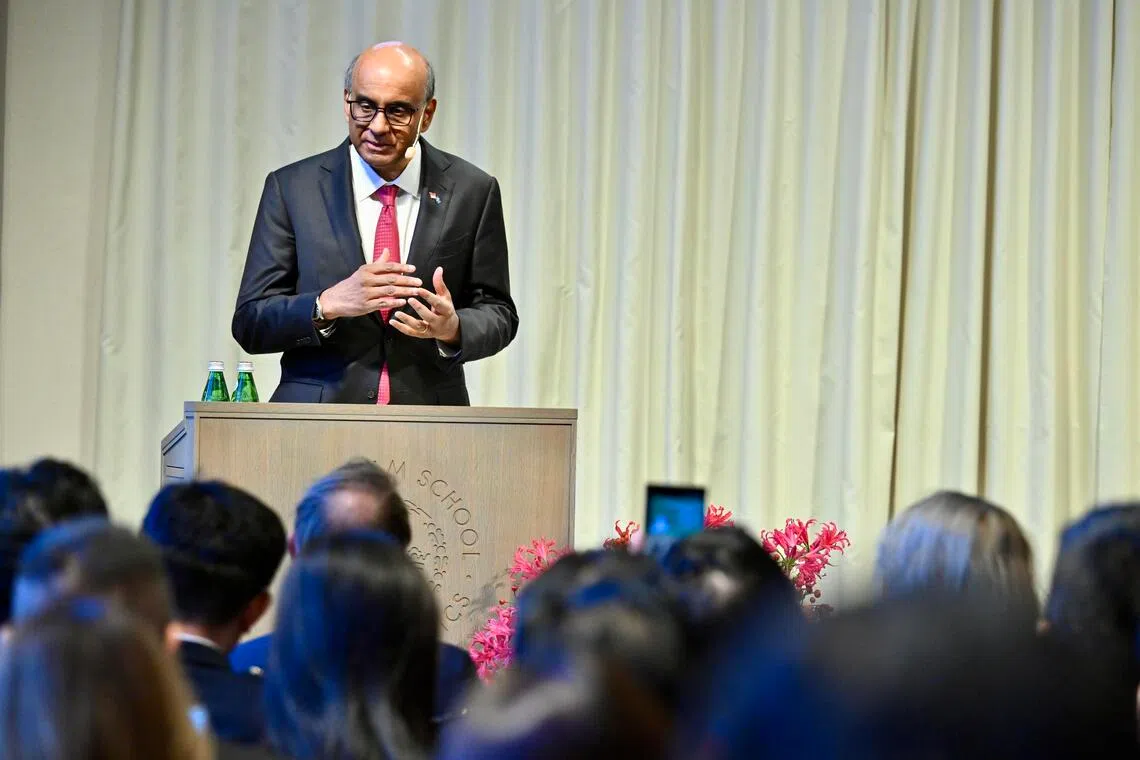
President Tharman said bridge builders will come from among nations of different sizes.
ST PHOTO: DESMOND FOO
Published Oct 21, 2026, 06:38 PM
Updated Oct 21, 2026, 06:38 PM
President Tharman said the world needs 'bridge builders' to move from US-led order to a stable multi-polar system that can deal with climate change and AI safety.
He warned that without such states, the world may face suspicion, trade weaponisation, conflict, and divided blocs. He cited Sweden and Singapore as examples of coalition builders.
He said global cooperation needs both the US and China. He urged stronger social compacts at home, and warned that decoupling AI, technology, supply chains and payments would be “more profoundly dangerous”.
STOCKHOLM - The world needs countries who are bridge builders if it is to reach a stable, new global order that can address common challenges such as climate change and artificial intelligence safety, said President Tharman Shanmugaratnam.
This is as the passing of a uni-polar world order led by the United States is no assurance that the world will naturally arrive at a cooperative multi-polar order, he said at a lecture during his state visit to Sweden.
“If anything, we are more likely than not to see growing suspicion, friction or conflicts, weaponisation of trade and materials, and a steady grind into a world of divided blocs,” he said at the Stockholm School of Economics on Oct 19.
It is critical therefore that there are states which can bring regions together, building coalitions that develop rules for a new era and to take bolder action on complex problems.
The President said these bridge builders will be nations that may be small, medium, or large. He cited Sweden, which has been building coalitions for more than half a century to support the planet’s health.
Singapore has also been working actively to advance cooperation, such as between ASEAN and the European Union, and to find ways to help small states be heard at the United Nations, he noted.
Countries must also recast the political and social narrative when it comes to climate change to the here and now so that there is greater urgency to taking action, said President Tharman.
He cited credible surveys that showed that people are more motivated to support measures to tackle climate change if they were aware of its impact on their health.
“People know what pollution feels like, and they can see what heat stress does. And they know that those who are poorer tend to suffer the most,” he added.
Efforts to tackle the current haze affecting South-east Asian countries are an example of measures that can have both short and long-term impact, he noted.
Indonesia’s initiative to restore its peatlands, which contain 28 billion tonnes of carbon - about two times what the world emits each year - both improves people’s health immediately and is an important tool of climate change mitigation, he said.
At the same time, the world cannot achieve win-win outcomes internationally if countries face problems at home, such as of unequal outcomes and disillusionment.
President Tharman called on countries to repair and reinvigorate their social compacts, such as by returning to investing in high-quality public services, even as they redistribute resources to mitigate inequality.
Nations must also ensure that while their economy as a whole does well, workers and communities who lose out due to technological change get timely assistance to bounce back, he added.
“Markets do not relieve these problems quickly, and often not at all,” he said. “The task of government is to not let such problems fester, and to intervene to help those displaced.”
No possible world order without US, China
President Tharman stressed in his lecture that no system of global cooperation is possible without both the US and China being integral parts of such an order.
This is as the two power have the largest markets and are the largest sources of innovation, he noted. They are also essential to tackling climate change, by virtue of the scale of their carbon emissions.
They also have an overwhelming share of global AI compute and are essential , he added.
While countries should not expect the US to return to the responsibilities it took on when it led the global order, neither should people assume an unchanging political mood there, said the President.
He cited surveys that consistently showed that the majority of Americans like the idea of global cooperation. One such survey by the Rockefeller Foundation found that two-thirds of Americans favoured this, even if it meant some compromise to their nation’s interests.
“In fact, a higher proportion of Americans agreed to that statement than most other developed countries,” he said.
On its part, China needs to recognise that to continue to be a large source of supply of goods to the world, it will have to be a larger source of demand than it is currently, said President Tharman. He noted that domestic reforms are underway, but will need time to raise consumption.
Bridge builders are needed between the US and China, so as to preserve economic networks that are integral to both of them, he added.
“We must maintain those overlapping networks and supply chains, that include both the US and China, and avoid as much as we can the drift towards bifurcation,” he said.
If managed well, interdependence between the US and China will be a source of prosperity for both countries, as well as a basis for peace and stability globally, said President Tharman.
“It will surely be more a more dangerous world if we end up with whole AI and technology stacks decoupled, and other supply chains and payment systems decoupled,” he said. “It will make for a more profoundly dangerous world.”
Tharman Shanmugaratnam
尚达曼总统表示,桥梁建设者将来自不同大小的国家。
圣路易斯照片:德斯蒙德·福
发布于 2026 年 10 月 21 日下午 6:38
更新于2026年10月21日下午6:38
尚达曼总统表示,世界需要“桥梁建设者”,才能从美国主导的秩序过渡到能够应对气候变化和人工智能安全的稳定多极体系。
他警告说,如果没有这样的国家,世界可能会面临猜忌、贸易武器化、冲突和分裂的阵营。他以瑞典和新加坡为例,说明它们是如何构建联盟的。
他表示,全球合作需要美国和中国的共同参与。他敦促国内加强社会契约,并警告说,人工智能、技术、供应链和支付脱钩将“更加危险”。
斯德哥尔摩——韩国总统尚达曼表示,世界需要一些能够搭建桥梁的国家,才能建立一个稳定的、新的全球秩序,以应对气候变化和人工智能安全等共同挑战。
他在对瑞典进行国事访问期间的一次演讲中表示,美国领导的单极世界秩序的结束并不能保证世界会自然而然地走向合作的多极秩序。
“如果说有什么变化的话,那就是我们更有可能看到猜疑、摩擦或冲突加剧,贸易和物资被武器化,以及世界逐渐走向分裂,”他在10月19日于斯德哥尔摩经济学院表示。
因此,至关重要的是,要有一些国家能够将各个地区团结起来,建立联盟,制定新时代的规则,并对复杂问题采取更大胆的行动。
总统表示,这些桥梁建设者可能是小型、中型或大型国家。他以瑞典为例,瑞典半个多世纪以来一直在构建联盟,以维护地球健康。
他还指出,新加坡也一直在积极推进合作,例如东盟与欧盟之间的合作,并寻找方法帮助小国在联合国发出声音。
尚达曼总统表示,各国还必须重新构建有关气候变化的政治和社会叙事,使其与当下息息相关,从而更加迫切地采取行动。
他引用了一些可信的调查,这些调查显示,如果人们意识到气候变化对他们健康的影响,他们就会更有动力支持应对气候变化的措施。
“人们知道污染是什么滋味,也亲眼目睹了热应激的危害。他们也知道,贫困人口往往遭受的苦难最大,”他补充道。
他指出,为应对目前影响东南亚国家的雾霾而采取的措施,就是一个既能产生短期影响又能产生长期影响的措施的例子。
他说,印尼恢复泥炭地的举措(泥炭地含有 280 亿吨碳,大约是世界每年排放量的两倍)既能立即改善人们的健康,也是减缓气候变化的重要工具。
与此同时,如果各国在国内面临不平等的结果和失望情绪等问题,世界就无法在国际上实现双赢的结果。
尚达曼总统呼吁各国修复和重振社会契约,例如重新投资高质量的公共服务,同时重新分配资源以缓解不平等现象。
他还补充说,各国必须确保在整体经济发展良好的同时,那些因技术变革而蒙受损失的工人和社区能够及时获得援助,从而恢复元气。
他说:“市场并不能迅速缓解这些问题,而且往往根本不起作用。政府的任务是防止这些问题恶化,并进行干预以帮助那些流离失所的人。”
没有美国和中国,世界秩序是不可能的。
尚达曼总统在演讲中强调,如果没有美国和中国作为这一秩序不可或缺的一部分,任何全球合作体系都不可能存在。
他指出,这是因为这两个大国拥有最大的市场,也是最大的创新源泉。此外,鉴于其巨大的碳排放规模,它们在应对气候变化方面也至关重要。
他还补充说,它们在全球人工智能计算领域占据了压倒性的份额,至关重要。
总统表示,虽然各国不应指望美国重新承担起领导全球秩序时所承担的责任,但人们也不应认为美国的政治氛围一成不变。
他引用多项调查,这些调查一致表明,大多数美国人赞成全球合作。洛克菲勒基金会的一项调查发现,三分之二的美国人支持全球合作,即使这意味着要对本国利益做出一些妥协。
“事实上,认同这一说法的美国人比例高于大多数其他发达国家,”他说。
尚达曼总统表示,中国自身也需要认识到,要想继续保持世界商品供应大国的地位,就必须成为比目前更大的需求国。他指出,国内改革正在进行中,但提振消费仍需时间。
他补充说,中美两国需要桥梁建设者,以维护对两国都至关重要的经济网络。
他说:“我们必须维护这些重叠的网络和供应链,包括美国和中国,并尽可能避免走向分裂。”
尚达曼总统表示,如果管理得当,中美之间的相互依存将成为两国繁荣的源泉,也是全球和平与稳定的基础。
“如果我们最终导致人工智能和技术堆栈完全脱钩,其他供应链和支付系统也脱钩,那世界肯定会变得更加危险,”他说。“这将使世界变得更加危险。”
尚达曼