App to help diners with visual impairment at hawker centres among ideas showcased at inaugural challenge在首届挑战赛上展示的创意中,有一款应用程序旨在帮助视障人士在小贩中心用餐。
Prototype app helps diners with visual impairment find empty tables at Singapore hawker centres Read more at straitstimes.com.
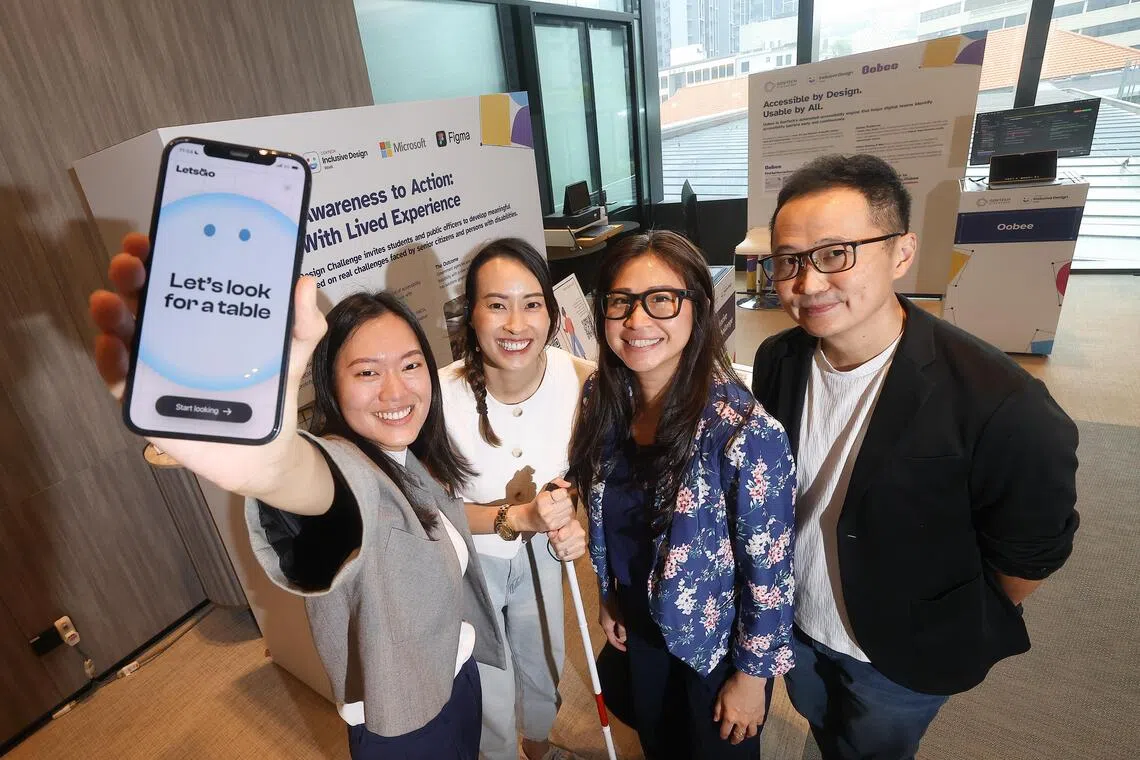
The team of four developed a prototype app to help diners with visual impairment find empty tables at hawker centres. From left, product designers from Skills and Workforce Development Agency (SWDA) Tay Yu Qing and Genevieve Yip (in white), Ho Yin Mei, a principal design lead from the Ministry of Social and Family Development (MSF) and Jeffrey Ang, a principal architect from the Urban Redvelopment Authority.
Published Oct 21, 2026, 06:45 PM
Updated Oct 21, 2026, 06:45 PM
Singapore launched the Inclusive Design Challenge to create accessible digital solutions. Minister Josephine Teo said services must work for all citizens, and GovTech is piloting real-user “Mystery Shopper” checks.
LetsGo is a prototype app for diners with visual impairement. It uses audio or smart glasses to say “occupied table” or “empty table”, helping users find seats at hawker centres.
Teams also tackled payment and language barriers. GovTech plans to follow up on some ideas, while tools like EasyTranslate and Polyglot now translate government webpages into Chinese, Malay and Tamil.
SINGAPORE - Finding an empty table in a packed hawker centre is hard enough, let alone for persons with visual impairments.
An app that is being developed seeks to help them with this aspect of dining out through audio guidance over a paired Bluetooth earpiece or pair of smart glasses, though this is just one step of a complex journey for them.
Named LetsGo, the app prototype will tell the user “occupied table” or “empty table” when the user points their phone camera at their surroundings.
It is among several prototypes showcased on Oct 21 under the inaugural Inclusive Design Challenge (IDC) organised by GovTech Singapore in collaboration with Microsoft and software company Figma.
Held as part of GovTech Singapore’s annual Inclusive Design Week, the challenge aims to put users at the heart of the design process.
“For Singapore, our ambition for digital inclusion must reach higher,” said Minister for Digital Development and Information Josephine Teo in launching IDC on Oct 21.
“Having achieved the basics of broadband and device access, we have focused on building skills, including for seniors and disadvantaged communities. But we must not stop there. We must instead do better to identify groups who still have difficulty getting the most out of digital.”
At the launch event held at Guoco Midtown Network Hub, Teo said that GovTech started piloting a programme known as Mystery Shopper to help it understand how people use its digital services.
GovTech said the pilot started in September 2026. By inviting users, including persons with disabilities and seniors, to use selected services as they would in everyday life, it can then uncover barriers that its accessibility checks may miss and help agencies improves their services.
LetsGo, for instance, addresses a key point in a complex multi-step journey to the hawker centre, based on feedback from eight visually-impaired interviewees that the app’s designers had garnered, said G enevieve Yip, a product designer from the Skills and Workforce Development Agency (SWDA), who’s part of the four-member team behind LetsGo.
“Ordering food... making payment. All these steps that we don’t even think about is a challenge for the visually-impaired , and that’s why a lot of them end up not going there on their own,” she said.
Other challenges include joining a queue, understanding the menu, carrying the food to the table, returning the tray and exiting the hawker centre, she said.
Another team member, product designer Tan Yu Qing, said one feedback that arose after testing the app with two visually-impaired persons, was to also incorporate the use of haptic phone vibrations because the loud ambient noise in hawker centres can drown out the audio guidance.
LetsGo is one of five concepts showcased at IDW.
Over two months from August 2026, a total of 17 teams comprising either public officers or tertiary students had worked alongside GovTech Singapore mentors, industry experts and users to research, design and test prototypes addressing everyday accessibility barriers.
A team of Temasek Polytechnic students, for instance, tackled the difficulties visually-impaired individuals face when making digital payments. They proposed consistent design principles across banking apps, such as reading important information first, announcing the status of a payment, and guiding users on what to do next.
Joy Ng, the head of the Chief Digital Experience Office at GovTech Singapore said the agency will continue to work with government agencies to further develop promising prototypes beyond the challenge.
Beyond inclusive solutions and making digital services “inclusive by design”, Singapore is also expanding AI-driven tools to tackle digital language barriers.
Teo said that GovTech and OGP (Open Government Products) have developed tools like EasyTranslate and Polyglot that translate government webpages into Chinese, Malay or Tamil while preserving the original webpage.
These tools have been deployed to the portals of more agencies like REACH or Reaching Everyone for Active Citizenry @ Home, a government feedback and e-engagement unit and the Immigration & Checkpoints Authority, she said.
Technology and research
GovTech/Government Technology Agency
这个由四人组成的团队开发了一款原型应用程序,旨在帮助视障人士在小贩中心找到空桌。从左至右依次为:新加坡技能与劳动力发展局 (SWDA) 的产品设计师郑宇青 (Tay Yu Qing) 和叶慧芬 (Genevieve Yip)(身穿白色衣服),新加坡社会及家庭发展部 (MSF) 的首席设计负责人何茵梅 (Ho Yin Mei),以及新加坡市区重建局的首席建筑师杰弗里·昂 (Jeffrey Ang)。
发布于 2026 年 10 月 21 日下午 6:45
更新于2026年10月21日下午6:45
新加坡发起“包容性设计挑战赛”,旨在打造无障碍的数字化解决方案。部长杨莉明表示,公共服务必须惠及所有公民,政府科技局(GovTech)正在试点开展“神秘顾客”真实用户体验调查。
LetsGo是一款面向视障人士的用餐应用原型。它利用语音或智能眼镜播报“有人用餐”或“空桌”,帮助用户在小贩中心找到座位。
各团队还着手解决支付和语言障碍问题。政府科技局计划跟进其中一些想法,而像EasyTranslate和Polyglot这样的工具现在可以将政府网页翻译成中文、马来语和泰米尔语。
新加坡——在拥挤的小贩中心找到一张空桌子已经够难了,更何况是视障人士。
一款正在开发中的应用程序旨在通过配对的蓝牙耳机或智能眼镜提供语音指导,帮助他们解决外出就餐的这一问题,但这只是他们复杂旅程中的一步。
这款名为 LetsGo 的应用程序原型会在用户将手机摄像头对准周围环境时,告诉用户“桌子有人”或“桌子空着”。
这是 10 月 21 日在新加坡政府科技局与微软和软件公司 Figma 联合举办的首届包容性设计挑战赛 (IDC) 上展出的几个原型之一。
作为新加坡政府科技局年度包容性设计周的一部分,这项挑战旨在将用户置于设计过程的核心。
“对于新加坡来说,我们在数字包容方面的雄心壮志必须更高,”数字发展及新闻部长杨莉明在10月21日启动IDC时表示。
“在实现了宽带和设备接入的基本目标之后,我们一直致力于技能培养,包括为老年人和弱势群体提供技能培训。但我们不能止步于此。相反,我们必须更好地识别那些仍然难以充分利用数字技术的群体。”
在国浩 Midtown Network Hub 举行的启动仪式上,Teo 表示,政府科技局已开始试行一项名为“神秘顾客”的计划,以帮助其了解人们如何使用其数字服务。
政府科技局表示,该试点项目于2026年9月启动。通过邀请包括残疾人和老年人在内的用户像在日常生活中一样使用选定的服务,它可以发现其无障碍检查可能遗漏的障碍,并帮助各机构改进其服务。
例如,LetsGo 解决了前往小贩中心的复杂多步骤旅程中的一个关键点,这是根据该应用程序的设计者从八位视障受访者那里收集到的反馈而制定的。技能和劳动力发展局 (SWDA) 的产品设计师 Genevive Yip 说道,她是 LetsGo 背后的四人团队成员之一。
“点餐……付款。所有这些我们想都没想过的步骤,对视障人士来说都是挑战,这就是为什么很多视障人士最终不会独自去那里的原因,”她说。
她表示,其他挑战还包括排队、理解菜单、将食物端到桌子上、归还托盘和离开小贩中心。
另一位团队成员,产品设计师谭宇青表示,在与两名视障人士测试该应用程序后,得到的反馈之一是,还应该加入触觉手机振动功能,因为小贩中心嘈杂的环境噪音可能会盖过语音提示。
LetsGo 是 IDW 上展示的五个概念之一。
从 2026 年 8 月起的两个多月时间里,共有 17 个团队(成员包括公务员或高等院校学生)与新加坡政府科技局的导师、行业专家和用户合作,研究、设计和测试原型,以解决日常无障碍障碍。
例如,淡马锡理工学院的一个学生团队致力于解决视障人士在进行数字支付时遇到的困难。他们提出了一系列适用于所有银行应用程序的统一设计原则,例如优先显示重要信息、播报支付状态以及引导用户进行下一步操作。
新加坡政府科技局首席数字体验办公室主任Joy Ng表示,该机构将继续与政府机构合作,进一步开发有前景的原型,以应对挑战。
除了包容性解决方案和使数字服务“从设计上就具有包容性”之外,新加坡还在扩大人工智能驱动的工具,以解决数字语言障碍。
Teo表示,政府科技局和开放政府产品(OGP)已经开发出EasyTranslate和Polyglot等工具,可以将政府网页翻译成中文、马来语或泰米尔语,同时保留原始网页内容。
她表示,这些工具已被部署到更多机构的门户网站上,例如 REACH(即“居家积极公民计划”)、政府反馈和电子互动部门以及移民和关卡局。
技术与研究
政府科技局/政府技术局