Why is it difficult to identify companies linked to fires? How can S’pore’s haze law be strengthened?为什么难以确定与火灾有关的公司?如何加强新加坡的雾霾防治法?
Enforcement is limited by the cross-border nature of investigations and difficulties in collecting evidence. Read more at straitstimes.com.
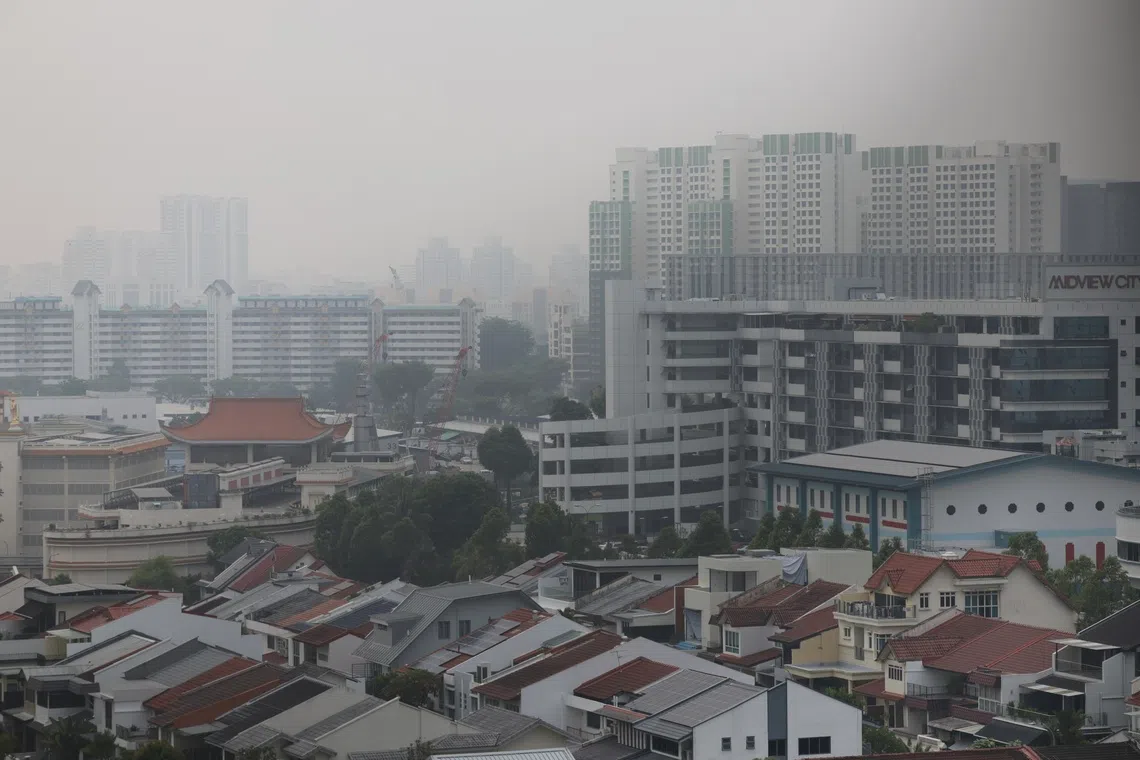
As the blazes continue and the region grapples with bad air, the lack of action taken against errant firms have prompted questions about why prosecution is so challenging.
Published Oct 21, 2026, 08:00 PM
Updated Oct 21, 2026, 08:00 PM
It has been hard to name haze-linked firms because organisations lacks up-to-date plantation maps and full company data, making satellite evidence alone unreliable.
The Transboundary Haze Pollution Act can fine firms up to "$100,000 a day" and "$2 million" total, but cross-border probes make enforcement difficult.
Experts want stronger rules, including disclosure of plantation, supply chain and ownership data, plus earlier fire prevention and possibly tougher penalties.
SINGAPORE - As South-east Asia faces its most severe haze crisis in over a decade, governments and environmental organisations are starting to identify the companies that could be responsible for the widespread burning.
Singapore has for instance served legal notices to 10 companies under its Transboundary Haze Pollution Act, asking them to provide more information on their fire prevention and suppression strategies.
Companies were identified by analysing satellite imagery and meteorological data on regional hot spots and smoke plumes, including open sources and concession maps.
Other environmental groups such as Greenpeace and Indonesian non-government organisation Pantau Gambut have also done their own analyses of satellite data to identify firms linked to starting haze-belching fires through slash-and-burn practices.
For instance, in an Oct 5 report, Greenpeace identified fires and smoke in concessions linked to two Singapore Exchange -listed companies First Resources and Bumitama Agri.
But as the blazes continue and the region grapples with bad air, the lack of action taken against errant firms have prompted questions about why prosecution is so challenging.
Addressing this issue about enforcement in a media interview on Oct 19, Senior Minister K. Shanmugam said the Republic will consider legal, regulatory and economic measures to exert pressure on companies linked to the haze.
These include targeting their bottom lines, access to financing, government grants and standing with investors. He also said Singapore will consider changing existing laws or introducing new ones on an urgent basis to ensure further cooperation.
The Straits Times speaks to environment groups and legal experts to find out why it has been tricky to hold polluting firms accountable, and how Singapore could potentially strengthen its haze laws to ensure the culprits take responsibility for the fires.
What are the challenges in pinpointing haze culprits?
The main challenge is the lack of access to up-to-date maps of plantation companies.
Such maps are needed to identify and verify the locations where fires were started, and monitor if companies are taking measures to restore peatlands on their land, if they had previously claimed to do so.
Greenpeace Indonesia’s forest campaigner Belgis Habiba said the Indonesian government has never disclosed full information on fires by corporations, and its data usually shows only areas by administrative boundaries, such as provincial or district ones.
Not all companies disclose the boundaries of the suppliers they source pulpwood or oil palm from.
Without such information, it is difficult to determine a fire’s origin through satellite images alone, as flames can spread across land plots, said Tomi Haryadi, programme director for food, land and water at WRI Indonesia.
“Improving data transparency from both government and companies, including access to updated concession maps and relevant fire prevention and fire management data, is essential to strengthen independent monitoring and accountability,” he said.
On Oct 16, The Jakarta Post reported that Indonesia’s Forestry Ministry had restricted people from retrieving information from its mapping platform Sigap without written approval. It had threatened criminal charges against those who allegedly using geospatial data without the government’s authorisation.
Not all firms provide information on their fire history, inspection findings, and links to larger conglomerates and shareholders, added Wahyu Perdana, advocacy, campaign, and communications manager of Pantau Gambut.
Such data is necessary to determine if a firm is genuinely responsive to complaints about fire hotspots emerging on its supplier’s plantation, Wahyu added.
Companies should share such information to help observers and environmental groups monitor their efforts at fire prevention and ecosystem restoration, and whether they take steps to ensure that suppliers meet environmental standards.
Without access to concession maps, environmental groups say they build their own databases through other means.
For instance, WRI Indonesia and WALHI said they rely on satellite imagery, the government’s fire monitoring platform and concession data from Global Nature Watch when conducting their own investigations.
Greenpeace Indonesia also has a database of concessions maps established from various “reliable sources” , it said.
What are the limitations of Singapore’s Transboundary Haze Pollution Act?
The Act targets those responsible for causing or condoning fires. It can be triggered if the haze causes the Pollutant Standards Index (PSI) – a measure of air quality here – to stay in the unhealthy range in any part of Singapore for 24 hours or more.
Those guilty under the Act can be fined up to $100,000 a day, capped at a total of $2 million.
This law has been wielded twice so far - in 2015, during the last major haze crisis to affect Singapore, and again in 2026. But no fines have been meted out so far.
Lawyers say enforcement is limited by the cross-border nature of investigation and difficulties in collecting evidence of haze-causing fire sources outside of Singapore.
In 2015, preventive measure notices were issued by Singapore’s National Environment Agency (NEA) to six firms. These notices request the firms to stop burning on their land, and to submit plans on how they plan to prevent the fires from recurring.
Two cases were eventually closed, while investigations into the remaining four are still open.
This year, as at Oct 19, 10 plantation firms in Sumatra and Kalimantan have been served preventive measures notices.
Four of them are listed as pulpwood suppliers to one of Indonesia’s largest pulp and paper companies, Asia Pulp & Paper (APP), which has a presence in Singapore . Three of these four are repeat offenders who had been served notices in both years.
Under the section in the law which allows the NEA to issue these notices, there are no penalties if firms do not comply, said Sean Tseng, an adjunct senior research fellow at the Asia-Pacific Centre for Environmental Law at the National University of Singapore.
Gary Beh, a corporate and environmental, social, and governance partner at law firm Withers KhattarWong, said that being served a notice does not, by itself, establish that a company is liable for causing haze pollution in Singapore.
Cross-border investigations and identifying culprits have practical challenges such as the opaque nature of land ownership, according to a 2025 paper by the Singapore Management University’s associate professor of law Adeline Chong.
Indonesia has refused to share concession maps, citing its freedom of information law, stated the paper published in the Chinese Journal of Transnational Law.
How can Singapore’s anti-haze law be improved?
Obtaining information needed to identify companies responsible for fires overseas is a major challenge to enforcing the law, said Tseng.
Tseng said it is most critical t o close such information gaps .
One way of giving Singapore more regulatory teeth is to introduce new regulations that will require companies to disclose certain information when seeking to get listed in Singapore, or sell to the market here , suggested Tseng.
This could involve getting plantation and forestry businesses with a presence here to provide information such as maps of their plantation operations, their supply chains and sourcing, and the subsidiaries or other entities that they control, suggested Tseng.
“It is worth considering whether (these rules) could be incorporated into existing legal and regulatory frameworks governing corporate disclosures, access to capital markets, financing or other conditions for doing business in Singapore,” Tseng said.
“The objective would be to equip investigators with reliable information before the next haze crisis arises, rather than having to seek that information from overseas authorities when the crisis is already unfolding,” he said.
Michelle Lim, an associate professor of law at SMU, added that Singapore-linked companies operating in fire-prone areas should be required to implement precautionary, fire prevention measures on land they have authority over.
“Prevention needs to start far earlier (before haze) ... Restoration of peatlands is a further measure which would also have important co-benefits for communities and nature,” she added.
It is also worth asking if the existing penalty capped at $2 million remain appropriate, added Withers KhattarWong’s Beh.
“Parliament could conceivably consider whether that level of penalty continues to provide an appropriate deterrent,” he said.
According to APP’s financial statement for 2025, it recorded an operating profit of US$1.65 billion (S$2.1 billion).
Shanmugam’s warning that the country will use regulatory and economic measures to exert pressure on errant companies show that the Government recognises that the THPA may not be able to operate effectively in isolation, and need additional levers, noted Tseng.
Shabana Begum is a correspondent, with a focus on environment and science, at The Straits Times.
National Environment Agency
随着火势持续蔓延,该地区空气质量恶化,而对违规公司缺乏制裁,引发了人们对起诉为何如此困难的质疑。
发布于2026年10月21日晚上8点
更新于2026年10月21日晚上8点
由于相关机构缺乏最新的种植园地图和完整的公司数据,因此很难确定与雾霾有关的公司,仅凭卫星证据并不可靠。
《跨境烟霾污染法》可对企业处以每天最高 10 万美元、总计最高 200 万美元的罚款,但跨境调查使执法变得困难。
专家希望制定更严格的规则,包括披露种植园、供应链和所有权数据,以及更早的防火措施和可能更严厉的处罚。
新加坡——东南亚正面临十多年来最严重的雾霾危机,各国政府和环保组织开始寻找可能造成大范围焚烧的公司。
例如,新加坡已根据其《跨境烟霾污染法》向 10 家公司发出法律通知,要求它们提供更多关于其防火和灭火策略的信息。
通过分析卫星图像和气象数据,包括开放来源和特许经营地图,确定了相关公司。
其他环保组织,如绿色和平组织和印尼非政府组织 Pantau Gambut,也对卫星数据进行了分析,以找出与刀耕火种引发浓烟滚滚的大火有关的公司。
例如,绿色和平组织在 10 月 5 日的一份报告中指出,与新加坡交易所上市的两家公司 First Resources 和 Bumitama Agri 有关的特许经营区内发生了火灾和烟雾。
但随着火势持续蔓延,该地区空气质量恶化,对违规公司缺乏制裁引发了人们的质疑:为什么起诉如此困难?
10月19日,高级部长尚穆根在接受媒体采访时谈到执法问题,表示新加坡将考虑采取法律、监管和经济措施,向与雾霾有关的公司施加压力。
这些措施包括改善企业的盈利状况、融资渠道、政府补助以及提升企业在投资者中的地位。他还表示,新加坡将考虑紧急修改现有法律或出台新法律,以确保进一步的合作。
《海峡时报》采访了环保团体和法律专家,以了解为什么追究污染企业的责任如此棘手,以及新加坡如何才能加强其雾霾法律,以确保肇事者承担火灾责任。
找出雾霾罪魁祸首面临哪些挑战?
主要挑战是缺乏获取种植园公司最新地图的途径。
需要此类地图来识别和核实火灾发生的地点,并监督公司是否正在采取措施恢复其土地上的泥炭地(如果他们之前声称这样做过)。
绿色和平组织印尼分部的森林保护活动家贝尔吉斯·哈比巴表示,印尼政府从未公开过企业引发火灾的完整信息,其数据通常只显示行政边界(如省或县)所划分的区域。
并非所有公司都会披露其纸浆木材或油棕供应商的来源范围。
世界资源研究所印尼分部粮食、土地和水项目主任托米·哈里亚迪表示,如果没有此类信息,仅凭卫星图像很难确定火灾的起因,因为火焰可能会蔓延到不同的地块。
他说:“提高政府和企业的数据透明度,包括获取最新的特许经营地图和相关的防火和消防管理数据,对于加强独立监督和问责制至关重要。”
10月16日,《雅加达邮报》报道称,印尼林业部已限制未经书面许可的人员从其地图平台Sigap获取信息。该部门还威胁要对那些涉嫌未经政府授权使用地理空间数据的人提起刑事诉讼。
Pantau Gambut 的倡导、宣传和传播经理 Wahyu Perdana 补充说,并非所有公司都会提供有关其火灾历史、检查结果以及与大型企业集团和股东的联系的信息。
Wahyu补充说,此类数据对于确定一家公司是否真正回应有关其供应商种植园中出现的火灾热点的投诉是必要的。
公司应分享此类信息,以帮助观察员和环保组织监督其在防火和生态系统恢复方面的努力,以及其是否采取措施确保供应商符合环境标准。
由于无法获取特许经营地图,环保组织表示,他们只能通过其他方式建立自己的数据库。
例如,WRI 印尼分部和 WALHI 表示,他们在进行自己的调查时,会依赖卫星图像、政府的火灾监测平台以及来自 Global Nature Watch 的特许经营数据。
绿色和平组织印尼分部还表示,他们拥有一个根据各种“可靠来源”建立的特许经营地图数据库。
新加坡《跨境烟霾污染法》有哪些局限性?
该法案旨在追究那些造成或纵容火灾的责任人。如果雾霾导致新加坡任何地区的污染物标准指数(PSI,衡量空气质量的指标)连续24小时或以上处于不健康水平,则该法案即可生效。
根据该法案,违法者每天最高可被处以 10 万美元的罚款,最高罚款总额可达 200 万美元。
这项法律迄今为止已经实施过两次——一次是在 2015 年新加坡上次遭遇严重雾霾危机期间,另一次是在 2026 年。但到目前为止,还没有人因此被罚款。
律师表示,由于调查涉及跨境性质,以及难以收集新加坡境外造成烟雾的火灾源的证据,执法力度受到限制。
2015年,新加坡国家环境局(NEA)向六家公司发出预防措施通知。这些通知要求这些公司停止在其土地上焚烧,并提交防止火灾再次发生的计划。
其中两起案件最终结案,其余四起案件的调查仍在进行中。
今年截至 10 月 19 日,苏门答腊和加里曼丹已有 10 家种植园公司收到预防措施通知。
其中四人被列为印尼最大的纸浆和造纸公司之一——亚洲浆纸业(APP)的纸浆木材供应商,该公司在新加坡设有分支机构。这四人中有三人是惯犯,连续两年都收到过处罚通知。
新加坡国立大学亚太环境法中心兼职高级研究员曾先生表示,根据法律中允许国家环境局发出这些通知的条款,如果企业不遵守,则不会受到处罚。
Withers KhattarWong 律师事务所的企业及环境、社会和治理合伙人 Gary Beh 表示,收到通知本身并不能证明一家公司应对新加坡的雾霾污染承担责任。
根据新加坡管理大学法学副教授 Adeline Chong 在 2025 年发表的一篇论文,跨境调查和识别罪犯面临着土地所有权不透明等实际挑战。
发表在《中国跨国法杂志》上的一篇论文指出,印尼以信息自由法为由,拒绝分享特许经营地图。
新加坡的反雾霾法还有哪些可以改进的地方?
曾表示,获取识别海外火灾责任公司所需信息是执法的一大挑战。
曾表示,弥合此类信息差距至关重要。
曾先生建议,赋予新加坡更多监管力度的一个方法是引入新的法规,要求公司在寻求在新加坡上市或向新加坡市场销售产品时披露某些信息。
曾先生建议,这可能包括让在本地开展业务的种植园和林业企业提供相关信息,例如其种植园运营地图、供应链和采购信息,以及其控制的子公司或其他实体。
曾表示:“值得考虑的是,这些规则是否可以纳入现有的法律和监管框架中,这些框架规范了企业信息披露、进入资本市场、融资或在新加坡开展业务的其他条件。”
他说:“我们的目标是在下一次雾霾危机发生之前,为调查人员提供可靠的信息,而不是在危机已经发生时才不得不从海外当局寻求这些信息。”
新加坡管理大学法学副教授林美玲补充说,在易燃地区经营的与新加坡有关联的公司应该被要求在其拥有管辖权的土地上实施预防性防火措施。
她补充说:“预防工作需要更早开始(在雾霾出现之前)……恢复泥炭地是另一项措施,这项措施也将对社区和自然带来重要的协同效益。”
Withers KhattarWong 的 Beh 补充道,同样值得探讨的是,目前 200 万美元的罚款上限是否仍然合适。
他说:“议会或许可以考虑,这种程度的惩罚是否还能继续起到适当的威慑作用。”
根据 APP 2025 年的财务报表,其营业利润为 16.5 亿美元(21 亿新元)。
曾指出,尚穆根警告说,国家将采取监管和经济措施向违规公司施压,这表明政府认识到,泰国旅游局可能无法单独有效运作,需要额外的手段。
沙巴娜·贝古姆是《海峡时报》的记者,主要关注环境和科学领域。
国家环境局