French Navy carrier commander ponders data overload, battle at sea法国海军航母舰长思考数据过载和海上战斗
"We are now cooperating at a sort of equal level with the threat – being a lot more humble and thinking more efficiently," said Rear Adm. Jacques Mallard.
Rear Adm. Jacques Mallard has led the French carrier strike group — FRSTRIKEFOR — since August 2023, focusing his efforts on enhancing how the naval formation shares information and trains in realistic battle conditions.
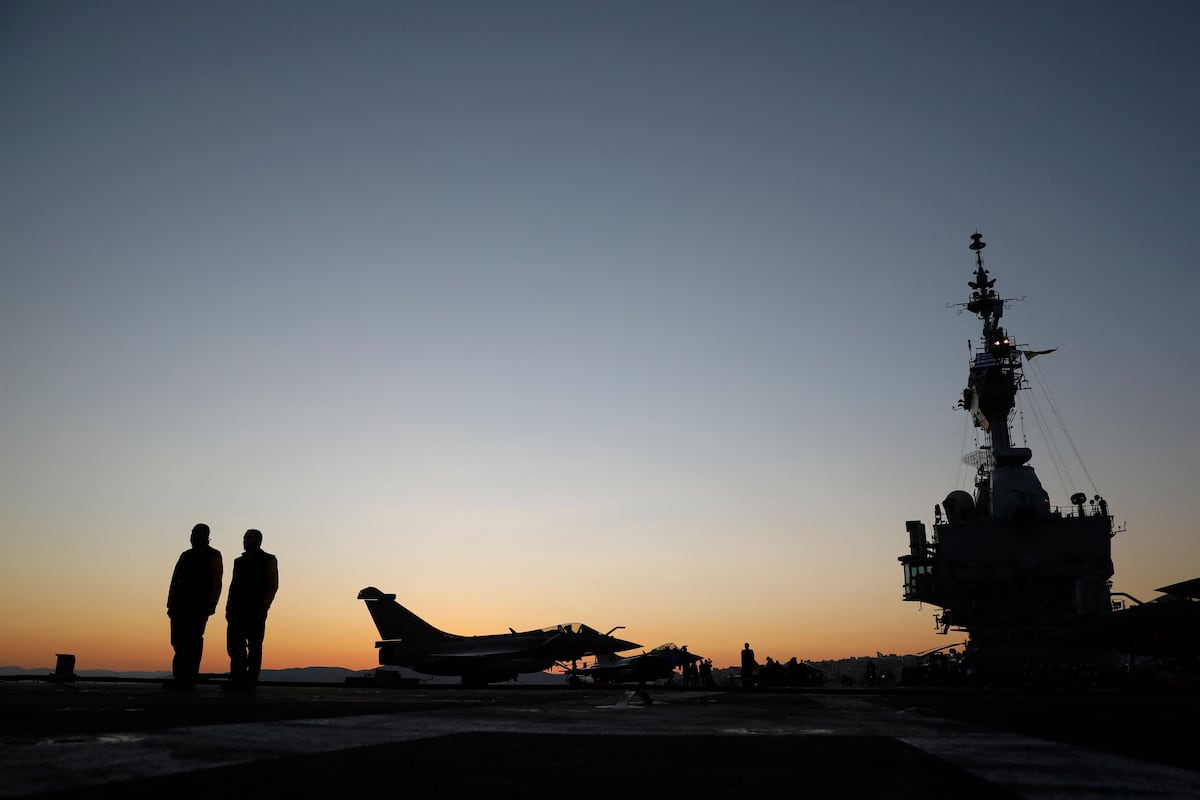
France’s nuclear-powered aircraft carrier Charles de Gaulle and its strike group are set to deploy over the next few weeks to the Indo-Pacific as part of mission Clemenceau 25, during which it will also take part in three major exercises with allies.
In an interview during the Euronaval Talks, organized in the context of the Euronaval show in Paris earlier this month, Mallard commented on the new types of environments and competitors the strike group is up against, the complexities of applying lessons learned after missions, and feedback from a recent exercise with the Italian Navy.
This interview was edited for length and clarity.
Rear Adm. Jacques Mallard has led the French carrier strike group since August 2023. (French MOD via X)
Data has been at the center of all discussions this week given the unprecedented level of information military forces are now faced with and the importance of having capable systems to verify, simplify and transmit this data faster than humans can in many cases. How does FRSTRIKEFOR ensure this?
The French Navy has developed data hubs that it has already tested on a ship [Fremm Provence] and we will be deploying several of those inside the FRSTRIKEFOR for the next mission sailing off at the end of the year to the Indo-Pacific.
We have had one issue inside the French Navy, where we don’t always have the competence to use data [as much as we should]. Data is what I call a work of art, you must know how to make sense of it in order to improve decision-making. That is why data scientists from industry on military reservists contracts will also be onboard our next mission to assist us with their competence in data analysis and interpretation. We expect that through this experimentation our ability to use it and develop some new applications can be applied across the entire French Navy. Once those applications are fit for operations, they could be used as a standard.
FRSTRIKEFOR often participates in international exercises with other allies, as was the case recently in Mare Aperto 2024, with the Italian Navy. What feedback did you take away from this and how do such events reinforce the battle group?
The Mare Aperto/Polaris [exercise] is basically changing the way we see training and the way we see war at sea, where you are opposed to another force that will not act as scheduled on the program. It gets two symmetric forces, one on each side, and assigns dedicated missions to either slow or hinder your opponent. It is essentially a confrontation of will, like real wars, and closer to what we can expect in the next couple of years concerning war at sea.
We have agreed with the Italian Navy to test this concept – Mare Aperto was an interesting challenge. We had 50 combat units in the West Mediterranean sharing the same tactical situations and positions.
One point that differed a little bit with the other editions of Mare Aperto was that when you were hit, you could not be revived. When you had fired all of your weapons, you had to reload, meaning you had to go into port … which required time to do. We trained in more realistic conditions.
The Italian Navy is a very very efficient one – with good ships, radars, submarines, and sensors, and being opposed to them with our carrier strike group was a very challenging experience. We had seven days of high-intensity training, both groups going up against each other. The general lessons learned were very positive. The commander of the Italian group told me that the training gained through Mare Aperto was a very, very interesting way of raising the stakes and allowed them to be more ready to be deployed in other regions.
How do you balance being transparent about operations and information with your allies while also keeping a certain level of confidentiality for opponents to not be able to predict your next move?
That is definitely a real challenge. Because on the one hand, you want to share – sharing means opening bridges, ways of exchanging information and sharing makes you very powerful. But on the other hand you want to protect yourself – you don’t want to have the opponent understand what your intentions are because that will give him the opportunity to have an advantage on you.
Until now, most of the communications infrastructure was segregated so we had a specific, secret network level where we would exchange data or tactical situations through data link. In my opinion, this was the early 21st century way of protecting things. Today, with getting new data management tools and raw material, we must think of a different way of sharing information and most importantly of protecting the data itself.
This is where a data-centric security approach comes into play – being able to send a pack of data to several different allies but [building and tailoring it] so that only specific allies have access to it and are reachable for the one that concerns them. For example, let’s say you have ten data sets to work and send to five different nations, one nation will have [access to] the whole ten but the other ones will only get eight.
What will the upcoming deployment of the FRSTRIKEFOR to the Indo-Pacific entail?
France has deployed ships to the Indo-Pacific previously, but it has been quite a few years since we deployed a high-end asset to the area. The general intention is to continue this momentum to show the interest of France in this particular part of the world, where at least 40% of the world’s GDP will transit through in the next decade. We have developed a fairly robust level of interoperability with fellow members of NATO, and the hope is to achieve a similar level of cooperation with Indo-Pacific navies.
The purpose of our deployment will be to raise up the expectations in order to make sure we’re not just talking to each other on a radio, [but] that we can actually conduct operations together. A key element to increasing interoperability is sharing data with fellow partners, and making sense of all the information the carrier strike group is gathering is a major focus of this upcoming mission. When you have at least seven to ten ships and aircraft gathering data simultaneously across many domains, there’s a fairly huge amount to collect.
There are many nations to collaborate with in the Indo-Pacific, and it’s a very important challenge to raise the stakes and catch up with the way they’re doing things. That is basically what I am working on and it will be a fairly long process. Then, after that, we will go through the lessons learned and maybe change some of our processes and standards or weapon systems and sensors in order to always follow up with what will be the next threat.
To absorb lessons learned, are we talking about a matter of months or years to change or adapt strategies? How does that work?
I wish it could be a matter of days or weeks – but it’s mostly months and years. The thing is that we have very, very complex weapon systems, when you think about the Rafale, the French carrier strike group has a number of them, so to make them evolve, is not as easy as an Iphone. You know sometimes we would like to be as agile and as able as Google is, but we are not able to do that.
Another thing to consider is that the biggest challenge and strengths of our units is the men and women that are working together in order to use their weapons. It takes a long time to form an officer of the watch, a commanding officer but also an operator of a radar. So you cannot change every two weeks with a new version of the things you need to work on.
On the one hand, you need to be as close as you can be to the best tech availability, on the other hand we need to have people that know how to use it – that’s the biggest challenge of all the navies, to form the new operator of a new sensor that will completely change the way of doing war at sea.
But not everybody is a PhD in tech, and so we are building up the way we are teaching those competences and that’s something that takes time. You cannot make a mistake on that. If you are forming somebody that is not adapted to the new sensors that will be developed.
In my discussion with the French chief of staff of the Navy we touched on how emerging technologies like artificial intelligence may shape the future of naval operations. When it comes to the future of the Carrier Strike Group and the missions you will embark on, how might some of this emerging tech shape or change the way you operate?
Information is now a domain where you can fight each other through different ways of seeing things and that can also have an effect on public opinion. But showing or hiding information is also an issue. At sea, the only questions you ask every moment as a task force commander are: Who is where, and what are their intentions? Because we are on a moving vehicle and we are in a moving domain, and there is civilian transport going around as well as competitors.
The new data that you are talking about will enhance this priority of information – in thinking of quantum technology, in a couple of years, no code and no crypto will be resistant to this kind of power of computing. We have to think about how we will protect our information against this. Talking about AI – it will definitely enhance the awareness of sensors.
There is however one thing that will never change – that is that when you are at sea and preparing for combat, you have to be ready to concentrate your firepower and defend all your platforms. There is no AI that will give you this protection against the fire of an enemy. However, what AI can give you would be basically the challenge of what could be happening with a competitor, to get you more ready for different scenarios and not be taken by surprise.
How would you say international cooperation has evolved over the years and the amount of data you now have access to changed the operations the FRSTRIKEFOR carries out?
We’ve been through the sort of sleeping cycles of the late 1990s and early 2000s where no competitors were identified and we were mostly fighting against asymmetric threats. Over the last 3-5 years, everybody has realized that the threat we have to face and be prepared for is a symmetrical one, with missiles and with capabilities very close to us.
We are now cooperating at a sort of equal level with the threat – being a lot more humble and thinking more efficiently than what we were used to and [going away] from the sort of confidence that we were the best. Now, we are challenged.
In what way would you say you are the most challenged today compared to earlier years?
It is in basically every way. For now, the common spaces either cyber, maritime but also space, are basically an arena where the challenge is permanent. Everyday, you see in these domains, across the world, some powerful competitors trying to gain and appropriate themselves a piece of this common airspace.
As seamen, we are very attached to the freedom of navigation and the fact that high seas belong to everybody and that between seamen we have to be a sort of solidarity because living at sea is not living in the natural domain where men are used to. That is how the culture of our navy works. We do also see more and more fishing vessels as well as actors saying, “It is my place to interdict the freedom of the traffic in the Red Sea for instance or South China Sea.” And that is a big challenge for us.
We are not anymore free of our movements – we have to cope with the intentions of most people that want to change the rules of order that have governed the sea over for a long period of time. So, either we get in agreement or our toes will be stepped on.
What are your main ambitions for the FRSTRIKEFOR in the next year?
The [Indo-Pacific] mission we are about to embark on will last long and we will go very far, so that is my main concern at present. For instance, we will be so far from our bases that logistics will be a game-changer and could potentially even be a show-stopper. So building up the logistics maneuvers of the deployment will be a challenge in itself.
Second, our experimentation with data – I think we are going to definitely be changing the way we are using our combat systems. We need to have a more versatile way of using information and filtering it.
Elisabeth Gosselin-Malo was a Europe correspondent for Defense News. She covers a wide range of topics related to military procurement and international security, and specializes in reporting on the aviation sector. She is based in Milan, Italy.
自 2023 年 8 月以来,雅克·马拉尔海军少将一直领导着法国航母打击群——FRSTRIKEFOR——致力于提高该海军编队的信息共享和在真实战斗条件下的训练能力。
法国核动力航空母舰“戴高乐”号及其打击群将在未来几周内部署到印太地区,执行“克莱蒙梭25”任务,期间还将与盟友进行三项重大演习。
在本月初于巴黎举行的欧洲海军展期间,Mallard在一次欧洲海军对话中接受采访时,谈到了打击群面临的新型环境和竞争对手、任务后吸取的经验教训的复杂性,以及最近与意大利海军进行演习的反馈。
为了篇幅和清晰度,本次采访内容经过编辑。
自2023年8月起,雅克·马拉尔海军少将一直领导着法国航母打击群。(法国国防部供图,经X发布)
鉴于军队目前面临的信息量空前庞大,以及拥有能够比人类更快验证、简化和传输这些数据的高效系统的重要性(在许多情况下),数据一直是本周所有讨论的核心。FRSTRIKEFOR 如何确保这一点?
法国海军已经开发出数据中心,并在一艘舰艇(弗雷姆·普罗旺斯号)上进行了测试。我们将把其中几个数据中心部署到 FRSTRIKEFOR 上,用于年底前往印度洋-太平洋的下一次任务。
法国海军内部存在一个问题,那就是我们并非总能充分发挥数据应用能力。数据在我看来是一门艺术,你必须懂得如何解读它,才能改进决策。因此,我们将邀请一些来自工业界的、以军事预备役人员身份加入下一次任务,利用他们在数据分析和解读方面的专业知识来协助我们。我们希望通过这次试验,能够提升我们运用数据和开发新应用的能力,并将这些应用推广到整个法国海军。一旦这些应用成熟到可以投入使用,它们就可以成为标准配置。
FRSTRIKEFOR经常与其他盟友参加国际演习,例如最近与意大利海军举行的“Mare Aperto 2024”联合演习。您从中获得了哪些反馈?此类活动如何增强战斗群的实力?
“开放海/北极星”演习从根本上改变了我们对海上训练和战争的理解。在海上战争中,一方将与另一方对抗,而后者不会按照既定计划行事。演习中,双方各派出一支规模相当的部队,并各自执行特定的任务,以减缓或阻碍对方的行动。这本质上是一场意志的较量,如同真正的战争,也更接近我们未来几年可能面临的海上战争形势。
我们已与意大利海军达成协议,对这一概念进行测试——“开放海域”演习是一项有趣的挑战。我们在西地中海部署了50个作战单位,模拟了相同的战术情境和阵地。
与以往的“海之开放”演习略有不同的一点是,一旦被击中,就无法复活。所有武器都打光后,必须重新装弹,这意味着必须靠岸……这需要时间。我们的训练环境更加贴近实战。
意大利海军是一支非常高效的海军——拥有优秀的舰艇、雷达、潜艇和传感器,与他们的对抗对我们的航母打击群来说是一次极具挑战性的经历。我们进行了为期七天的高强度训练,双方展开了对抗演练。总的来说,我们从中汲取的经验教训非常积极。意大利舰队指挥官告诉我,通过“开放海域”(Mare Aperto)演习获得的训练是一种非常有效的提升实战水平的方式,使他们能够更好地为在其他地区的部署做好准备。
如何在对盟友保持行动和信息透明的同时,又能对对手保持一定程度的保密性,使其无法预测你的下一步行动?
这的确是个真正的挑战。一方面,你想分享——分享意味着搭建桥梁,开辟信息交流的途径,分享能让你变得非常强大。但另一方面,你又想保护自己——你不想让对手了解你的意图,因为那样会给他机会占你便宜。
此前,大部分通信基础设施都是隔离的,我们通过一个特定的秘密网络层,利用数据链路交换数据或战术信息。在我看来,这是21世纪初的信息保护方式。如今,随着新型数据管理工具和原材料的出现,我们必须思考一种不同的信息共享方式,更重要的是,如何保护数据本身。
这就体现了以数据为中心的安全方法的作用——能够将一组数据发送给多个不同的盟友,但通过构建和定制,确保只有特定的盟友才能访问这些数据,并且只能针对他们关心的方面进行访问。例如,假设你有十个数据集需要处理并发送给五个不同的国家,其中一个国家可以访问全部十个数据集,而其他国家只能访问八个。
即将部署到印太地区的 FRSTRIKEFOR 将包含哪些内容?
法国此前曾向印太地区部署舰艇,但已有数年未向该地区部署高端舰艇。总体目标是保持这一势头,以展现法国对该地区的高度重视。未来十年,全球至少40%的GDP将经由该地区运输。我们已与北约成员国建立了相当稳固的互操作性,并希望与印太地区各国海军也建立类似的合作水平。
此次部署的目的是提高各方预期,确保我们不仅能通过无线电进行沟通,还能真正协同作战。提升互操作性的关键在于与伙伴国共享数据,而解读航母打击群收集的所有信息正是此次任务的重点。当至少七到十艘舰艇和飞机在多个领域同时收集数据时,需要收集的信息量相当庞大。
印太地区有很多国家需要合作,提高合作力度、迎头赶上他们的步伐是一项非常重要的挑战。这正是我目前的工作重点,而且这将是一个相当漫长的过程。之后,我们将总结经验教训,并可能调整一些流程、标准、武器系统和传感器,以便始终能够应对下一个威胁。
为了吸取经验教训,我们需要花费数月还是数年时间来改变或调整策略?这具体是如何运作的?
我希望这能在几天或几周内完成——但大多数时候需要几个月甚至几年。问题在于,我们的武器系统非常非常复杂,想想“阵风”战斗机,法国航母打击群就装备了好几架,所以要让它们升级换代,远没有iPhone那么简单。你知道,有时候我们也希望自己能像谷歌那样灵活高效,但我们做不到。
另一点需要考虑的是,我们部队最大的挑战和优势在于官兵们为了熟练使用武器而通力合作。培养一名值班军官、一名指挥官,甚至一名雷达操作员,都需要很长时间。因此,你不可能每两周就更换一次需要训练的内容。
一方面,你需要尽可能接近最先进的技术;另一方面,我们需要有懂得如何使用这些技术的人——这是所有海军面临的最大挑战,即培养能够操作新型传感器的人员,这将彻底改变海上作战的方式。
但并非人人都是技术博士,所以我们正在逐步完善这些技能的教学方法,这需要时间。在这方面,你不能犯错。如果你培养的人无法适应即将开发的新型传感器,那就太糟糕了。
在与法国海军参谋长的讨论中,我们谈到了人工智能等新兴技术将如何塑造未来的海军作战。就航母打击群的未来以及你们将要执行的任务而言,这些新兴技术将如何影响或改变你们的作战方式?
如今,信息领域已成为各方可以因看待事物的不同方式而相互争斗的战场,而这种争斗也会影响公众舆论。但信息的公开或隐瞒同样至关重要。在海上,作为特遣部队指挥官,你每时每刻都在问自己:谁在哪里?他们的意图是什么?因为我们身处移动的舰艇和不断变化的环境中,周围既有民用运输工具,也有竞争对手。
您提到的新数据将进一步凸显信息的重要性——考虑到量子技术,几年之内,任何代码和加密技术都将无法抵御这种强大的计算能力。我们必须思考如何保护我们的信息免受其害。至于人工智能,它无疑会增强传感器的感知能力。
然而,有一点永远不会改变——那就是在海上准备战斗时,你必须集中火力,保卫所有平台。没有任何人工智能能够为你提供抵御敌方火力的保护。但是,人工智能可以为你提供的,主要是模拟对手可能采取的行动,从而让你更好地应对各种不同的情况,避免措手不及。
您认为国际合作这些年来发生了怎样的变化?您现在能够获取的数据量又如何改变了 FRSTRIKEFOR 的行动?
我们经历了上世纪90年代末和本世纪初那种沉睡的时期,那时没有发现竞争对手,我们主要应对的是非对称威胁。但在过去的3到5年里,大家都意识到,我们必须面对并做好准备应对的威胁是对称的,对方拥有导弹和相应的能力,而且距离我们非常近。
我们现在与威胁处于某种平等的合作状态——比以往更加谦逊,思考更加高效,也摒弃了那种自以为是、觉得自己最强的心态。现在,我们面临挑战。
与往年相比,您认为如今自己面临的最大挑战是什么?
基本上各个方面都是如此。目前,无论是网络空间、海事空间还是太空,这些公共空间基本上都是一个挑战永无止境的竞技场。每天,你都能看到世界各地的一些强大竞争对手在这些领域试图攫取并占据这片公共领空的一部分。
作为海员,我们非常珍视航行自由,深信公海属于所有人,海员之间必须团结一致,因为海上生活与人们习以为常的自然环境截然不同。这就是我们海军的文化。我们也看到越来越多的渔船和相关人士声称:“我有权干涉红海或南海等海域的航行自由。”这对我们来说是一个巨大的挑战。
我们不再拥有行动自由——我们不得不应对大多数人想要改变长期以来支配海洋的秩序规则的意图。所以,要么我们同意,要么我们的利益就会受到侵害。
FRSTRIKEFOR在未来一年的主要目标是什么?
我们即将展开的印太任务将持续很长时间,而且行程会非常远,这正是我目前最关心的问题。例如,我们将远离基地,后勤保障将成为决定性因素,甚至可能成为行动的致命障碍。因此,构建部署的后勤保障体系本身就是一项挑战。
其次,关于数据实验——我认为我们肯定会改变作战系统的使用方式。我们需要一种更灵活的方式来使用和筛选信息。
伊丽莎白·戈斯林-马洛曾任《防务新闻》欧洲通讯员。她的报道涵盖军事采购和国际安全等广泛领域,尤其擅长航空领域的报道。她常驻意大利米兰。