Rising phone prices fuel repairs and second-hand sales in Singapore as consumers delay upgrades由于消费者推迟升级换代,新加坡手机价格上涨推动了维修和二手手机销售。
The average selling price of a mobile phone in Singapore has risen nearly 12 per cent since 2023, reaching S$1,000 this year, data shows.
新闻视频
The average selling price of a mobile phone in Singapore has risen nearly 12 per cent since 2023, reaching S$1,000 this year, data shows.
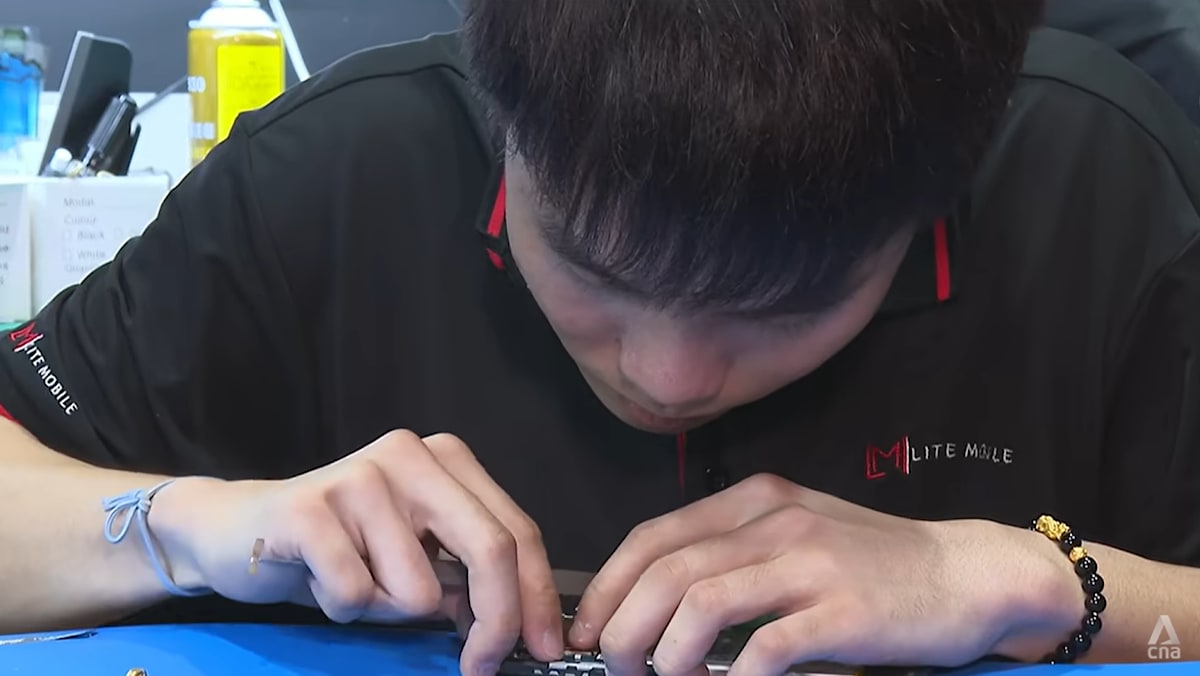
A Litemobile employee carrying out repairs on a smartphone. (Image: CNA)
This audio is generated by an AI tool.
SINGAPORE: As handset prices rise, consumers in Singapore are holding on to their mobile phones for longer, driving demand for repairs and second-hand devices.
Since 2023, the average selling price of a mobile phone in Singapore has risen nearly 12 per cent, from S$898 (US$700) to S$1,000 in 2026, according to market research firm NielsenIQ.
New phone sales, however, fell nearly 14 per cent between 2023 and 2025, dropping from 1.34 million units to 1.16 million as consumers delayed upgrading their devices.
Ms Louise Hawley, NielsenIQ’s Asia Pacific tech and durables managing director, told CNA that more than two-thirds of smartphones sold this year cost over S$1,000, up from just over half three years ago.
CNA Games Guess Word Crack the word, one row at a time Buzzword Create words using the given letters Mini Sudoku Tiny puzzle, mighty brain teaser Mini Crossword Small grid, big challenge Word Search Spot as many words as you can Show More Show Less Consumers are taking various steps to manage the rising cost of new phones, Ms Hawley noted. "One of those is the increased or elongated replacement cycle," she said, adding that people now typically use their phones for three to four years, up from about two-and-a-half years previously.
Consumers are taking various steps to manage the rising cost of new phones, Ms Hawley noted.
"One of those is the increased or elongated replacement cycle," she said, adding that people now typically use their phones for three to four years, up from about two-and-a-half years previously.
REPAIRING INSTEAD OF REPLACING
That trend has fuelled demand for repair services.
Retailer Litemobile handles between 4,000 and 5,000 phones each month across its seven outlets, with battery replacements the most common job, followed by screen and charging-port repairs.
"Usually after two years, they will change the battery and then they'll continue using it," said the company’s director Desmond Goi.
"But after four years, due to newer updates, OS (operating system) updates, older phones might not be able to support the software, so they will have no choice (but) to change."
Mister Mobile, which according to its website operates 20 outlets islandwide, has seen a similar shift towards repairs. Such jobs across its branches increased by 46 per cent between 2023 and 2025, and are up a further 12 per cent so far this year.
Mister Mobile currently handles about 7,000 repairs on a monthly basis, said CEO Alan Tan.
Most repairs involve phones that are between three and five years old.
The firm said a simple battery replacement could extend an older phone's lifespan by another year or two, allowing consumers to get more use out of their devices while avoiding the cost of buying a new one.
A Mister Mobile employee attending to a customer. (Image: CNA)
SECOND-HAND MARKET GROWS
The move away from frequent phone upgrades has also benefited Singapore's second-hand phone market, with affordability remaining the "number one trigger" for consumers choosing refurbished phones, according to Ms Hawley.
Mister Mobile said the number of used phones it took in rose by 33 per cent between 2023 and 2025.
The company currently takes in more than 10,000 phones for trade-in each month, according to Mr Tan.
About 95 per cent of trade-in devices are resold to new owners, while the remaining 5 per cent are sent for recycling, Mister Mobile added.
An iPhone being dismantled. (Photo: CNA/Eugene Chow)
RECOVERING VALUABLE MATERIALS
At e-waste recycler Virogreen, workers take apart the phones, separating components such as screens, batteries and printed circuit boards into different boxes.
The circuit board is where personal data is stored and contains some of a device's most valuable materials, including small amounts of gold, platinum and silver.
To ensure sensitive information cannot be retrieved, the boards are first punctured using a hydraulic press before being shredded.
"That will completely destroy all the data or the motherboard beyond recovery,” said Virogreen sustainability and recycling consultant Vincent Quck.
The company said that e-waste recycling volumes, particularly for mobile phones, are increasing as awareness grows.
Bins of collected materials to be recycled. (Photo: CNA/Eugene Chow)
"For the first eight months of 2026 compared with the whole of last year, there is a 10.7 per cent increase in volume of mobile phones," said Virogreen.
According to Mr Quck, between 80 and 90 per cent of a phone's materials can be recovered, depending on the make and model.
The recovered materials are sent to other recyclers and refineries in Singapore and overseas.
Aluminium and other mixed metals can be further processed locally, while the precious metals in circuit boards are extracted abroad and reused in new products.
The remaining material that cannot be recycled or recovered is then incinerated.
Get our pick of top stories and thought-provoking articles in your inbox
Stay updated with notifications for breaking news and our best stories
Join our channel for the top reads for the day on your preferred chat app
数据显示,自 2023 年以来,新加坡手机的平均售价上涨了近 12%,今年已达到 1000 新元。
一名Litemobile员工正在维修一部智能手机。(图片:CNA)
这段音频是由人工智能工具生成的。
新加坡:随着手机价格上涨,新加坡消费者延长了手机的使用寿命,从而推动了对维修和二手设备的需求。
根据市场研究公司尼尔森IQ的数据,自2023年以来,新加坡手机的平均售价上涨了近12%,从898新元(700美元)涨至2026年的1000新元。
然而,由于消费者推迟升级设备,2023 年至 2025 年间,新手机销量下降了近 14%,从 134 万部降至 116 万部。
尼尔森IQ亚太区科技及耐用品董事总经理路易丝·霍利女士告诉亚洲新闻台,今年售出的智能手机中,超过三分之二的售价超过1000新元,而三年前这一比例略高于一半。
CNA游戏 猜词游戏 逐行破解单词 流行词游戏 用给定的字母组成单词 迷你数独 小谜题,大挑战 迷你填字游戏 小方格,大挑战 单词搜索 尽可能多地找出单词 显示更多 显示更少 霍利女士指出,消费者正在采取各种措施来应对不断上涨的新手机成本。“其中一项措施是延长或增加手机的更换周期,”她说道,并补充说,人们现在通常使用手机三到四年,而以前大约是两年半。
霍利女士指出,消费者正在采取各种措施来应对新手机价格上涨的问题。
“其中之一是手机更换周期的延长,”她说道,并补充说,现在人们通常使用手机三到四年,而以前大约是两年半。
维修而非更换
这一趋势刺激了对维修服务的需求。
零售商 Litemobile 每月在其七家门店处理 4,000 至 5,000 部手机,其中更换电池是最常见的维修工作,其次是屏幕和充电端口维修。
“通常两年后,他们会更换电池,然后继续使用,”该公司董事 Desmond Goi 说。
“但四年后,由于操作系统更新,旧手机可能无法支持新软件,所以它们别无选择,只能更换。”
据其官网显示,Mister Mobile在全岛拥有20家门店,该公司也出现了类似的业务增长趋势,维修业务占比大幅提升。2023年至2025年间,其各门店的维修业务量增长了46%,而今年迄今为止又增长了12%。
Mister Mobile 的首席执行官 Alan Tan 表示,该公司目前每月处理约 7000 起维修业务。
大多数维修涉及的手机机龄在三到五年之间。
该公司表示,只需简单更换电池,即可将旧手机的使用寿命延长一到两年,让消费者能够更长时间地使用他们的设备,同时避免购买新手机的费用。
一位Mister Mobile的员工正在为顾客服务。(图片:CNA)
二手市场增长
霍利女士表示,人们不再频繁更换手机,这也有利于新加坡的二手手机市场,价格实惠仍然是消费者选择翻新手机的“首要因素”。
Mister Mobile表示,2023年至2025年间,其回收的二手手机数量增长了33%。
据谭先生介绍,该公司目前每月接收超过 10,000 部旧手机进行以旧换新。
Mister Mobile补充说,约95%的旧设备会被转售给新用户,而剩余的5%会被送去回收。
一部正在被拆解的iPhone。(图片:CNA/周永健)
回收有价值的材料
在电子垃圾回收商 Virogreen,工人们拆解手机,将屏幕、电池和印刷电路板等组件分别放入不同的盒子中。
电路板是存储个人数据的地方,并且包含设备中最有价值的一些材料,包括少量的黄金、铂金和白银。
为确保敏感信息无法被恢复,在粉碎之前,先用液压机在木板上打孔。
Virogreen可持续发展和回收顾问Vincent Quck表示:“这将彻底摧毁所有数据或主板,使其无法恢复。”
该公司表示,随着人们环保意识的提高,电子垃圾(尤其是手机)的回收量正在增加。
装满待回收材料的垃圾箱。(图片:中央社/周永健)
Virogreen表示:“与去年全年相比,2026年前八个月的手机销量增长了10.7%。”
据库克先生称,根据手机的品牌和型号,手机材料的回收率可以达到 80% 到 90%。
回收的材料会被送往新加坡和海外的其他回收商和精炼厂。
铝和其他混合金属可以在当地进一步加工,而电路板中的贵金属则从国外提取,并在新产品中重新利用。
剩余的无法回收或再利用的材料将被焚烧。
订阅我们的邮件,即可获取精选热点新闻和引人深思的文章。
订阅通知,第一时间获取突发新闻和精彩报道。
加入我们的频道,即可在您常用的聊天应用上获取当日热门文章。