Strengthening schools as key places for young people to seek help, build mental health resilience加强学校作为青少年寻求帮助、培养心理健康韧性的关键场所的作用
Singapore expands Grow Well SG to secondary schools and unifies community mental health teams under HealthierMind SG. Read more at straitstimes.com.
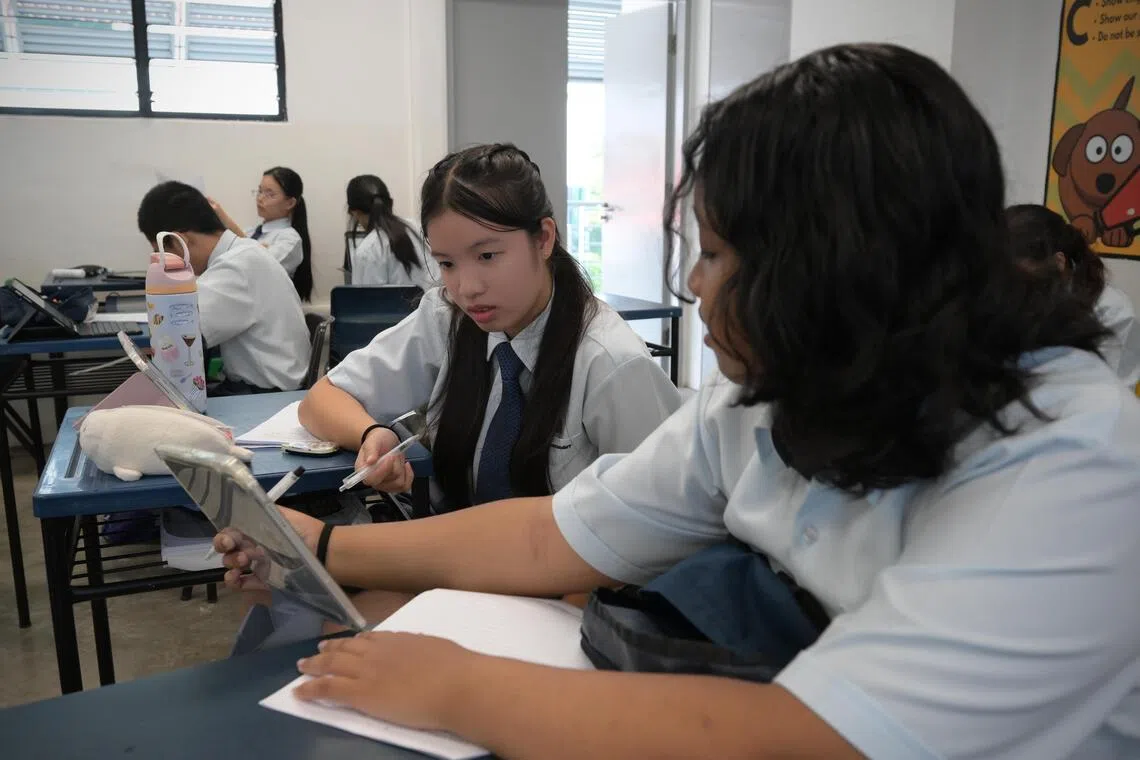
etaiclass/ST20260817_202622700627/Ng Sor Luan/Canberra Secondary School's student Chloe Loh, 15 discussing school work with a classmate.
Published Oct 22, 2026, 12:30 PM
Updated Oct 22, 2026, 12:30 PM
Grow Well SG will reach Secondary One and Two students at 20 schools next year, then all secondary schools in 2028, to build healthier habits and mental resilience early.
MOH will merge community mental health teams into HealthierMind SG to improve triage, link services better, and send less severe cases to community groups.
Ong Ye Kung said early help, family support and schools are key, while stigma still stops young people from seeking care.
SINGAPORE - Grow Well SG, a national health promotion initiative for children and adolescents, will be extended to Secondary One and Two students at 20 schools early next year, before being expanded to all secondary schools in 2028, Minister for Health Ong Ye Kung announced on Oct 22.
The idea is to strengthen schools as key places where young people learn to build resilience earlier and cope with mental health challenges, said Ong, who is also Coordinating Minister for Social Policies.
“Schools are a major part of a young person’s life besides their families. They are where young people learn and grow, receive and give support, and feel safe to step forth and seek help when they face personal challenges,” he said, speaking at the Singapore Systemic Family Therapy Conference at the Singapore University of Social Sciences.
“Our schools are already doing some of this today, including building resilience through the curriculum, supportive relationships and access to school counsellors. We want to build on this through Grow Well SG.”
It will also be easier for young people to access mental health support when they need it.
The Ministry of Health (MOH) will bring existing community mental health teams into a single network under a unified framework called HealthierMind SG. This will better integrate services and help individuals navigate the system and access appropriate support more easily, he said.
An immediate obstacle is stigma, and young people may hesitate to seek help not because they do not want to get better, but because they are worried about the consequences of doing so, he pointed out.
“They worry whether it would leave a permanent mark on their record and affect their future; whether it would disappoint their families; and whether they would be judged by people around them.”
So the longer-term solution, similar to how other chronic diseases are managed, lies in prevention and managing the condition early, before it becomes severe.
“We must intervene earlier to help people stay mentally well, recognise problems early, and support them in the community,” said Ong in his speech.
“If we do this well, an individual will not face these pressures alone. They can be supported by the people and environments around them, especially their families, schools and communities.”
Mental health needs are rising in Singapore, with one in three young persons aged 10 to 18 reported mental health symptoms such as depression and anxiety.
Next year, under Grow Well Sg, each secondary school student will develop a personalised health plan together with healthcare professionals. Unlike the plans for primary school students, the Grow Well SG Health Plan for secondary schools will focus on normalising conversations about mental health, and raising awareness of the mental health support available, Ong said.
Launched in early 2025 by the Ministry of Health (MOH), Ministry of Education (MOE) and Ministry of Social and Family Development (MSF), Grow Well SG aims to inculcate healthier lifestyles in children and adolescents to address their health and well-being in the digital age.
Crucially, the new HealthierMind SG framework will change how cases are triaged in schools are beyond.
Giving an example, he said that schools today refer all cases requiring additional mental health support only to public health institutions such as the Institute of Mental Health.
“But a more integrated arrangement would be to triage the cases, evaluate each case on their severity so that less severe cases can be referred to community organisations instead of the IMH. There, they can receive more accessible and appropriate support,” Ong said.
This would also open up opportunities for closer partnerships between schools and community organisations, he added.
MOH will work with the Agency for Integrated Care AIC and community organisations to transition to the new HealthierMind SG framework in the coming months, Ong said.
In his speech, Ong also said MOH is developing a set of guidelines to provide clearer guidance on how to give a young person a safe way to seek initial help, while involving the family at the right time as care progresses.
MOH plans to progressively strengthen the involvement of General Practitioners in providing mental health support.
He had said in an Oct 10 World Mental Health Day message that MOH is developing guidelines on parental consent for various service providers.
SUSS/Singapore University of Social Sciences
etaiclass/ST20260817_202622700627/Ng Sor Luan/堪培拉中学学生 Chloe Loh,15 岁,正在与同学讨论学校作业。
发布于2026年10月22日下午12:30
更新于2026年10月22日下午12:30
Grow Well SG 明年将覆盖 20 所中学的一、二年级学生,然后在 2028 年覆盖所有中学,旨在从小培养更健康的生活习惯和心理韧性。
卫生部将把社区心理健康团队并入 HealthierMind SG,以改善分诊、更好地衔接服务,并将病情较轻的病例转交给社区团体。
王义公表示,早期帮助、家庭支持和学校至关重要,但社会偏见仍然阻碍年轻人寻求治疗。
新加坡——卫生部长王乙康于10月22日宣布,面向儿童和青少年的全国性健康促进计划“健康成长SG”将于明年初推广至20所中学的一、二年级学生,并于2028年推广至所有中学。
王乙康表示,此举旨在加强学校作为关键场所的作用,让年轻人能够更早地培养韧性,应对心理健康挑战。王乙康同时也是社会政策统筹部长。
“除了家庭之外,学校是年轻人生活中非常重要的一部分。在学校里,年轻人学习成长,获得并给予支持,并且在面临个人挑战时感到安全,可以勇敢地站出来寻求帮助,”他在新加坡社会科学大学举行的新加坡系统家庭治疗会议上说道。
“我们学校目前已经在做一些这方面的工作,包括通过课程培养学生的韧性、建立支持性的人际关系以及提供学校辅导员服务。我们希望通过‘健康成长新加坡’项目在此基础上更进一步。”
年轻人需要心理健康支持时也会更容易获得帮助。
卫生部将把现有的社区心理健康团队整合到一个名为“HealthierMind SG”的统一框架下,形成一个单一的网络。他表示,这将更好地整合服务,帮助个人更轻松地了解和使用系统,并获得适当的支持。
他指出,眼前的障碍是耻辱感,年轻人可能因为担心寻求帮助的后果而犹豫不决,而不是因为他们不想好起来。
“他们担心这是否会在他们的档案中留下永久的污点,影响他们的未来;担心这是否会让他们的家人失望;担心他们是否会受到周围人的评判。”
因此,从长远来看,与其他慢性疾病的治疗方法类似,关键在于预防和早期控制病情,防止病情恶化。
王在演讲中说:“我们必须更早地介入,帮助人们保持心理健康,及早发现问题,并在社区中为他们提供支持。”
“如果我们能做好这一点,个人就不会独自面对这些压力。他们可以得到周围人和环境的支持,特别是他们的家人、学校和社区。”
新加坡的心理健康需求正在上升,三分之一的 10 至 18 岁青少年表示有抑郁和焦虑等心理健康症状。
明年,在“健康成长新加坡”(Grow Well SG)计划下,每位中学生都将与医疗专业人员共同制定个性化的健康计划。翁先生表示,与小学生计划不同,中学“健康成长新加坡”健康计划将侧重于使人们能够正常谈论心理健康,并提高人们对现有心理健康支持的认识。
Grow Well SG 由卫生部、教育部和社会及家庭发展部于 2025 年初启动,旨在培养儿童和青少年更健康的生活方式,以解决他们在数字时代的健康和福祉问题。
至关重要的是,新的 HealthierMind SG 框架将改变学校及其他地区病例的分类方式。
他举例说,如今学校只会将所有需要额外心理健康支持的案例转介给公共卫生机构,例如心理健康研究所。
“但更综合的安排是对病例进行分诊,评估每个病例的严重程度,以便将病情较轻的病例转介给社区组织,而不是心理卫生学院。在那里,他们可以获得更便捷、更合适的帮助,”翁说。
他还补充说,这将为学校和社区组织之间建立更紧密的合作关系创造机会。
王乙康表示,卫生部将在未来几个月内与综合护理机构(AIC)和社区组织合作,过渡到新的“更健康的心灵SG”框架。
王毅在讲话中还表示,卫生部正在制定一套指导方针,以便更清晰地指导如何为年轻人提供安全寻求初步帮助的方式,并在护理进展过程中适时让家人参与进来。
卫生部计划逐步加强全科医生在提供心理健康支持方面的参与。
他在 10 月 10 日世界精神卫生日致辞中表示,卫生部正在为各种服务提供商制定家长同意指南。
新加坡社会科学大学