Content creator who labelled beauty salon a ‘scam’ on Instagram ordered to pay $15k for defamation一名在Instagram上将一家美容院称为“骗局”的内容创作者被判赔偿1.5万美元诽谤罪。
Content creator ordered to pay $15,000 for defamation after calling a Singapore beauty salon a scam on Instagram. Read more at straitstimes.com.
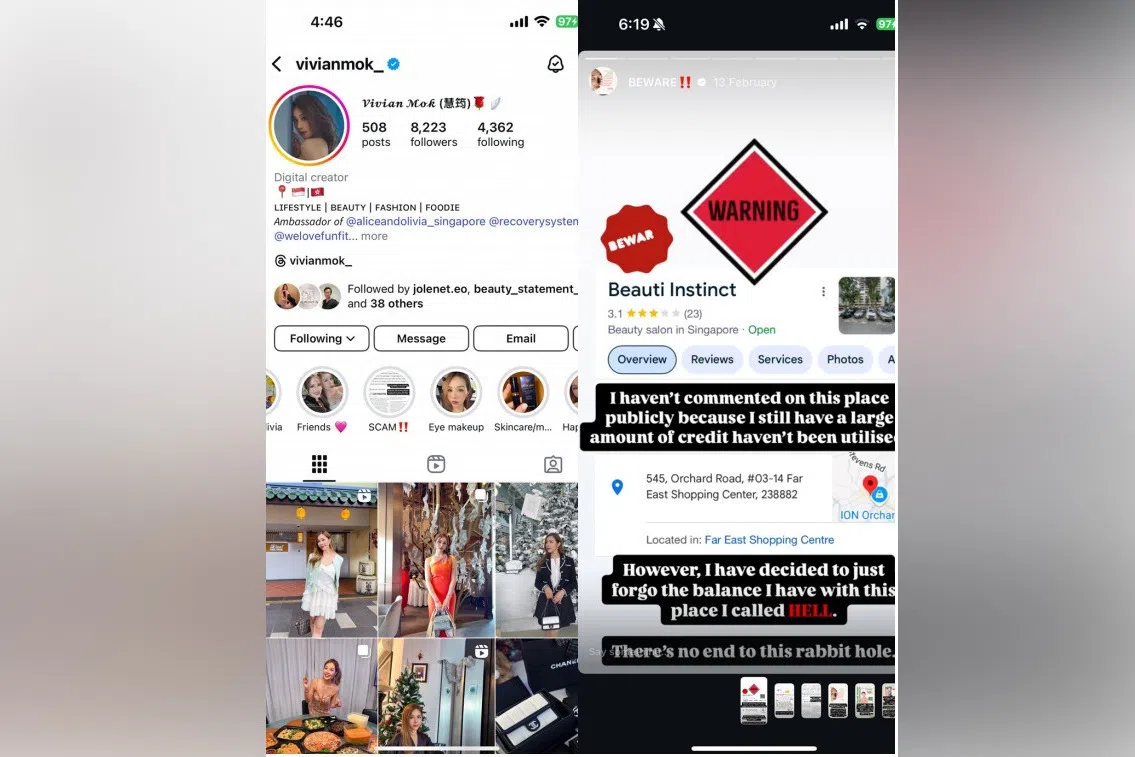
The judge found that while Mok Wai Kwan had misgivings about the salon’s practices, she had not proved it was unethical.
PHOTOS: VIVIANMOK_/INSTAGRAM
Published Oct 21, 2026, 11:25 PM
Updated Oct 22, 2026, 09:24 AM
A Singapore content creator called a beauty salon a “scam” on Instagram and was ordered to pay $15,000 for defamation after the court found her claims were not proved.
District Judge Sim Mei Ling said Mok Wai Kwan had real concerns, but she did not prove the salon had designed to cheat customers, and she did not genuinely believe her own posts.
The salon won general damages, but not extra compensation or an injunction, because it failed to prove the posts caused lost sales and there was no sign she would repeat the allegations.
SINGAPORE – A content creator who labelled a beauty salon a “scam” on Instagram after she was unhappy with its prepaid treatment packages has been ordered to pay the business $15,000 in damages for defamation.
District Judge Sim Mei Ling found that while the customer had genuine misgivings about the salon’s practices, she had not proved that it was an unethical business designed to cheat or defraud customers.
In a written judgment released on Oct 15, the judge also found that the woman did not genuinely believe what she had stated in her Instagram posts, which she had pinned to her profile under the title “SCAM !!”.
However, the judge declined to award the salon additional damages for alleged lost sales, or to grant an injunction to prevent the woman from repeating the allegations.
The court heard that Mok Wai Kwan – who goes by the handle @vivianmok_ on Instagram – was a customer of Beauti Instinct at Far East Shopping Centre from 2020 to early 2025.
She bought a six-session “Silk Peel” facial package for $488 through the beauty salon’s website in January 2020.
At her first consultation, salon director Cheang Norita told her that her skin was too sensitive for the treatment and that she needed other treatments, the court heard.
Mok said she felt pressured into signing up for a membership. She eventually bought a trial membership costing $1,000, which gave her 1,000 treatment credits and access to treatments at discounted rates.
In November 2020, she bought a Gold membership for $5,000, which entitled her to 6,340 treatment credits. She later bought promotional treatment packages costing thousands of dollars.
Mok’s unhappiness stemmed partly from occasions when she said she had gone to the salon expecting a treatment but instead spent time discussing packages or buying products.
On one occasion in December 2022, she received a treatment costing $757 when she had only 537 credits remaining in her membership. She had to pay an additional $220.
The salon charged Mok the full price for the treatment and not the discounted member’s rate because her remaining credits were insufficient to pay for the session in full.
Cheang acknowledged in court that she had not told Mok the treatment’s cost before carrying it out.
On this issue, the judge said: “It is good business practice for a business to be upfront and transparent about pricing, so that customers can make an informed choice about whether to proceed. This would also minimise any subsequent dispute.”
Another source of frustration arose in November 2023 when Mok was told that some of her remaining treatment credits could not be used without doing the “Silk Peel” treatment, but she was down to her last credit for that s ervice.
On Feb 13, 2025, after a further disagreement over her remaining Silk Peel credits, Mok decided to stop patronising the salon and give up her unused credits.
By then, she had received treatment at the salon on 26 occasions over about five years.
Mok then posted a series of Instagram stories recounting her experiences. The posts described the salon as “HELL” and said it should be reported to the Consumers Association of Singapore. The posts also alleged that she had been trapped by an “unethical business model”.
She later pinned the stories to her Instagram profile as a highlight under the title “SCAM !!”. Two months later, on April 11, 2025, she changed the title to “BEWARE!!”. The highlight was subsequently removed around July that year.
The salon sued her for defamation, arguing that the posts portrayed it as a business that cheated customers, engaged in fraudulent operations and used deceptive practices.
Mok argued that her posts merely described the salon’s unethical business practices and were justified by her experiences. She also relied on the defence of fair comment.
The judge drew a distinction between the stories themselves and the additional “SCAM !!” title.
Viewers who saw the stories directly would understand them to mean that the salon employed unethical business practices or had an unethical business model, the judge found.
Those who viewed them through the highlight while it was titled “SCAM !!” would also understand Mok to be accusing the salon of being a business designed to cheat or defraud customers.
The judge noted that although the word “scam” appeared only once, that was enough to convey an accusation that the salon was fraudulent.
She accepted that Mok’s account of what happened during her first consultation was true and that she had felt trapped and had misgivings about the salon.
But she said Mok had not proved that the salon’s practice of recommending treatments based on Cheang’s assessment of customers’ skin needs was unethical.
The judge also found that Mok had no evidence that Cheang’s assessment of her skin was false, or that the salon director had knowingly made an untrue statement.
“I find that the defendant did not genuinely believe what she stated in her stories,” the judge said of Mok.
Mok had acknowledged that she was not forced to buy the memberships and had benefited from the treatment packages. She continued visiting the salon until early 2025 and had made few documented complaints during that period.
She had also published a promotional Instagram post about the salon in exchange for sponsored treatments.
“At best therefore, this was a case of buyer’s remorse,” the judge said.
The salon had sought $50,000 in general damages, as well as additional damages and compensation for lost business.
The judge awarded $15,000 in general damages, taking into account the seriousness of the allegations, the extent of publication and the circumstances of the case.
But the salon failed to prove that Mok’s posts caused its sales or customer numbers to fall. The judge said the figures showed that the business had already been experiencing a downward trend, and the evidence did not establish that the posts caused the subsequent decline.
The court therefore rejected the claim for special damages and declined to grant an injunction, as there was no evidence that Mok was likely to repeat the allegations.
Costs are to be agreed between the parties or determined by the court.
法官认为,虽然莫慧娟对沙龙的做法有所顾虑,但她并未证明这种做法是不道德的。
照片:VIVIANMOK_/INSTAGRAM
发布于 2026 年 10 月 21 日晚上 11:25
更新于2026年10月22日上午9:24
一名新加坡内容创作者在 Instagram 上称一家美容院是“骗局”,法院认定她的说法不成立,并判处她支付 15,000 美元的诽谤赔偿金。
地方法官沈美玲表示,莫慧君的担忧并非空穴来风,但她未能证明该美发沙龙有意欺骗顾客,而且她也不相信自己发布的帖子。
该美发沙龙赢得了一般性损害赔偿,但没有获得额外赔偿或禁令,因为它未能证明这些帖子导致了销售损失,也没有迹象表明她会再次提出这些指控。
新加坡——一名内容创作者因对一家美容院的预付费护理套餐不满意,在 Instagram 上称其为“骗局”,被勒令向该美容院支付 15,000 美元的诽谤赔偿金。
地方法官沈美玲认为,虽然顾客对沙龙的做法确实有所疑虑,但她并没有证明该沙龙是一家旨在欺骗或诈骗顾客的不道德企业。
法官在 10 月 15 日发布的书面判决中还认定,该女子并非真心相信她在 Instagram 帖子中所说的内容,她将这些帖子置顶到她的个人资料中,标题为“骗局!!”。
然而,法官拒绝判令该沙龙赔偿所谓的销售损失,也拒绝颁布禁令阻止该女子再次提出指控。
法庭获悉,莫慧君(在 Instagram 上的账号是 @vivianmok_)从 2020 年到 2025 年初一直是远东购物中心 Beauti Instinct 的顾客。
2020 年 1 月,她通过美容院的网站购买了价值 488 美元的六次“丝滑焕肤”面部护理套餐。
据法庭获悉,在第一次咨询时,美容院院长张诺丽塔告诉她,她的皮肤太敏感,不适合接受这种治疗,她需要接受其他治疗。
莫女士表示,她感到被迫办理了会员。最终,她购买了一份价值1000美元的试用会员资格,获得了1000次疗程积分,并可以享受折扣价的疗程服务。
2020年11月,她花费5000美元购买了黄金会员资格,获得了6340次治疗积分。之后,她又购买了价值数千美元的促销治疗套餐。
莫女士的不满部分源于她曾多次表示自己去美容院是为了做护理,结果却花了时间讨论套餐或购买产品。
2022年12月,她曾接受过一次价值757美元的治疗,而当时她的会员积分只剩下537分。她不得不额外支付220美元。
由于 Mok 的剩余积分不足以全额支付此次疗程费用,美容院没有按会员折扣价向她收取全价。
张女士在法庭上承认,她在进行治疗前没有告诉莫女士治疗费用。
关于这个问题,法官表示:“企业在定价方面坦诚透明是良好的商业惯例,这样客户才能在知情的情况下做出是否购买的选择。这也有助于最大限度地减少后续的纠纷。”
2023 年 11 月,莫女士被告知,她剩余的一些疗程次数必须先进行“丝滑焕肤”疗程才能使用,但这时她只剩下最后一次疗程次数了,这让她感到非常沮丧。
2025 年 2 月 13 日,在就剩余的 Silk Peel 积分再次发生争执后,Mok 决定停止光顾该沙龙并放弃她未使用的积分。
到那时为止,她在五年左右的时间里已经在该美容院接受过 26 次护理。
随后,莫女士在Instagram上发布了一系列限时动态,讲述了她的遭遇。她在帖子中将这家美发沙龙形容为“人间地狱”,并表示应该向新加坡消费者协会举报。帖子还声称,她被一家“不道德的商业模式”所蒙蔽。
之后,她将这些故事置顶到她的Instagram个人主页,标题为“骗局!!”。两个月后,即2025年4月11日,她将标题改为“小心!!”。该置顶帖随后于同年7月左右被删除。
该美发沙龙以诽谤罪起诉她,称这些帖子将沙龙描绘成一家欺骗顾客、从事欺诈活动和使用欺骗手段的企业。
莫女士辩称,她的帖子只是描述了这家美发沙龙不道德的商业行为,并且有她自身的经历佐证。她还援引了“合理评论”的辩护理由。
法官区分了故事本身和“骗局!!”这个附加标题。
法官认为,直接看过这些报道的观众会理解为,这家美发沙龙采用了不道德的商业行为或采用了不道德的商业模式。
那些在标题为“骗局!!”时通过高亮显示观看过这些视频的人也会明白,莫克是在指责这家沙龙是一家旨在欺骗或诈骗顾客的企业。
法官指出,虽然“诈骗”一词只出现了一次,但这足以表明该美发沙龙存在欺诈行为。
她接受了莫克对她第一次咨询期间发生的事情的描述,并承认自己当时感到被困住了,对这家美容院心存疑虑。
但她表示,莫女士并未证明该美容院根据张女士对顾客皮肤需求的评估来推荐治疗方案的做法是不道德的。
法官还认定,莫女士没有证据表明张女士对她皮肤的评估是错误的,也没有证据表明沙龙主管明知故犯地作出了不实陈述。
法官在谈到莫女士时说:“我认为被告人并没有真正相信她在故事中所说的内容。”
莫女士承认她并非被迫购买会员卡,并且享受了相应的护理套餐。她一直光顾这家美容院直到2025年初,在此期间几乎没有提出过任何书面投诉。
她还曾在 Instagram 上发布过一篇关于这家美容院的宣传帖,以换取赞助的护理服务。
“因此,往好了说,这是一起买家后悔的案例,”法官说。
该美发沙龙寻求 5 万美元的一般性赔偿,以及额外的损失赔偿和营业损失补偿。
考虑到指控的严重性、公布的范围以及案件的具体情况,法官判决赔偿15000美元。
但这家美发沙龙未能证明莫女士的帖子导致其销售额或顾客数量下降。法官表示,数据显示该店的生意原本就呈下滑趋势,证据不足以证明这些帖子是造成后续下滑的原因。
因此,法院驳回了特别损害赔偿请求,并且拒绝颁布禁令,因为没有证据表明莫某可能会再次提出这些指控。
诉讼费用由双方协商确定或由法院裁定。