Air quality improves to ‘good to moderate’ range across Singapore after 18 days of unhealthy air新加坡空气质量在连续18天处于不健康水平后,改善至“良好至中等”范围。
At 3pm, the 24-hour PSI ranged from 71 to 99 across all regions. Read more at straitstimes.com.
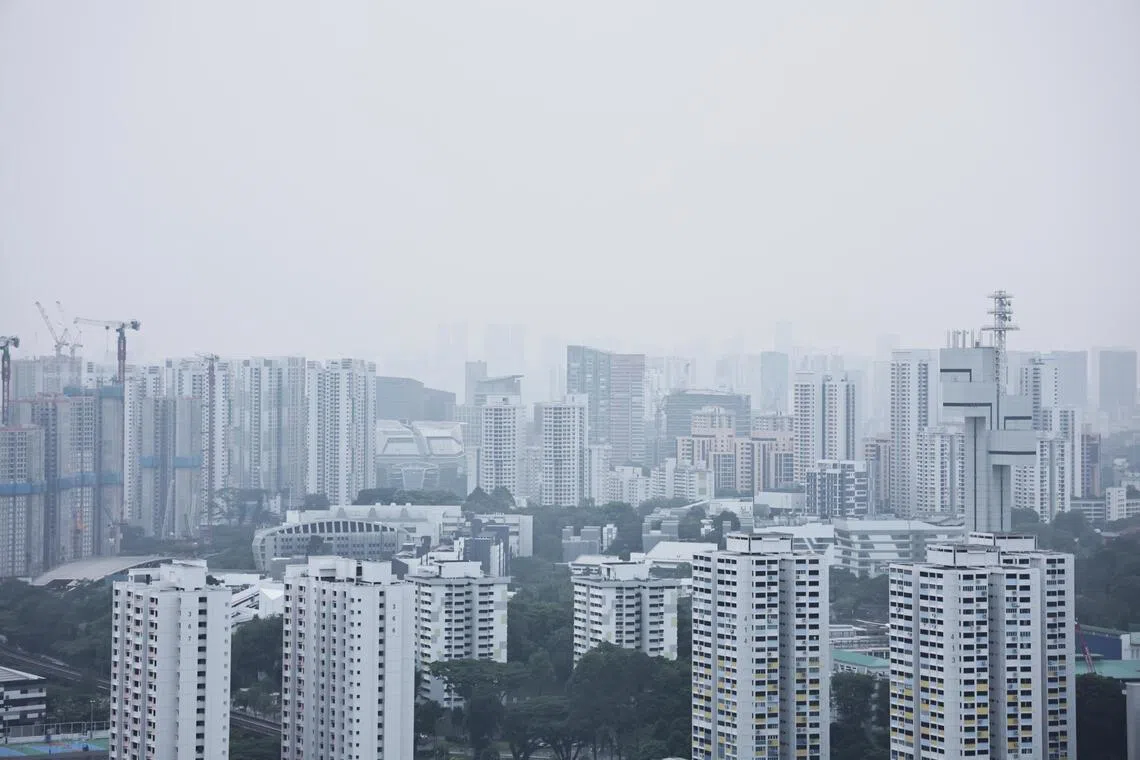
Haze conditions seen in the Clementi area at about 7.10am on Oct 22.
ST PHOTO: KELVIN CHNG
Published Oct 22, 2026, 03:06 PM
Updated Oct 22, 2026, 03:06 PM
SINGAPORE - The air quality in Singapore is back in the ‘good to moderate’ range, after 18 days of bad air.
At 3pm on Oct 22, the 24-hour Pollutant Standards Index (PSI) had improved in all regions across the island, with readings ranging from 71 to 99 .
Readings in this band denote good to moderate air quality, and normal activities can be carried out.
The west was the last region to exit the unhealthy zone, dropping from 101 to 99 at 3pm.
Singapore had since Oct 5 been experiencing unhealthy air quality, denoted by 24-hour PSI readings above 101.
When air quality breaches this threshold, people should start scaling down their outdoor activities. The 24-hour PSI reflects air quality in Singapore over the past day.
The PSI tracks the levels of six pollutants, although the dominant toxin during periods of transboundary haze is small particulate matter known as PM2.5.
Meanwhile, the one-hour PM2.5 readings, which are measured in micrograms per cubic m and are a gauge of the current air quality, have remained in the “normal” range islandwide since 1am.
At 3pm, their values were between 16 and 39 .
Scores from zero to 55 represent normal values, those between 56 and 150 indicate an elevated concentration of fine particles, readings between 151 and 250 are considered high, and scores above 251 are classified as very high.
However, satellite maps on the National Environment Agency’s (NEA) website showed the persistence of hotspots in Indonesia - indicating that the haze crisis is not yet over.
Prevailing winds have kept the smoke plumes away for Singapore for now, with denser clouds of pollution observed in areas such as Peninsular Malaysia, Kalimantan, Sumatra, and the western parts of Sarawak.
10月22日上午7点10分左右,金文泰地区出现雾霾天气。
《海峡时报》摄影:KELVIN CHNG
发布于 2026 年 10 月 22 日下午 3:06
更新于2026年10月22日下午3:06
新加坡——在经历了18天的空气质量不佳之后,新加坡的空气质量已恢复到“良好至中等”的水平。
10 月 22 日下午 3 点,全岛所有地区的 24 小时污染物标准指数 (PSI) 均有所改善,读数在 71 到 99 之间。
该范围内的读数表示空气质量良好至中等,可以进行正常的活动。
西部地区是最后一个脱离不健康区域的地区,下午 3 点从 101 降至 99。
自 10 月 5 日以来,新加坡一直处于空气质量不健康状态,24 小时 PSI 读数超过 101。
当空气质量超过此阈值时,人们应该开始减少户外活动。24小时空气污染指数(PSI)反映新加坡过去一天的空气质量。
PSI 追踪六种污染物的水平,尽管跨境雾霾期间的主要毒素是被称为 PM2.5 的小颗粒物。
与此同时,以每立方米微克为单位测量的PM2.5一小时读数(衡量当前空气质量的指标)自凌晨1点以来一直保持在全岛“正常”范围内。
下午3点,他们的数值在16到39之间。
0 到 55 分代表正常值,56 到 150 分表示细颗粒物浓度升高,151 到 250 分被认为是高浓度,251 分以上则被归类为非常高浓度。
然而,国家环境局 (NEA) 网站上的卫星地图显示,印度尼西亚的热点地区仍然存在——这表明雾霾危机尚未结束。
目前盛行风向使新加坡免受烟雾侵袭,而马来西亚半岛、加里曼丹、苏门答腊和沙捞越西部等地区则观测到更浓的污染云。