Dad gives daughter cooking tips from prison: How Project HOPE helps inmates bond with family狱中父亲教女儿做饭:希望工程如何帮助服刑人员与家人建立联系
Project HOPE helps Singapore inmates bond with children through video calls, supporting family ties and reducing intergenerational offending. Read more at straitstimes.com.
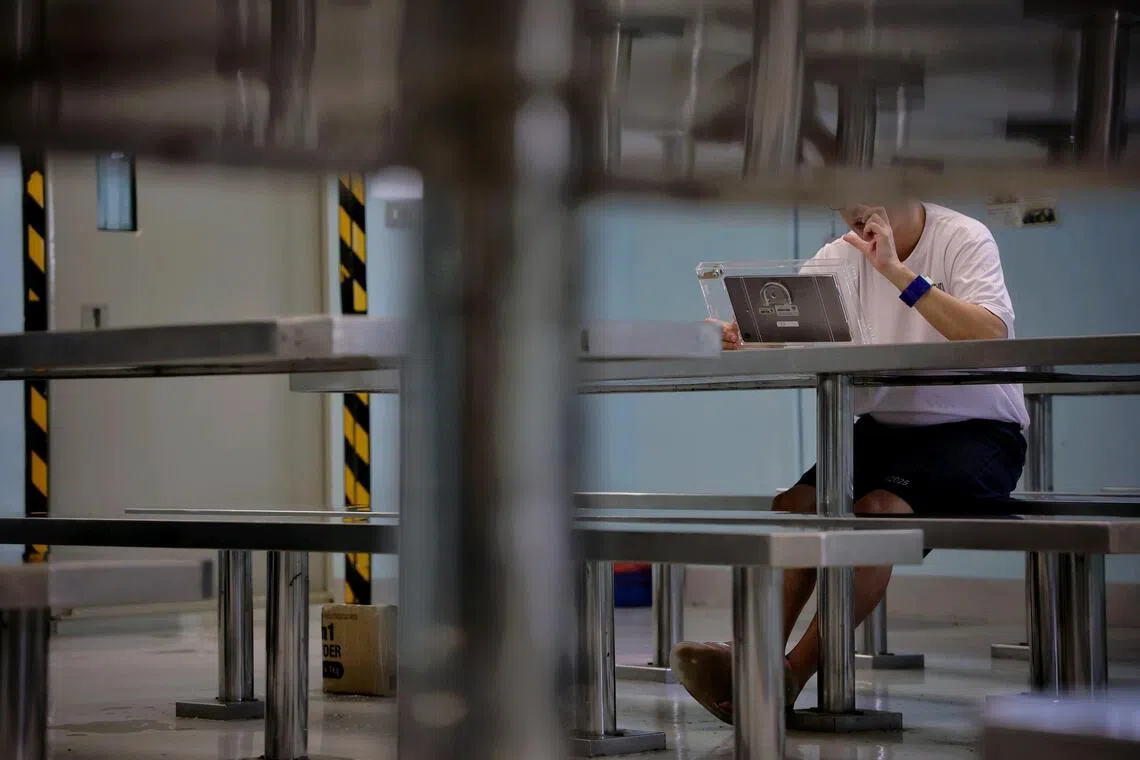
Fai (not his real name), who is currently serving his sentence of 10 years and four weeks, speaking to his 15-year-old daughter over a video call in Changi Prison on Oct 22.
Zaihan Mohamed Yusof
Published Oct 22, 2026, 07:00 PM
Updated Oct 22, 2026, 07:00 PM
Project HOPE lets inmate parents in Singapore join quarterly video calls with their school-going children, helping them stay involved in their kids' lives.
The scheme started as a 2020 pilot and now includes 134 inmates, 186 children and 79 schools.
Officials say the programme may reduce intergenerational offending. Studies found about one in five incarcerated parents had a child who later offended.
SINGAPORE – His instructions to his daughter, 15, were clear – add the rice to the dish only at the end of the cooking process .
“Fai” (not his real name), 46, reminded her to add black pepper and butter to the mix.
But father and daughter were not standing next to each other in their kitchen.
Fai, 46, was seated in an empty room in Changi Prison Complex, while his child was in school.
Fai, who is serving a prison term of 10 years and four weeks for financial crimes, was speaking to his daughter on Oct 22 via a video call on a tablet, thanks to Project HOPE.
It is an initiative between the Singapore Prison Service (SPS) and the Ministry of Education that helps incarcerated parents stay involved in their school-going children’s lives through quarterly video calls.
Project HOPE began in 2020, and now has 134 inmates and 186 children from 79 schools partnering SPS in the project.
In April, Home Affairs Minister K. Shanmugam said in written replies to Parliamentary questions that a 2017 SPS study found that about one in five incarcerated parents had at least one child who offended.
Fai, who spent an hour talking to his daughter about her exam results and home cooked food, said he was aware his children could go astray because of his absence.
He said: “I’m concerned that teenagers with parents who are not around will feel there’s no one to talk to (about their problems).
“Although I’m not around, I can still give my moral support (via Project HOPE), so that they are not lost.”
Fai, who was incarcerated in 2025, has so far made his third video call to his daughter, who will be taking her N-level examinations next year.
He is determined that his daughter and son, 17, will not commit crimes , given the statistical reality of intergenerational offending.
The study – which examined a 10-year cohort of drug offenders admitted between 2008 and 2017 – also found that these children tended to come into contact with the criminal justice system at a younger age than their parents.
Similarly, then Second Minister for Home Affairs Josephine Teo said in 2024 that more support will be given to prison inmates and their families to cut the risk of intergenerational offending.
Teo had spoken at the International Corrections and Prisons Association Annual Conference, adding that a 2019 study by the SPS found that 22 per cent of children with drug-abusing parents had committed offences.
Other than Project HOPE, inmates also maintain family connections via e-letters and prison visits.
Yi Shuqin, correctional rehabilitation specialist (CRS) from SPS’ family and peer intervention branch, said: “We believe having continued connection between inmate parents and their children not only helps with the emotional well-being of the child, but it’s also a way for inmate parents to work towards their commitment to rehabilitate and reintegrate into society.”
Yi Shuqin, CRS from SPS’ family and peer intervention branch, said that some children may take more time to start conversations because they are still angry with that parent. ST PHOTO: KEVIN LIM
Yi Shuqin, CRS from SPS’ family and peer intervention branch, said that some children may take more time to start conversations because they are still angry with that parent.
Yi said while some children are ready to reconnect with their incarcerated parents, others may take more time to start conversations because they are still angry with that parent.
For Fai, he is aware any fights or disputes with another inmate could end his participation in Project HOPE, with a possible suspension of the video calls .
He has promised himself to not leave the family again and to take them on a holiday.
Fai said: “I have missed their milestones like school exams, proms and graduations. I want to be there for their polytechnic graduation.”
Zaihan Mohamed Yusof is senior crime correspondent at The Straits Times.
Ministry of Education
费伊(化名),目前正在服刑 10 年零 4 周,于 10 月 22 日在樟宜监狱通过视频通话与他 15 岁的女儿交谈。
扎伊汉·穆罕默德·优素福
发布于2026年10月22日晚上7点
更新于2026年10月22日晚上7点
“希望工程”让新加坡的服刑人员父母每季度与上学的孩子进行视频通话,帮助他们参与到孩子的生活中。
该计划于 2020 年启动试点,目前已覆盖 134 名囚犯、186 名儿童和 79 所学校。
官员表示,该项目有望减少代际犯罪。研究发现,约五分之一的服刑父母的子女后来走上了犯罪道路。
新加坡——他对15岁的女儿的指示很明确——只有在烹饪过程的最后才能将米饭加入菜肴中。
46岁的“Fai”(化名)提醒她要在混合物中加入黑胡椒和黄油。
但父女俩并没有并肩站在厨房里。
46岁的费伊独自一人坐在樟宜监狱大楼的一间空房间里,而他的孩子则在学校里。
因金融犯罪被判处 10 年零 4 周监禁的 Fai,在“希望工程”的帮助下,于 10 月 22 日通过平板电脑与女儿进行了视频通话。
这是新加坡监狱署 (SPS) 和教育部之间的一项倡议,旨在通过每季度一次的视频通话,帮助被监禁的父母参与到子女的学习生活中。
“希望工程”于 2020 年启动,目前已有 134 名囚犯和来自 79 所学校的 186 名儿童与西雅图公立学校 (SPS) 合作开展该项目。
今年 4 月,内政部长尚穆根在书面答复国会质询时表示,新加坡惩教署 (SPS) 2017 年的一项研究发现,约五分之一的被监禁父母至少有一个孩子犯过罪。
Fai花了一个小时和女儿谈论她的考试成绩和家常菜,他说他意识到,因为他的不在家,孩子们可能会误入歧途。
他说:“我担心父母不在身边的青少年会觉得没有人可以倾诉(他们的问题)。
“虽然我不在他们身边,但我仍然可以给予他们精神上的支持(通过‘希望工程’),这样他们就不会迷失方向。”
费伊将于 2025 年入狱,至今已与女儿进行了第三次视频通话,他的女儿明年将参加 N 水准考试。
鉴于代际犯罪的统计现实,他决心不让自己的女儿和17岁的儿子犯罪。
这项研究调查了 2008 年至 2017 年间收治的 10 年毒品犯罪者队列,结果还发现,这些孩子与刑事司法系统接触的年龄往往比他们的父母要小。
同样,时任内政部第二部长杨莉明在2024年表示,将向监狱服刑人员及其家人提供更多支持,以降低代际犯罪的风险。
张先生曾在国际惩教和监狱协会年会上发言,并补充说,新加坡监狱管理局 2019 年的一项研究发现,父母吸毒的儿童中有 22% 犯了罪。
除了“希望工程”项目外,服刑人员还通过电子邮件和监狱探访与家人保持联系。
新加坡监狱管理局家庭和同伴干预部门的矫正康复专家易淑琴表示:“我们相信,让服刑人员的父母与子女保持持续的联系,不仅有助于孩子的情感健康,也是服刑人员的父母努力履行其改造和重新融入社会的承诺的一种方式。”
新加坡公立学校家庭与同伴干预部门的社区康复专家易淑琴表示,有些孩子可能需要更长时间才能开始与父母沟通,因为他们仍然对父母感到生气。(海峡时报照片:林凯文)
SPS家庭和同伴干预部门的CRS(儿童资源专家)易淑琴表示,有些孩子可能需要更多时间才能开始对话,因为他们仍然对父母感到生气。
易表示,虽然有些孩子已经准备好与被监禁的父母重新建立联系,但另一些孩子可能需要更多时间才能开始对话,因为他们仍然对父母感到愤怒。
对于费伊来说,他意识到与狱友发生任何争执或纠纷都可能导致他退出“希望工程”,甚至可能被暂停视频通话。
他向自己保证以后不再离开家人,一定要带他们去度假。
Fai说:“我错过了他们人生中的重要时刻,比如学校考试、毕业舞会和毕业典礼。我希望能够参加他们的理工学院毕业典礼。”
Zaihan Mohamed Yusof 是《海峡时报》的高级犯罪记者。
教育部