Need help caring for grandma? Undergrads create the Ahma app to help caregivers需要帮忙照顾奶奶吗?大学生开发了 Ahma 应用来帮助照护者。
NUS undergraduates develop Ahma, an AI-powered voice app that supports caregivers with personalised help and resource navigation in Singapore. Read more at straitstimes.com.
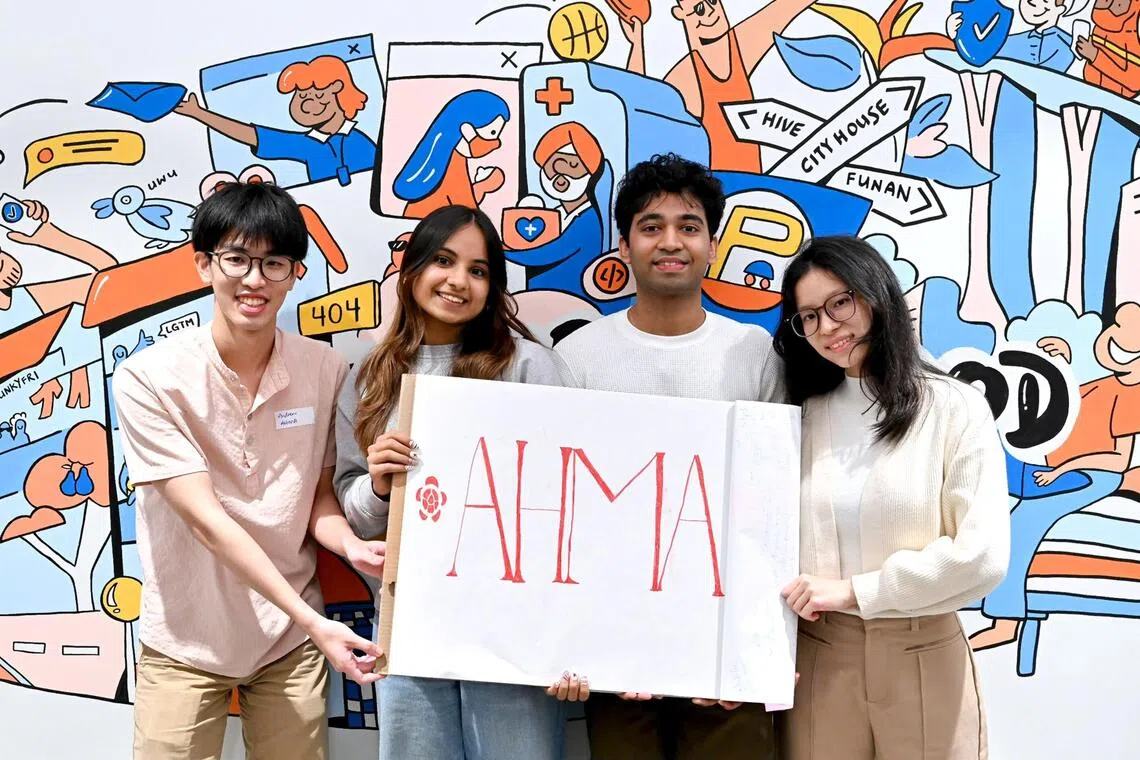
The TL;DR: Inspired by their experiences caring for grandparents and friends, four NUS undergraduates develop an AI-powered app for caregivers that listens and provides information.
NUS computer science students (from left) Andrew Soon, Aishwarya Goyal, Abhishek Paranjape and Hazel Low designed the Ahma app to support caregivers.
PHOTO: COURTESY OF AHMA
Published Sep 02, 2026, 06:19 AM
Updated Sep 02, 2026, 04:41 PM
Four NUS undergraduates developed Ahma, an AI-powered voice app that supports caregivers by listening and providing relevant information and resources.
The app personalises support by storing user context and helps with tasks like writing e-mails and managing schedules.
Caregivers contributed to the app's design, and feedback from users and organisations like Mindfull Community is guiding further improvements before launch.
SINGAPORE – Imagine venting about caregiving frustrations to an app, then receiving words of encouragement, as well as links to verified sources such as community organisations.
Four National University of Singapore (NUS) students are aiming to make their prototype app Ahma, which is powered by artificial intelligence, a reality.
The team said it chose to use a voice interface as Ahma’s main mode of interaction, since some caregivers are older adults who are uncomfortable with texting and would rather voice out their needs.
The passion project by computer science students Aishwarya Goyal, 20; Abhishek Paranjape, 22; Andrew Soon, 21; and Hazel Low, 20, was initially conceived through a hackathon in 2025. They were inspired by their own experiences with their grandparents, and friends who were struggling with mental health issues.
Said Paranjape: “We’ve thought a lot about how we can add value in a digital space... We decided that the key gap that we could be filling is essentially resource navigation in Singapore for caregivers. There are a lot of resources that are provided by SSAs (social service agencies) and the Government, but (caregivers) don’t really know what’s the right fit for them.”
The students said that what they learnt at university gave them the technical know-how to build their app. However, it was important to them that they included caregivers in the development process so that it would be user-friendly.
Low said: “A core value we have is co-creating with the caregivers themselves... We’re trying to figure out their journey every step of the way and how we can translate that into a feature in the app.”
The team said that one of the features of the app was its private database that stores context about each user’s or caregiver’s background, “enabling Ahma to empathise and understand each caregiver’s unique story”.
Ahma’s AI can also proactively assist caregivers with everyday tasks. This includes writing e-mail to organisations to make inquiries, and adding appointments, medication schedules and task reminders directly to Google Calendar.
The students gathered feedback on their prototype, including from caregivers at a recent event by non-profit Mindfull Community. The organisation supports caregivers and families of those with mental health issues, and those in recovery.
Said Samantha Foo, deputy head of partnerships at Mindfull Community: “We see first-hand the complex challenges and gaps in access to support, and it is heartening to see students recognise these needs and take the initiative to develop practical, user-focused solutions.”
The Ahma team interacting with participants of a Mindfull Community event on July 25. PHOTO: COURTESY OF MINDFULL COMMUNITY
The Ahma team interacting with participants of a Mindfull Community event on July 25.
PHOTO: COURTESY OF MINDFULL COMMUNITY
For now , the app can handle conversations in English, Malay and Mandarin, though the team is looking to add more languages, including dialects. The team trained the app’s text-to-speech model on Goyal’s voice so it would be familiar with the way people in Singapore spoke.
Mindfull’s Foo added that the team’s move to gather feedback directly from potential users was meaningful for both sides as “caregivers felt heard, and the students gained valuable insights to refine their solution”.
The organisation will review the working product when it is launched and likely introduce it to caregivers.
S. Susheela Devi, 62, is caregiver to her widowed mother and a volunteer with various organisations, including Mindfull Community. She said she felt heartened as her interactions with the team showed how some were taking the initiative to offer support for caregivers.
Rachel Sim, a 24-year-old health administrator, asked the app about the services that she could potentially link her grandmother up with. She said: “It was able to provide relevant information and contacts that could help me connect her with the appropriate support services.”
She added: “I liked that the app starts by getting to know the user on a more personal level, rather than immediately providing generic information . I also found the voice interaction quite natural and responsive, which made the experience feel more conversational and approachable.”
The students, who will be refining their app based on feedback, aim to launch a working product in three to four months.
Caregivers/Caregiving
简而言之:受照顾祖父母和朋友的经历启发,四名新加坡国立大学本科生开发了一款人工智能驱动的护理人员应用程序,该程序可以倾听并提供信息。
新加坡国立大学计算机科学系学生(从左至右)Andrew Soon、Aishwarya Goyal、Abhishek Paranjape 和 Hazel Low 设计了 Ahma 应用程序来支持护理人员。
图片由AHMA提供
发布于 2026 年 9 月 2 日 上午 6:19
更新于2026年9月2日下午4:41
四名新加坡国立大学本科生开发了 Ahma,这是一款人工智能语音应用程序,通过聆听并提供相关信息和资源来支持护理人员。
该应用程序通过存储用户上下文来提供个性化支持,并帮助用户完成诸如撰写电子邮件和管理日程安排等任务。
护理人员参与了应用程序的设计,来自用户和 Mindfull Community 等组织的反馈正在指导发布前的进一步改进。
新加坡——想象一下,你向一个应用程序倾诉照顾家人的挫折,然后收到鼓励的话语,以及社区组织等经过验证的资源链接。
新加坡国立大学 (NUS) 的四名学生正致力于将他们开发的由人工智能驱动的原型应用程序 Ahma 变为现实。
该团队表示,他们选择使用语音界面作为 Ahma 的主要交互方式,因为有些护理人员是老年人,他们不习惯发短信,更喜欢用语音表达自己的需求。
计算机科学系学生 Aishwarya Goyal(20 岁)、Abhishek Paranjape(22 岁)、Andrew Soon(21 岁)和 Hazel Low(20 岁)的这项热情之作,最初是在 2025 年的一次黑客马拉松中构思出来的。他们的灵感来源于自己与祖父母以及正在与心理健康问题作斗争的朋友们的经历。
帕兰贾佩说:“我们一直在思考如何在数字领域创造价值……我们认为,我们可以填补的关键空白本质上是新加坡护理人员的资源导航。社会服务机构和政府提供了很多资源,但(护理人员)并不真正了解哪些资源适合他们。”
学生们表示,他们在大学里学到的知识让他们具备了开发应用程序的技术能力。然而,对他们来说,让照护者参与开发过程至关重要,这样才能确保应用程序的易用性。
Low表示:“我们秉持的核心价值观是与护理人员共同创造……我们努力了解他们每一步的经历,以及如何将这些经历转化为应用程序中的功能。”
该团队表示,该应用程序的一项功能是其私有数据库,其中存储了每个用户或护理人员的背景信息,“使 Ahma 能够理解和体谅每个护理人员的独特故事”。
Ahma的人工智能还可以主动协助护理人员处理日常事务。这包括向相关机构发送电子邮件进行咨询,以及直接将预约、用药时间表和任务提醒添加到谷歌日历中。
学生们收集了关于他们原型产品的反馈意见,其中包括来自非营利组织“正念社区”(Mindfull Community)近期举办的一场活动中,由照护者们提供的反馈。该组织为精神健康问题患者及其家属,以及正在康复中的患者提供支持。
Mindfull Community 合作关系副主管 Samantha Foo 表示:“我们亲眼目睹了获得支持方面存在的复杂挑战和差距,令人欣慰的是,学生们认识到这些需求,并主动开发以用户为中心的实用解决方案。”
7月25日,Ahma团队与正念社区活动的参与者互动。照片由正念社区提供。
7月25日,Ahma团队与正念社区活动的参与者互动。
图片:由 MINDFULL COMMUNITY 提供
目前,该应用支持英语、马来语和普通话对话,但团队正在努力添加更多语言,包括方言。团队使用 Goyal 的声音训练了应用的文本转语音模型,使其熟悉新加坡人的说话方式。
Mindfull 的 Foo 补充说,团队直接从潜在用户那里收集反馈的做法对双方都很有意义,因为“护理人员感到自己的意见被倾听,而学生们则获得了宝贵的见解来改进他们的解决方案”。
该组织将在产品发布后对其进行评估,并可能将其介绍给护理人员。
62岁的苏希拉·德维(S. Susheela Devi)是一位照顾寡母的照护者,同时也是包括“正念社区”(Mindfull Community)在内的多个组织的志愿者。她说,与该团队的交流让她深受鼓舞,因为她看到有些人主动为照护者提供支持。
24岁的卫生行政人员瑞秋·西姆(Rachel Sim)通过这款应用程序询问她可以帮助祖母联系到哪些服务。她说:“它能够提供相关信息和联系方式,帮助我为她联系到合适的援助服务。”
她补充道:“我喜欢这款应用首先从更个性化的角度了解用户,而不是立即提供通用信息。我还发现语音交互非常自然流畅,这让使用体验感觉更像是在与人对话,更容易上手。”
学生们将根据反馈意见改进他们的应用程序,目标是在三到四个月内推出一个可用的产品。
照护者/照护