The Pentagon has gone too far in using the Other Transaction Authority. Congress should act.五角大楼滥用“其他交易授权”的做法太过分了。国会应该采取行动。
Created in 1958 for NASA, the obscure fiscal tool has since become the predominant approach to military contracting – at great risk to taxpayers, one researcher warns.
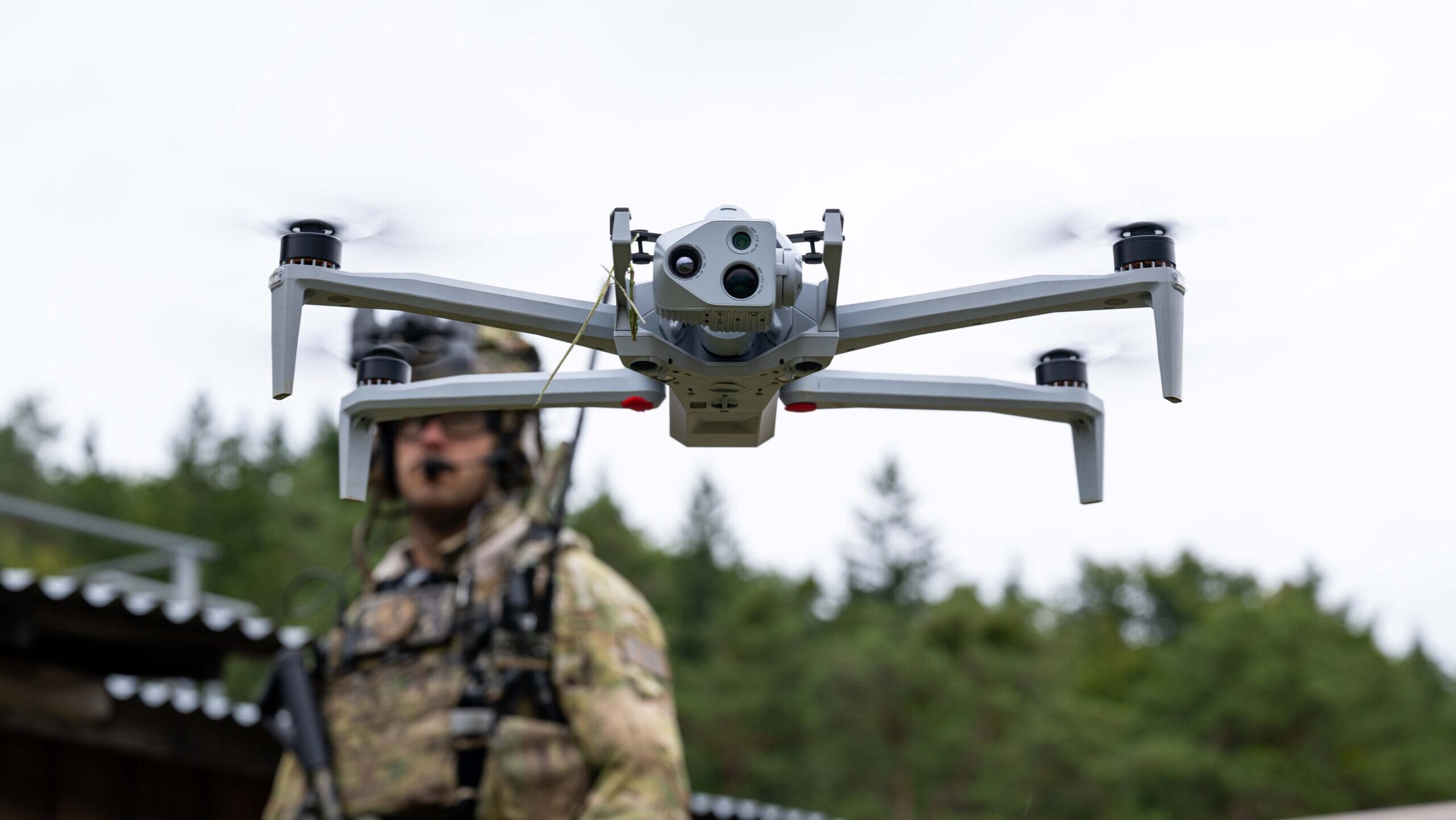
A U.S. Air Force Tactical Air Control Party Airmen assigned to the 57th Rescue Squadron flies a drone during Exercise Saber Junction 25 at the Joint Multinational Readiness Center in Hohenfels, Germany, Sept. 10, 2025. During SJ25, the 57th RQS brought specialized agility to showcase the Air Force special warfare’s ability to deploy anytime, anywhere. (U.S. Air Force photo by Senior Airman Joseph Bartoszek)
In the past decade, the Pentagon has increasingly relied on the Other Transaction Authority (OTA) to advance major weapon programs while skirting competition requirements and cost transparency standards. If lawmakers don’t narrow the authority, they risk sleepwalking the American people into a generation of Pentagon boondoggles.
Congress created the OTA in 1958 to provide the newly-established NASA with a flexible tool to pursue “ research, development and exploration ” in its race to space after the Soviets’ successful Sputnik launch. In the decades since then, lawmakers have dramatically expanded the OTA’s usage and scope, enabling elements of the Pentagon to rely on it not only for research and development , but also for weapons prototyping and production. As a result, Other Transactions have become the predominant approach to military contracting, at great risk to taxpayers.
Under the OTA, contractors are exempt from standard procurement rules specified in the Federal Acquisition Regulation (FAR), including competition standards, cost and pricing data requirements and accounting principles designed to protect the government from unreasonable expenses on military contracts. Put simply, the authority grants contractors the freedom to set prices on military contracts practically unilaterally, simultaneously foreclosing the possibility of government recourse should contractors price gouge the military.
Policymakers should narrow OT use for research and development purposes only, given both an increased risk of waste as well as their uncertain impact on delivery speed. The consequences of expanded OT usage simply outweigh any potential benefits.
The primary argument for increased OT use is that they deliver capabilities to the military faster than traditional FAR-based procurement contracts. However, there is little if any evidence to substantiate this claim, as the Pentagon fails to track how quickly production OTs deliver capabilities to service members relative to traditional contracts subject to competition requirements and cost transparency standards. The department releases information about how many prototyping OTs result in the production of new capabilities, either through production OTs or traditional FAR-based contracts; but according to the Government Accountability Office (GAO), past findings have been “ unreliable and inaccurate .”
Another justification for OTs is that they attract new or non-traditional companies to the defense sector, increasing competition in a consolidated industry. The problem with this argument is that the Pentagon doesn’t even know what contractors are doing the work for OTs awarded through consortia. These are groups of vendors focused on specific technology domains, like naval energetic systems or aviation and missile technology. They are led by managers who receive awards from the government and then distribute work among vendors. From 2021 to 2024, the government made half of its OT obligations through consortia, yet a 2025 GAO report claims that the Pentagon cannot fully account for which vendors are carrying out OT awards.
Significant non-traditional participation in OTs is one of the four requirements that the Pentagon must fulfill to grant a prototyping project to a contractor through the OTA. In FY24, the department claimed that 93 percent of OT obligations were agreements awarded to companies in which non-traditional contractors “significantly participate.” However, the GAO maintains that the Pentagon’s ability to analyze engagement by non-traditional defense contractors (NDCs) remains limited. It lacks department-wide “aggregated data on whether OTA awardees are NDCs, the obligations they have received and their contributions to OTA projects,” casting doubt on that 93 percent claim.
Weaponizing the supply chain for a liquid-fueled howitzer-fired munition that flies 150 km
The goal of such weaponization is to tie warfighter needs to the RDT&E cycle.
To make matters worse, the legal definition of “ non-traditional ” is not based on the size of a company or the value of their Pentagon contracts, but on whether a company has received a Pentagon contract subject to certain accounting principles in the last year. I wrote about the importance of these principles, the Cost Accounting Standards, in Breaking Defense last year . Companies use them to determine the costs that should be charged to government contracts. Without them, contractors can assign costs to government contracts, even if they have nothing to do with government work. Despite this, Congress ultimately exempted non-traditional contractors from the Cost Accounting Standards in the FY26 NDAA. In so doing, lawmakers expanded the number of contractors considered non-traditional without broadening its legal definition – an effort that failed in the same bill.
Democratic and Republican administrations alike have relied on the OTA to kickstart the prototyping and production of major weapons programs. The Biden administration relied on it to kickstart its “Replicator” program, which the Trump administration renamed the Defense Autonomous Warfare Group (DAWG). This White House has likewise relied on the OTA to advance key components of programs like the president’s theoretical missile defense shield, Golden Dome, announcing the award earlier this year of up to $3.2 billion in OTA agreements to advance the Space-Based Interceptor program and $6.5 billion in OTs to develop the Space-Based Airborne Moving Target Indicator program and the Space Data Network.
However, the OTA obfuscates contractors’ costs, a particularly alarming lack of transparency in the case of major programs like Golden Dome or the DAWG. In FY27, the Trump administration requested nearly $55 billion for the latter program, up from $225 million in FY26. By pursuing DAWG through the OTA, the Pentagon essentially forfeits insight into the costs and profitability of components and systems integral to the program. The department effectively legalizes whatever overcharging may occur on OT agreements, making it practically invisible to the public and impeding future efforts not only to control program cost growth, but to seek reimbursement should military contractors overcharge on components.
A quick review of recent OTs suggests that typical prime contractors are significant beneficiaries of the OTA. Twelve companies received OTs to prototype Golden Dome’s Space-Based Interceptors, a third of which are prime contractors: General Dynamics Mission Systems (a business unit of General Dynamics), Lockheed Martin, Northrop Grumman and Raytheon (a business unit of RTX). Other recipients include Anduril, Booz Allen Hamilton and SpaceX. In addition to Space-Based Interceptors, SpaceX has also received a combined total of $6.5 billion in OTs to develop the Space-Based Airborne Moving Target Indicator program and the Space Data Network, upon which a hypothetical Golden Dome system would depend.
OTs were once the exception in government contracting, but from 2016 to 2024, Pentagon obligations for prototyping and production agreements through the OTA increased tenfold, reaching over $18 billion in 2024. Defense Secretary Pete Hegseth has taken it a step further, releasing in 2025 two memorandums establishing OTs as a default contracting approach and directing their maximal usage. Since he released the first of these memos, Space Systems Command has increased the number of OTs by at least 470 percent, escalating an already established shift toward OTs and away from traditional FAR-based contracts.
Ultimately, prototyping and production OTs greatly increase the risk of overcharging by military contractors while doing little to ameliorate acquisition ills like schedule delays and cost overruns. However, there are options to curb the situation.
Lawmakers should help mitigate this risk by limiting OTA usage to research and development only. If they don’t, they will likely end up rubberstamping billions of dollars of Pentagon waste. Lawmakers may also rein in the OTA by repealing the non-traditional exemption from the Cost Accounting Standards, narrowing the number of contractors deemed non-traditional. Finally, the Pentagon should track how fast OTs deliver capabilities to the military relative to traditional, FAR-based contracts.
It’s irresponsible to assume, without evidence, that OTs deliver capabilities at speed. It is incumbent upon lawmakers to require the Pentagon to fill this data gap and narrow the OTA, on behalf of constituents and taxpayers.
Julia Gledhill is a Research Analyst at the Stimson Center, a foreign policy think-tank in Washington, DC. She focuses her research and writing on Pentagon spending, military contracting and weapons acquisition. She has appeared on various outlets including Al Jazeera, CNBC, NPR and Bloomberg. Julia is a regular contributor for Forbes.com, and her writing is featured in publications including The Nation, The National Interest, The Baffler and Responsible Statecraft.
2025年9月10日,在德国霍亨费尔斯联合多国战备中心举行的“军刀交汇25”(Saber Junction 25)演习中,隶属于美国空军第57救援中队的战术空中管制小组(TACP)成员操控无人机。在“军刀交汇25”演习中,第57救援中队展现了其特种作战部队的敏捷性,彰显了空军特种作战部队随时随地部署的能力。(美国空军高级飞行员约瑟夫·巴托谢克摄)
过去十年,五角大楼越来越依赖“其他交易授权”(OTA)来推进重大武器项目,同时规避竞争要求和成本透明度标准。如果立法者不限制这项授权,他们就有可能让美国民众在不知不觉中陷入五角大楼一代又一代的劳民伤财的泥潭。
1958年,国会设立了“其他交易”(OTA),旨在为新成立的美国国家航空航天局(NASA)提供一个灵活的工具,使其能够在苏联成功发射人造卫星“斯普特尼克”后,在太空竞赛中开展“研究、开发和探索”。此后的几十年里,立法者大幅扩展了OTA的使用范围和权限,使得五角大楼的某些部门不仅可以依赖OTA进行研发,还可以将其用于武器原型设计和生产。因此,“其他交易”已成为军事合同的主要方式,给纳税人带来了巨大的风险。
根据《对外交易法》(OTA),承包商可以豁免遵守《联邦采购条例》(FAR)中规定的标准采购规则,包括竞争标准、成本和定价数据要求以及旨在保护政府免受军事合同不合理支出影响的会计原则。简而言之,该授权赋予承包商几乎单方面设定军事合同价格的自由,同时排除了政府在承包商哄抬军方价格时追究其责任的可能性。
鉴于增加浪费风险以及对交付速度的不确定性影响,政策制定者应将OT的使用范围限制在研发领域。扩大OT使用所带来的后果远远大于任何潜在益处。
支持增加OT(技术验证)使用的主要论点是,与传统的基于FAR(联邦采购条例)的采购合同相比,OT能更快地向军方交付能力。然而,几乎没有证据支持这一说法,因为五角大楼未能追踪生产型OT相对于受竞争要求和成本透明度标准约束的传统合同向军方交付能力的速度。国防部会公布有多少原型OT最终转化为新功能,无论是通过生产型OT还是传统的基于FAR的合同;但据美国政府问责局(GAO)称,以往的调查结果“不可靠且不准确”。
支持开放式技术合同(OT)的另一个理由是,它们能吸引新兴或非传统公司进入国防领域,从而加剧这个高度整合行业的竞争。然而,这种论点的问题在于,五角大楼甚至不清楚哪些承包商在执行通过联合体授予的开放式技术合同。这些联合体是由专注于特定技术领域的供应商组成的团体,例如海军能源系统或航空和导弹技术。它们由经理领导,经理从政府获得合同,然后将工作分配给各个供应商。2021年至2024年,政府一半的开放式技术合同义务都是通过联合体履行的,但美国政府问责局(GAO)2025年的一份报告却声称,五角大楼无法完全掌握哪些供应商正在执行开放式技术合同。
在OTA(其他交易协议)中,非传统承包商的大量参与是五角大楼必须满足的四项要求之一,才能通过OTA将原型项目授予承包商。2024财年,国防部声称93%的OT义务都授予了非传统承包商“大量参与”的公司。然而,美国政府问责局(GAO)认为,五角大楼分析非传统国防承包商(NDC)参与情况的能力仍然有限。它缺乏全部门范围内的“关于OTA中标者是否为NDC、他们已承担的义务以及他们对OTA项目的贡献的汇总数据”,这使得93%的说法受到质疑。
将供应链武器化,用于生产射程达150公里的液体燃料榴弹炮弹药
这种武器化的目标是将作战人员的需求与研发、测试和评估周期联系起来。
更糟糕的是,“非传统”的法律定义并非基于公司规模或其五角大楼合同的价值,而是基于公司在过去一年中是否获得过受特定会计准则约束的五角大楼合同。我去年在《国防新闻》上撰文阐述了这些准则(即成本会计准则)的重要性。公司运用这些准则来确定应计入政府合同的成本。如果没有这些准则,承包商可以将与政府工作毫无关系的成本计入政府合同。尽管如此,国会最终还是在2026财年国防授权法案中豁免了非传统承包商遵守成本会计准则。如此一来,立法者扩大了被视为非传统承包商的范围,却没有扩大其法律定义——而这一努力在同一法案中未能实现。
民主党和共和党政府都曾依赖其他交易协议(OTA)来启动重大武器项目的原型设计和生产。拜登政府曾利用OTA启动其“复制器”(Replicator)项目,特朗普政府将其更名为“国防自主作战小组”(DAWG)。本届白宫同样依赖OTA来推进一些项目的关键组成部分,例如总统设想的导弹防御系统“金穹顶”(Golden Dome)。今年早些时候,白宫宣布授予高达32亿美元的OTA协议,用于推进天基拦截器(S-Based Interceptor)项目;并授予65亿美元的OTA协议,用于开发天基机载移动目标指示器(S-BAIM)项目和空间数据网络(Space Data Network)。
然而,OTA(其他交易协议)掩盖了承包商的成本,对于像“金穹顶”或“国防采办工作组”(DAWG)这样的大型项目而言,这种缺乏透明度的情况尤其令人担忧。在2027财年,特朗普政府为DAWG项目申请了近550亿美元的预算,而2026财年仅为2.25亿美元。通过OTA推进DAWG项目,五角大楼实际上放弃了对项目关键组件和系统成本及盈利能力的了解。国防部实际上将OTA协议中可能出现的任何超额收费合法化,使其几乎不为公众所知,并阻碍了未来控制项目成本增长以及在军方承包商对组件收取过高费用时寻求补偿的努力。
对近期开放交易协议(OTA)的快速回顾表明,典型的主承包商是OTA的主要受益者。共有12家公司获得了OTA,用于开发金穹顶天基拦截器的原型,其中三分之一是主承包商:通用动力任务系统公司(通用动力公司的一个业务部门)、洛克希德·马丁公司、诺斯罗普·格鲁曼公司和雷神公司(RTX公司的一个业务部门)。其他受益者包括Anduril公司、博思艾伦咨询公司和SpaceX公司。除了天基拦截器项目外,SpaceX公司还获得了总计65亿美元的OTA,用于开发天基机载移动目标指示器项目和空间数据网络,而假想中的金穹顶系统将依赖于这两个网络。
OT(其他交易协议)曾经是政府合同中的例外,但从2016年到2024年,五角大楼通过OTA(其他交易协议)签订的原型和生产协议的支出增加了十倍,到2024年超过180亿美元。国防部长皮特·赫格塞斯更进一步,在2025年发布了两份备忘录,将OT确立为默认的合同方式,并指导最大限度地使用OT。自他发布第一份备忘录以来,太空系统司令部已将OT的数量至少增加了470%,进一步加剧了从传统的基于FAR(联邦采购条例)的合同转向OT的趋势。
最终,原型制作和生产加班大大增加了军工承包商过度收费的风险,却对缓解诸如进度延误和成本超支等采购弊端收效甚微。然而,仍有一些方法可以遏制这种情况。
立法者应限制OTA的使用范围,使其仅限于研发领域,从而帮助降低这种风险。否则,他们很可能最终会为五角大楼数十亿美元的浪费开绿灯。立法者还可以通过废除成本会计准则中对非传统承包商的豁免条款来控制OTA的使用,从而减少被认定为非传统承包商的数量。最后,五角大楼应该追踪OTA向军方交付能力的速度,并将其与基于联邦采购条例(FAR)的传统合同进行比较。
在没有证据的情况下就断定作战训练系统能够快速交付能力是不负责任的。立法者有责任代表选民和纳税人,要求五角大楼填补这一数据空白,并缩小作战训练协议的范围。
朱莉娅·格莱德希尔是位于华盛顿特区的外交政策智库史汀生中心的研究分析师。她的研究和写作主要集中在五角大楼的开支、军事合同和武器采购方面。她曾出现在包括半岛电视台、CNBC、NPR和彭博社在内的多家媒体上。朱莉娅是福布斯网站的定期撰稿人,她的文章也发表在《国家》、《国家利益》、《巴夫勒》和《负责任的治国之道》等刊物上。