Navy awards Applied Intuition $25M to deploy AI sensor fusion at sea美国海军授予Applied Intuition公司2500万美元,用于在海上部署人工智能传感器融合技术。
The Intelligent Perception System will help sailors understand a flood of sensor feeds while collecting data to train improved AI models, the company said.
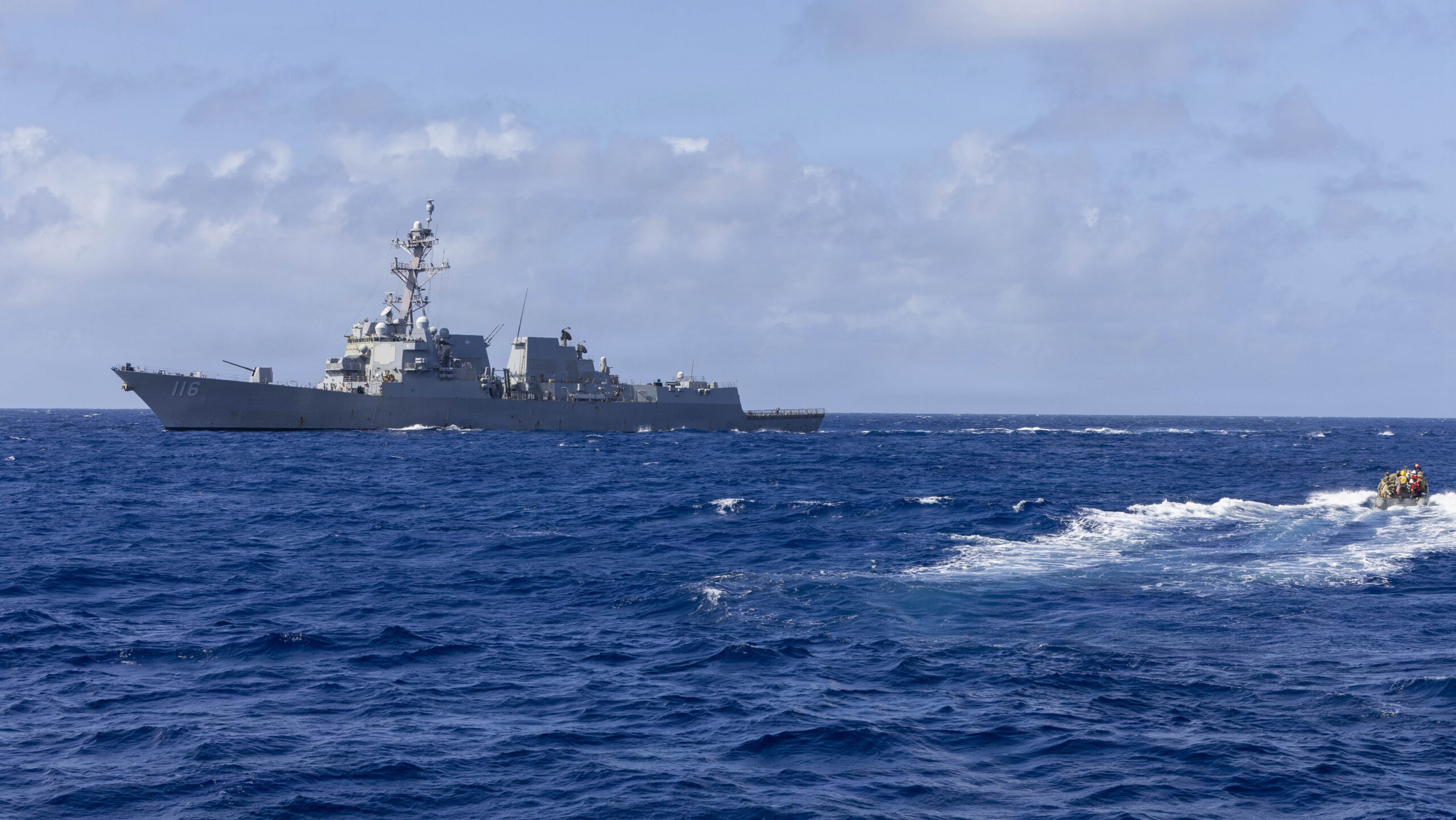
U.S. Sailors, assigned to Arleigh Burke-class guided-missile destroyer USS Thomas Hudner (DDG 116), and U.S. Coast Guard tactical team members conduct small boat operations while underway in the Caribbean Sea, Jan. 24, 2026. (U.S. Navy)
WASHINGTON — Applied Intuition has won a $2 5 million contract from the US Navy to begin deploying AI-powered sensor fusion on warships, starting with five Arl eigh Burke-class destroyers but potentially expanding “across the fleet,” the company announced this morning.
The new Intelligent Perception System (IPS) will do two jobs at once, Applied said in its announcement and a blog post . In near real time, IPS will pull in data from various cameras and infrared sensors — many of which were never designed to work together — and synthesize a single, coherent picture for the sailors. It’ll even offer helpful features like “automated alerts” when another vessel is approaching on a collision course.
Sailors aboard the USS Fitzgerald and McCain definitely could have benefited from such a capability during their back-to-back collision incidents in 2017, which killed 17 sailors and severely damaged both ships.
Meanwhile, IPS will also record the sensor data and — when bandwidth is available and security conditions permit — transmit it back to shore. There, the system’s land-based component can analyze the collected data and use it to train improved AI models for both manned and unmanned vessels.
The system even allows ships to receive updates over the air while still at sea, instead of waiting for maintenance and modernization in port, the company said. That could enable multiple refresh cycles in a single deployment.
That kind of fast-paced adaptation is reminiscent of the drone war in Ukraine and fits with Defense Secretary Pete Hegseth’s push for rapid upgrades . It also jibes with the Pentagon’s desire to piggyback off advances in commercial tech rather than waiting for bespoke military developme nts.
Applied originally focused on self-driving cars — still a major part of its business — before it branched out into defense . At its core, the technology it’s bringing to the Navy draws on that dual-use foundation.
“The amount of data the Navy collects, and the operating environments it is constantly engaged in, [are] very similar to what we do gathering data to develop driverless cars,” Jason Brown, general manager at Applied Intuition, said in a statement to Breaking Defense.
While details obviously vary, the essentials are the same for “any autonomous system that needs to perceive environments in order to feed planning and control algorithms,” he argued. “We built those data engines for our commercial business and applied the same technical approach to naval operations.”
This new contract isn’t the first time Applied has brought its technology to the Navy. IPS builds on an earlier pilot program called DECK — short for Data Edge Collection Kit— that was tested on at least one Navy vessel earlier this year .
“DECK was massively successful,” Brown declared. “It collected data, transported it — all with commercial technology — and did it securely and within Navy operational constraints.”
Breaking Defense Video
Army’s tech chief talks autonomy, acquisition and the future of drones
Drones take over AUSA, plus the Army’s plan to bring in new vendors
Hegseth talks autonomy at AUSA, a key show focus
Army doubles down on autonomy, stakes out Indo-Pacific role: AUSA Day 2
Telle talks ‘manufacturing rodeo,’ supply chain ‘weak links’: AUSA Day 1
New leaders, new drone command: What we expect from AUSA 2026
Unpacking Boeing’s F/A-XX win, plus a report from wartime Ukraine
How Hegseth envisions a new Autonomous Warfare Command
What Europe’s military air fleets will look like in 30 years
Riyadh gets closer to F-35s, Damascus presses sovereignty and an expert take on Iran
2026年1月24日,隶属于阿利·伯克级导弹驱逐舰“托马斯·哈德纳”号(DDG 116)的美国海军水兵和美国海岸警卫队战术小组成员在加勒比海航行期间进行小型艇类作业。(美国海军)
华盛顿——Applied Intuition公司今天上午宣布,该公司已从美国海军获得一份价值250万美元的合同,将开始在军舰上部署人工智能驱动的传感器融合技术,首先从五艘伯克级驱逐舰开始,但有可能扩展到“整个舰队”。
应用材料公司在其公告和博客文章中表示,新型智能感知系统(IPS)将同时完成两项任务。IPS能够近乎实时地从各种摄像头和红外传感器(其中许多设备原本并非设计用于协同工作)获取数据,并为水手们合成一幅清晰连贯的图像。它甚至还能提供一些实用功能,例如当有船只沿碰撞航线接近时发出“自动警报”。
2017 年,“菲茨杰拉德”号和“麦凯恩”号驱逐舰上的水兵如果拥有这种能力,肯定会在两舰相撞事故中受益匪浅。这两起事故造成 17 名水兵丧生,两艘军舰均严重受损。
与此同时,IPS还会记录传感器数据,并在带宽充足且安全条件允许的情况下,将其传输回岸上。岸上系统组件可以分析收集到的数据,并利用这些数据训练更先进的AI模型,以用于有人驾驶和无人驾驶船舶。
该公司表示,该系统甚至允许船舶在海上航行时通过无线方式接收更新,而无需在港口等待维护和现代化改造。这使得单次部署即可实现多次更新周期。
这种快速适应让人想起乌克兰的无人机战争,也符合国防部长皮特·赫格塞斯推动快速升级的政策。此外,这也与五角大楼希望借助商业技术的进步,而不是等待专门的军事技术研发的愿望相符。
应用材料公司最初专注于自动驾驶汽车——这至今仍是其主要业务——之后才拓展到国防领域。该公司为海军提供的核心技术正是基于这种军民两用理念。
应用直觉公司总经理杰森·布朗在接受《防务新闻》采访时表示:“海军收集的数据量以及它不断参与的运行环境,与我们收集数据开发无人驾驶汽车的工作非常相似。”
他认为,虽然细节上肯定有所不同,但对于“任何需要感知环境以驱动规划和控制算法的自主系统”而言,其基本原理都是相同的。“我们为我们的商业业务构建了这些数据引擎,并将相同的技术方法应用于海军作战。”
这份新合同并非应用材料公司首次将其技术应用于海军。IPS系统建立在名为DECK(数据边缘采集套件的缩写)的早期试点项目之上,该项目已于今年早些时候在至少一艘海军舰艇上进行了测试。
布朗宣称:“DECK系统取得了巨大的成功。它利用商业技术收集数据、传输数据,并且安全地完成了所有操作,完全符合海军的作战限制。”
突破性防御视频
陆军技术主管谈无人机的自主性、采购和未来
无人机主导了美国陆军协会(AUSA)的会议,此外,陆军还计划引入新的供应商。
Hegseth 在 AUSA 大会上谈到了自主性,这是本次大会的一个重点议题。
陆军加倍强调自主性,明确印太地区角色:AUSA第二天
特勒谈“制造业乱象”、供应链“薄弱环节”:AUSA 第一天
新领导人,新无人机指挥部:我们对 AUSA 2026 的期待
深入剖析波音F/A-XX的竞标结果,以及来自战时乌克兰的报道
赫格塞斯设想的新型自主作战指挥部
30年后欧洲军用空军机队会是什么样子
利雅得距离F-35战机更近一步,大马士革强调主权,以及专家对伊朗的看法