Four KJ-3000 Radar Jets At Chinese Factory Point To Serial Production中国工厂的四架KJ-3000雷达喷气式飞机表明其即将批量生产。
The KJ-3000 is the most capable of China’s rapidly expanding airborne early warning and control aircraft fleet. The KJ-3000 is the most capable of China’s rapidly expanding airborne early warning and control aircraft fleet.
Published Oct 22, 2026 4:46 PM EDT
Satellite image ©2026 Vantor
New satellite imagery shows four of China’s new KJ-3000 airborne early warning and control (AEW&C) aircraft at the Xi’an Aircraft Company (XAC) facility at Xi’an-Yanliang , raising the possibility that the large radar planes are moving toward or have entered serial production.
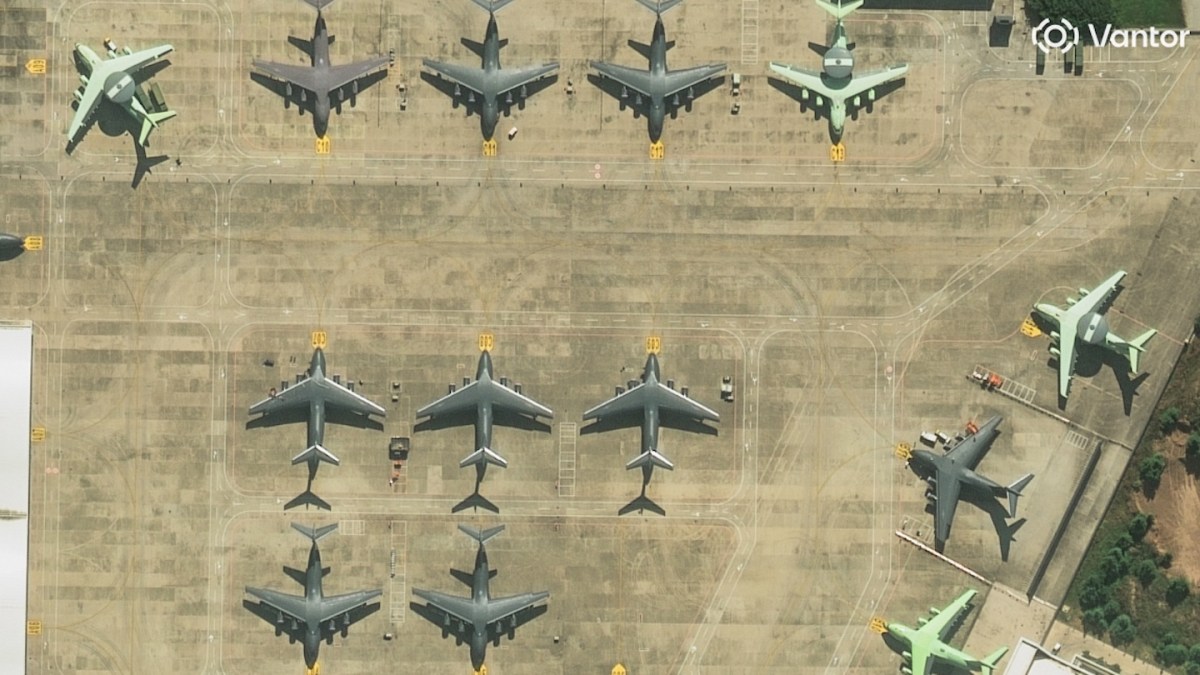
Satellite imagery captured on October 5 and provided by Vantor shows three KJ-3000s near the XAC factory in the western part of the facility, with a fourth at the nearby China Flight Test Establishment (CFTE). J. Michael Dahm, a senior fellow at the Mitchell Institute for Aerospace Studies, assesses that the presence of four aircraft points to the type having entered serial production.
An overview of the Xi’an Aircraft Company (XAC) facility on October 5. A total of four KJ-3000s are visible. Satellite image ©2026 Vantor
Three KJ-3000s along with other Y-20s at the XAC factory in the western part of the facility. Satellite image ©2026 Vantor
Andreas Rupprecht , an analyst of Chinese military aviation and TWZ contributor, offered a more cautious assessment, noting that the imagery could indicate that series production or low-rate initial production (LRIP) has begun. However, he also pointed out that all four previously identified prototypes could simply have been at the facility at the same time. Specifically, he identified the aircraft seen at the CFTE portion of the airfield as being a prototype.
A closer view of one of the KJ-3000s at the XAC factory. Satellite image ©2026 Vantor
An additional KJ-3000 seen alongside a pair of Y-20Bs. Satellite image ©2026 Vantor
Whatever the explanation, the imagery offers a fresh look at a program set to significantly expand China’s already substantial airborne surveillance and battle-management capabilities.
The KJ-3000, also referred to as the KJ-20, is based on the four-engine Y-20 transport aircraft , specifically the improved Y-20B variant powered by Chinese-made engines. The aircraft features a large circular radome mounted above the rear fuselage, along with a prominent series of antennas on the forward fuselage. An aerial refueling probe is mounted above the cockpit, while a conspicuous intake at the base of the tailfin is likely intended to provide cooling air for its extensive onboard electronics.
A stock Y-20B transport with its distinctive locally produced WS-20 turbofan engines. via Chinese internet
The first low-quality photographs of the aircraft began circulating in December 2024. More detailed imagery emerged in May 2025, showing an example at an undisclosed Chinese airfield. That aircraft, bearing the serial number 7821 and assessed to be the first example, was still wearing primer, in contrast to the examples now seen at the XAC factory.
This photo emerged in May 2025 and shows the presumed first KJ-3000 on the ground at an undisclosed airfield in China. The aircraft still wears a coat of primer, and the serial number 7821 is clearly visible on the forward fuselage. via Chinese internet
The KJ-3000 is expected to address longstanding limitations in China’s existing large jet-powered AEW&C fleet. To date, only four KJ-2000 Mainring aircraft have been completed. Based on the Russian-built Ilyushin Il-76MD transport, the KJ-2000 program was constrained by the limited availability of suitable airframes, and now faces the twin issues of reliance on Russian supply chains and aging aircraft.
A side view of a standard PLAAF KJ-2000, albeit with the serial number censored from the photo. FYJS/via Chinese internet
A domestically produced Y-20-based platform provides a more sustainable basis for a much larger AEW&C fleet, with greater scope for upgrades and potentially export opportunities.
The larger airframe should also provide advantages over China’s numerous turboprop-powered AEW&C aircraft, including greater speed, range, and endurance. Its higher operating altitude would give its radar a better vantage point for detecting and tracking targets, particularly low-flying aircraft and missiles that may be masked from ground-based sensors by terrain or the radar horizon.
The aerial refueling probe could further extend the aircraft’s range and time on station, although the precise operational capabilities of the KJ-3000 remain unclear.
The exact configuration of the KJ-3000’s primary radar has yet to be established. China’s existing KJ-2000 and smaller KJ-500 use fixed radomes containing three active electronically scanned array (AESA) antennas to provide 360-degree coverage, rather than the rotating radomes found on aircraft such as the U.S. E-3 Sentry and Russia’s A-50 Mainstay . Whether the new aircraft follows the same approach remains to be seen.
A Russian Aerospace Forces A-50U Mainstay. Russian Ministry of Defense Russian Air Force A-50U Mainstay. (Russian MoD)
As well as its large AESA radar, the new aircraft is likely to carry additional intelligence, surveillance, and reconnaissance (ISR) systems, while its communications equipment could make it an important networking node for Chinese forces operating across the vast distances of the Indo-Pacific. Such capabilities would be particularly valuable for coordinating combat aircraft, including uncrewed ones , sharing targeting information, and extending the reach of China’s integrated air defense and broader military networks.
The KJ-3000 is also part of a broader expansion and diversification of China’s AEW&C fleet. Alongside the new jet-powered aircraft, the People’s Liberation Army continues to field and develop smaller platforms based on the four-turboprop Y-9 transport family .
These include the KJ-500 , which has been produced and delivered at a rapid pace, as well as the newer KJ-700, believed to combine radar with electro-optical and infrared sensors for a broader range of surveillance missions. The precise capabilities of the KJ-700 remain uncertain, but you can read about the platform in more detail here .
A prototype KJ-700. via Chinese internet
The smaller turboprop aircraft offer advantages of their own. They are better suited to operating from dispersed and relatively austere airfields, and they regularly appear at Chinese island outposts and in the strategically important Taiwan Strait . Together, the different types give Chinese forces a range of options for surveillance and command and control, from persistent coverage close to home to operations farther afield.
The U.S. Department of Defense has repeatedly highlighted the growing importance of China’s AEW&C fleet.
In its latest annual report on Chinese military developments, the Pentagon specifically pointed to the KJ-3000:
“The PLA conducted an initial flight with the KJ-3000 Airborne Early Warning and Control (AEW&C) aircraft, which will serve as a surveillance aircraft to monitor aircraft, ships, and other vehicles. The KJ-3000 will probably be the world’s first model to use digital radar and will be capable of anti-jamming, passive detection, and target identification.”
Airborne radar and command-and-control aircraft are also important force multipliers for increasingly capable Chinese combat jets , including the stealthy J-20 and aircraft armed with long-range air-to-air missiles . Radar planes like these can serve as critical networking nodes for data sharing and, in some cases, allow Chinese fighters to prosecute targets without turning on their own radar.
In 2022, then-Pacific Air Forces commander Gen. Kenneth Wilsbach praised the command and control associated with J-20 operations, noting that some of China’s long-range air-to-air missiles benefit from support provided by the KJ-500.
A stock photo of a J-20 stealth fighter. PLAAF
For China, a larger and more capable AEW&C fleet would support both the defense of its airspace and efforts to project military power across the Indo-Pacific. These aircraft could help coordinate operations around Taiwan and the South China Sea , improve situational awareness over maritime approaches, and support combat operations at greater distances from the mainland.
The same Pentagon report from 2025 further noted:
“China’s integration of support aircraft, such as the KJ-500 airborne early warning aircraft, provides the PLAAF with improved ISR capability to support PLA operations, as demonstrated during surge operations near Taiwan.”
A KJ-500 arrives at the Zhuhai Air Show Center in November 2022 in Zhuhai, Guangdong Province of China. This is specifically the probe-equipped KJ-500A version. Photo by VCG/VCG via Getty Images VCG
A domestically developed, jet-powered platform such as the KJ-3000 would be a logical centerpiece of that effort, particularly since it can be produced in substantially greater numbers than the KJ-2000.
The prospect of China expanding its fleet of large, jet-powered AEW&C aircraft stands in contrast to the U.S. Air Force’s troubled effort to replace its aging E-3 Sentry . The U.S. E-7 Wedgetail program has encountered major hurdles , raising concerns about a potential gap in airborne battle management as China continues to field new capabilities.
The October 5 imagery does not confirm that serial production has begun. Further imagery showing additional airframes, activity around production facilities, or aircraft in new operational markings may provide a clearer indication of the program’s progress.
Regardless, the KJ-3000 appears poised to become an important addition to China’s expanding airborne surveillance and command-and-control architecture.
Contact the author: thomas@thewarzone.com
Comments couldn’t be loaded. Please refresh the page.
发布于美国东部时间2026年10月22日下午4:46
卫星图像 ©2026 Vantor
新的卫星图像显示,中国新型KJ-3000空中预警与控制(AEW&C)飞机在西安燕梁的西安飞机公司(XAC)工厂内,这引发了人们对大型雷达飞机正在走向或已经进入批量生产阶段的可能性的猜测。
Vantor提供的10月5日卫星图像显示,在西飞工厂西部区域附近有三架KJ-3000飞机,第四架则位于附近的中国飞行试验中心(CFTE)。米切尔航空航天研究所高级研究员J·迈克尔·达姆评估认为,四架飞机的出现表明该机型已进入批量生产阶段。
10月5日西安飞机公司(XAC)厂区概览。图中可见四架KJ-3000飞机。卫星图像©2026 Vantor
西飞工厂西部区域停放着三架KJ-3000飞机以及其他运-20飞机。卫星图像 ©2026 Vantor
中国军用航空分析师、TWZ撰稿人安德烈亚斯·鲁普雷希特(Andreas Rupprecht)提出了更为谨慎的评估,他指出,这些图像可能表明批量生产或小批量初始生产(LRIP)已经开始。但他同时指出,此前发现的四架原型机可能只是同时出现在同一设施内。他特别指出,在机场CFTE区域看到的飞机是一架原型机。
这是西飞工厂一台KJ-3000的近景照片。卫星图像 ©2026 Vantor
另一架KJ-3000飞机与两架Y-20B飞机并排停放。卫星图像©2026 Vantor
无论出于何种原因,这些图像都让我们得以重新审视一项旨在大幅扩展中国已经相当强大的空中监视和作战管理能力的计划。
KJ-3000,又称KJ-20,是以四引擎运-20运输机为基础,具体而言,是以国产发动机驱动的改进型运-20B为基础。该机在后机身上方安装了一个大型圆形雷达罩,前机身则布满了醒目的天线。驾驶舱上方装有空中加油探管,而尾翼底部的显眼进气口很可能是为了给机载的大量电子设备提供冷却空气。
一架Y-20B运输机,配备国产WS-20涡扇发动机,极具特色。图片来自中国互联网
该飞机的首批低质量照片于2024年12月开始流传。2025年5月,更清晰的图像出现,显示一架飞机停放在中国某未公开的机场。这架序列号为7821的飞机被认为是第一架原型机,机身仍涂有底漆,这与目前在西飞工厂看到的飞机有所不同。
这张照片于2025年5月曝光,照片显示疑似首架空警-3000飞机停放在中国某未公开的机场地面上。飞机机身仍保留着底漆,机身前部清晰可见序列号7821。(图片来自中国互联网)
KJ-3000有望解决中国现有大型喷气式预警机机队长期存在的局限性。迄今为止,仅有四架KJ-2000主环型飞机完成制造。KJ-2000项目基于俄罗斯伊尔-76MD运输机,由于合适的机身供应有限而受到制约,目前又面临着依赖俄罗斯供应链和飞机老化的双重挑战。
这是一架标准型中国空军KJ-2000的侧视图,但照片中的序列号已被遮盖。FYJS/来自中国互联网
国产的Y-20平台为更大规模的预警机机队提供了更可持续的基础,并具有更大的升级空间和潜在的出口机会。
更大的机身也应使其在速度、航程和续航能力等方面优于中国众多的涡桨式预警机。更高的飞行高度将使其雷达拥有更好的目标探测和跟踪角度,特别是那些可能因地形或雷达视距而被地面传感器遮蔽的低空飞行飞机和导弹。
空中加油探管可以进一步延长飞机的航程和驻守时间,尽管KJ-3000的具体作战能力仍不清楚。
KJ-3000主雷达的具体配置尚未确定。中国现有的KJ-2000和较小的KJ-500采用固定式雷达罩,内含三根有源相控阵(AESA)天线,可提供360度全方位覆盖,而非像美国E-3“哨兵”预警机和俄罗斯A-50“主力”攻击机那样采用旋转式雷达罩。新型飞机是否会沿用相同的设计方案,还有待观察。
俄罗斯空天军A-50U主力战机。俄罗斯国防部,俄罗斯空军A-50U主力战机。(俄罗斯国防部)
除了大型AESA雷达外,这款新型飞机还可能搭载额外的情报、监视和侦察(ISR)系统,其通信设备可使其成为中国军队在广袤的印太地区开展行动的重要网络节点。这些能力对于协调包括无人机在内的作战飞机、共享目标信息以及扩展中国一体化防空网络和更广泛的军事网络覆盖范围尤为重要。
KJ-3000也是中国预警机机队更广泛扩充和多元化发展的一部分。除了新型喷气式飞机外,中国人民解放军还在继续部署和研发基于四涡桨Y-9运输机系列的较小型平台。
其中包括生产和交付速度很快的KJ-500,以及据信将雷达与光电和红外传感器相结合,以执行更广泛监视任务的新型KJ-700。KJ-700的具体性能尚不明确,但您可以在这里阅读更多关于该平台的详细信息。
KJ-700原型机。图片来自中国互联网
小型涡桨飞机也具有自身的优势。它们更适合在分散且相对简陋的机场起降,并且经常出现在中国的岛屿前哨和具有重要战略意义的台湾海峡。不同类型的飞机共同为中国军队提供了多种监视、指挥和控制选择,从近海持续监控到远距离作战,均可胜任。
美国国防部多次强调中国预警机部队日益增长的重要性。
在最新的中国军事发展年度报告中,五角大楼特别提到了KJ-3000:
“解放军对KJ-3000空中预警与控制(AEW&C)飞机进行了首次试飞,该机将作为监视飞机、舰船和其他车辆的侦察机。KJ-3000很可能是世界上首款采用数字雷达的机型,并具备抗干扰、被动探测和目标识别能力。”
机载雷达和指挥控制飞机也是中国日益强大的战斗机(包括隐形歼-20和装备远程空空导弹的战机)的重要作战力量倍增器。这类雷达飞机可以作为数据共享的关键网络节点,在某些情况下,还能让中国战机在不开启自身雷达的情况下攻击目标。
2022 年,时任太平洋空军司令肯尼斯·威尔斯巴赫将军赞扬了歼-20作战相关的指挥和控制,并指出中国的一些远程空空导弹受益于KJ-500提供的支持。
一张歼-20隐形战斗机的库存照片。中国人民解放军空军
对中国而言,规模更大、性能更强的预警机机队将有助于其保卫领空,并加强在印太地区的军事力量投射。这些飞机可以帮助协调台湾和南海周边的军事行动,提升海上航道态势感知能力,并支持远距离作战行动。
同一份五角大楼2025年的报告还指出:
“中国将空警-500等支援飞机整合到空军中,提高了空军的情报、监视和侦察能力,从而更好地支持解放军的作战行动,这在台湾附近的突击行动中得到了充分体现。”
2022年11月,一架KJ-500无人机抵达中国广东省珠海市珠海航展中心。这架无人机是配备探管的KJ-500A型。图片来源:VCG/VCG via Getty Images VCG
国产喷气式平台,例如 KJ-3000,将是这项工作的合理核心,尤其是因为它的产量可以比 KJ-2000 大得多。
中国扩充大型喷气式预警机机队的计划与美国空军更换老旧E-3“哨兵”预警机的艰难历程形成鲜明对比。美国的E-7“楔尾”预警机项目遭遇了重大阻碍,引发了人们对中国不断部署新型预警机后,空中作战管理能力可能出现缺口的担忧。
10月5日的图像并未证实批量生产已经开始。更多显示机身数量、生产设施周边活动或涂装全新作战涂装的图像或许能更清晰地表明该项目的进展情况。
无论如何,KJ-3000 似乎有望成为中国不断扩展的空中监视和指挥控制架构的重要组成部分。
联系作者:thomas@thewarzone.com
评论加载失败,请刷新页面。