PAP internal election: Will there be new faces and what changes can we expect on Oct 25?人民行动党内部选举:10月25日会有新面孔出现吗?我们可以期待哪些变化?
Few moves are expected at the top when the PAP elects its leadership on Oct 25, but newly promoted ministers could take their first step into the party’s innermost circle Read more at straitstimes.com.
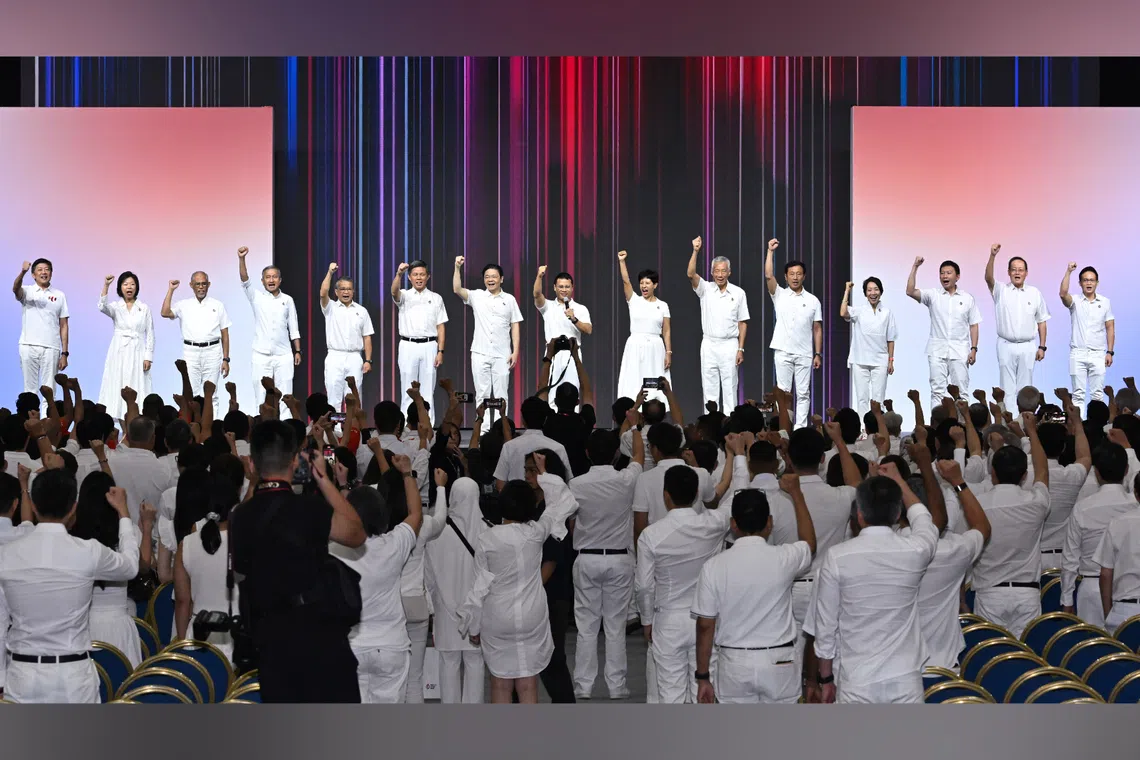
The PAP Awards and Convention on Nov 9, 2025. The PAP will meet on Oct 25 to elect its top leadership body for another two-year term.
ST PHOTO: LIM YAOHUI
Published Oct 23, 2026, 12:10 PM
Updated Oct 23, 2026, 12:37 PM
SINGAPORE – Few moves are expected at the top when the PAP elects its leadership on Oct 25 , but newly promoted ministers could take their first step into the party’s innermost circle.
Party insiders do not expect major changes and the party’s performance at the 2025 General Election , where it won with 65.57% of the vote, gives little impetus for change.
But on the back of a July Cabinet reshuffle , this weekend could see the party’s next generation start to take up some of its reins.
This follows a timeline set by Prime Minister Lawrence Wong, who took over as the ruling party’s secretary-general in 2024 , completing a generational leadership transition from Senior Minister Lee Hsien Loong.
At 2025 ’s party convention, PM Wong said he hoped the outline of the PAP’s next generation of leaders will emerge by the next general election .
The general election is due by 2030, meaning this weekend and the next party election in 2028 are where this has to happen.
On Sunday, more than 2,000 party cadres will congregate to elect the PAP’s next central executive committee (CEC) which will serve for two years.
This will be the first chance for some of the PAP’s 27 first-term MPs to be elected to the committee.
The majority of the CEC is made up of the party’s 4G leaders, with the notable exceptions of Senior Ministers Lee and K. Shanmugam. Both have been in Parliament since the 1980s.
The entry of new blood would give the next generation seats at the table and a say over various aspects of the party including its composition in who becomes a member or cadre, and its wider direction.
This matters especially for those drawn from the public service.
Because of restrictions on political activity for public servants, they have not, unlike some of their peers in the party, spent years building familiarity with systems and people.
Being in the CEC gives them sway within the party and the ability to mobilise activists, which is important to winning votes come election time and serving residents during the term.
After July’s reshuffle, three helm ministries – Jeffrey Siow, David Neo and Jasmin Lau – while Goh Pei Ming was promoted to senior minister of state.
Siow and Neo’s promotions to full minister and Lau’s appointment as acting minister mark them out as frontrunners to make the CEC, as the party has traditionally filled its top leadership with many from its frontbench in Parliament.
The other side of the coin is also worth watching: if newcomers enter, some will have to leave the CEC to make room at the top.
This could be an early signal of who could leave politics by the next election, although some party leaders such as former chairman Gan Kim Yong have left the CEC and stayed on in high positions in Government.
At the 2018 party election, then-Coordinating Minister for Infrastructure Khaw Boon Wan left the CEC before retiring from politics at the 2020 election.
Then, former ministers who had in a recent reshuffle become backbench MPs – Yaacob Ibrahim and Lim Swee Say – also left the top leadership.
At PAP elections, the party’s sitting CEC releases a list of about 19 candidates for cadres to choose from.
Within that list, a smaller group of about seven is marked out as recommended by the party’s inner circle as its core leaders.
Both lists are closely watched by the party faithful.
Cadres usually pick their 12 candidates from these lists for the CEC, which later parcels out the different roles such as chairman and treasurer amongst its members.
An inclusion of any new MP on either would signal the leadership’s support – to be validated by the wider vote.
The top 12 votegetters are elected and by custom the next two are co-opted. The CEC also has the option to co-opt up to four more members, and committees usually end up at 18 members – the maximum size.
The party has used both routes – the vote and co-option – in the past to add potential leaders to the CEC and has elected or co-opted several first-term MPs who later became prominent political figures.
From the 2011 batch of new MPs, Heng Swee Keat, Chan Chun Sing, and Tan Chuan-Jin were appointed into the CEC around six months after being elected into Parliament that year.
They were appointed to fill spots vacated by senior party leaders including former prime ministers Lee Kuan Yew and Goh Chok Tong who left the CEC to facilitate party renewal.
Later at the 2012 party election, Chan and Heng won seats outright, and PM Wong himself was also co-opted into that CEC. Tan was elected onto the next CEC in 2014, still in his first term as an MP.
Two from the 2015 batch of new MPs also entered the CEC in their first term: Ong Ye Kung and Ng Chee Meng. Ong was co-opted after the party election in 2016, while Ng was elected at the next one in 2018. Both now sit in PM Wong’s Cabinet.
But from the 2020 batch, only Tan See Leng made the CEC in his first term, having been co-opted after the vote in the 2022 party election.
In 2024, he was co-opted again along with Chee Hong Tat as the two next highest vote-getters after the first 12. Also co-opted to the CEC were Sim Ann, Desmond Choo and Lam Pin Min.
PM Wong has made renewing the party and Government a key priority since taking the reins of both in 2024.
He flagged this urgency to refresh the leadership in his speech at the party’s meeting last year, saying that renewal must never stop.
The July Cabinet reshuffle did so on the Government front.
On the party side, the onus is on this weekend and the next internal election in two years for PM Wong’s hope for the next generation to emerge by 2030 to come to pass.
Wei Kai is a correspondent at The Straits Times, where he covers politics. He also writes Unpacked, a weekly newsletter on Singapore politics and policy.
Singapore politicians
人民行动党颁奖典礼暨大会将于2025年11月9日举行。人民行动党将于10月25日召开会议,选举其最高领导机构,任期两年。
ST 照片:林耀辉
发布于2026年10月23日下午12:10
更新于2026年10月23日下午12:37
新加坡——预计人民行动党将于10月25日选举党魁,高层不会有太大变动,但新晋升的部长们可能会迈出进入党内核心圈子的第一步。
党内人士预计不会有重大变化,该党在 2025 年大选中以 65.57% 的得票率获胜,这并没有给变革带来多少动力。
但随着 7 月份内阁改组,本周末该党的下一代可能会开始接管一些权力。
这遵循了总理黄循财设定的时间表,他于 2024 年接任执政党秘书长一职,完成了从国务资政李显龙手中的代际领导层交接。
在2025年的党代会上,黄英贤总理表示,他希望人民行动党下一代领导人的轮廓能在下次大选中显现出来。
大选将于 2030 年举行,这意味着本周末和 2028 年的下一次政党选举是实现这一目标的时机。
周日,2000多名党员干部将聚集在一起,选举人民行动党下一届中央执行委员会(CEC),任期两年。
这将是人民行动党27名新当选议员首次有机会当选委员会成员。
中央执行委员会的大多数成员都是该党的第四代领导人,但李显龙和尚穆根两位高级部长是明显的例外。他们二人自上世纪80年代以来就一直在国会任职。
新鲜血液的注入将使下一代在党内拥有一席之地,并对党的各个方面拥有发言权,包括党员或干部的组成以及更广泛的发展方向。
这一点对那些来自公共服务部门的人来说尤其重要。
由于公务员的政治活动受到限制,他们不像党内一些同僚那样,花了数年时间去熟悉各种制度和人际关系。
进入中央执行委员会(CEC)可以让他们在党内拥有影响力,并能够动员积极分子,这对于在选举时赢得选票以及在任期内为居民服务至关重要。
7 月改组后,萧正祥、梁振英和刘嘉敏分别担任三个部门的部长,而吴佩明则被提拔为高级政务部长。
萧和梁晋升为正式部长,刘被任命为代理部长,这标志着他们成为中央执行委员会的热门人选,因为该党历来都从国会前排议员中选拔高层领导。
硬币的另一面也值得关注:如果有新人加入,一些人就不得不离开中共,为高层腾出空间。
这可能是下届选举前谁将退出政坛的早期信号,尽管一些政党领导人,如前主席颜金勇,已经离开中央执行委员会,并在政府中继续担任要职。
在 2018 年的党内选举中,时任基础设施统筹部长许文远离开了中央执行委员会,并在 2020 年的选举中退出了政坛。
随后,在最近的内阁改组中成为后座议员的前部长——雅各布·易卜拉欣和林瑞生——也离开了最高领导层。
在人民行动党选举中,该党现任中央执行委员会会公布一份约有 19 名候选人的名单,供党员干部从中挑选。
在该名单中,大约有七人被党的核心圈子推荐为核心领导人。
这两份名单都受到党内忠实拥护者的密切关注。
干部通常会从这些名单中挑选 12 名候选人进入中央执行委员会,中央执行委员会随后会将主席和司库等不同职位分配给其成员。
任何新议员加入其中任何一方都将表明领导层的支持——这还需要通过更广泛的投票来验证。
得票最多的12名候选人当选,按照惯例,接下来的两名候选人由委员会增选产生。中央执行委员会还可以选择增选最多四名成员,委员会最终通常由18名成员组成——这是委员会的最大规模。
该党过去曾通过投票和增选两种途径向中央执行委员会输送潜在领导人,并选举或增选了几位后来成为杰出政治人物的第一届议员。
2011 年新当选的国会议员中,王瑞杰、陈振声和陈川仁在当选国会议员约六个月后被任命为中央执行委员会成员。
他们被任命填补高级党内领导人(包括前总理李光耀和吴作栋)离开中央执行委员会以促进党内革新后留下的空缺。
在2012年的党内选举中,陈志远和王瑞杰直接赢得席位,黄之锋总理本人也被增选为中央执行委员会成员。陈志远在2014年当选为下一届中央执行委员会成员,当时他仍处于国会议员的第一任期内。
2015年新当选的国会议员中有两位在第一任期内也进入了中央执行委员会:王乙康和黄志明。王乙康在2016年党内选举后被增选,而黄志明则在2018年的党内选举中当选。两人目前都在黄英贤总理的内阁中任职。
但从 2020 届候选人中,只有陈世龙在第一任期内当选中央执行委员会成员,他在 2022 年党内选举投票后被增选。
2024 年,他和 Chee Hong Tat 再次被增选为中央执行委员会成员,他们是前 12 名候选人中得票最高的两位。同时被增选为中央执行委员会成员的还有 Sim Ann、Desmond Choo 和 Lam Pin Min。
黄循财总理自2024年执掌党政以来,一直将党政革新作为首要任务。
他在去年党的一次会议上发表讲话时,强调了更新领导层的紧迫性,并表示更新换代绝不能停止。
7月份的内阁改组对政府方面产生了影响。
党内方面,本周末以及两年后的下一次党内选举至关重要,这关系到黄英贤总理希望在2030年之前涌现出新一代领导人的愿望能否实现。
魏凯是《海峡时报》的记者,主要报道政治新闻。他还撰写每周一期的新加坡政治与政策简报《Unpacked》。
新加坡政治家