China’s High-Speed Drone Is Rocket-Powered And All About Doing What Satellites Can’t中国的高速无人机采用火箭动力,旨在完成卫星无法完成的任务。
The aircraft is designed to rapidly gather intel in contested areas by surprise and especially when key satellites are no longer operational.
Updated Dec 1, 2019 6:02 AM EST
China’s big 70th-anniversary parade marking the founding of the PRC has come and gone. There were a number of revelations, some of which we are still analyzing, but the biggest ones were in the unmanned space. In the days leading up to the parade, we had covered both of the most impressive unmanned vehicles that were to be displayed. It’s time to follow up with our analysis now that we have seen them in far greater detail. We posted our analysis on the GJ-11 Sharp Sword UCAV earlier today, now here are my takeaways from the official unveiling of the WZ-8—also referred to as the DR-8—high-speed reconnaissance drone.
Before we get started, it’s important to note that the two WZ-8s put on display for the parade appear to be real aircraft, not mockups. It is unclear how representative they are of the current maturity of the program, but they are indeed real aircraft. Considering that the WZ-8 has been around for some time , these could be early demonstrators or an early production configuration, we just don’t know.
A nice side-on image showing the WZ-8’s sleek profile and landing gear. , Chinese Internet
My writeup from a week ago regarding this shadowy aircraft was largely spot on. The WZ-8 is an air-launched, high-speed, high-altitude, unmanned reconnaissance aircraft that is recoverable via a runway. It also looks a lot like some of the high-speed shapes China had been testing via high-altitude balloon drops in recent years. What’s new is that we now know its propulsion method—rocket engines. In other words, it isn’t an air breather.
This isn’t surprising considering China’s struggles with advanced jet engine propulsion technology or how they would employ this aircraft operationally. Developing an engine that can operate at high supersonic speeds is a significant technological undertaking. Using rockets allows for a far more straightforward and available powerplant solution—one that can push the WZ-8 to extreme speeds, but also one that could limit its flexibility and range.
The engine and flight control arrangement on the WZ-8 drone., China Internet
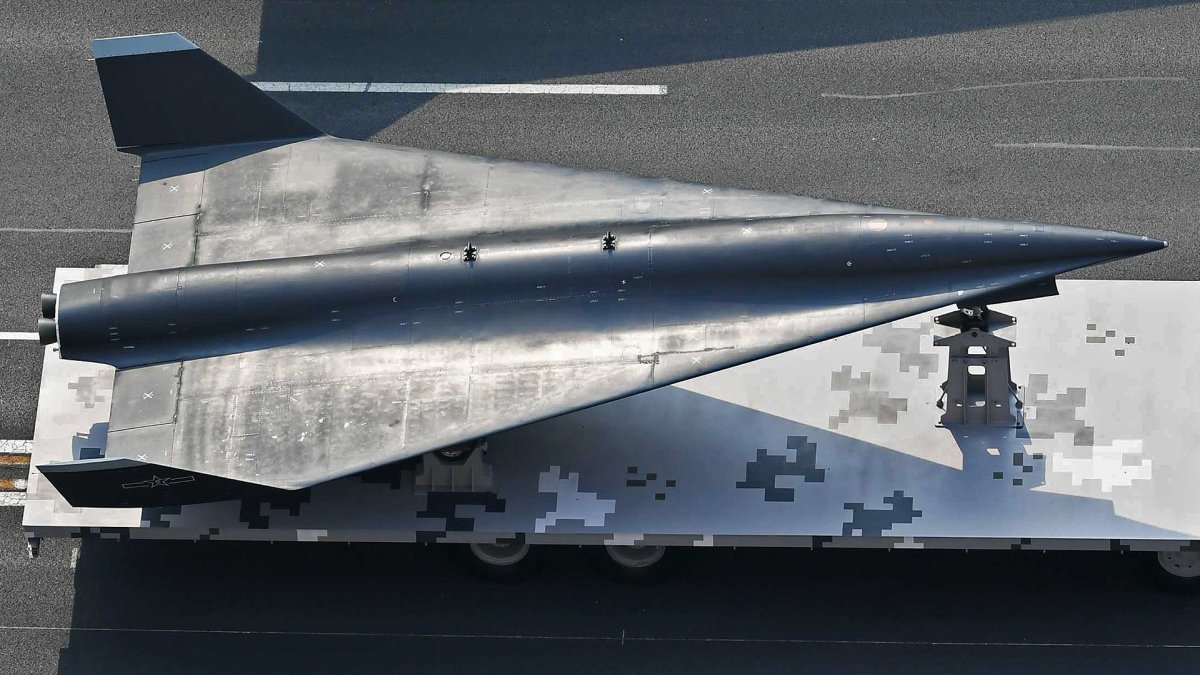
A pair of small open-cycle, liquid-fueled, rocket engines can be seen configured in a side-by-side arrangement on the aircraft displayed. It is unclear if these engines would be reusable or if they are just single-use. We also don’t know their exact fuel type, but being rocket-powered, this craft could have the potential to climb to extreme altitudes, potentially nearing the edge of space. It could then use the speed and altitude it has acquired to continue on a quasi-ballistic trajectory before turning toward its recovery location once in thicker air and eventually gliding in for a landing. So we are not talking about something that is necessarily limited to SR-71 / A-12 / D-21 altitudes or kinetic performance here.
A big question is how could it control itself above altitudes where traditional flight control surfaces are no longer useful? Without a reaction control system of thrusters, which it does not have, it would probably be limited to flight below roughly 140,000 feet. With thrust vectoring, this may be able to be increased for a short period of time, but based on what I can see in the images, its engines do not appear to have such a capability.
With all this in mind, I believe this aircraft was built to fly primarily at the very upper reaches of where traditional control surfaces are effective, and maybe slightly beyond on a ballistic arch, for a brief period of time. This is still quite high— even at 135,000 feet, Mach 3.42 is 2,500 mph.
When it comes to how fast this craft can go, it remains unclear. But high supersonic range would be my guess—somewhere between Mach 3.5 and Mach 4.5. Mach 4.5 at 135,000 feet is 3,285 mph. That isn’t quite hypersonic, but it is amazingly fast.
Even a 20-minute cruise at those speeds would allow such a craft to cover 1,100 miles. It is very likely air-launched from a specially outfitted H-6N bomber , so this wouldn’t include transit time to the launch area or its flight home, which would be a gliding descent to landing. I think it would be safe to say that this craft could have a range of 1,500 miles in total.
That range and altitude would allow it to cover huge swathes of the South China Sea. In fact, it could launch from near Hainan Island and recover at one of China’s South China Sea island outposts and return on another mission. Its H-6 carriers can also range far out to sea, launching the drone in a very remote location and allowing it sweep massive areas of the Pacific for American carrier strike groups or make high-speed runs over the territory of potential foes. Swatting down a small target arriving unannounced at Mach 4.5 and 135,000 feet is no easy task, to say the least.
If this craft can function well above the height at which standard control surfaces become ineffective, up to the edge of space, then it is likely hypersonic in nature. But at this time, we have no clear evidence that supports this possibility, although it is worth keeping it in mind as we learn more about this system in the coming years.
It isn’t clear what the aperture atop the nose is for. It could be for basic satellite communications for semi-autonomous control or even just periodic updates, but it could also be a celestial navigation system that would come in very handy considering its flight profile, mission set, and especially for operations in combat environments where satellite support is unassured. Such a system was used on the SR-71 Blackbird and the D-21 drone that landed in China’s own territory decades ago . You can read more about the Blackbird’s celestial navigations system, as well as others, some of which are still in use by America’s strategic forces, in this past feature of ours .
A view from under the aircraft shows its smooth and largely flat belly. It will be interesting to see what reconaissance payloads China can integrate into an aircraft with such extreme performance. , Screencap
So, what we are really talking about here is an asset that can be put into action with little notice and provide very prompt intelligence over critical areas, including those that are located substantial distances from the Chinese mainland. Above all else, it is just about as close to a perfect application as China is going to get for prosecuting a war in which its intelligence satellites may be blinded, jammed, disabled, or destroyed —an all too possible reality .
It also gives the PLA the ability to gather intelligence in a survivable and rapid manner without the enemy knowing eyes are going to be overhead—a major limitation of traditional spy satellites. Such an intelligence-gathering capability has many applications, not just locating carrier strike groups. Just the function of providing damage assessments after ballistic and cruise missile strikes on strategic locations throughout the region would be incredibly important as the information it collects could save valuable missiles for other targets and allow PLA commanders to execute an accelerated anti-access campaign during a time of war.
Still, many other basic questions remain, such as how is skin-friction heat attenuated and what sensor packages can be integrated into its svelte, arrowhead-like design. But overall, that’s where I am at with the WZ-8—who knows if that will end up being its official designation—at this time. The aircraft fits perfectly with China’s overall regional objectives and military strategy and it makes you wonder just what else they have up their sleeve.
Please add your own thoughts and analysis in the comments section below.
Contact the author: Tyler@thedrive.com
Comments couldn’t be loaded. Please refresh the page.
更新于美国东部时间2019年12月1日上午6:02
中国庆祝中华人民共和国成立70周年的盛大阅兵式已经落下帷幕。阅兵式上涌现出许多亮点,其中一些我们仍在分析,但最引人注目的莫过于无人领域。在阅兵式前的几天里,我们报道了即将展出的两款令人印象深刻的无人飞行器。现在,我们已经对它们进行了更深入的了解,是时候继续进行分析了。今天早些时候,我们发布了关于GJ-11“利剑”无人作战飞行器的分析,现在,我将分享我对WZ-8(也称DR-8)高速侦察无人机正式亮相的总结。
在正式开始之前,需要指出的是,阅兵式上展出的两架WZ-8飞机似乎是真机,而非模型。目前尚不清楚它们在多大程度上代表了该项目目前的成熟度,但它们的确是真机。考虑到WZ-8项目已经开展了一段时间,这两架飞机可能是早期验证机或早期生产型,我们目前还不得而知。
一张漂亮的侧视图,展示了WZ-8流畅的外形和起落架。(中国互联网)
我一周前关于这架神秘飞机的报道基本准确。WZ-8 是一款空射、高速、高空无人侦察机,可通过跑道回收。它的外形与中国近年来通过高空气球投放测试的一些高速飞行器非常相似。新的发现是,我们现在知道了它的推进方式——火箭发动机。换句话说,它不是吸气式飞机。
考虑到中国在先进喷气发动机推进技术方面面临的挑战,以及他们将如何实际运用这款飞机,这并不令人意外。研发一款能够在高超音速下运行的发动机是一项重大的技术挑战。使用火箭动力装置则提供了一种更为直接且易于实现的动力解决方案——这种方案能够将WZ-8推向极高的速度,但也可能限制其灵活性和航程。
WZ-8无人机的发动机和飞行控制系统。(中国互联网)
图中展示的飞机上并排安装了两台小型开式循环液体燃料火箭发动机。目前尚不清楚这些发动机是否可重复使用,或者是否为一次性使用。我们也不知道它们的具体燃料类型,但由于采用火箭动力,这架飞行器有可能爬升到极高的高度,甚至接近太空边缘。之后,它可以利用已获得的速度和高度,沿着准弹道轨迹继续飞行,然后在进入较稠密的大气层后转向回收地点,最终滑翔着陆。因此,我们这里讨论的并非仅限于SR-71/A-12/D-21那样的高度或动力性能的飞行器。
一个关键问题是,在传统飞行控制面失效的高空,它如何进行自我控制?由于它没有推进器反作用控制系统(而它确实没有),其飞行高度可能被限制在约14万英尺以下。如果采用推力矢量控制,或许可以在短时间内提高飞行高度,但从图片来看,它的发动机似乎并不具备这种能力。
考虑到以上所有因素,我认为这架飞机的设计初衷主要是在传统控制面有效飞行高度的极限范围内飞行,或许还能在弹道弧线上略微超出这个范围,但持续时间会很短。即便如此,这个高度仍然相当高——即使在135,000英尺(约41,600米)的高度,3.42马赫的速度也相当于2,500英里/小时(约4000公里/小时)。
至于这架飞行器究竟能飞多快,目前还不清楚。但我猜测它应该属于高超音速飞行范围——速度应该在3.5马赫到4.5马赫之间。在135,000英尺(约41,000米)的高空,4.5马赫的速度相当于3,285英里/小时(约5300公里/小时)。这虽然还达不到高超音速,但也快得惊人了。
即使以这样的速度巡航20分钟,这样的飞行器也能飞行1100英里。它很可能是由一架特制的H-6N轰炸机空投的,因此这不包括飞往发射场的飞行时间以及返航时间(返航过程可能是滑翔降落)。我认为可以肯定地说,这架飞行器的总航程可达1500英里。
这样的航程和高度使其能够覆盖南海的大片区域。事实上,它可以从海南岛附近起飞,在中国南海的某个岛礁回收,然后再次执行任务。其搭载的轰-6航母也能远航至更远的海域,在非常偏远的地点发射无人机,使其能够为美国航母打击群扫荡太平洋的大片区域,或者高速飞越潜在敌方领空。毫不夸张地说,击落一个以4.5马赫的速度、135000英尺高空突然出现的小型目标绝非易事。
如果这种飞行器能够在远高于标准控制面失效高度(直至太空边缘)的范围内正常工作,那么它很可能属于高超音速飞行器。但目前我们尚无确凿证据支持这一可能性,不过随着未来几年我们对该系统了解的深入,这种可能性值得我们关注。
目前尚不清楚机头顶部的开口用途。它可能用于基本的卫星通信,以实现半自主控制,甚至只是定期更新信息;但也可能是天文导航系统,考虑到其飞行剖面、任务类型,尤其是在卫星信号无法保障的作战环境中,这将非常有用。SR-71“黑鸟”侦察机和几十年前降落在中国境内的D-21无人机都曾使用过类似的系统。您可以在我们之前的专题报道中阅读更多关于“黑鸟”天文导航系统以及其他一些系统(其中一些至今仍在被美国战略部队使用)的信息。
从飞机下方看去,可以看到它光滑且基本平坦的机腹。中国能将哪些侦察载荷集成到这样一款性能卓越的飞机上,着实令人好奇。(截图)
所以,我们真正讨论的是一种可以在极短时间内投入使用,并能迅速提供关键区域(包括远离中国大陆的区域)情报的资产。最重要的是,对于中国而言,这几乎是应对一场情报卫星可能被干扰、瘫痪或摧毁的战争(这种情况极有可能发生)的最佳方案。
它还使解放军能够在敌方察觉不到的情况下,以安全且快速的方式收集情报——这是传统间谍卫星的一大局限。这种情报收集能力用途广泛,不仅仅局限于定位航母打击群。例如,在对整个地区的战略要地进行弹道导弹和巡航导弹打击后,提供损害评估信息就至关重要,因为收集到的信息可以帮助解放军将宝贵的导弹用于其他目标,并使解放军指挥官能够在战时迅速开展反介入行动。
不过,还有许多基本问题悬而未决,例如如何降低表面摩擦生热,以及哪些传感器组件可以集成到其纤细的箭头状机身中。但总的来说,这就是我目前对WZ-8(谁知道这是否会成为它的正式名称)的看法。这款飞机完美契合中国的整体区域目标和军事战略,不禁让人好奇他们还有什么其他计划。
请在下方评论区留下您的想法和分析。
联系作者:Tyler@thedrive.com
评论加载失败,请刷新页面。