Natilus secures Air Force contract to develop blended wing body aircraft纳蒂勒斯公司获得空军合同,开发混合翼身飞机
“We think now's the right time” for a blended wing body design to make its debut, Natilus Chief Operating Officer Nolan Giblin told Breaking Defense.
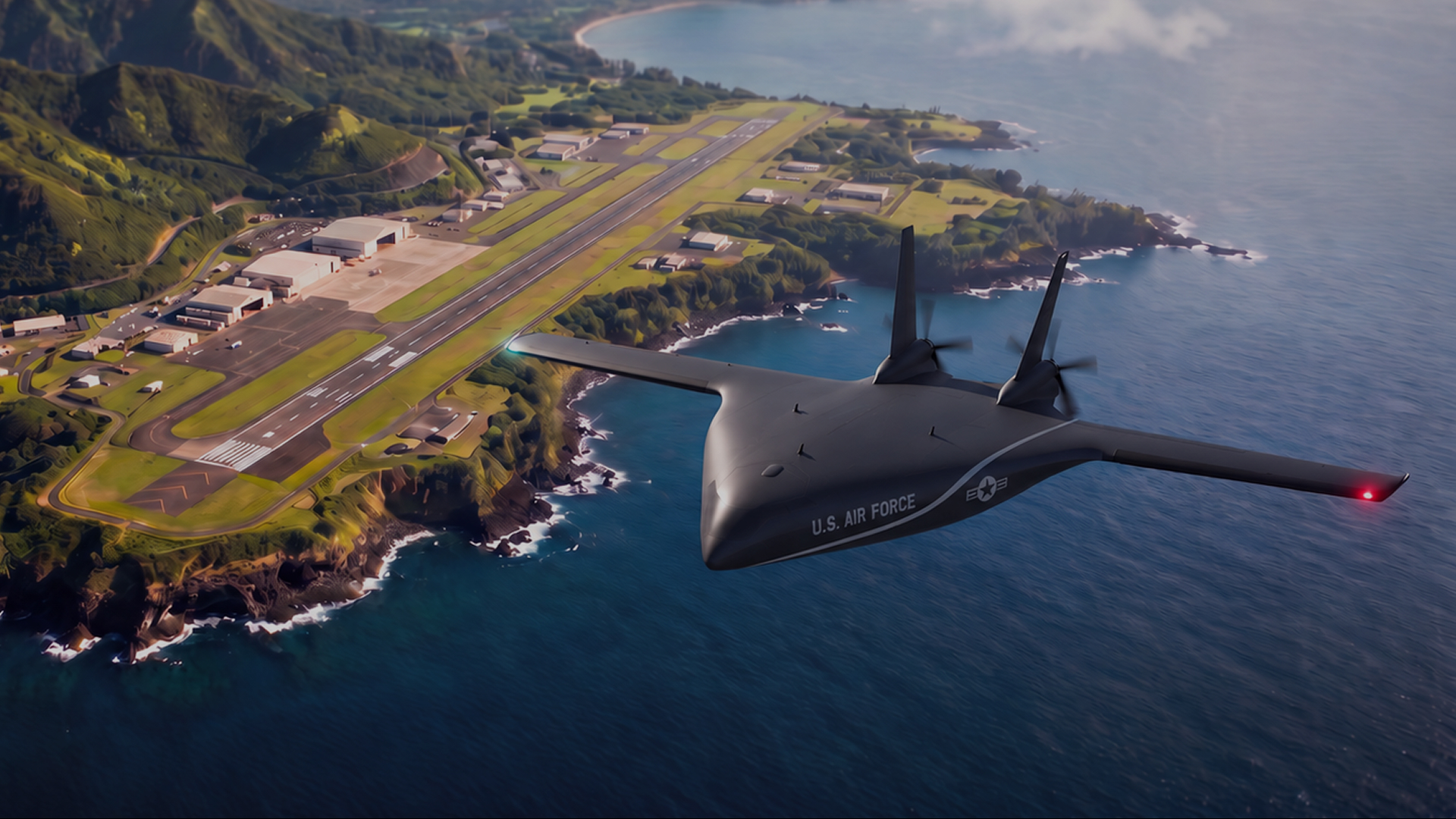
Natilus' KONA aircraft. (Natilus image)
WASHINGTON — The Air Force issued aircraft startup Natilus a $3.5 million contract to fund development for the firm’s blended wing body (BWB) aircraft with the hopes of moving military cargo, the company recently revealed.
Natilus’ aircraft is at least the second BWB design to be funded by the Air Force, following a $235 million investment announced in 2023 for the firm JetZero to build a full-up demonstrator. BWB concepts have been studied for decades, though one has not been brought to market.
“We think now’s the right time” for a BWB aircraft to make its debut, Natilus Chief Operating Officer Nolan Giblin told Breaking Defense in an interview on Wednesday, the day the company announced the new funding.
The contract complements privately raised capital and helps “de-risk” some key technologies to achieve a first flight for Natilus’s KONA aircraft by late next year or early 2028, Giblin said. The award is the first US government investment for the company.
A BWB design shares similarities with a “flying wing” like the B-2 bomber, with some key differences. It consists of an aircraft whose wings and fuselage are blended together, leaving no clean break between the two, while still sporting smaller, distinct wings. The approach provides more aerodynamic lift compared to traditional tube-and-wing designs, offering greater fuel efficiency. But the overall complexity of the aircraft and other aeronautical challenges have kept the design from going mainstream.
A B-2 Spirit bomber from the 509th Bomb Wing, Whiteman Air Force Base, Mo., approaches a tanker as both aircraft fly over Kansas on Sept. 9, 2011. (DoD photo by Senior Airman Courtney Witt, U.S. Air Force. )
Giblin said the KONA has an 85-foot wingspan with a max takeoff weight of 19,000 pounds. The company plans to outfit the aircraft with Pratt & Whitney’s PT6 turboprop engine.
Precision at scale: APKWS counters the threat
APKWS® laser‑guidance kit provides reliable precision‑guided munitions across missions and platforms, delivered quickly to meet evolving operational demands.
According to Giblin, the KONA offers different use cases than the JetZero aircraft, which Air Force officials have said could be a candidate for next-gen refueling or airlift solutions. (The service is still studying plans for its future mobility fleet.)
KONA, by contrast, is targeted at “sub-tactical lift” missions in environments the Indo-Pacific, bridging a gap between the smaller Cessna C-208 and larger Lockheed Martin C-130, Giblin said. He said there are currently no “defense-specific” modifications for the aircraft, as Natilus plans to offer the same design for military and commercial customers — the latter being the firm’s primary target.
Natilus plans to initially produce KONA with a traditional cable and pulley system, which mechanically connects a pilot’s stick to an aircraft’s flight control surfaces. Giblin said the company is “making provisions” for a pathway to optionally piloted or fully autonomous flight, which could come from an in-house autonomy stack or outside vendor.
Giblin added that Natilus is assembling the KONA prototype at the company’s San Diego, Calif. facilities, and is planning a manufacturing outlook of roughly five aircraft per month at full rate production.
Pointing to the success of Elon Musk’s SpaceX in “disrupt[ing]” incumbent providers, Giblin said Natilus is aiming to do the same for aircraft, where prevailing designs have largely stagnated around tube-and-wing configurations whose performance gains draw from incremental improvements in propulsion.
“No one’s really done that yet for aviation, so that’s what we’re striving to do,” he said.
Breaking Defense Video
Army’s tech chief talks autonomy, acquisition and the future of drones
Drones take over AUSA, plus the Army’s plan to bring in new vendors
Hegseth talks autonomy at AUSA, a key show focus
Army doubles down on autonomy, stakes out Indo-Pacific role: AUSA Day 2
Telle talks ‘manufacturing rodeo,’ supply chain ‘weak links’: AUSA Day 1
New leaders, new drone command: What we expect from AUSA 2026
Unpacking Boeing’s F/A-XX win, plus a report from wartime Ukraine
How Hegseth envisions a new Autonomous Warfare Command
What Europe’s military air fleets will look like in 30 years
Riyadh gets closer to F-35s, Damascus presses sovereignty and an expert take on Iran
纳蒂勒斯的 KONA 飞机。 (纳提勒斯图像)
华盛顿——飞机初创公司 Natilus 最近透露,美国空军授予该公司一份价值 350 万美元的合同,用于资助其混合翼身 (BWB) 飞机的研发,希望能够运输军事货物。
纳蒂勒斯公司的飞机至少是继2023年宣布向JetZero公司投资2.35亿美元建造一架完整的验证机之后,第二个获得美国空军资助的翼身飞行器(BWB)设计项目。翼身飞行器的概念已经研究了几十年,但至今还没有一款产品投入市场。
Natilus 首席运营官 Nolan Giblin 在周三接受 Breaking Defense 采访时表示:“我们认为现在是 BWB 飞机首次亮相的合适时机。”当天,该公司宣布了新的融资计划。
吉布林表示,这份合同是对私人融资的补充,有助于降低一些关键技术的风险,从而使纳蒂勒斯公司的KONA飞机能够在明年年底或2028年初实现首飞。这是该公司首次获得美国政府投资。
翼身融合式(BWB)设计与B-2轰炸机等“飞翼”飞机有相似之处,但也存在一些关键区别。它的机翼和机身融为一体,两者之间没有明显的界限,但机翼仍然较小且独立。与传统的管翼式设计相比,这种设计能提供更大的空气动力升力,从而提高燃油效率。但由于飞机整体结构复杂以及其他航空方面的挑战,这种设计尚未得到广泛应用。
2011年9月9日,一架隶属于密苏里州怀特曼空军基地第509轰炸机联队的B-2“幽灵”隐形轰炸机在堪萨斯州上空飞行时接近一架加油机。(美国空军高级飞行员考特尼·维特拍摄,美国国防部照片。)
吉布林表示,KONA飞机的翼展为85英尺,最大起飞重量为19000磅。该公司计划为该飞机配备普惠公司的PT6涡轮螺旋桨发动机。
规模化精准控制:APKWS 应对威胁
APKWS® 激光制导套件可在各种任务和平台上提供可靠的精确制导弹药,并可快速交付以满足不断变化的作战需求。
吉布林表示,KONA飞机与JetZero飞机用途不同,空军官员曾表示JetZero飞机可能是下一代空中加油或空运解决方案的候选机型。(空军仍在研究其未来机动机队的规划。)
相比之下,KONA 的目标任务是印太地区的“亚战术运输”任务,填补了塞斯纳 C-208 和洛克希德·马丁 C-130 之间的空白,吉布林说道。他还表示,目前该机型没有“国防专用”的改装,因为纳蒂勒斯公司计划向军方和民用客户提供相同的设计——后者是该公司的主要目标客户。
Natilus计划初期采用传统的缆绳滑轮系统生产KONA,该系统通过机械方式将飞行员的操纵杆与飞机的飞行控制面连接起来。Giblin表示,公司正在“预留”空间,以便未来能够实现可选有人驾驶或完全自主飞行,这可能来自公司内部自主控制系统,也可能来自外部供应商。
吉布林补充说,纳蒂勒斯公司正在其位于加利福尼亚州圣地亚哥的工厂组装 KONA 原型机,并计划以全速生产的方式每月生产大约五架飞机。
吉布林指出埃隆·马斯克的 SpaceX 在“颠覆”现有供应商方面取得了成功,并表示 Natilus 的目标是在飞机领域也做到这一点,目前飞机设计大多停滞在管翼结构上,其性能提升依赖于推进系统的渐进式改进。
“航空领域还没有人真正做到这一点,所以这就是我们努力的方向,”他说。
突破性防御视频
陆军技术主管谈无人机的自主性、采购和未来
无人机主导了美国陆军协会(AUSA)的会议,此外,陆军还计划引入新的供应商。
Hegseth 在 AUSA 大会上谈到了自主性,这是本次大会的一个重点议题。
陆军加倍强调自主性,明确印太地区角色:AUSA第二天
特勒谈“制造业乱象”、供应链“薄弱环节”:AUSA第一天
新领导人,新无人机指挥部:我们对 AUSA 2026 的期待
深入剖析波音F/A-XX的中标,以及来自战时乌克兰的报道
赫格塞斯设想的新型自主作战指挥部
30年后欧洲军用空军机队会是什么样子
利雅得距离F-35战机更近一步,大马士革强调主权,以及专家对伊朗的看法