Are yearlong deployments the Navy’s new normal?海军的年度部署是否已成为新常态?
That's what officials are telling sailors' families in Japan, where two destroyers are slated for 12- and 14-month cruises.
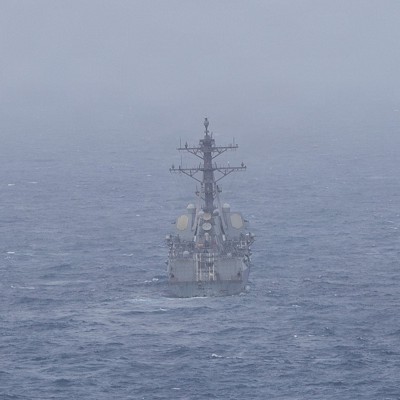
The Arleigh Burke-class guided-missile destroyer John Finn (DDG 113) sails in the Arabian Sea on June 16, 2026. U.S. Navy
That's what officials are telling sailors' families in Japan, where two destroyers are slated for 12- and 14-month cruises.
When the U.S. Navy destroyer John Finn left home in January, sailors expected to be home in March. Now, after extensions on top of extensions, their families have been told to expect them next March—after a 14-month deployment.
The Mustin, another Arleigh Burke-class destroyer, switched homeports this year, leaving San Diego in February and arriving in Yokosuka, Japan, in March . As the sailors stepped off the ship, they were told they needed to be ready to deploy “tomorrow.”
The Mustin actually left Japan in April for a deployment that was supposed to end in August. Now its crew has been told they will return in April 2027, the spouse of one of the sailors told Defense One .
These marathon deployments—a month or more longer than the carrier Abraham Lincoln’s record-breaking 322 days—may be the new normal for U.S. warships. Last week, a Navy official told families at Yokosuka that all ship deployments and patrols, stateside and overseas, will be 10 to 12 months long for the foreseeable future.
Asked about that statement, a Navy spokesperson told Defense One , “It is U.S. Navy policy not to discuss future operations or movements due to operations security.”
But last month, Chief of Naval Operations Adm. Daryl Caudle said that sailors and their families should expect “longer deployments” until “I can grow the Navy we need.” The service’s battle force currently consists of about 290 warships , down from 295 two years ago but up from about 275 a decade ago.
In recent decades, the Navy has generally kept deployments to six or seven months, although that is not a set-in-stone policy, said Katherine Kuzminski, vice president of studies at the Center for a New American Security. But, she said, “that commitment is being violated now.”
“Certainly, depending on operational needs and demands, I think service members and their families are fully on board with providing—with the requirements that are put on them in ongoing operations,” Kuzminski said. “A potential way that the Navy can mitigate this is actually to just commit to the longer term upfront and be clear with service members and their families.”
After initial reports of the Lincoln’s woes emerged , some veterans of other services and other conflicts were quick to post online about their own longer deployments. But the issue, Kuzminski said, is not so much the length of the deployment, but the “dissonance between what was said at the beginning and what is happening in actuality.”
That dissonance is particularly pronounced for the John Finn, one of several “forward deployed” guided-missile destroyers based at Yokosuka. While other Navy ships tend to deploy for about six months and then return home for a year, forward-deployed ships typically leave for two or three months at a time, then return to port for two to three months of maintenance before heading back out to sea. Those deployments are designed to keep the ships ready for combat in the region, deter aggression from China, and “maintain a free and open Indo-Pacific.”
Last year, the John Finn left home in June for a “normal” deployment in the region and returned in early November. But much of the following two months were spent in hasty preparations to return to sea.
“We really only saw him a collective 20 days,” the spouse of a sailor on the ship told Defense One .
In early January, the ship left again, for what was expected to be a deployment of perhaps 45 to 60 days. It headed to the Indian Ocean and was involved in the boarding of a Venezuelan oil tanker before being directed to the Arabian Sea, shortly before Operation Epic Fury began.
The ship was part of the initial attack on Iran , the spouse said, and they’re “still there.”
Earlier this month, the sailors were told they would likely not be home until March 2027.
“There’s cars that were left on base that have been stickered to be towed and then to be junked. So there’s sailors that are going to come back and have no cars,” the spouse said. “They left in the winter months, and there’s some sailors that live off base and are single sailors and will have abandoned their entire house, their apartment, for over a year. And when they left in the winter months, when they left everything on heat mode, and then the summer came.” Sailors know “that they’re going to come home and all their stuff will be trashed.”
For families, it’s more than a year without a parent—without any of the planning for a long deployment.
“It’s been absolutely gut-wrenching to my kids,” the spouse said, and there is “next to no mental health support” available on base. The deployment length is “absolutely unheard-of for a destroyer,” she said.
The Finn’s story is extreme—but not unique among Yokosuka-based destroyers.
Photos posted on the Pentagon’s DVIDS media site show the Rafael Peralta in the Philippine Sea in November , in the South China Sea in December , and back in the Philippine Sea on Jan. 8. Then, instead of returning home, it headed for the Middle East in April, where it remains today. Families have been told not to expect the ship home until April 2027.
The Higgins, which lost power and propulsion for a few hours in the Indo-Pacific in April, continued its deployment after repairs and is currently operating in the Indian Ocean. The Milius left Japan in February and has been in the Middle East since March .
The Mustin left its old homeport of San Diego in February and arrived in Japan in March. Sailors are usually given 30 days to help their families move and settle in for a homeport shift, particularly when the move is to a foreign country, and the majority of the families had waited until the ship arrived to make the move. But “the moment they pulled in, my husband stepped off the ship, and he goes, ‘We have to be prepared to leave tomorrow,” a Mustin spouse told Defense One .
The ship did stay in its new port for a few weeks because of a sonar problem that required an expert to fly in to fix it, but sailors did not get time off during that time frame because they needed to be ready at a moment’s notice, the spouse said. They left in April with the expectation that they would return in August and then go out again over the holidays before monthslong scheduled maintenance beginning in February.
But when August came, the ship’s commander told the sailors they would be out for “about another month,” the spouse said. A few weeks ago, they were told they wouldn’t be home until April 2027.
The situation is all the more frustrating for sailors and families because the ship has spent virtually the entire deployment in the Indian Ocean as “backup.”
“They’re not in the blockade, they’re like the next in line, just out there waiting,” she said.
The distinction means that the Mustin sailors don’t get combat pay or benefits.
“I know they feel forgotten about,” she said.
The John Finn spouse said it has been frustrating for families and sailors to read all the media coverage of the Lincoln’s long deployment, while knowing that other ships supporting her were “left behind.”
“I can do a long deployment,” she said. “The problem with this is that there is no answer as to when this will be over. … Why are we not rotating ships? And then why are we there? Why are you sending home stateside ships before your forward deployed ships?”
In response to questions about why the ships have not been replaced, a Navy spokesperson said, “The Department takes a thoughtful and deliberate approach to global force management, continually balancing immediate operational requirements against risks across theaters.”
If longer deployments increasingly become the norm, Kuzminski said, it’s important that the Navy be upfront with sailors and their families about what to expect.
But the situation highlights another problem: The Navy doesn’t have a confirmed civilian secretary, “a person who is fundamentally the accountability to Congress on how things are working,” she said.
Without a Navy secretary, she said, it’s hard to answer the big questions: “Is this the new normal? How are you handling that? How are we preparing sailors for that? How are we preparing their families for that? How are we preparing our ships for that?”
NEXT STORY: Qatar looks to bolster its military power with new hub, partnerships
2026年6月16日,阿利·伯克级导弹驱逐舰“约翰·芬”号(DDG 113)在阿拉伯海航行。美国海军
官员们正在向驻日水兵的家属们传达这一信息,两艘驱逐舰计划分别进行为期 12 个月和 14 个月的巡航。
今年1月,美国海军驱逐舰“约翰·芬恩”号离开母港时,水兵们预计3月就能回家。然而,经过一再延期,他们的家人被告知要等到明年3月才能见到他们——这意味着他们将在长达14个月的部署期后返回。
“穆斯汀”号是另一艘阿利·伯克级驱逐舰,今年更换了母港,2月离开圣地亚哥,3月抵达日本横须贺。水兵们下船时被告知,他们需要做好“明天”部署的准备。
据《Defense One》报道,一名水兵的配偶透露,穆斯汀号航母实际上于今年4月离开日本,开始执行原定于8月结束的部署任务。但现在,船员们被告知他们将于2027年4月返回。
这些马拉松式的部署——比“亚伯拉罕·林肯”号航母创下的322天纪录还要长一个月甚至更久——可能成为美国军舰的新常态。上周,一位海军官员在横须贺向家属们表示,在可预见的未来,所有舰艇的部署和巡逻,无论是在美国本土还是海外,都将持续10到12个月。
当被问及此事时,海军发言人告诉Defense One:“出于行动安全考虑,美国海军的政策是不讨论未来的行动或调动。”
但上个月,海军作战部长达里尔·考德尔海军上将表示,在“我能扩充到我们需要的海军规模”之前,水兵及其家属应该做好“部署时间延长”的准备。目前,海军的作战力量由约290艘军舰组成,比两年前的295艘有所减少,但比十年前的约275艘有所增加。
新美国安全中心研究副总裁凯瑟琳·库兹明斯基表示,近几十年来,海军通常将部署时间控制在六到七个月,尽管这并非一成不变的政策。但她也指出,“现在这一承诺正遭到违背。”
库兹明斯基说:“当然,这取决于作战需要,我认为军人和他们的家属完全愿意承担在持续作战行动中对他们提出的要求。海军可以采取的一个潜在缓解措施是,提前做出长期承诺,并与军人和他们的家属明确沟通。”
在林肯号航母遭遇困境的最初报道出现后,一些其他军种和参与过其他冲突的老兵迅速在网上分享了他们自己更长时间的部署经历。但库兹明斯基表示,问题不在于部署时间的长短,而在于“最初的说法与实际情况之间的不符”。
这种不协调在“约翰·芬恩”号上尤为明显,它是驻扎在横须贺的几艘“前沿部署”导弹驱逐舰之一。其他海军舰艇通常部署约六个月后返回母港休整一年,而前沿部署舰艇通常每次出海两到三个月,然后返回港口进行两到三个月的维护,之后再出海。这些部署旨在保持舰艇在该地区随时待命,遏制中国的侵略行为,并“维护自由开放的印太地区”。
去年,约翰·芬恩号于6月离开母港,前往该地区进行“常规”部署,并于11月初返回。但接下来的两个月大部分时间都用于匆忙准备再次出海。
“我们总共只见过他 20 天,”船上一名水手的配偶告诉《国防一号》杂志。
1月初,这艘军舰再次启航,预计部署时间可能为45至60天。它前往印度洋,参与了对一艘委内瑞拉油轮的登船行动,之后被派往阿拉伯海,不久后“史诗狂怒行动”开始。
配偶说,这艘船是最初袭击伊朗行动的一部分,他们“仍然在那里”。
本月初,水手们被告知他们可能要到 2027 年 3 月才能回家。
“有些车被留在基地里,贴上了拖车标签,准备报废。所以有些水兵回来后就没车开了,”这位配偶说。“他们是在冬天离开的,有些水兵住在基地外,而且是单身,他们把房子、公寓都弃置了一年多。冬天离开的时候,他们把所有东西都开着暖气,结果夏天来了。”水兵们都知道“他们回来后所有的东西都会被扔掉”。
对于家庭来说,这意味着一年多的时间里没有父母陪伴——而且没有任何针对长期部署的计划。
“这对我的孩子们来说简直是晴天霹雳,”这位配偶说道,而且基地里“几乎没有任何心理健康支持”。她还表示,这样的部署时长对于一艘驱逐舰来说“绝对是闻所未闻的”。
“芬兰号”的遭遇虽然极端,但在横须贺的驱逐舰中并非个例。
五角大楼国防信息与数据系统(DVIDS)媒体网站上发布的照片显示,“拉斐尔·佩拉尔塔”号航母11月出现在菲律宾海,12月出现在南海,1月8日再次出现在菲律宾海。之后,它没有返回美国,而是于4月前往中东,至今仍停留在那里。家属已被告知,该舰最早也要到2027年4月才能返回美国。
“希金斯”号潜艇4月份在印度洋-太平洋地区失去动力和推进系统数小时后,经过维修继续部署,目前正在印度洋执行任务。“米利厄斯”号潜艇2月份离开日本,自3月份以来一直在中东地区执行任务。
“穆斯汀”号于二月离开其原母港圣地亚哥,三月抵达日本。通常情况下,水兵们有30天的时间帮助家人搬家安顿下来,尤其是在母港调动到国外时。大多数家属都等到军舰抵达后才开始搬家。但一位“穆斯汀”号的家属告诉《防务一号》:“军舰一靠岸,我丈夫一下船就说,‘我们得做好明天离开的准备。’”
由于声呐系统出现故障,需要专家飞来维修,这艘船在新的港口停留了几个星期。但水手们在此期间没有休假,因为他们需要随时待命,这位配偶说道。他们四月份离开,预计八月份返回,然后在假期再次出海,之后从二月份开始进行长达数月的例行维护。
但到了八月,舰长告诉水兵们他们还要出海“大约一个月”,这位配偶说。几周前,他们又被告知要到2027年4月才能回家。
对于水兵和他们的家人来说,这种情况更加令人沮丧,因为这艘军舰几乎整个部署期间都在印度洋担任“后备”任务。
“他们不在封锁线内,他们就像是排在后面的人,就在那里等着呢,”她说。
这一区别意味着穆斯廷号上的水兵无法获得战斗津贴或福利。
“我知道他们觉得自己被遗忘了,”她说。
约翰·芬恩的配偶表示,看到媒体对林肯号航母长期部署的报道,而其他支援它的舰船却“被留在了后面”,这让家属和水兵们感到沮丧。
“我可以长期部署,”她说。“问题在于,我们不知道这场部署何时才能结束……为什么我们不轮换舰艇?而且我们为什么还要待在那里?为什么你们要先把驻扎在美国本土的舰艇送回基地,而不是让前沿部署的舰艇返回?”
针对为何这些舰艇没有被替换的问题,海军发言人表示:“海军部对全球兵力管理采取深思熟虑的方式,不断权衡当前作战需求与各战区风险。”
库兹明斯基表示,如果更长时间的部署成为常态,那么海军就必须坦诚地告诉水兵及其家人将会发生什么。
但这种情况凸显了另一个问题:海军没有一位正式的文职部长,“这个人从根本上来说要对国会负责,说明海军的运作情况,”她说。
她说,由于没有海军部长,很难回答一些重大问题:“这是新常态吗?你们是如何应对的?我们如何让水兵们为此做好准备?我们如何让他们的家人为此做好准备?我们如何让我们的舰艇为此做好准备?”
下一篇报道:卡塔尔寻求通过新的军事中心和合作伙伴关系来增强其军事实力