Watch This C-17 Engage Its Thrust Reversers In Mid-Air To Make An Extremely Rapid Descent观看这架C-17运输机在空中启动反推装置,实现极速下降
The reverse idle tactical descent is a pretty incredible way to lose altitude, and quickly.
新闻视频
Updated Aug 3, 2021 8:52 PM EDT
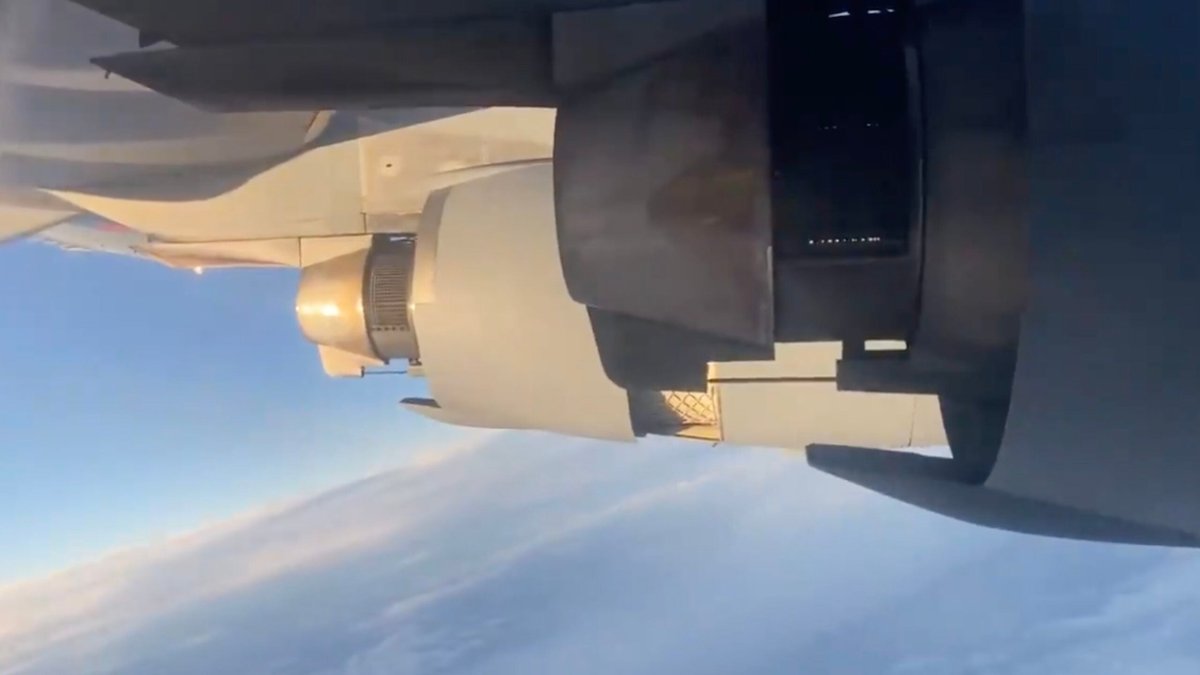
The ever-impressive C-17 Globemaster III military transport aircraft has recently been the focus of The War Zone’ s attention when it comes to getting off the ground, in the form of an eye-catching short-field tactical departure . Now, thanks to the U.K. Royal Air Force (RAF), we’ve got the chance to see another of the big airlifter’s unique attributes — the ability to deploy the thrust reversers on its engines in-flight to provide a quick descent from its cruising altitude perch.
The C-17’s thrust reversers are normally used to deflect the airflow from the four Pratt & Whitney F117-PW-100 turbofan engines upward and forward when landing. By diverting the thrust in the opposite direction, it can reduce the distance required to come to a stop to around 3,000 feet or less, and provide access to smaller, austere airstrips .
An RAF C-17 performing a ‘touch-and-go’ at its RAF Brize Norton base., Crown Copyright
On the ground, with the engines running in reverse idle, the thrust reversers also keep jet wash away from the rear of the aircraft, which is especially useful when loading or unloading via the ramp.
The Tweet below from 99 Squadron showcases the manuever:
In fact, so effective are the thrust reversers that they can even be used to propel the aircraft backward on the ground, which can be ideal for reversing backward on shorter airstrips, for example. They can even push a fully loaded Globemaster up a two-degree slope if required.
Another function of the thrust reversers is less well known, but thanks to a recent video from No. 99 Squadron, the RAF’s sole C-17 operator, we have a rare chance to see a “reverse idle tactical descent” during a seven-hour training sortie around the United Kingdom on July 29.
In this particular procedure, the thrust reversers are engaged in flight to enable a maximum-rate descent. As the caption to No. 99 Squadron’s video explains, the C-17 seen here drops from a cruising altitude of 30,000 feet to 5,000 feet in just two minutes, although this is “not even close to max performance for this beast!”
Flightpath of RAF C-17 ZZ174 on its July 29 training sortie. Reverse idle descents were conducted in the Norfolk and Cotswolds/Worcestershire areas, shown here in blue., ADS-B Exchange
As the squadron goes on to explain, once the thrust reversers are engaged in flight, the pilots ensure that the C-17’s speed is maintained by adjusting the aircraft’s attitude. That can be seen in the video, with the dramatic relationship between the horizon and the angle of the wing.
“The low nose attitude needed to maintain speed is part of what causes the massive rate of descent,” No. 99 Squadron explains, “Speed brakes are also used, for an even higher decent rate. Higher speed also means higher rates [of descent].”
The unit goes on to state that the in-flight thrust reversal is primarily used for “Getting on the deck as quickly as possible” and it is “unlikely to be used in an emergency due to the highly dynamic nature of it, but you never know.”
One can imagine how the maneuver could be useful for dropping from normal cruise to low altitude for penetrating into or near contested airspace or even landing at an airfield in hostile territory without flying low over dangerous areas that a normal descent could mandate.
As for the physiological effect on the crew, this is reportedly limited to vibration felt through the aircraft: “From the cockpit, the amount the wings and nacelles shake with all four [engines] in reverse is also quite incredible.” Otherwise, the automatic cabin pressurization system ensures this maneuver is relatively kind on the ears and body, and the forces imparted are somewhere between 0.0 and 2.0G.
The War Zone spoke to former RAF C-17 pilot Andy Netherwood about the reverse idle tactical descent, which he described as a “great party trick and fun to fly,” although noting that even without the thrust reversers engaged, the C-17 has a seriously impressive rate of descent.
“There is no risk of stall and it’s fairly simple to fly,” Netherwood explained. “Idle, slow down, configure, idle reverse then chase the flight director as it drops off the bottom of the head-up display! The amount of ground in the windscreen is more than transport pilots are used to seeing, but otherwise, it’s straightforward.”
While the maneuver could potentially be a vital tool to ensure the survival of the C-17 in a combat zone, it also speaks to the versatility of the airlifter, a hallmark that ensures its status as one of the most in-demand military transports among the air arms fortunate enough to operate it.
Contact the author: thomas@thedrive.com
Comments couldn’t be loaded. Please refresh the page.
更新于美国东部时间2021年8月3日晚上8:52
令人印象深刻的C-17“环球霸王III”军用运输机最近因其惊人的短距战术起飞能力而成为《战区》节目的关注焦点。现在,感谢英国皇家空军(RAF),我们有机会一睹这款大型运输机的另一项独特功能——在飞行中启动发动机反推装置,从而从巡航高度快速下降。
C-17运输机的反推装置通常用于在着陆时将四台普惠F117-PW-100涡扇发动机的气流向上向前偏转。通过将推力反向偏转,它可以将飞机的减速距离缩短到3000英尺甚至更短,从而使其能够在小型、简易的跑道上起降。
一架英国皇家空军C-17运输机在其布里兹诺顿皇家空军基地进行“触地复飞”演练。(英国皇家版权所有)
在地面上,发动机处于反向怠速运转状态,反推装置还可以使喷气发动机尾流远离飞机尾部,这在通过坡道装卸货物时特别有用。
以下这条来自99中队的推文展示了这一战术:
事实上,反推装置非常有效,甚至可以用于在地面上向后推动飞机,例如,这对于在较短的跑道上倒车非常理想。必要时,它们甚至可以推动满载的环球霸王飞机爬上两度斜坡。
反推装置的另一个功能鲜为人知,但多亏了英国皇家空军唯一 C-17 运营商第 99 中队最近发布的一段视频,我们才有机会看到 7 月 29 日在英国上空进行的 7 小时训练飞行中出现的“反向怠速战术下降”。
在这个特定的程序中,反推装置在飞行中启动,以实现最大下降率。正如第99中队视频的说明文字所解释的那样,视频中出现的这架C-17在短短两分钟内从30000英尺的巡航高度下降到5000英尺,尽管这“远未达到这架巨兽的最大性能!”
英国皇家空军C-17运输机ZZ174于7月29日执行训练任务时的飞行轨迹。图中蓝色区域显示了诺福克郡和科茨沃尔德/伍斯特郡地区的反向怠速下降情况。(ADS-B交换)
正如该中队进一步解释的那样,一旦在飞行中启用反推装置,飞行员就会通过调整飞机姿态来确保C-17的速度保持不变。这一点可以从视频中看出,地平线与机翼角度之间存在着显著的关系。
第99中队解释说:“为了保持速度,飞机需要保持较低的机头姿态,而这正是造成巨大下降率的原因之一。此外,还会使用减速板,以获得更高的下降率。速度越高,下降率也就越高。”
该单位还指出,飞行中反推力主要用于“尽快降落到甲板上”,并且“由于其高度动态的特性,不太可能在紧急情况下使用,但谁也说不准”。
人们可以想象,这种机动方式对于从正常巡航高度下降到低空,从而进入或靠近敌对空域,甚至在敌对领土的机场降落,而无需像正常下降那样低空飞越危险区域,会是多么有用。
至于对机组人员的生理影响,据报道仅限于飞机内部的振动:“从驾驶舱来看,四台发动机全部反向运转时,机翼和发动机舱的震动幅度也相当惊人。”此外,自动客舱增压系统确保了这一操作对耳朵和身体的冲击相对较小,产生的重力加速度在0.0到2.0G之间。
《战区》采访了前英国皇家空军 C-17 飞行员安迪·内瑟伍德,谈到了反向怠速战术下降,他将其描述为“一个很棒的派对绝技,而且飞行起来很有趣”,尽管他指出,即使不启用反推装置,C-17 的下降率也相当惊人。
“没有失速的风险,而且飞行起来相当简单,”内瑟伍德解释说。“怠速、减速、配置、怠速反推,然后跟着抬头显示器底部的飞行指引线走!挡风玻璃上的地面视野比运输机飞行员通常看到的要大,但除此之外,操作起来很简单。”
虽然这种机动可能成为确保 C-17 在战区生存的重要手段,但也体现了该运输机的多用途性,这一特点确保了它成为有幸操作它的空军部队中最受欢迎的军用运输机之一。
联系作者:thomas@thedrive.com
评论加载失败,请刷新页面。