US Navy Destroyers And Royal Navy Ships Use These Big Blow-Up Anti-Ship Missile Decoys美国海军驱逐舰和英国皇家海军舰艇使用这些大型可爆反舰导弹诱饵
They are a low-cost addition to ships' layered defenses used to counter anti-ship missiles and the Royal Navy want to invest in improved models.
新闻视频
By Joseph Trevithick
Updated Dec 1, 2019 6:46 AM EST
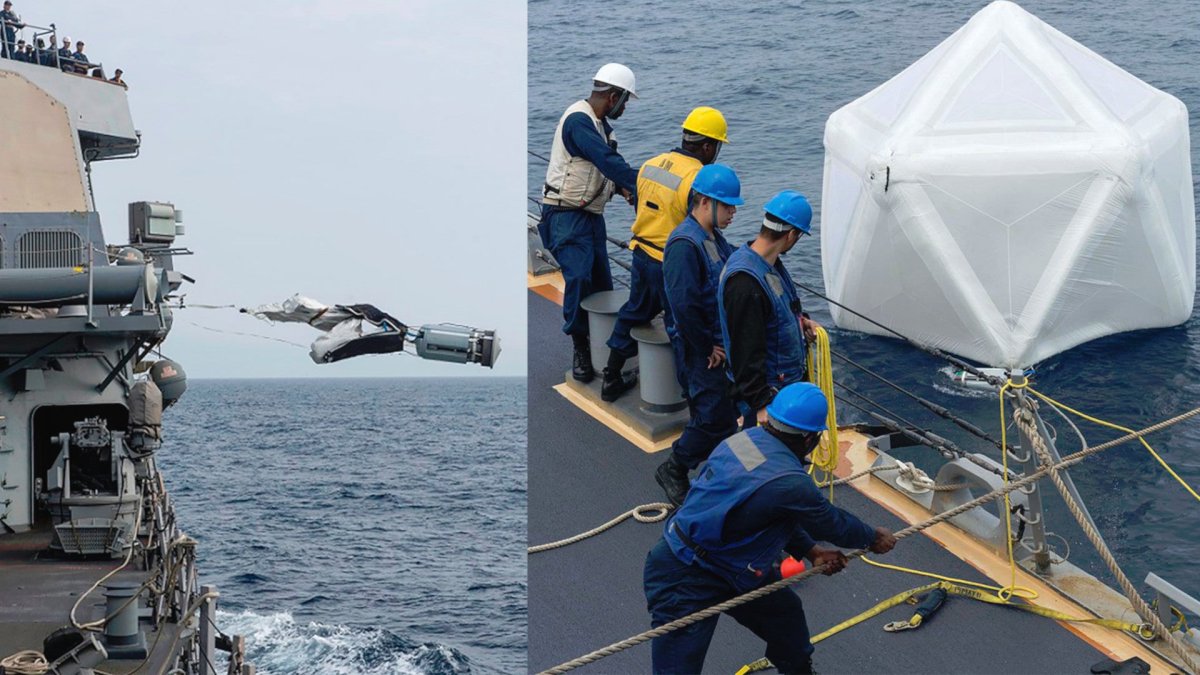
The U.S. Navy’s Arleigh Burke -class destroyers have a comprehensive suite of defenses to shield against anti-ship missiles, including chaff canisters, active decoys that generate confusing electromagnetic signatures, electronic warfare suites , and “hard kill” close-in weapon systems . But they also have the ability to launch passive radar-reflecting decoys that inflate like a huge, oddly-shaped beach ball to entice incoming missiles, a system that came by way of the United Kingdom. Now, the U.K. Royal Navy, which was first to adopt these decoys, is looking to buy an improved design as it looks to expand its global reach .
Jane’s 360 was first to report the United Kingdom was looking for a new floating decoy as part of a program known as the Naval Passive Off-Board Decoy (N-POD), on Mar. 3, 2019. This new system will replace the existing IrvinGQ Outfit DLF-3B that the Royal Navy uses at present across various classes of warships and smaller craft, including offshore patrol vessels and minesweepers. This is the same one the U.S. Navy has on its Arleigh Burke s, but the service has given it its own designation as the Mk 59 decoy launching system.
The U.K. Ministry of Defense’s Defense Equipment and Support (DE&S) office announced it was “considering replacing the current floating offboard decoy system … with a similar system,” in a notice on Feb. 18, 2019, according to Jane’s . However, the exact requirements are classified “Secret-U.K. Eyes Only,” which also prohibits bids from companies outside of the country.
The existing DLF-3B, also known variously as the Inflatable Decoy System 300 (IDS 300) or Floating Decoy System 3 (FDS3), consists of launchers on the ship’s deck, each containing an un-inflated hexagonal decoy. When fired, the lid of the launch canister, which also includes the inflation system, pulls the decoy out and into the water.
After the decoy inflates, the lid acts as a drag anchor to keep it relatively stable. The decoy itself is made of a highly radar-reflective material that confuses and distracts incoming anti-ship missiles. It may even be enough to “seduce” the incoming threat to home in on and hit the decoy directly. It can remain afloat for more than three hours.
The system is relatively simple to install and links directly to the host ship’s own power supply. It also has a manual launch mode in case of a power loss.
Though we don’t know for sure, the U.K. Ministry of Defense’s call for a “similar system” and one that is still passive, suggests that the new N-POD will provide a similar type of defense, but with various improvements. These could include a shell made of materials more adept at bewildering radar seekers on incoming missiles, a shape that is also more enticing to those threats, or features that allow the decoy to inflate faster and remain afloat longer, even in poor weather.
The DLF-3B, as its name would imply is already the fourth iteration of IrvinGQ’s decoy system. The original DLF-1 was actually a direct copy of a Soviet design and featured a spherical decoy, which saw only very limited service. This was followed by the more angular DLF-2 and -3, which also incorporated lessons learned from the Royal Navy’s experiences during the Falklands War .
The decoys from earlier DLF-series systems., via Federation of American Scientists
During the Falklands, Argentinian forces sunk or damaged a number of British ships with French-made Exocet anti-ship missiles, as seen in the video below. These strikes, along with other lessons learned during the conflict, prompting a significant reassessment of Royal Navy shipboard air and missile defenses in the years that followed.
In the 1980s, the U.S. Navy was seeing risks posed by anti-ship missiles itself. In 1987, an Iraqi Mirage F1 fired Exocet missiles at the U.S. Navy’s Oliver Hazard Perry -class frigate USS Stark sailing in the Persian Gulf on the sidelines of the Iran-Iraq war, killing 37 sailors and injuring 21 more. The following year it began trials of earlier model DLF-series decoys, eventually adopting these as the AN/SLQ-49 decoy system, which subsequently earned the nickname “rubber duck.”
By the 1990s , British surface ships from its Type 42 destroyers to small offshore patrol vessels all had provisions for DLF-series decoys, though they were often only actually installed based on the potential risk of attack. The U.S. Navy had similarly installed the AN/SLQ-49 on all major surface combatants, including its aircraft carriers, as well as various large auxiliary vessels.
In the aftermath of the Cold War, American warships steadily saw their rubber ducks withdrawn from service as the apparent threat of a major naval confrontation appeared to recede. The decoys continued to be available for ships throughout Royal Navy, as necessary, though.
At the same time, the threat of anti-ship cruise missiles has only expanded in size and scope. Major potential adversaries, such as Russia and China , continue to develop more capable, faster-flying, and longer-range air-, sea-, and ground-launched types. Smaller nations, such as Iran , also have growing anti-ship missile arsenals and the threat is proliferating down to even non-state actors .
The United Kingdom is also hoping to expand its own naval capabilities and its maritime presence globally , including sending ships to places such as the hotly contested South China Sea . China has been building up an archipelago of man-made islands in this region with various shore-based defenses , including anti-ship missiles .
Trucks carry Chinese supersonic YJ-12 anti-ship missiles during a parade., Imaginechina via AP
These plans for an expanded maritime force posture only increase the demand for new and improved anti-missile defenses. DLF-3B will already be a feature on the Royal Navy’s future Type 26 frigates and the improved N-POD could offer some additional protection for the United Kingdom’s new and woefully under-defended supercarrier HMS Queen Elizabeth .
Of course, the DLF-series of decoys only provide a defense against radar-guided missiles and would not necessarily be able to defeat weapons with multi-mode guidance systems, including imaging infrared seekers. N-POD could have similar limitations. But they’re also supposed to be just one component of a layered defensive arrangement that includes other active and passive defense systems, such as chaff canisters, active decoys that generate their own confusing electromagnetic signatures, electronic warfare suites , and “hard kill” close-in weapon systems .
The DLF-series of decoys have offered a cost-effective addition to those other defenses, with earlier systems, consisting of eight decoys in pairs positioned around a ship, reportedly costing as little as $100,000 in total . Even the improved N-POD is likely to be cheaper than many other defensive options available on the market. Individual Nulka decoys, in service with the U.S. and Australian navies, which actively produce a signature similar to that of a large warship to distract incoming anti-ships missiles, cost more than $1 million each , according to recent U.S. Navy budget documents .
Presented with this reality itself, the U.S. Navy began using inflatable decoys again in 2013. That year, the service started installing the DLF-3B system on Arleigh Burke -class destroyers . It’s not clear if other American ships have received the system since then, as well.
It is very possible that the United States could follow the United Kingdom’s lead again with the N-POD program. The United Kingdom might also seek to work together with other allies and partners who might be interested in the decoys.
The crew of the Arleigh Burke -class destroyer USS Ramage test fire the then-new Mk 59 Mod 0 decoy launching system in 2013., USN
As part of its aforementioned plans to increase its posture in the Pacific region, the U.K. Ministry of Defense has notably touted its relationship with its Australian counterpart , which are in the process of acquiring new destroyers and frigates that could be in need of added and improved defenses in the face of increasing regional challenges from the Chinese People’s Liberation Army Navy. NATO members France, Italy, and The Netherlands have purchased DLF-series systems in the past, as well, and could be interested in an improved version given growing concerns about potential threats from Russia.
At present, the U.K. Ministry of Defense hopes to have the first N-POD systems in service by 2023, according to Jane’s . The Royal Navy would then look to reach full operational capability with the decoys two years after that.
It will be interesting, figuratively and literally, to see how this new decoy system takes shape.
Contact the author: jtrevithickpr@gmail.com
Comments couldn’t be loaded. Please refresh the page.
作者:约瑟夫·特雷维西克
更新于美国东部时间2019年12月1日上午6:46
美国海军的阿利·伯克级驱逐舰配备了一套全面的防御系统来抵御反舰导弹,包括箔条干扰弹、产生干扰电磁信号的主动诱饵、电子战系统以及“硬杀伤”近程武器系统。此外,它们还能够发射被动式雷达反射诱饵,这种诱饵会像一个巨大的、形状奇特的沙滩球一样膨胀,以引诱来袭导弹。这套系统源自英国。如今,率先采用这种诱饵的英国皇家海军正寻求采购改进型,以扩大其全球作战能力。
简氏防务周刊360栏目于2019年3月3日率先报道,英国正在寻求一种新型海上浮式诱饵,作为一项名为“海军被动式离岸诱饵”(N-POD)计划的一部分。这套新系统将取代目前英国皇家海军在各类军舰和小型舰艇(包括近海巡逻舰和扫雷舰)上使用的IrvinGQ Outfit DLF-3B系统。美国海军在其“阿利·伯克”级两栖攻击舰上也装备了同一款系统,但美国海军将其命名为Mk 59诱饵发射系统。
据《简氏防务周刊》报道,英国国防部国防装备与保障办公室(DE&S)于2019年2月18日发布公告称,正在考虑“用类似系统替换现有的海上浮动诱饵系统”。然而,具体要求被列为“仅限英国内部人员查阅”的机密文件,这也意味着英国境外的公司无法参与竞标。
现有的DLF-3B,也称为充气诱饵系统300(IDS 300)或漂浮诱饵系统3(FDS3),由安装在舰艇甲板上的发射器组成,每个发射器内装有一个未充气的六边形诱饵。发射时,包含充气系统的发射筒盖会将诱饵拉出并放入水中。
诱饵充气后,盖子起到拖锚的作用,使其保持相对稳定。诱饵本身由高雷达反射材料制成,能够干扰和分散来袭反舰导弹的注意力。它甚至可能“引诱”来袭导弹直接锁定并击中诱饵。它可以漂浮三个多小时。
该系统安装相对简便,可直接连接到主机的电源。此外,它还具备手动启动模式,以防断电。
虽然我们无法确定,但英国国防部呼吁研发一种“类似系统”且仍保持被动防御,这表明新型N-POD将提供类似的防御能力,但会进行多项改进。这些改进可能包括:采用更能干扰来袭导弹雷达导引头的材料制造外壳;采用对威胁更具迷惑性的形状;或者增加一些功能,使诱饵能够更快充气并保持更长时间的漂浮,即使在恶劣天气下也能如此。
正如其名所示,DLF-3B已经是IrvinGQ公司诱饵系统的第四代产品。最初的DLF-1实际上是直接仿制苏联的设计,采用球形诱饵,但实际使用非常有限。之后推出了造型更加棱角分明的DLF-2和DLF-3,这两款产品也吸取了英国皇家海军在福克兰群岛战争中的经验教训。
早期DLF系列系统的诱饵。(图片来自美国科学家联盟)
在福克兰群岛战争期间,阿根廷军队使用法国制造的“飞鱼”反舰导弹击沉或击伤了多艘英国舰艇,如下方视频所示。这些袭击以及冲突中汲取的其他教训,促使英国皇家海军在随后的几年里对其舰载防空和导弹防御系统进行了重大重新评估。
上世纪80年代,美国海军自身也开始意识到反舰导弹带来的威胁。1987年,在两伊战争期间,一架伊拉克幻影F1战斗机向正在波斯湾航行的美国海军奥利弗·哈泽德·佩里级护卫舰“斯塔克”号发射了飞鱼导弹,造成37名水兵丧生,另有21人受伤。次年,美国海军开始试用早期型号的DLF系列诱饵,最终将其采用为AN/SLQ-49诱饵系统,该系统后来获得了“橡皮鸭”的绰号。
到了20世纪90年代,从42型驱逐舰到小型近海巡逻舰,英国水面舰艇都预留了DLF系列诱饵的位置,但实际上往往只有在面临潜在攻击风险时才会安装。美国海军也采取了类似的措施,在其所有主要水面作战舰艇(包括航空母舰)以及各种大型辅助舰艇上都安装了AN/SLQ-49诱饵。
冷战结束后,随着大规模海上冲突的威胁逐渐减弱,美国军舰上的橡皮鸭诱饵也陆续退役。不过,英国皇家海军的舰艇仍可根据需要继续使用这些诱饵。
与此同时,反舰巡航导弹的威胁规模和范围都在不断扩大。俄罗斯和中国等主要潜在对手仍在持续研发性能更强、飞行速度更快、射程更远的空射、海射和陆基反舰巡航导弹。伊朗等较小国家也在不断扩充其反舰导弹武库,这种威胁甚至蔓延至非国家行为体。
英国也希望扩大自身的海军能力和全球海上存在,包括向南海等争议激烈的地区派遣舰艇。中国一直在该地区建造人工岛礁,并部署了各种岸基防御设施,包括反舰导弹。
阅兵式上,卡车运载着中国超音速YJ-12反舰导弹。(图片来自Imaginechina via AP)
这些扩大海上力量部署的计划只会增加对新型和改进型反导防御系统的需求。DLF-3B反导系统将成为英国皇家海军未来26型护卫舰的标配,而改进型N-POD反导系统则有望为英国新型且防御能力严重不足的“伊丽莎白女王”号超级航母提供额外的保护。
当然,DLF系列诱饵只能防御雷达制导导弹,未必能有效拦截配备多模制导系统的武器,包括成像红外导引头。N-POD也可能存在类似的局限性。但它们也应该只是多层防御体系中的一个组成部分,该体系还包括其他主动和被动防御系统,例如箔条干扰弹、能够产生自身干扰电磁信号的主动诱饵、电子战系统以及“硬杀伤”近程武器系统。
DLF系列诱饵为其他防御措施提供了一种经济高效的补充。据报道,早期的DLF系统由8个诱饵两两组合环绕舰艇部署而成,总成本低至10万美元。即使是改进后的N-POD系统,其价格也可能低于市场上许多其他防御方案。根据美国海军最近的预算文件,目前美国和澳大利亚海军正在使用的Nulka诱饵,其单个造价超过100万美元。Nulka诱饵能够主动产生类似于大型军舰的信号特征,以干扰来袭的反舰导弹。
面对这一现实,美国海军于2013年重新开始使用充气诱饵。同年,海军开始在阿利·伯克级驱逐舰上安装DLF-3B系统。目前尚不清楚此后其他美国舰艇是否也装备了该系统。
美国很有可能再次效仿英国,推出N-POD项目。英国也可能寻求与其他对诱饵感兴趣的盟友和伙伴合作。
2013年,美国海军“阿利·伯克”级驱逐舰“拉马奇”号的船员试射了当时新型的Mk 59 Mod 0诱饵发射系统。
作为其上述加强在太平洋地区军事部署计划的一部分,英国国防部特别强调了与澳大利亚国防部的关系。澳大利亚正在采购新型驱逐舰和护卫舰,面对中国人民解放军海军日益增长的地区挑战,这些舰艇可能需要增强和改进防御能力。北约成员国法国、意大利和荷兰过去也曾购买过DLF系列系统,鉴于对俄罗斯潜在威胁的日益担忧,它们可能对改进型系统感兴趣。
据《简氏防务周刊》报道,英国国防部目前希望首批N-POD系统能在2023年投入使用。皇家海军则计划在此两年后实现诱饵系统的全面作战能力。
从字面意义和比喻意义上来说,观察这个新的诱饵系统如何成形将会很有趣。
联系作者:jtrevithickpr@gmail.com
评论加载失败,请刷新页面。