Two 28-year-olds swop stable jobs to open $10,000 pasta stall Casa Osteria in Serangoon Gardens两名28岁的年轻人放弃稳定的工作,在实龙岗花园开设了一家价值1万美元的意大利面摊位Casa Osteria。
Two friends quit jobs and started Casa Osteria as a home-based business and now run a pasta stall at Chomp Chomp Food Centre. Read more at straitstimes.com.
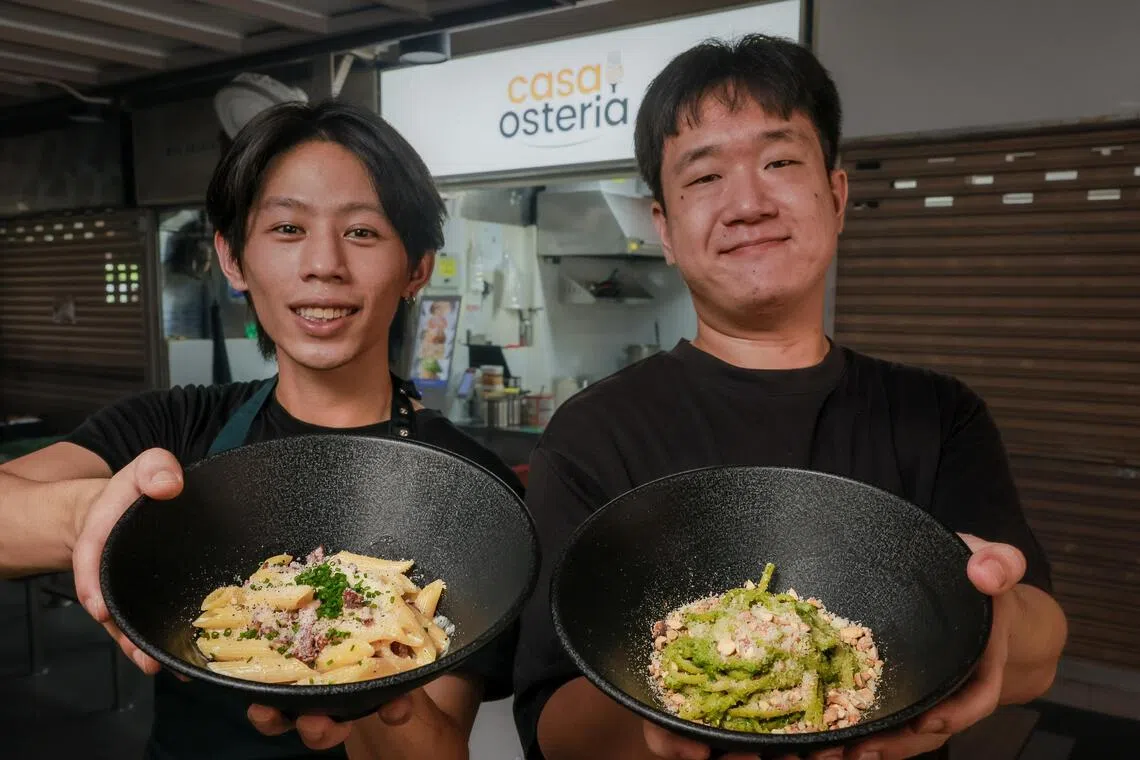
Jerome Chin (left) and Michael Lam with plates of Penne Carbonara and Linguine Pesto at their hawker stall, Casa Osteria, at Chomp Chomp Food Centre.
Published Oct 24, 2026, 08:45 AM
Updated Oct 24, 2026, 08:45 AM
Michael Lam and Jerome Chin spent $5,000 to start Casa Osteria as a home-based business.
Their orders grew fast, from one a day to more than 400 portions by April 2026. In August, they opened as a hawker stall using $10,000.
They now want to keep quality high and avoid expanding too quickly. They are working with a food factory and hope to open up to five outlets in two years.
SINGAPORE – When punishing hours at his project-management job landed Michael Lam in hospital due to overwork, his parents urged him to find a less stressful job.
The 28-year-old quit his position as a project executive in January.
By then, he was already helping with the administration of Casa Osteria, a home-based pasta business he started with his best friend Jerome Chin, also 28, in March 2025. Chin handled the cooking and fulfilled orders from his parents’ five-room flat in Sengkang.
In August, the friends moved Casa Osteria into a hawker stall at Chomp Chomp Food Centre. They now work there full-time, six days a week, from about 11.30am to 10pm on weekdays and 11.30pm on weekends.
Lam acknowledges the irony of choosing another labour-intensive path after leaving a job that had taken a toll on his health.
With a wry smile, he says: “Aside from the tiredness, I am regulating myself well and the work is fulfilling.”
The former Beatty Secondary School classmates, close friends since Secondary 1, pooled $20,000 of their savings to start the business.
Lam’s last drawn monthly salary was $4,200, while Chin, whose last post was sous chef at private members’ wine club 67 Pall Mall, was earning $5,000 a month before he quit in January 2025.
Neither paid himself while Casa Osteria was home-based. They took home only $1,000 each for September and October.
Lam, who is single, says he does not have much opportunity to spend money, with the stall taking up most of his time. It is the same for Chin , whose 26-year-old Indonesian girlfriend of three years is based in Batam.
“We’re not getting rich running this stall,” Chin says with a chuckle.
The idea of going into business together was mooted in November 2024.
The two friends first mooted the idea of running a business together in November 2024. ST PHOTO: GAVN FOO
The two friends first mooted the idea of running a business together in November 2024.
Chin recalls: “Every time we met, which was almost weekly, we were spending on meals, movies or playing pool. I told Michael that we should meet to make money together instead.”
In the years since he graduated from ITE College West with a Nitec in culinary arts in 2016, Chin worked at chain restaurant Peperoni Pizzeria, restaurants Bar-A-Thym, Thevar and Tambi, and 67 Pall Mall.
He rose from cook to sous chef and wanted the chance to run a business of his own. “If I fail, I can go back to F&B,” he says. “Having a best friend and partner helped make it less intimidating . It is not as scary as going into it alone .”
Capitalising on strengths
The partnership capitalises on their individual strengths. While Lam has no formal culinary training, Chin says his friend is adept at handling paperwork and the business side.
After obtaining a Nitec in architectural design from ITE College Central in 2016, Lam worked as an architectural assistant, 3D modeller, drafter and project executive.
He was diagnosed with hyperthyroidism while serving national service in 2021. Stress and lack of sleep can aggravate his condition.
At his last job at an interior design firm, where he had to oversee commercial renovation projects, he often worked from 10pm to 6am, yet still had to report to the office during the day, for up to five hours.
One night in January, as he got up to go to the bathroom, both his legs went numb and gave way . His mother found him on the floor of the living room, unable to stand.
His father helped him onto an office chair, wheeled him out and drove him to Changi General Hospital, where he was hospitalised for three days. Lam resigned that month.
After quitting, he became more involved with Casa Osteria, going to Chin’s home about three times a week to pluck basil leaves, portion sauces and pack Grab orders.
Lam had started cooking at 14 because his parents travelled frequently and he had to settle his own meals. He also enjoyed helping his paternal grandmother prepare food for family gatherings. His first dish was fried rice and he later learnt dishes such as sweet-and-sour pork from her .
Going into F&B was an obvious choice for the two friends as cooking is Chin’s forte and Lam is a foodie too . They chose to specialise in pasta as it is a comfort food that locals take to and allows Chin culinary creativity in terms of the sauces.
“It is easy to find pasta everywhere , but it is not easy to find a good version,” adds Chin.
They spent about $2,000 on new equipment, including a two-door fridge with freezer, hand blenders, pots and pans, and another $3,000 on restaurant-grade ingredients. Chin’s parents, both 67 – his father is a car mechanic and his mother a part-time chef – agreed to let him use their home kitchen.
Chin handled cooking and preparation, while Lam set up the Grab account for their business which handled orders for delivery or self-pickup.
Chin made six sauces from scratch, including chilli crab sauce , staggering production through the week. The bolognese, made with minced beef, tomato and soffritto, took up to five hours.
The first two weeks were “miserable”, says Chin. On two days, they received just one order each and averaged about seven a day.
He had prepared 180 portions a week and began cutting back on prep. Then orders rocketed.
By the third week, they exceeded 200 portions. By the fourth, they were doing as many as 300.
“I was panicking that I didn’t have enough ingredients,” Chin says.
Salted egg sauce, which proved not as popular as the other options, was eventually replaced with spicy tomato-based arrabbiata sauce.
They drummed up sales with Grab discounts of up to 25%, although platform fees were about 30%. Orders came, but profits were thin.
Still, they recovered the initial $5,000 spent setting up the home-based operation in six months instead of the 10 months they had anticipated.
By April, they were making more than 400 portions, with some regulars ordering four or five times a week.
At that volume, a home kitchen was no longer sustainable. Customers were also asking for a physical place where they could dine in.
Spurred by disappointing meal
Their decision to move into a bricks-and-mortar space was cemented after a disappointing $120 meal at an Italian restaurant.
Chin found the seafood aglio olio so bland that he sent it back. Lam challenged him: Could he do better?
Chin took on the challenge and later invited Lam home for spaghetti with a tomato-based sauce and sous-vide chicken, pan-fried with herbs. His friend was impressed with the restaurant-quality meal.
It bolstered the duo’s belief that they could plug a gap in the market for affordable restaurant-style pasta priced below $20.
Chomp Chomp was a natural choice as the friends often dined there and they felt it had the potential for their business to grow.
Being in a partnership made starting a hawker stall less intimidating, say both partners. ST PHOTO: GAVIN FOO
Being in a partnership made starting a hawker stall less intimidating, say both partners.
They successfully bid for a Chomp Chomp stall in July and opened in August, spending about $10,000 on the set-up. To save money, they bought second-hand professional kitchen equipment.
About 60% of sales now come through Grab and 40% from dine-in customers.
One signature dish is Linguine Pesto ($13.90). Chin makes about 2kg of pesto a week with fresh basil, cashew nuts, Parmesan and olive pomace oil.
The basil is blanched, chilled and frozen before blending, so the heat from the blender does not discolour it. He uses cashews instead of pine nuts, a tip picked up from his restaurant days.
Pesto is made from scratch, using cashew nuts, for Linguine Pesto at Casa Osteria. ST PHOTO: GAVIN FOO
Pesto is made from scratch, using cashew nuts, for Linguine Pesto at Casa Osteria.
The other signature is Penne Carbonara ($13.90), which Chin readily admits “is not authentic, but is practical and lends itself to delivery”.
Instead of egg yolks, he uses Irish whipping cream infused with caramelised onion, bay leaf and thyme. Smoked duck replaces bacon, as the stall does not use pork or lard.
Fat rendered from smoked duck is used to prepare Penne Carbonara. ST PHOTO: GAVIN FOO
Fat rendered from smoked duck is used to prepare Penne Carbonara.
While he is willing to adapt for practicality, Chin will not compromise on the quality of the ingredients. Their Parmigiano Reggiano costs about $31 a kg, compared with cheaper alternatives at around $15.
Partnership built on trust
Before they started, Lam and Chin’s friends and family warned them about the pitfalls of doing business with a best pal . But the pair say 15 years of friendship have given them absolute trust in each other.
Chin runs the kitchen, while Lam handles marketing, paperwork and administration. When the business is in full swing, however, there is no horsing around.
It took Lam about a month to adapt to Chin’s cooking style and kitchen workflow. He can now prepare ingredients, stir-fry pasta and put orders together.
“When it is busy, we do not joke around,” says Chin. “I don’t talk to him like a friend. We go into work mode.”
Chin (left) and Lam prepare dishes at their hawker stall, Casa Osteria, at Chomp Chomp Food Centre. ST PHOTO: GAVIN FOO
Chin (left) and Lam prepare dishes at their hawker stall, Casa Osteria, at Chomp Chomp Food Centre.
Lam’s father, 48, a country manager in the fintech industry who once ran a zi char stall in Kim Keat Lane, had warned him about the heat and pressure behind the stove, especially given his health. So did his housewife mother, 51.
Lam’s father also advised the partners to look beyond simply keeping the business alive for two or three years.
They are now working with a food factory to produce Casa Osteria’s sauces and hope to start using the factory-produced sauces from February 2027 .
Using the food factory will lessen their preparation work and free up their time to think about expanding their business. Currently, it takes them five hours to prepare two sauces daily.
Neither regrets leaving a stable job to start Casa Osteria, but they are wary of expanding too quickly and jeopardising their reputation.
For now, they intend to focus on their current stall and hope to expand to up to five outlets in the next two years.
Where: 01-08 Chomp Chomp Food Centre, 20 Kensington Park Road Open: 4pm to 10pm, Tuesdays to Thursdays and Sundays, 4pm to 11.30pm, Fridays and Saturdays Info: @casaosteria.sg on Instagram
Hedy Khoo is senior correspondent at The Straits Times. She covers food-related news, from reviews to human interest stories.
Jerome Chin(左)和 Michael Lam 在 Chomp Chomp 美食中心的 Casa Osteria 小贩摊位前,手捧 Penne Carbonara 和 Linguine Pesto 两盘菜肴。
发布于 2026 年 10 月 24 日上午 8:45
更新于2026年10月24日上午8:45
Michael Lam 和 Jerome Chin 花费 5000 美元创办了 Casa Osteria,最初是一家家庭式企业。
他们的订单增长迅速,从每天一份增长到 2026 年 4 月的 400 多份。8 月,他们用 10,000 美元开设了一个小贩摊位。
他们现在希望保持高品质,避免扩张过快。他们正在与一家食品工厂合作,并希望在两年内开设至多五家分店。
新加坡——由于项目管理工作时间过长,Michael Lam 因过度劳累而住院,他的父母敦促他找一份压力较小的工作。
这位28岁的年轻人于1月份辞去了项目主管的职务。
那时,他已经开始协助管理 Casa Osteria,这是一家他和他最好的朋友 Jerome Chin(也是 28 岁)于 2025 年 3 月创办的家庭式意大利面生意。Chin 负责烹饪,并在他父母位于盛港的五房式组屋里完成订单。
八月份,朋友们将 Casa Osteria 搬到了 Chomp Chomp 美食中心的一个摊位。现在他们每周六天全职在那里工作,工作日从上午 11:30 到晚上 10 点,周末到晚上 11:30。
林承认,离开一份损害了他健康的职业后,选择另一条劳动密集型职业道路,这本身就具有讽刺意味。
他苦笑着说:“除了疲惫之外,我调整得很好,工作也很有成就感。”
这两位曾就读于比蒂中学的同学,从中学一年级起就是好朋友,他们拿出20000美元的积蓄创办了这家企业。
林先生最后领取的月薪为 4,200 美元,而陈先生在 2025 年 1 月辞职前,在私人会员制葡萄酒俱乐部 67 Pall Mall 担任副主厨,月薪为 5,000 美元。
Casa Osteria居家办公期间,他们两人都没有给自己发工资。九月和十月,他们每人只拿到了1000美元。
单身的林先生说,他没有太多机会花钱,因为摆摊占据了他大部分时间。陈先生的情况也一样,他26岁的印尼女友在巴淡岛生活,两人已经交往三年了。
“我们靠摆这个摊位是发不了财的,”秦笑着说。
2024年11月,双方提出了合伙创业的想法。
两位朋友于2024年11月首次提出合伙创业的想法。ST PHOTO:GAVN FOO
两位朋友于 2024 年 11 月首次提出了共同创业的想法。
Chin回忆说:“我们几乎每周都会见面,每次见面都花钱吃饭、看电影或打台球。我告诉Michael,我们应该见面一起赚钱。”
自 2016 年从 ITE 西区学院获得烹饪艺术 Nitec 证书以来,Chin 曾在连锁餐厅 Peperoni Pizzeria、Bar-A-Thym 餐厅、Thevar 和 Tambi 餐厅以及 67 Pall Mall 工作过。
他从厨师一路晋升为副主厨,一直渴望拥有自己的事业。“如果失败了,我还可以重操旧业,回到餐饮业,”他说。“有挚友兼合伙人,让我感觉没那么可怕。这比单枪匹马创业要轻松得多。”
发挥优势
这次合作充分发挥了他们各自的优势。林先生虽然没有接受过正规的烹饪训练,但陈先生表示,他的朋友擅长处理文书工作和业务运营。
2016 年从 ITE 中央学院获得建筑设计专业 Nitec 证书后,林先生曾担任建筑助理、3D 建模师、绘图员和项目主管。
他在2021年服兵役期间被诊断出患有甲状腺机能亢进。压力和睡眠不足会加重他的病情。
在他上一份室内设计公司的工作中,他负责监督商业装修项目,经常从晚上 10 点工作到早上 6 点,但白天仍然需要到办公室上班,最多可达 5 个小时。
一月份的一个晚上,他起身去洗手间时,双腿突然麻木,瘫倒在地。他母亲发现他倒在客厅的地板上,站都站不起来。
他父亲扶他坐到办公椅上,用轮椅把他推出去,然后开车送他到樟宜综合医院,他在那里住院三天。林郑月娥当月辞职。
辞职后,他更多地参与到 Casa Osteria 的事务中,每周大约三次去 Chin 家采摘罗勒叶、分装酱料和打包 Grab 订单。
林先生14岁就开始做饭,因为他的父母经常出差,他必须自己解决吃饭问题。他也喜欢帮奶奶准备家庭聚会的饭菜。他的第一道菜是炒饭,后来又跟奶奶学了糖醋里脊等其他菜肴。
对于这两位好友来说,进军餐饮业是顺理成章的选择,因为烹饪是Chin的强项,而Lam也是个美食爱好者。他们选择专攻意面,因为意面是当地人喜爱的家常美食,而且能让Chin在酱汁方面尽情发挥创意。
“意大利面随处可见,但好吃的意大利面却不容易找到,”Chin补充道。
他们花了大约2000美元购置新设备,包括一台带冷冻室的双门冰箱、手持搅拌机、锅碗瓢盆,又花了3000美元购买餐厅级别的食材。秦的父母都67岁了——他父亲是汽车修理工,母亲是兼职厨师——同意让他使用家里的厨房。
Chin负责烹饪和准备,而Lam则为他们的生意开设了Grab账户,处理送货或自取订单。
Chin亲手制作了六种酱料,包括辣椒蟹酱,为此他花了整整一周的时间分批制作。用牛肉末、番茄和炒香料制成的肉酱面,制作时间长达五个小时。
秦说,头两周“糟透了”。有两天他们每人只接到一个订单,平均每天也只有七个左右。
他之前每周准备180份,后来开始减少准备工作。结果订单量反而激增。
到第三周,他们的产量就超过了200份。到第四周,他们甚至达到了300份。
“我当时很慌张,担心食材不够,”秦说。
咸蛋黄酱不如其他酱料受欢迎,最终被辣味番茄酱取代。
他们通过Grab平台提供高达25%的折扣来刺激销售,尽管平台费用约为30%。订单确实来了,但利润却很微薄。
尽管如此,他们还是在六个月内收回了最初投入的 5000 美元,而不是他们预期的 10 个月。
到四月份,他们每天制作超过 400 份,一些常客每周订购四到五次。
如此大的订单量,家庭厨房已经无法维持运营。顾客们也希望有一个可以堂食的实体场所。
因一顿令人失望的饭菜而起。
在一家意大利餐厅享用了一顿令人失望的 120 美元晚餐后,他们更加坚定了搬进实体店面的决心。
Chin觉得海鲜蒜香橄榄油意面味道太淡,就退回去了。Lam向他发起挑战:他能做得更好吗?
Chin接受了挑战,之后邀请Lam到他家享用番茄酱意大利面和用低温慢煮法烹制、再用香草煎制的鸡肉。他的朋友对这顿堪比餐厅水准的晚餐赞不绝口。
这更加坚定了两人的信念,他们相信自己能够填补市场上价格低于 20 美元的平价餐厅级意大利面的空白。
Chomp Chomp 餐厅自然而然地成为了他们的选择,因为朋友们经常在那里用餐,他们觉得这家餐厅有潜力促进他们的业务发展。
两位合伙人都表示,合伙经营让开摊位这件事变得不那么令人畏惧。(海峡时报摄影:Gavin Foo)
两位合伙人都表示,合伙经营让开摊位这件事变得不那么令人畏惧了。
他们7月份成功竞标到Chomp Chomp的摊位,8月份开业,前期投入约1万美元。为了节省开支,他们购买了二手专业厨房设备。
目前约 60% 的销售额来自 Grab 外卖平台,40% 来自堂食顾客。
招牌菜之一是香蒜酱扁面(13.90美元)。Chin每周用新鲜罗勒、腰果、帕玛森奶酪和橄榄油渣油制作约2公斤香蒜酱。
罗勒叶先焯水、冷却、冷冻后再进行搅拌,这样搅拌机的热量就不会使其变色。他用腰果代替松子,这是他以前在餐厅工作时学到的技巧。
Casa Osteria餐厅的香蒜酱是用腰果手工制作的,用于制作意式香蒜酱扁面。照片:GAVIN FOO
Casa Osteria餐厅的香蒜酱是用腰果手工制作的,用于制作意式青酱面。
另一道招牌菜是培根蛋面(13.90 美元),Chin 坦言“这道菜并不正宗,但很方便,也适合外卖”。
他不用蛋黄,而是用爱尔兰鲜奶油,并加入焦糖洋葱、月桂叶和百里香。由于摊位不使用猪肉或猪油,所以用烟熏鸭肉代替培根。
用烟熏鸭油熬制的油脂是制作培根蛋面(Penne Carbonara)的原料。照片:GAVIN FOO
用熏鸭油熬制的油脂可以用来制作培根蛋面。
尽管他愿意为了实际操作而做出调整,但秦先生绝不会在食材品质上妥协。他们家的帕尔马干酪每公斤售价约为31美元,而其他更便宜的替代品每公斤售价约为15美元。
建立在信任基础上的伙伴关系
在创业之初,林和秦的亲朋好友都曾警告他们与挚友合伙做生意存在诸多风险。但两人表示,15年的友谊让他们彼此之间建立了绝对的信任。
Chin负责厨房,Lam负责市场营销、文书工作和行政管理。然而,当生意红火起来的时候,可就没时间嬉戏打闹了。
林师傅花了大约一个月的时间才适应陈师傅的烹饪风格和厨房工作流程。现在他可以准备食材、炒意面和打包订单了。
“忙的时候,我们不开玩笑,”秦说。“我不会像朋友一样跟他说话。我们进入工作状态。”
Chin(左)和Lam在Chomp Chomp美食中心的Casa Osteria摊位准备菜肴。(海峡时报摄影:Gavin Foo)
Chin(左)和 Lam 在 Chomp Chomp 美食中心的 Casa Osteria 小贩摊位准备菜肴。
林的父亲今年48岁,是金融科技行业的国家经理,曾经在金吉巷经营过一家煮炒摊。他告诫儿子要小心炉灶后的热浪和压力,尤其考虑到他的身体状况。他51岁的家庭主妇母亲也这样告诫过他。
林先生的父亲也建议合伙人不要仅仅满足于维持公司两三年的运营。
他们目前正与一家食品工厂合作生产 Casa Osteria 的酱料,并希望从 2027 年 2 月开始使用工厂生产的酱料。
使用食品加工厂可以减轻他们的备餐工作量,让他们有更多时间考虑业务拓展。目前,他们每天需要花费五个小时来准备两种酱料。
他们都不后悔放弃稳定的工作去创办 Casa Osteria,但他们也担心扩张太快会损害自己的声誉。
目前,他们打算专注于现有摊位,并希望在未来两年内扩展到五家分店。
地点:Chomp Chomp Food Centre 01-08,肯辛顿公园路20号 营业时间:周二至周四及周日 下午4点至晚上10点;周五及周六 下午4点至晚上11点30分 更多信息:请关注Instagram账号@casaosteria.sg
Hedy Khoo是《海峡时报》的资深记者。她报道与食品相关的新闻,包括食品评论和人物故事。